-
-
banger gui
-
login
Inspiration
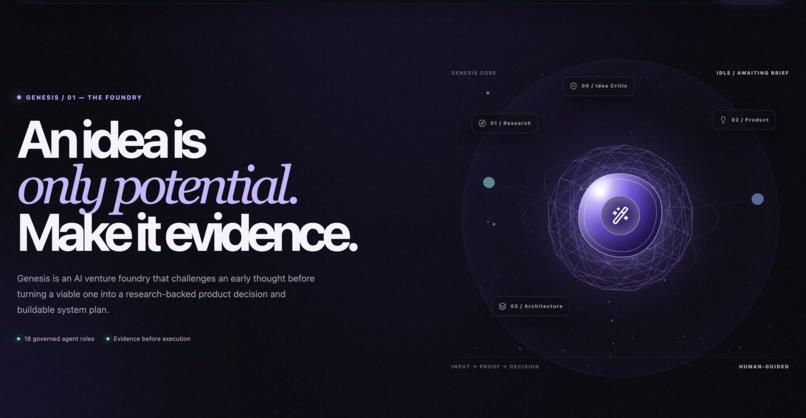
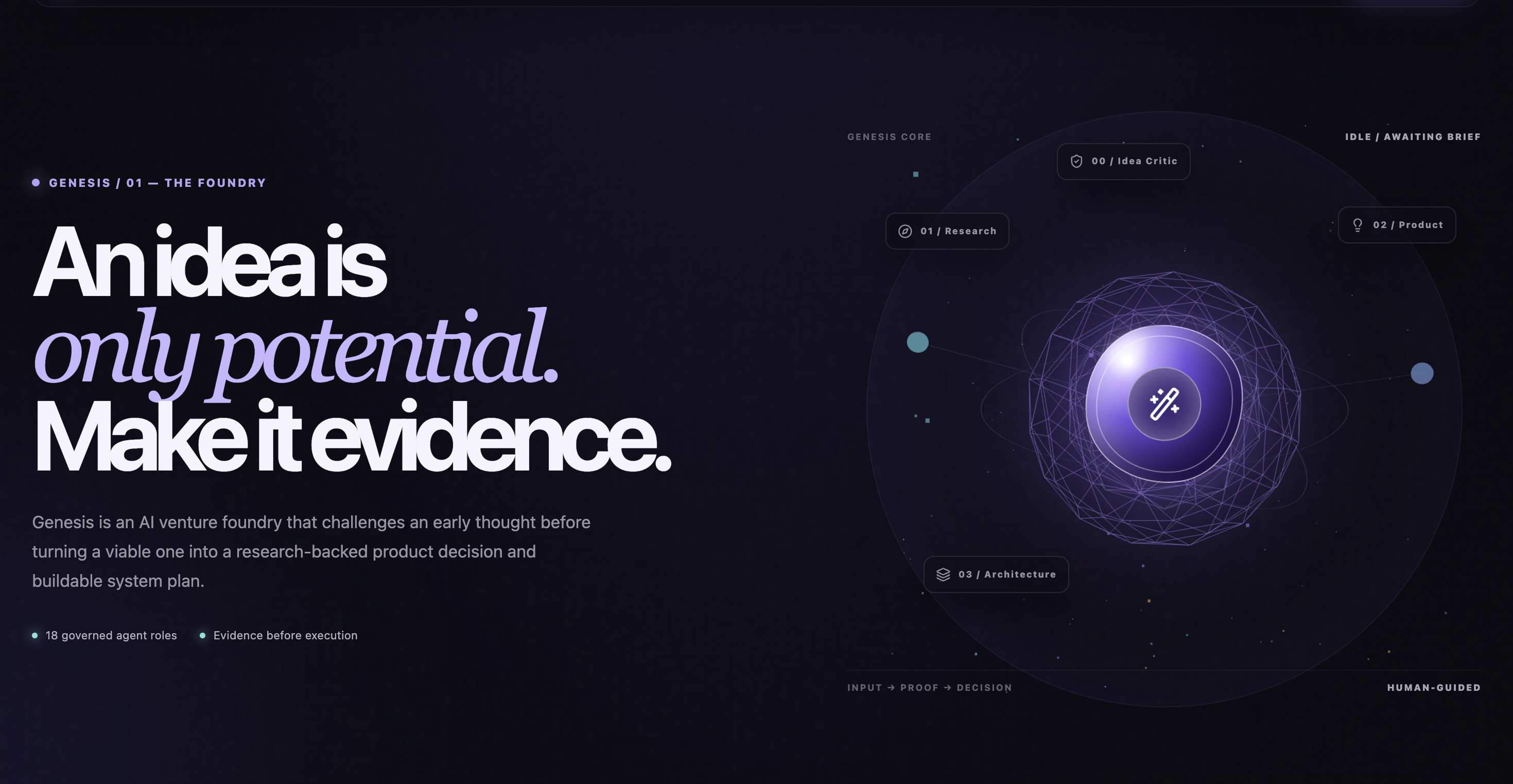
I've always loved startup ideas, but I realized that turning an idea into a real product takes much more than just coding. You need research, product planning, technical design, deployment, and constant iteration. Most AI tools only help with one piece of that journey. So I built Genesis - an autonomous AI organization that works like a real startup team, helping founders go from a single idea to a deployed SaaS product.
What it does
Genesis transforms a one-line startup idea into a complete SaaS venture. Instead of relying on a single AI assistant, it uses 18 specialized AI agents that collaborate to critique the idea, research the market, define the product, design the architecture, generate an MVP, deploy it to GitHub, Render, and Vercel, and continuously improve it through feedback. Every stage produces structured, traceable outputs while keeping humans in control of important decisions.
How we built it
Genesis is built with Next.js, FastAPI, LangGraph, and SQLite. The frontend streams every AI agent's progress in real time, while the backend orchestrates the workflow, stores project memory, maintains a knowledge graph, and integrates AI providers like Groq, OpenRouter, and optional Tavily for live web research. I also built automated deployment so Genesis can generate a GitHub repository, deploy the backend to Render, the frontend to Vercel, and even create an investor pitch.
Challenges we ran into
The biggest challenge was making multiple AI agents work together instead of behaving like separate chatbots. I also spent a lot of time handling API rate limits, provider failures, live progress streaming, deployment automation, and making sure every decision remained transparent and traceable.
Accomplishments that we're proud of
The thing I'm most proud of is that Genesis feels like a real AI startup team rather than another AI chat interface. Seeing an idea go from evaluation to research, architecture, deployment, and finally a live application—all inside one workflow—was incredibly rewarding.
What we learned
This project taught me that building AI applications isn't just about using powerful models. It's about designing reliable systems where multiple AI agents can collaborate, share context, and produce meaningful outcomes while keeping humans in the loop.
What's next for Genesis
I'm planning to make Genesis even more autonomous by improving code generation, expanding the knowledge graph, strengthening long-term memory, and adding more specialized AI roles. The long-term vision is to make Genesis an AI co-founder that can help anyone turn an idea into a real software business.


Log in or sign up for Devpost to join the conversation.