-
-
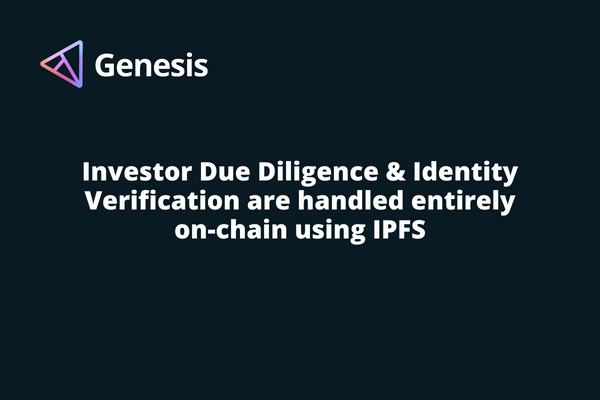
investor due diligence & identity verification are handled entirely on chain using ipfs
-
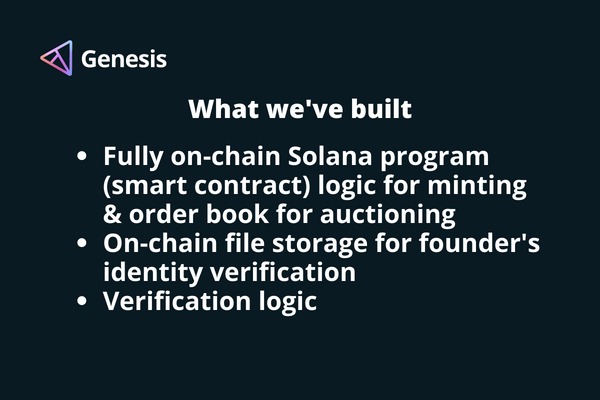
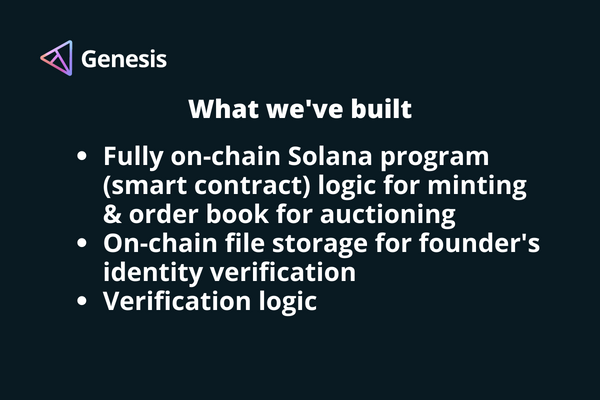
what we've built
-
founders mint genesia tokens that can be auctioned, bringing illiquid asset
-
we're a solana dApp
-
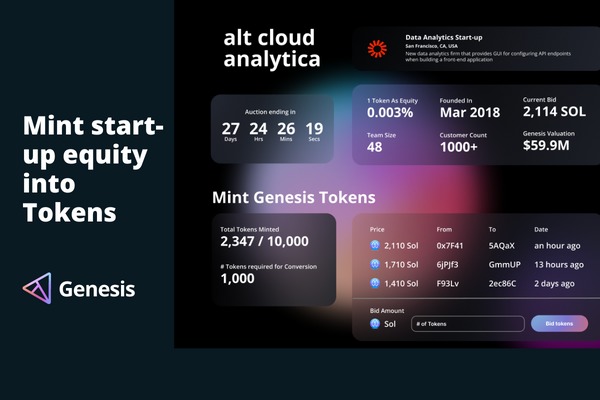
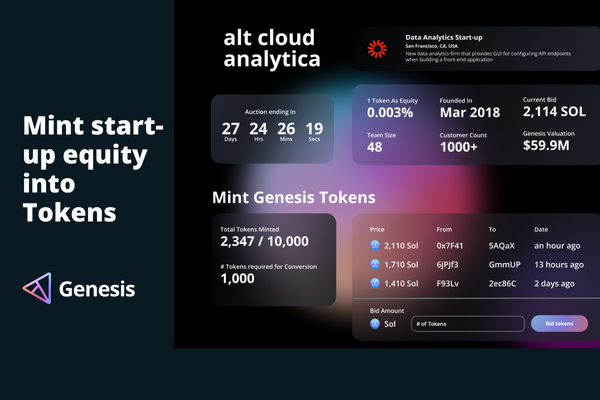
mint startup equiting into tokens
-
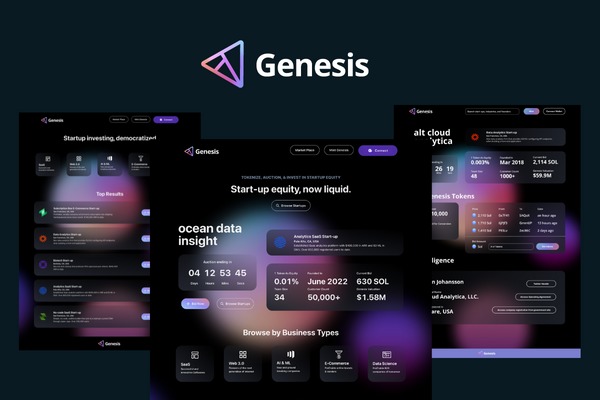
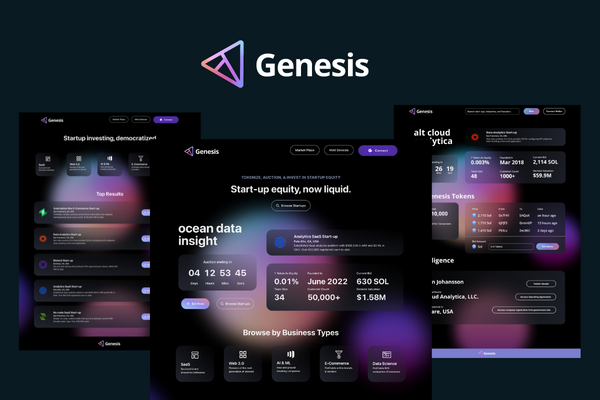
hero
Inspiration
We set out to solve two problems with Genesis:
First, the high barrier of access both financially and legally for retail investors to invest in startups.
Second, founders of almost all early stage startup holds almost nothing but high risk, illiquid equity that is no different than ink on some paper.
What it does
Genesis fundamentally changes the way founders and investors interact in three crucial ways:
The Genesis dApp, built on the Solana blockchain allows startup founders to mint a portion of their equity as Genesis tokens to be auctioned as fractional equity on the Genesis auction platform. The founder decides however much equity to mint into (up to 5,000) tokens, and inputs relevant company information such as user counts, current revenue, past fundraising, and more to be displayed on their business page. This page serves as a place for investors to mint equity tokens, and upon the minting of all units, token holders are able to auction Minted Genesis tokens of a founder's equity on the same page.
In order for minting to be successful, the founder must provide a series of personal & company identity verifications - their website url, Twitter handle, operating agreement, driver's license, etc. The founders’ responses & documents are then hashed by IPFS, stored on chain, and embedded into their business profile page for investors to perform due diligence. We handle the storage process using IPFS, a distributed file storage protocol.
The founder sets a threshold of minimum token holding for an investor to convert their tokens into real, legal equity. We handle this conversion in an entirely decentralized manner using Solana smart contracts. When the investor initiates a conversion and burns their tokens, the founder is provided with an in-app, natural language agreement, once both parties fill in their fields and sign with their wallet addresses, Genesis transforms the legal contract into a machine-readable object that is hashed and stored on the Solana chain.
By removing unnecessary friction from the startup investment process using Defi & Smart Contracts, we want to make it easier for founders to access liquidity, raise capital, and provide retail investors with an equal shot at VC level returns.
How we built it
- We created the Frontend UI & logic using React with Typescript, specifically with the Solana web3.js & Chakra component libraries.
- We created both the Genesis token minting process and the auction order book logic as smart contracts from scratch on the Solana blockchain using Rust & Anchor's testing library
- We used IPFS(distributed protocol) for hashing documents and placing them onto the Blockchain.
Challenges we ran into
This was the first time any of us had built anything web3 related, so we had to continuously adjust our product vision to be realistic to the 24 hour time constraints yet still deliver an impressive product.
Since we used Chakra on the front-end, it was difficult to resolve dependency conflicts with the web3.js library, resulting in hours of debugging our app in order to compile. We eventually fixed this issue by manually troubleshooting the JSON library and re-routing our react app. Being too perfectionist when it comes to UI.
All of us came into this Hackathon with zero experience when it comes to writing Solana programs, so implementing the logic for both minting and an auction order book on chain using rust was one of the biggest programming challenges we had faced. Fortunately, Anchor provided a very helpful testing library that greatly accelerated our dev journey.
Accomplishments that we're proud of
This is an idea with real world impact - by making startup equity more accessible for retail investors, we level the playing field towards a more decentralized, equitable and democratic start-up eco-system.
Despite the difficulty we faced from all fronts, we still created a beautiful front-end and a fully functional, on-chain backend for a complex idea that serves as a viable alternative to traditional fundraising.
What we learned
- Building smart contracts from scratch with rust on the Solana network.
- We got much better at writing more elegant code, especially on the back-end.
- Organizing complex interactions between blockchain wallets into a decentralized system.
- Decentralized file storage, hashing, different protocols, testing libraries, and smart contract standards.
- Type-based languages are kind of a nightmare for hackathons.
- "Are we still addressing the pain point?" is a useful question when pivoting a product vision to adjust to limitations.
What's next for Genesis
- Although we implemented our token burning and on chain token to equity logic into functional Solana programs, we did not have time to integrate it with our frontend. We're gonna pull another all-nighter and build this thing out!
Built With
- anchor
- chakra
- ipfs
- react
- rust
- solana
- typescript
- web3.js

Log in or sign up for Devpost to join the conversation.