-
-
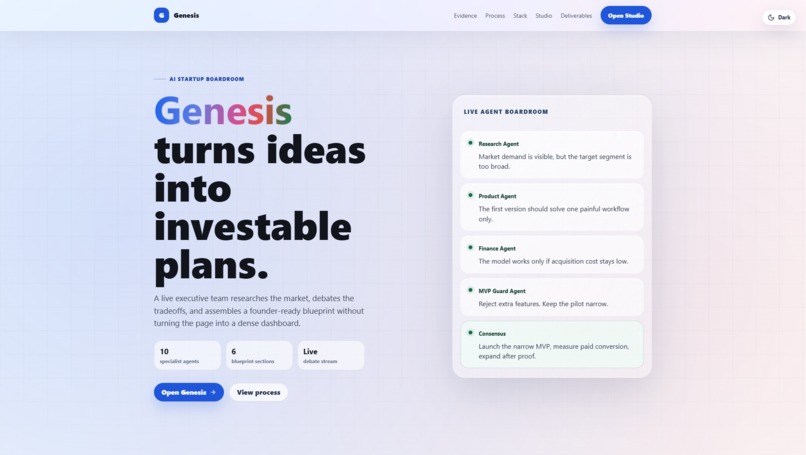
Landing page screenshot
-
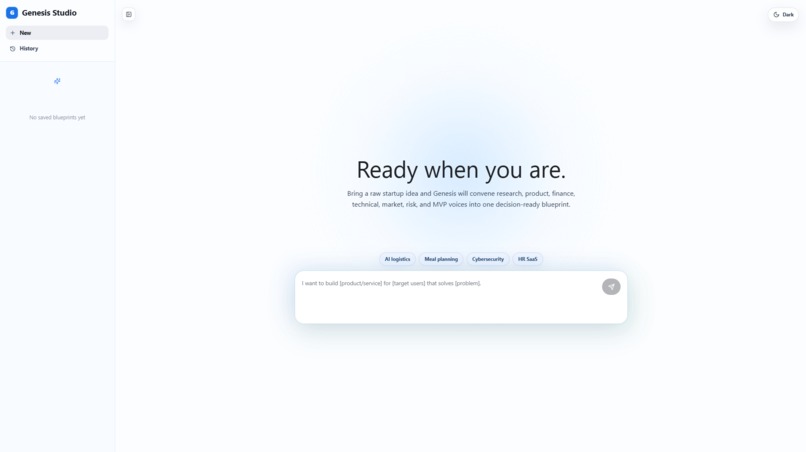
Studio input screenshot
-
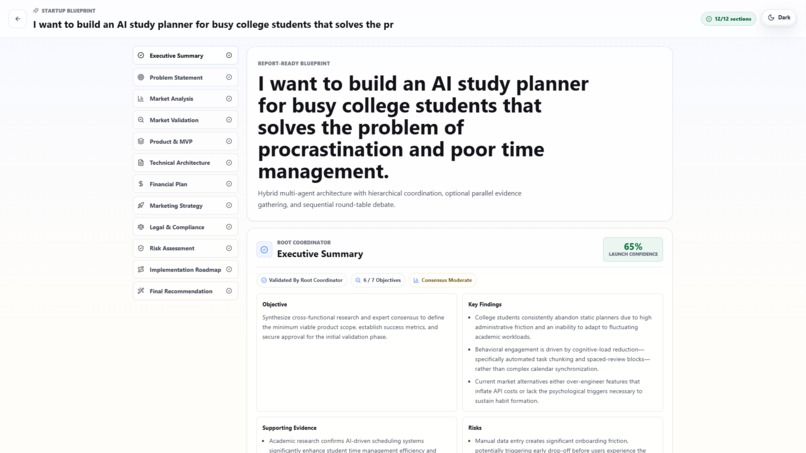
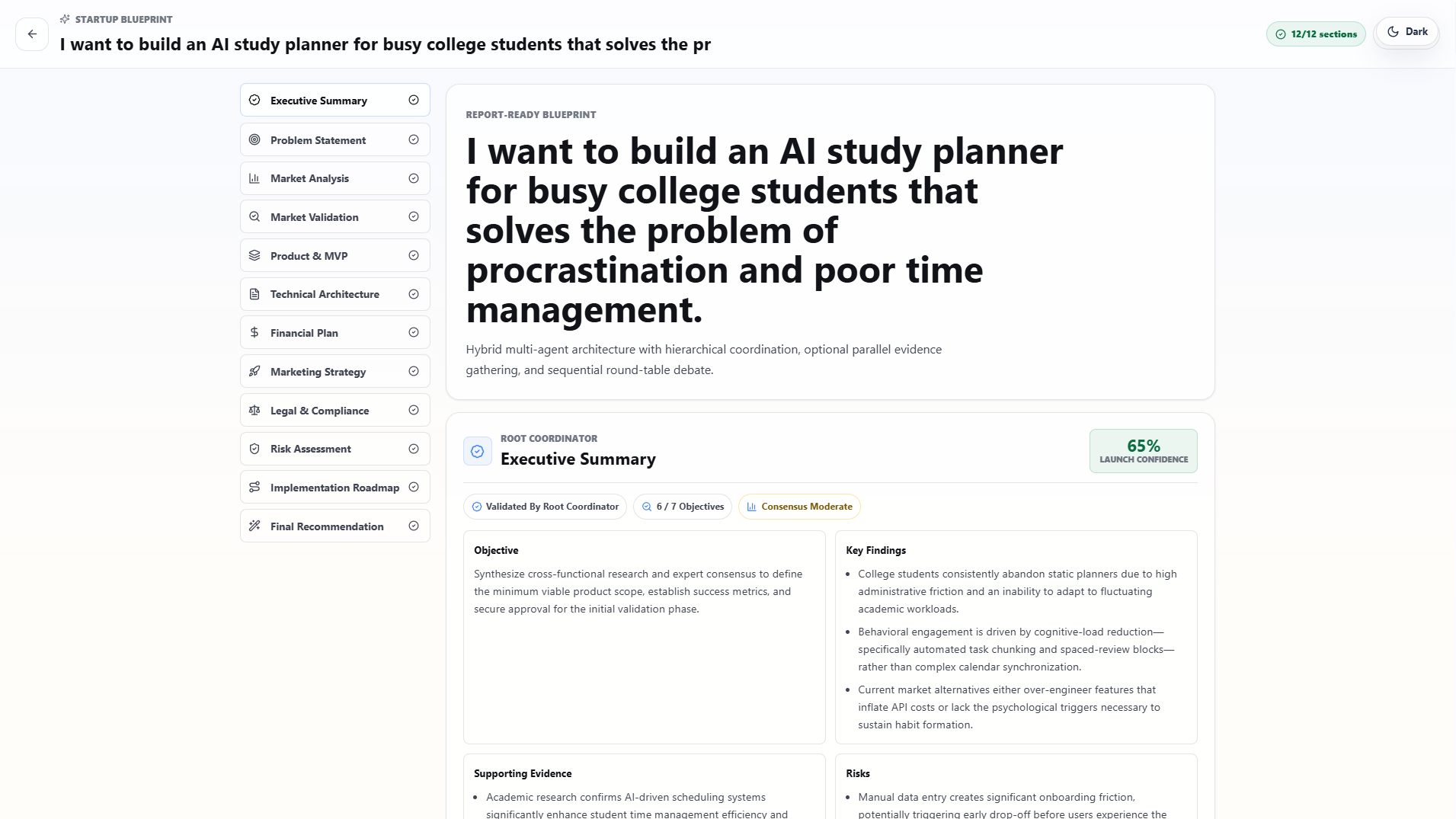
Blueprint output screenshot
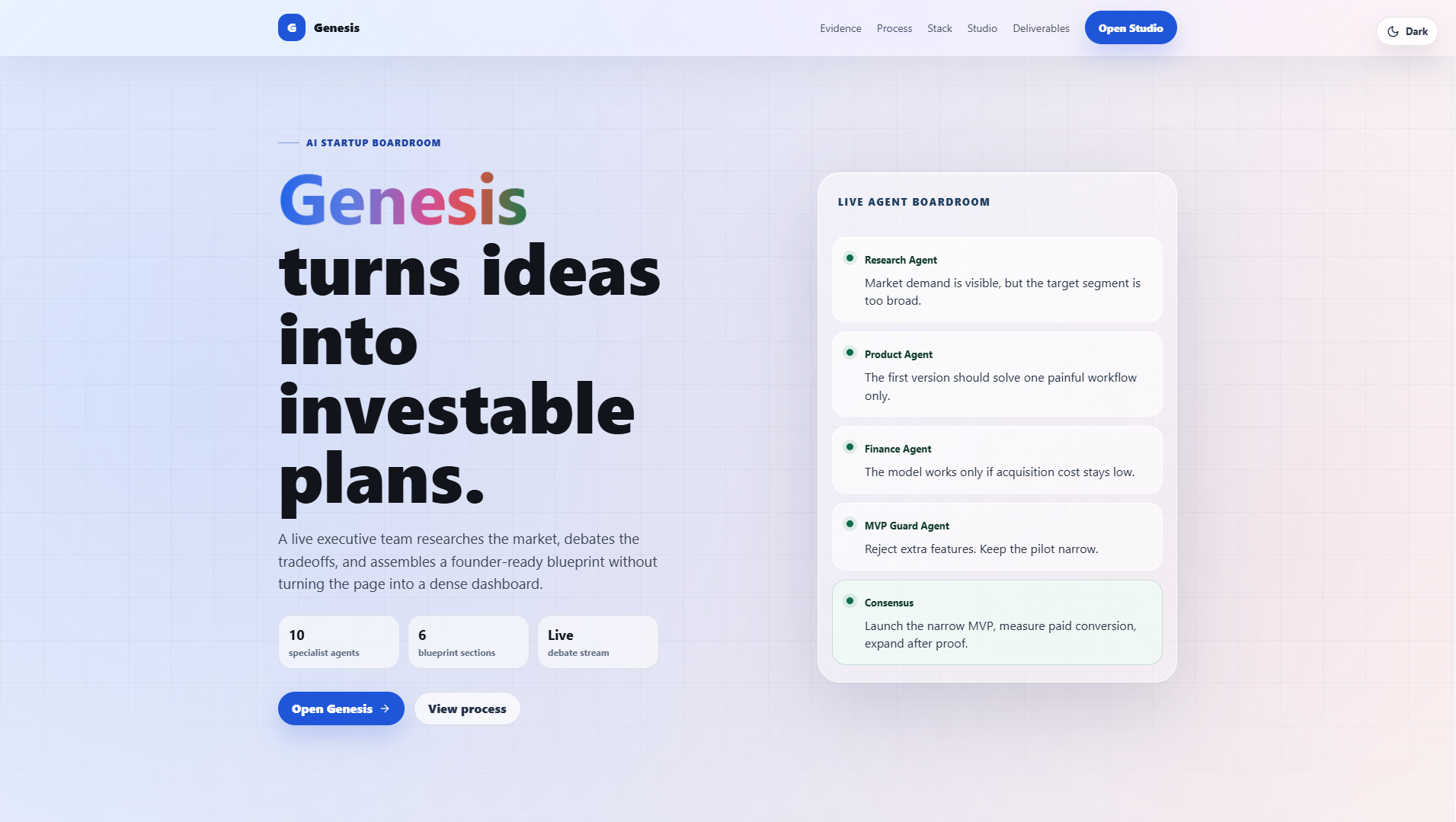
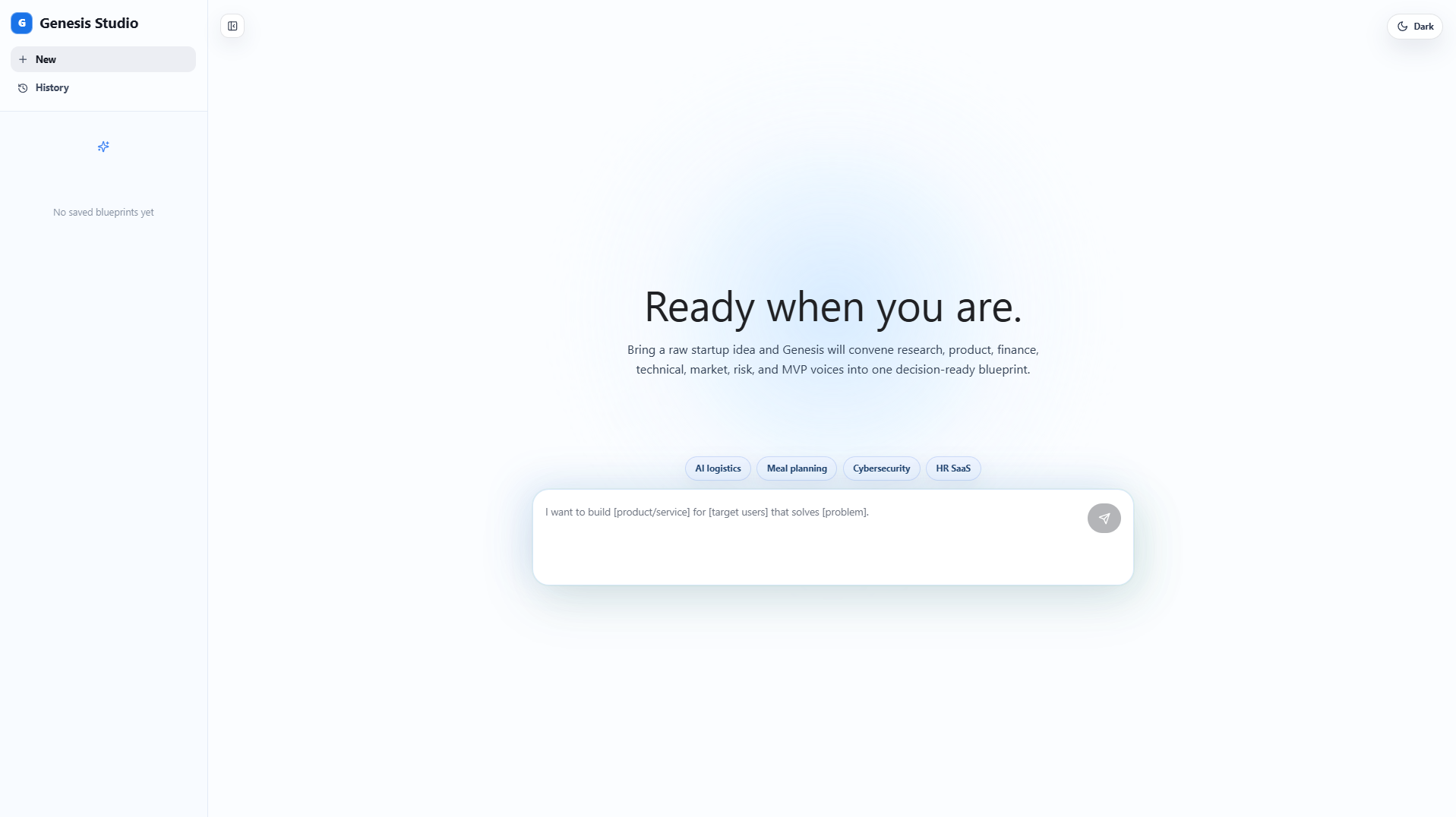
Genesis Studio
Inspiration
Many people have strong business ideas, but a raw idea is not enough to start building. Intrapreneurs, growth hackers, and early-stage builders often need more than brainstorming. They need to understand the product scope, market direction, technical feasibility, financial risk, and stakeholder value before they can move forward.
That inspired us to build Genesis Studio: a multi-agent MVP builder that turns a raw idea into a structured, decision-ready MVP blueprint.
The main idea behind Genesis is simple:
Raw ideas need validation, not just generation.
Instead of producing a generic AI response, Genesis uses multiple specialized agents to review the idea from different angles and decide what should be built first a follow up question can be done to allow agents to start the debate and research again
What It Does
Genesis Studio helps users transform a raw idea into a structured MVP blueprint.
For example, in our demo, the raw idea is an AI study planner for college students who struggle with procrastination, academic workload, and deadline pressure.
Genesis analyzes the idea and produces a blueprint that includes:
- Executive Summary
- Problem Statement
- Market Analysis
- Market Validation
- Product & MVP Scope
- Technical Architecture
- Financial Plan
- Marketing Strategy
- Legal & Compliance Review
- Risk Assessment
- Implementation Roadmap
- Final Recommendation
The goal is not to generate more features. The goal is to help the user decide what should be validated first.
How We Built It
Genesis Studio is built as a hybrid multi-agent system.
The system uses two collaboration patterns:
1. Hierarchical Coordination
At the top of the workflow is the Root Coordinator.
The Root Coordinator understands the raw idea, selects the right specialist agents, assigns research tasks, manages the workflow, and summarizes the final blueprint.
2. Sequential Agent Debate
After task assignment, the agents review the idea sequentially.
Each agent builds on the previous output, adds its own expertise, challenges weak assumptions, and passes refined context to the next agent.
This allows Genesis to combine:
Top-down coordination + step-by-step expert debate
The agent system includes a default core team for product, strategy, technical research, business, finance, governance, and output generation. When deeper expertise is needed, standby specialists such as legal risk, data privacy, cybersecurity, education, healthcare, fintech, operations, or supply chain agents can also join.
The backend runs on Alibaba Cloud and connects to Qwen Cloud to coordinate the agent workflow and generate structured outputs.
MVP Scope Guard
One of the most important parts of Genesis Studio is the MVP Scope Guard.
A single agent can be useful for brainstorming, but it often leaves the user to manually judge scope, cost, risk, and stakeholder fit.
Genesis handles this through structured review.
For the study planner demo, some agents may suggest features such as calendar syncing, generative scheduling, passive tracking, or payment gates. However, these features increase cost, friction, and compliance risk.
The MVP Scope Guard keeps only the validation core:
- Three-field input flow
- Assignment chunking
- Spaced-review blocks
- Deterministic urgency nudges
- Plain-language consent gate
This keeps the MVP focused on what should be tested first before heavier development begins.
with this agent society structure we noticed that using a same prompt on a model compares with our system, a single model miss out multiple parts of information needed on building a mvp also the information might conflict with each other, but our system with multiple agents debate with each other and come out with a final corrected unconflicted solution.
Tavily api web research
Genesis uses Tavily Research as the web intelligence layer for its multi-agent startup analysis. When a user submits a startup idea, the research-oriented agents can use Tavily to investigate the real-world market surrounding that idea instead of relying only on the LLM's pre-trained knowledge.
Tavily enables Genesis to gather up-to-date information from multiple web sources, extract relevant content, and provide research context to the specialist agents. This is particularly valuable for areas such as market research, competitor analysis, technology trends, customer needs, regulations, pricing, and industry risks.
The research output can then be fed back into the multi-agent debate. For example, when evaluating a new startup idea, the research agent can investigate existing competitors and market trends, while the product, finance, marketing, technical, legal, and risk agents use those findings to challenge assumptions and refine their recommendations.
Why Tavily?
Traditional LLM responses can be limited by the model's knowledge cutoff or lack of current market information. Tavily provides Genesis with an AI-oriented web research capability, allowing agents to retrieve fresh, relevant, and structured information before making recommendations.
This also separates two responsibilities in the system:
Qwen — reasoning, analysis, debate, synthesis, and decision-making. Tavily — discovering and retrieving current information from the web. Genesis Multi-Agent Engine — coordinating specialist agents and combining their perspectives into a coherent startup blueprint.
This makes the research agent more than a generic chatbot: it acts as an evidence-gathering specialist that supplies the other agents with external market intelligence before they challenge and validate the startup idea.
Tavily's search and extraction capabilities are specifically designed for AI agents and RAG-style workflows, making it a natural fit for Genesis's research-driven multi-agent architecture.
Challenges We Faced
One major challenge was designing the system so it felt like a real multi-agent collaboration system, not just several prompts running independently.
We had to think carefully about:
- How the Root Coordinator should assign tasks
- How agents should build on each other’s outputs
- How to prevent the result from becoming too broad
- How to make the final blueprint structured and useful
- How to balance speed, output quality, and API response time
Another challenge was scope control. It is easy for AI systems to recommend too many features. We wanted Genesis to do the opposite: reduce unnecessary complexity and focus on validation.
We also tested different model APIs and observed different generation speeds during full blueprint generation. This helped us think about future model routing strategies for speed, cost, and output quality.
What We Learned
Through this project, we learned that multi-agent systems are most useful when each agent has a clear responsibility.
A multi-agent system should not exist only to make the product sound more advanced. It should create a better decision process.
We learned that:
- Product agents are useful for clarifying the user problem
- Technical agents are useful for feasibility and architecture
- Finance agents help control cost and runway
- Legal and risk agents help identify compliance concerns
- A coordinator is important for keeping the workflow organized
- A scope guard is necessary to keep the MVP focused
- Society agent is a trend of how llm respond to user token economy is the biggest problem that must be solved
Most importantly, we learned that AI product generation is not only about creating more content. It is about helping users make better build decisions.
What’s Next
Next, we want to improve Genesis Studio by adding better model routing, faster generation, stronger comparison between agent outputs, more agents integration and a more interactive blueprint editor.
We also want to make the system more practical for real builders by allowing users to refine sections of the blueprint, regenerate specific agent reviews, and export the final MVP plan into formats such as pitch decks, reports, or stakeholder briefs.
Genesis Studio is our attempt to turn raw ideas into investable MVP plans through structured multi-agent collaboration.
Our final thought is multi-agent society can be implemented into a model which have the ability to choose experts when answering a question from user in order to provide a better output
Built With
- camel-ai
- css
- fastapi
- git
- html
- httpx
- javascript
- openai
- pydantic
- python
- python-dotenv
- react
- sqlalchemy
- sqlite
- tavily-python
- uvicorn
- vite


Log in or sign up for Devpost to join the conversation.