Inspiration
Many people have ideas that could become research, but most never cross that gap.
I come from a background where access to mentors, labs and structured research guidance is limited. Curiosity often begins in messy forms—scribbled notes, half-formed questions, voice memos but transforming those into real research requires expertise that is not universally accessible.
GENESIS was inspired by a simple question:
What if an AI could help people think scientifically, not just answer questions?
Rather than replacing researchers, the goal was to build a system that amplifies human curiosity by guiding it through a structured scientific process.
What It Does
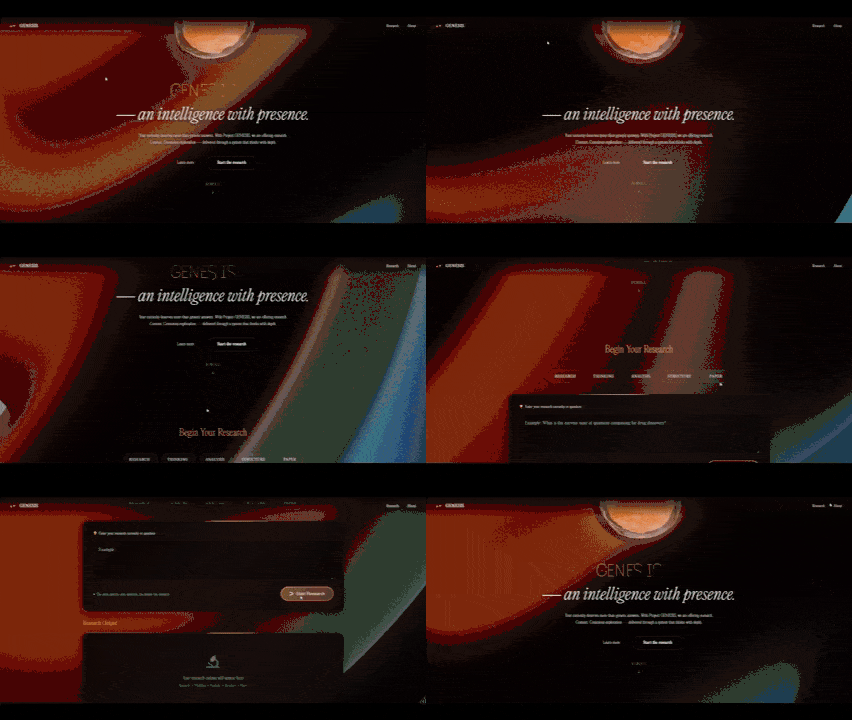
GENESIS is a multimodal AI research engine that converts unstructured human input into structured research artifacts.
Users can provide ideas as:
- Text
- Voice
- Images
- PDFs or handwritten notes
GENESIS produces:
- Refined research questions
- Explicit assumptions and constraints
- Multiple falsifiable hypotheses
- Experiment or evaluation designs
- Reasoned simulations of outcomes
- A structured research outline for further work
Instead of functioning as a chatbot, GENESIS behaves like a scientific reasoning pipeline, mirroring how human researchers think.
How It Works
GENESIS is implemented as a modular system of reasoning agents, each responsible for a specific cognitive step:
Multimodal Interpreter
Uses the Gemini 3 API to unify text, image, voice, and document inputs into a structured intent.Idea Normalization Agent
Transforms vague curiosity into a researchable question.Hypothesis Generator
Produces falsifiable hypotheses and explicitly states underlying assumptions.Experiment Designer
Constructs validation strategies, metrics, and expected outcomes.Reasoning Simulator
Updates conclusions when assumptions change and explores counterfactuals.Artifact Generator
Outputs structured research notes and paper-ready outlines.
Formally, the reasoning loop can be summarized as:
$$ \text{Curiosity} \rightarrow \text{Structure} \rightarrow \text{Hypothesis} \rightarrow \text{Validation} \rightarrow \text{Insight} $$
Challenges
The primary challenge was avoiding the creation of yet another fluent but shallow chatbot.
Early iterations produced correct sounding responses without scientific discipline. This highlighted that meaningful reasoning emerges only when the system is designed around process, not just outputs.
Another challenge was balancing flexibility with rigor allowing creative exploration while ensuring assumptions remained explicit and hypotheses remained falsifiable.
What I Learned
Building GENESIS reinforced that powerful models are most effective when guided by clear roles and constrained reasoning pathways.
Multimodal capability matters not because it adds inputs but because it mirrors how humans naturally think and explore ideas.
The most important insight was that AI’s real potential lies not in replacing expertise, but in scaling access to expert thinking.
Vision
GENESIS represents a step toward democratizing scientific reasoning.
By lowering the barrier between curiosity and structured inquiry, systems like GENESIS could empower students, independent researchers, and creators worldwide to explore ideas that would otherwise remain unrealized.
The goal is not to generate answers, but to help people learn how to think.


Log in or sign up for Devpost to join the conversation.