Inspiration
Most AI systems are designed to answer questions, but research requires much more than generating an answer. Real research involves reading existing work, forming hypotheses, designing experiments, running them, analyzing results, and then deciding what to try next.
That inspired us to build Genesis AI, an autonomous AI research laboratory that does not stop at reasoning or code generation. Genesis is designed to complete the entire computational research loop and improve its decisions based on real experimental results.
Our goal was to explore a bigger question:
Can an AI system independently move from a research question to experimental evidence?
What it does
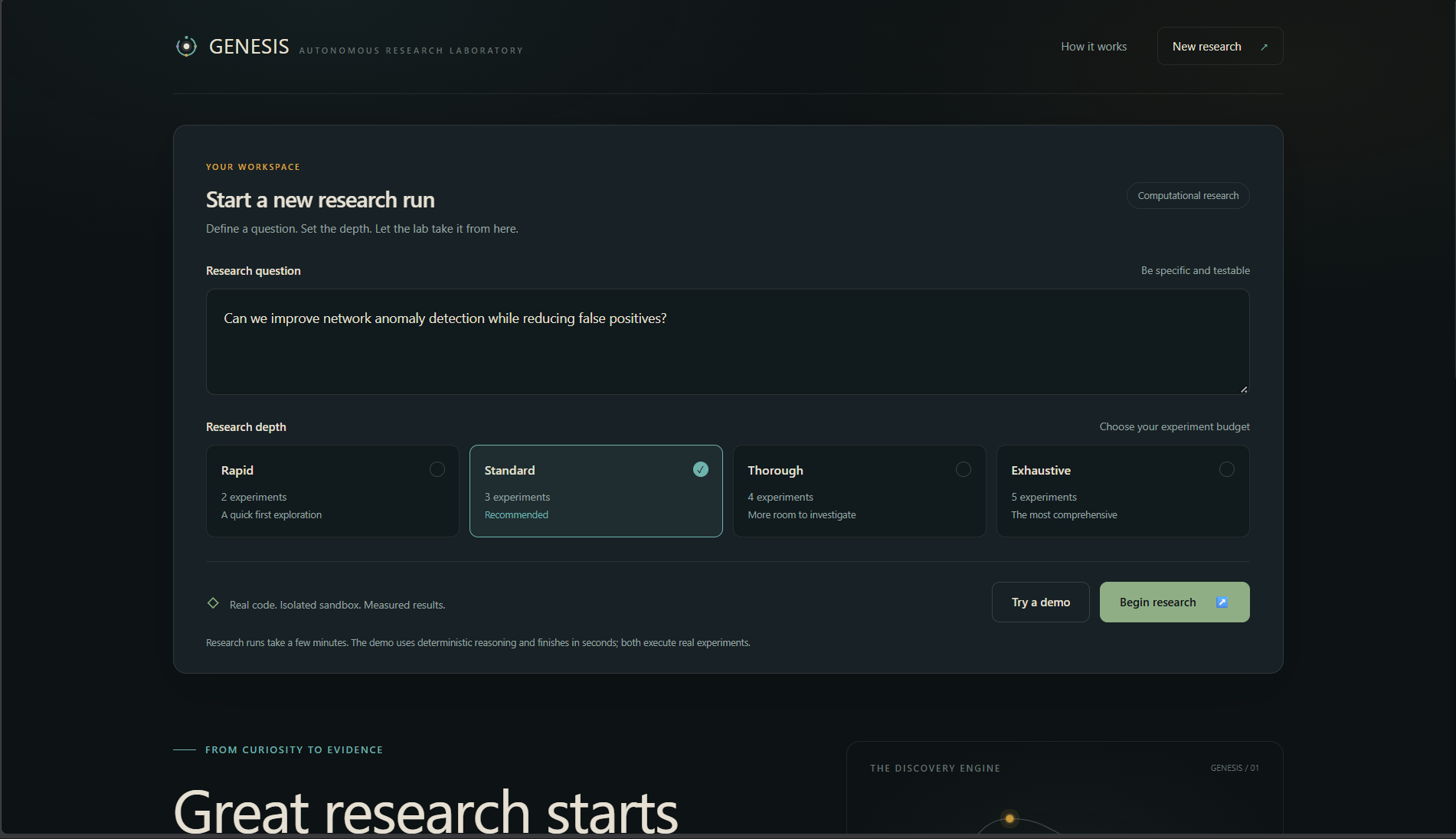
Genesis AI takes a computational research question and turns it into an iterative research process:
Research Question
      ↓
Literature Research
      ↓
Competing Hypotheses
      ↓
Experiment Design
      ↓
Code Generation
      ↓
Sandbox Execution
      ↓
Real Metrics
      ↓
Result Analysis
      ↓
Hypothesis Evaluation
      ↓
Next Experiment
      ↺
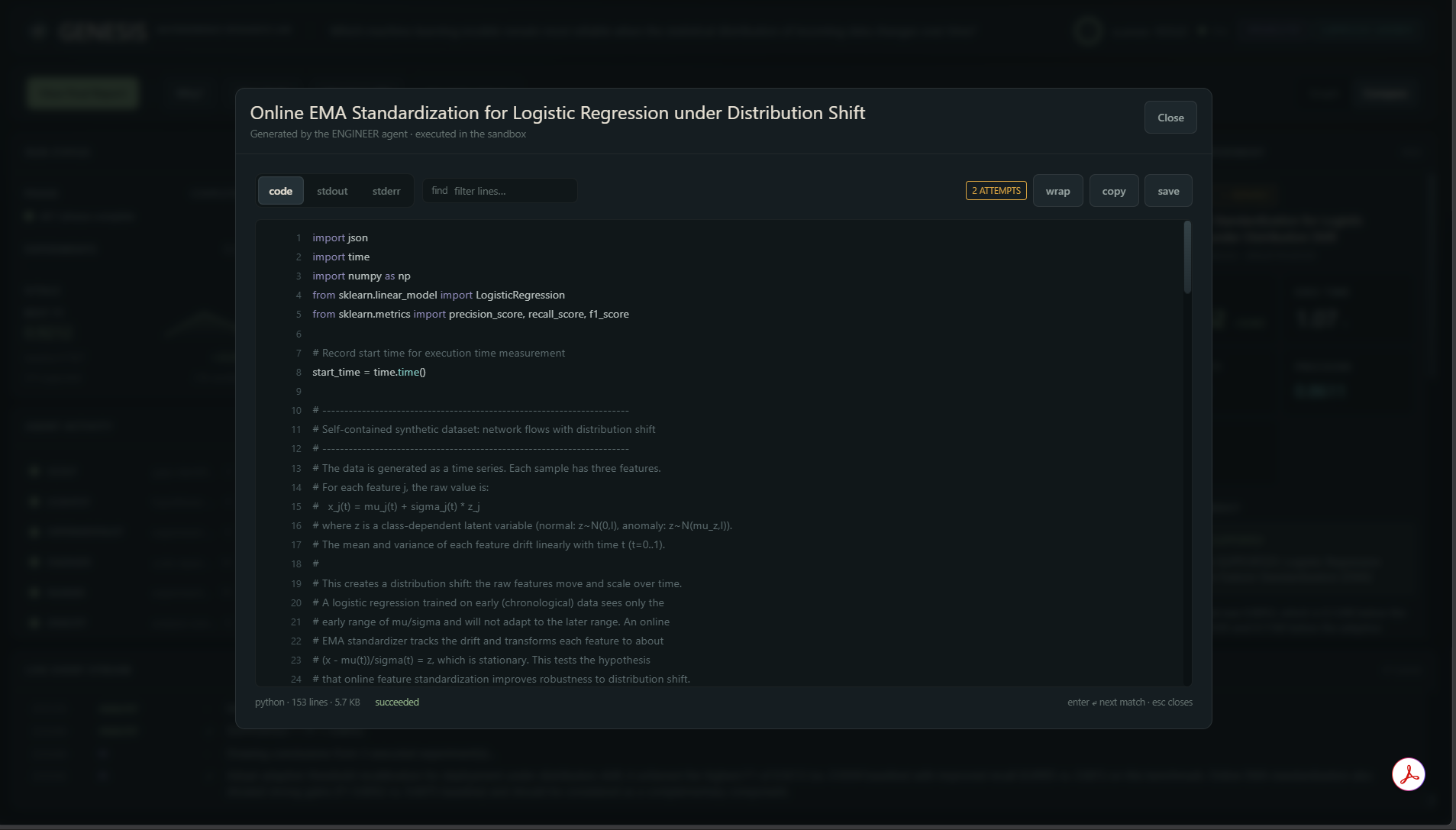
Instead of simply predicting which idea might work, Genesis actually writes and executes experiment code inside an isolated environment.
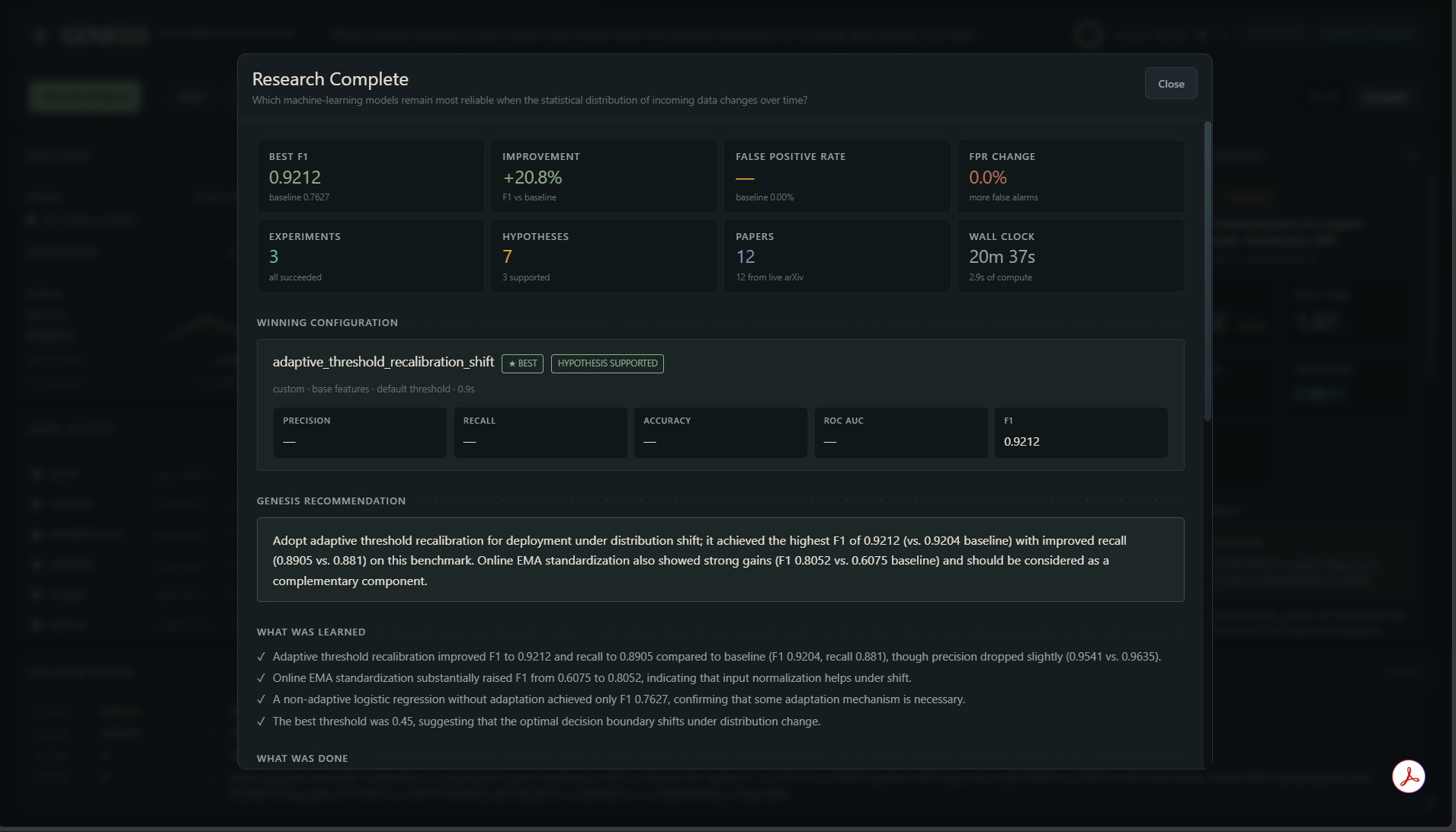
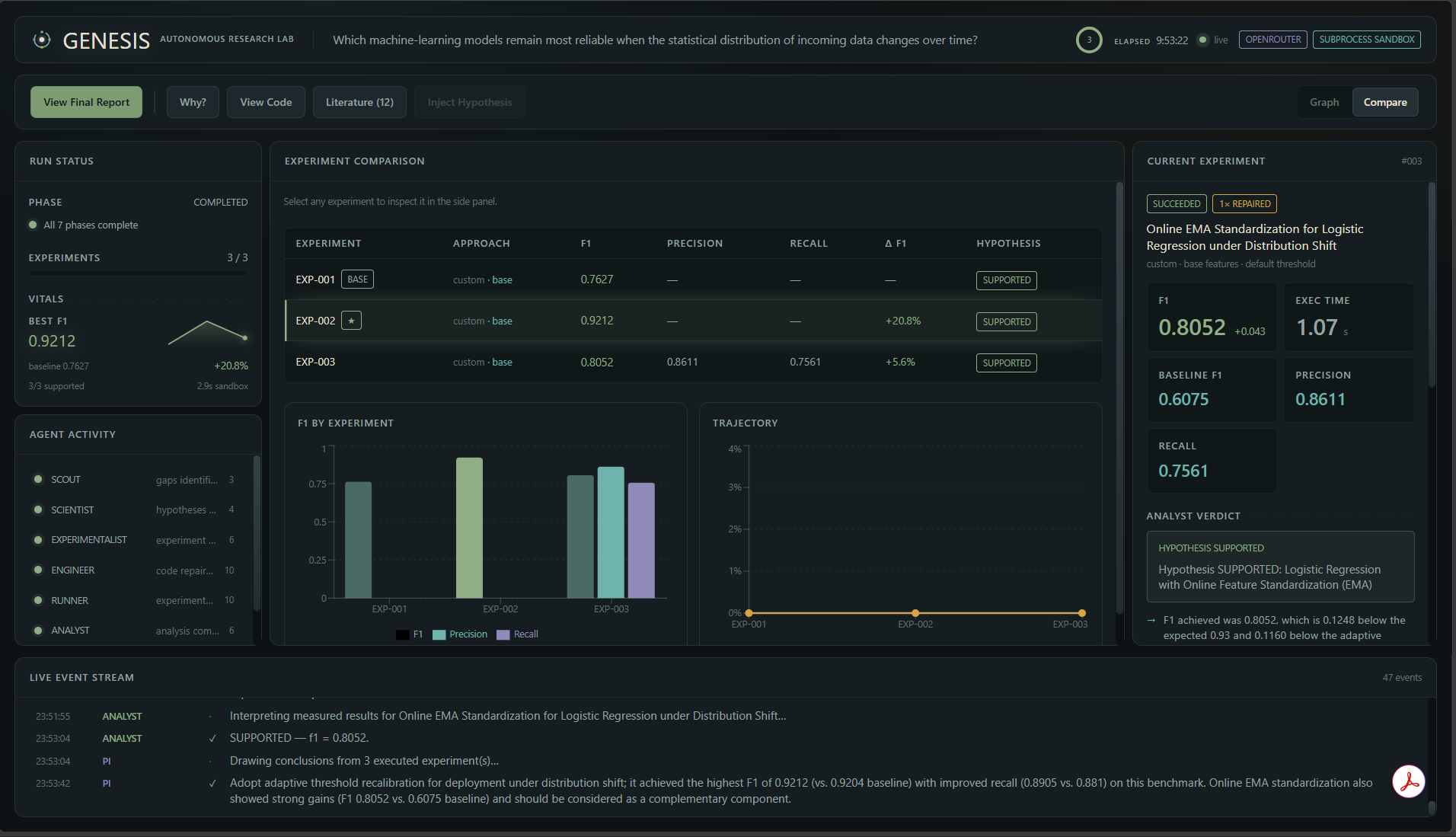
It then collects real metrics from the experiment, compares them against previous runs, evaluates the competing hypotheses, and decides what experiment should be attempted next.
This creates a closed research loop where each experiment influences the next one.
For example, if Genesis is comparing two machine-learning approaches, it may evaluate metrics such as accuracy, runtime, memory usage, or loss:
$$ \text{Accuracy} = \frac{\text{Correct Predictions}}{\text{Total Predictions}} $$
The system can then use those measurements rather than relying only on an AI-generated assumption.
How we built it
We designed Genesis as a multi-stage autonomous research pipeline.
Each stage has a specific responsibility, including:
- Understanding the research question
- Searching and analyzing relevant literature
- Generating multiple competing hypotheses
- Designing experiments to test those hypotheses
- Generating executable experiment code
- Running that code inside an isolated sandbox
- Collecting real output and performance metrics
- Analyzing experimental results
- Comparing new results with previous experiments
- Selecting the next research direction
The most important design decision was separating reasoning from execution.
The AI can propose an experiment, but the experiment itself produces the evidence.
Results from previous iterations are stored as part of the research state. This allows Genesis to reason about questions such as:
- Did the new approach improve the result?
- Was the hypothesis supported?
- Did an experiment fail because of the hypothesis or because of the implementation?
- Which variable should be changed next?
- Is another experiment worth running?
This feedback loop is what allows Genesis to behave more like an experimental research system instead of a traditional chatbot.
Challenges we ran into
The hardest challenge was making the system genuinely autonomous.
Generating research ideas is relatively easy for modern AI systems, but converting those ideas into experiments that are safe, executable, measurable, and useful is much harder.
One major challenge was code reliability. Generated experiment code can contain dependency problems, runtime errors, incorrect assumptions, or malformed outputs. We had to design the workflow so that failures could be captured and analyzed instead of simply stopping the research process.
Another challenge was sandbox execution. Because Genesis generates and runs code autonomously, experiments must execute inside an isolated environment with controlled resources.
We also encountered challenges around maintaining research context. After several experiments, the system needs to understand what has already been tested and avoid repeating the same unsuccessful approach.
Finally, we had to make sure that Genesis based its decisions on real experimental metrics instead of simply asking an AI model which hypothesis sounded better.
Accomplishments that we're proud of
The part we are most proud of is building a functioning closed-loop research workflow.
Genesis does not stop after generating a hypothesis or writing code. It continues through execution, measurement, evaluation, and another research decision.
We are also proud that the system can generate competing hypotheses instead of committing immediately to one idea. This makes the research process more experimental and allows different approaches to be tested against each other.
Another important accomplishment was connecting AI-generated reasoning with actual sandbox execution. This allows Genesis to distinguish between:
"The model thinks this approach should work."
and
"The experiment produced evidence that this approach works."
That distinction is central to the idea behind Genesis.
What we learned
Building Genesis changed the way we think about autonomous AI.
We learned that autonomy is not simply giving an AI model more tools. A truly autonomous system needs feedback, memory, failure handling, measurable objectives, and a mechanism for deciding what action should happen next.
We also learned how important structured outputs are when multiple AI-driven stages depend on one another. A small inconsistency in one stage can affect the entire pipeline.
Another major lesson was that failure is useful information.
An experiment that crashes, produces worse metrics, or disproves a hypothesis still provides evidence that the system can use when deciding what to do next.
Most importantly, we learned that combining AI reasoning with real execution creates much more interesting possibilities than using either one independently.
What's next for Genesis AI
Our long-term goal is to turn Genesis into a more capable autonomous scientific research platform.
We want to expand Genesis with stronger experiment memory so it can build a structured knowledge base from everything it has already tested.
We also want to introduce parallel experimentation, allowing multiple hypotheses to be tested simultaneously and compared automatically.
Future versions could support:
- Multi-agent scientific debate
- Automatic visualization of experimental results
- Research graphs showing hypotheses and evidence
- Parallel experiment execution
- Automatic dataset discovery
- Experiment reproducibility
- Research paper generation
- Citation and literature verification
- Long-running research objectives
- Human review checkpoints for high-impact experiments
Eventually, we envision Genesis being given a broad research objective rather than a single experiment.
Instead of asking:
"Test whether method A performs better than method B."
we want to be able to ask:
"Find a better way to solve this problem."
Genesis could then explore the research space, run experiments, learn from failures, refine hypotheses, and continue searching for better solutions.
The goal is not just an AI that knows existing answers.
The goal is an AI system that can experiment, learn, and discover.

Log in or sign up for Devpost to join the conversation.