Inspiration
The concept of the Digital-FTE (Full-Time Equivalent) was born out of a simple observation: humans are brilliant at strategy and creativity, but we often get bogged down by the repetitive execution required to move the needle. I wanted to build more than just a "chatbot"; I wanted to build a digital twin—an autonomous agent capable of thinking, planning, and executing tasks with the same reliability as a human teammate. The goal was to see if I could "clone" my professional capabilities into a scalable, 24/7 autonomous worker.
What it does
General Agent FTE—affectionately nicknamed Abdullah Junior—is an AI-driven autonomous agent designed to handle end-to-end workflows. Unlike standard LLMs that wait for a prompt, this agent:
- Self-Plan: Breaks down complex, high-level objectives into actionable sub-tasks.
- Tool Usage: Interacts with external APIs, search engines, and local environments to gather data or execute code.
- Autonomous Iteration: It critiques its own work and loops through tasks until the objective is met. # Context Management: Maintains a long-term "memory" of the project goals to ensure consistency across long-running tasks.
How we built it
The architecture is built on a foundation of "Agentic Workflows" rather than simple prompting.
- Core Engine: Powered by [Mention LLM used, e.g., GPT-4o or Gemini 1.5 Pro] to handle high-level reasoning.
- Orchestration: Built using [Mention Framework, e.g., LangChain, CrewAI, or Autogen] to manage the state machine and agent handoffs.
- Memory Layer: Utilized a vector database to allow the agent to recall previous interactions and documentation.
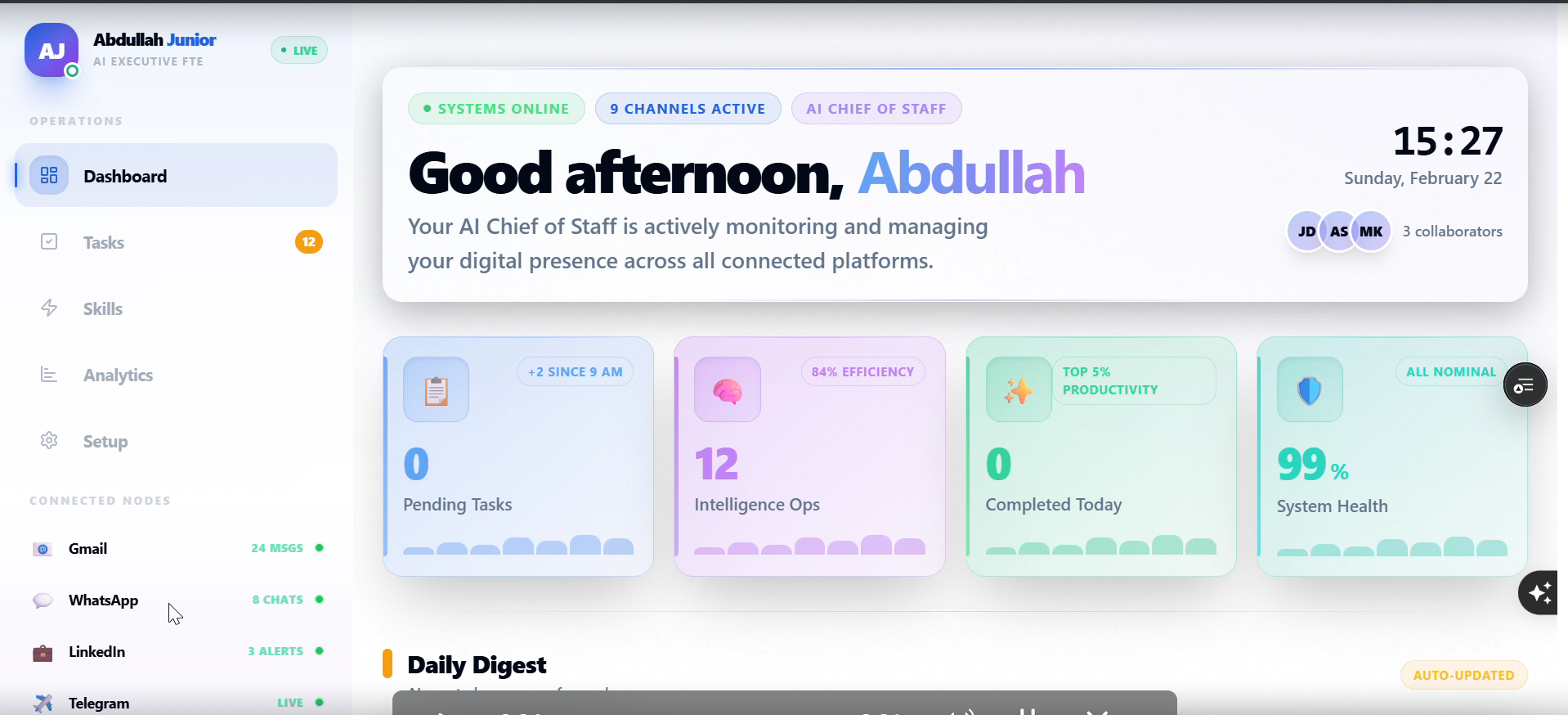
- Interface: Developed a clean, responsive UI to monitor the agent's "Chain of Thought" in real-time.
Challenges we ran into
One of the biggest hurdles was "Agent Looping." Occasionally, the agent would get stuck in a logic loop, repeatedly trying the same failing solution. We had to implement a "circuit breaker" logic and a more robust reflection step to help it realize when it was spinning its wheels. Additionally, managing the context window during multi-step tasks required a custom summarization logic to ensure the agent didn't "forget" the primary goal halfway through.
Accomplishments that we're proud of
We are incredibly proud of the agent's reliability. It’s one thing to get an agent to answer a question; it’s another to have it successfully navigate a 10-step process involving research, synthesis, and file generation without human intervention. Seeing "Abdullah Junior" successfully complete its first full-day equivalent of research tasks was a massive milestone.
What we learned
Building this project taught us that the prompt is only 10% of the battle. The real magic lies in the architecture—how you handle errors, how the agent perceives its environment, and how it recovers from mistakes. We also learned that "constraints" are an agent's best friend; giving the agent too much freedom leads to hallucinations, while structured tools lead to success.
What's next for General Agent FTE (Abdullah Junior)
The journey is just beginning. Our roadmap includes:
- Multi-Agent Collaboration: Introducing specialized "sub-agents" for coding, marketing, and research that report back to the General Agent.
- Voice Integration: Allowing for real-time verbal briefing and reporting.
- Enterprise Deployment: Creating a version that can securely integrate with corporate Slack and Jira environments to truly act as a remote FTE.
Built With
- azure
- claude
- gemini
- kafka
- neon
- next.js
- openai
- python
- typescript


Log in or sign up for Devpost to join the conversation.