-
GenefixAI
Inspiration
Gene editing is powerful but remains complex, fragmented, and difficult to access for many researchers. Existing CRISPR workflows require multiple tools, deep expertise, and significant time to interpret genomic data effectively. The idea behind GeneFix AI was to simplify this process by creating a unified platform where researchers can upload DNA sequences and instantly receive intelligent, actionable insights. The goal is to bridge biology and artificial intelligence to make genomic correction faster, more accessible, and scalable.
What it does
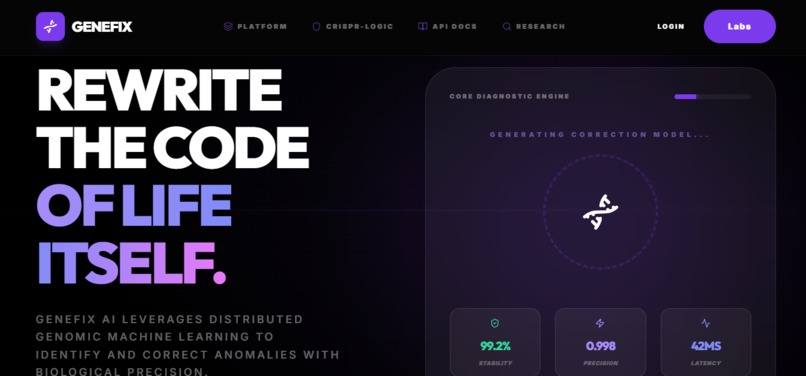
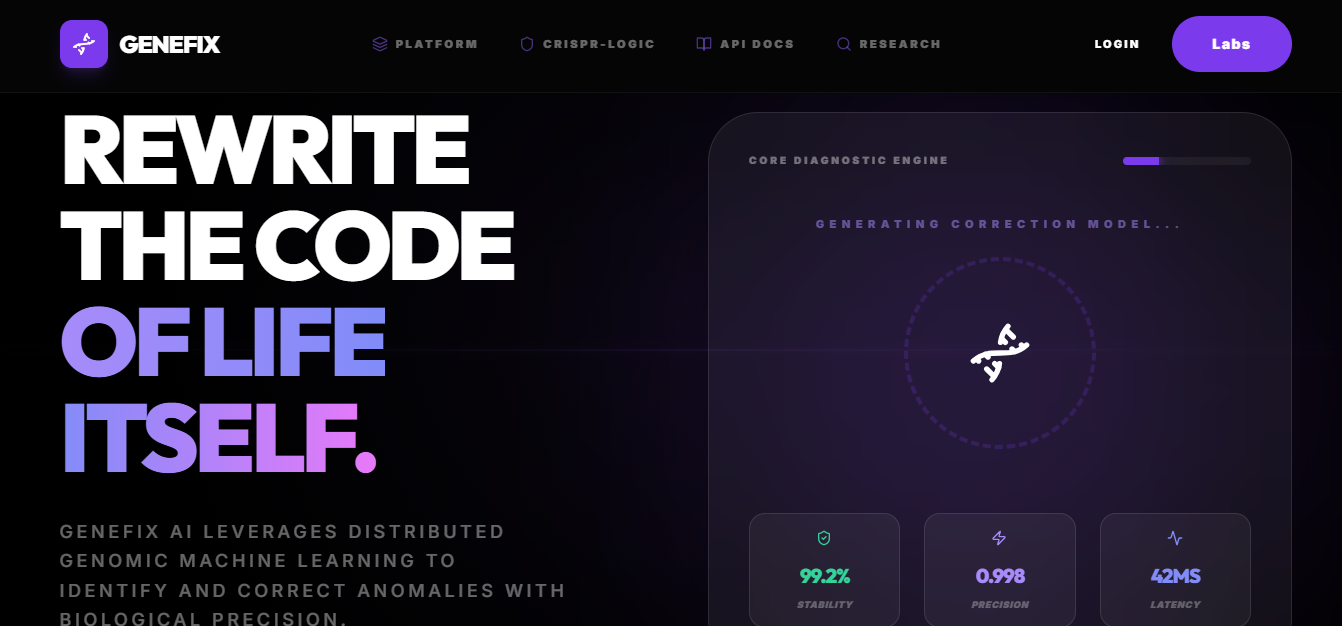
GeneFix AI is an AI-powered genomic analysis platform designed for CRISPR-Cas9 research. It allows users to input DNA sequences and receive a complete analysis pipeline in return. The system identifies potential CRISPR target sites, evaluates guide RNA efficiency, detects off-target risks, and highlights mutation-prone regions. It also generates human-readable scientific summaries and correction strategies using generative AI. The platform transforms raw genomic data into structured insights that can support real research decisions.
How I built it
The system is built using a full-stack SaaS architecture combined with a scientific computing engine. The frontend is developed with Next.js and TypeScript, providing an interactive dashboard for researchers. The backend uses Next.js Server Actions with Prisma and PostgreSQL for data management, along with Clerk for authentication and Stripe for billing.
The core innovation lies in a Python-based FastAPI microservice that acts as the scientific engine. This engine includes a modular machine learning inference system responsible for DNA feature extraction, CRISPR guide efficiency prediction, off-target risk classification, and mutation hotspot detection. Generative AI integration is implemented using Google Gemini to convert complex outputs into understandable summaries. The entire system is containerized using Docker for scalable deployment.
Challenges I ran into
One of the main challenges was designing meaningful feature extraction from raw DNA sequences, which required combining biological knowledge with machine learning techniques. Integrating a Node.js-based SaaS application with a Python-based scientific engine introduced complexity in communication and orchestration. Maintaining low latency for analysis, especially for real-time feedback, required performance optimization of the ML pipeline. Ensuring data reliability while working with genomic datasets also required careful validation. Additionally, implementing secure multi-tenant architecture and handling user-specific API keys added another layer of complexity.
Accomplishments that I'm proud of
I successfully built a production-level SaaS platform that integrates bioinformatics, machine learning, and modern web technologies. The project includes a custom ML inference engine capable of analyzing genomic data in depth. It supports real-world workflows such as sequence analysis, risk detection, and AI-assisted correction strategies. The system also includes authentication, billing, and scalable deployment, making it more than just a prototype. It represents a complete, functional platform that can be extended into a real product.
What I learned
This project helped me gain strong experience in full-stack development, microservices architecture, and machine learning system design. I learned how to process biological data and translate it into features usable by ML models. It also improved my understanding of CRISPR systems, mutation patterns, and genomic analysis workflows. On the engineering side, I developed skills in integrating multiple technologies, optimizing performance, and designing scalable systems. I also learned how to combine heuristic methods, machine learning, and generative AI into a single intelligent pipeline.
What's next for GenefixAI - AI-Powered CRISPR-Cas9 System
The next step is to enhance the platform with more advanced scientific capabilities, such as in-silico gene editing simulations and protein-level impact predictions. The machine learning models can be further improved through fine-tuning on domain-specific datasets. Future development also includes building a public API for researchers, enabling batch sequence processing, and adding collaboration features for research teams. On the product side, the platform can evolve into a full SaaS offering targeted at biotech startups, research labs, and academic institutions.
Built With
- ai
- nextjs
- python

Log in or sign up for Devpost to join the conversation.