-
-
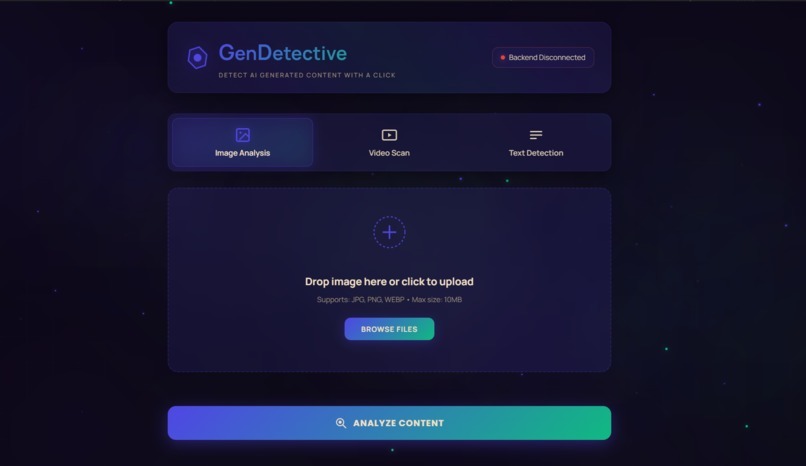
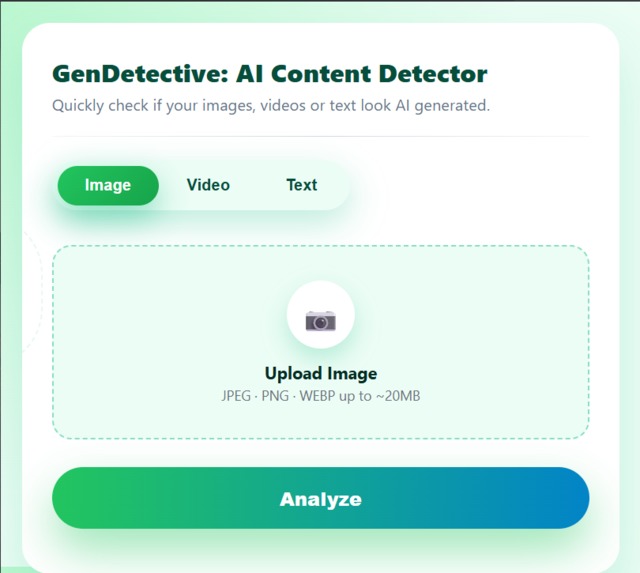
Improved Dashboard
-
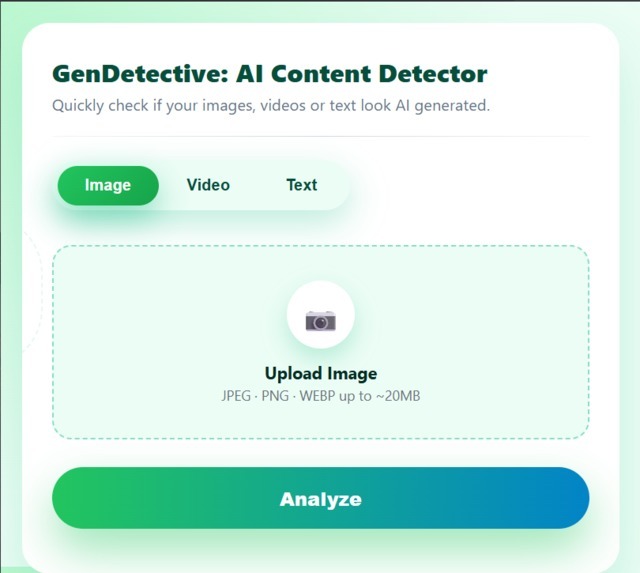
Extension Frontend
-
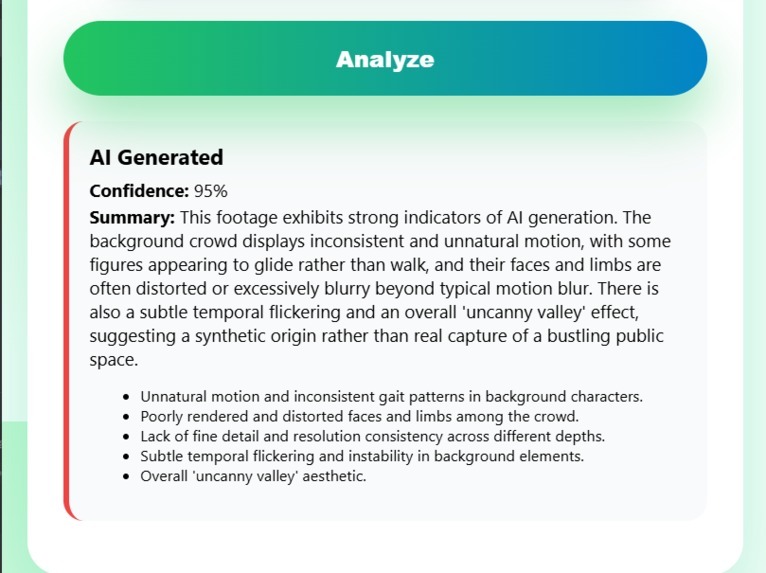
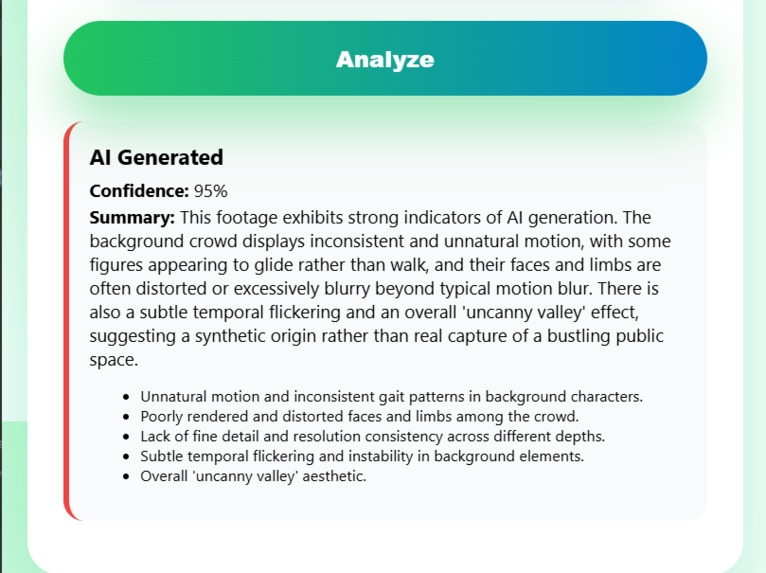
Image Output Example
-
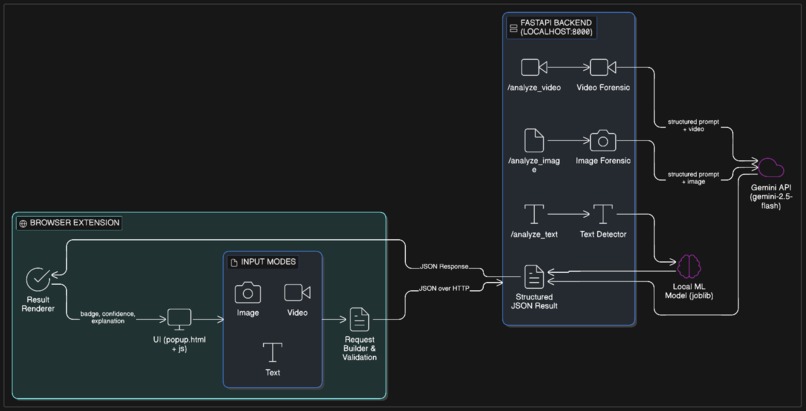
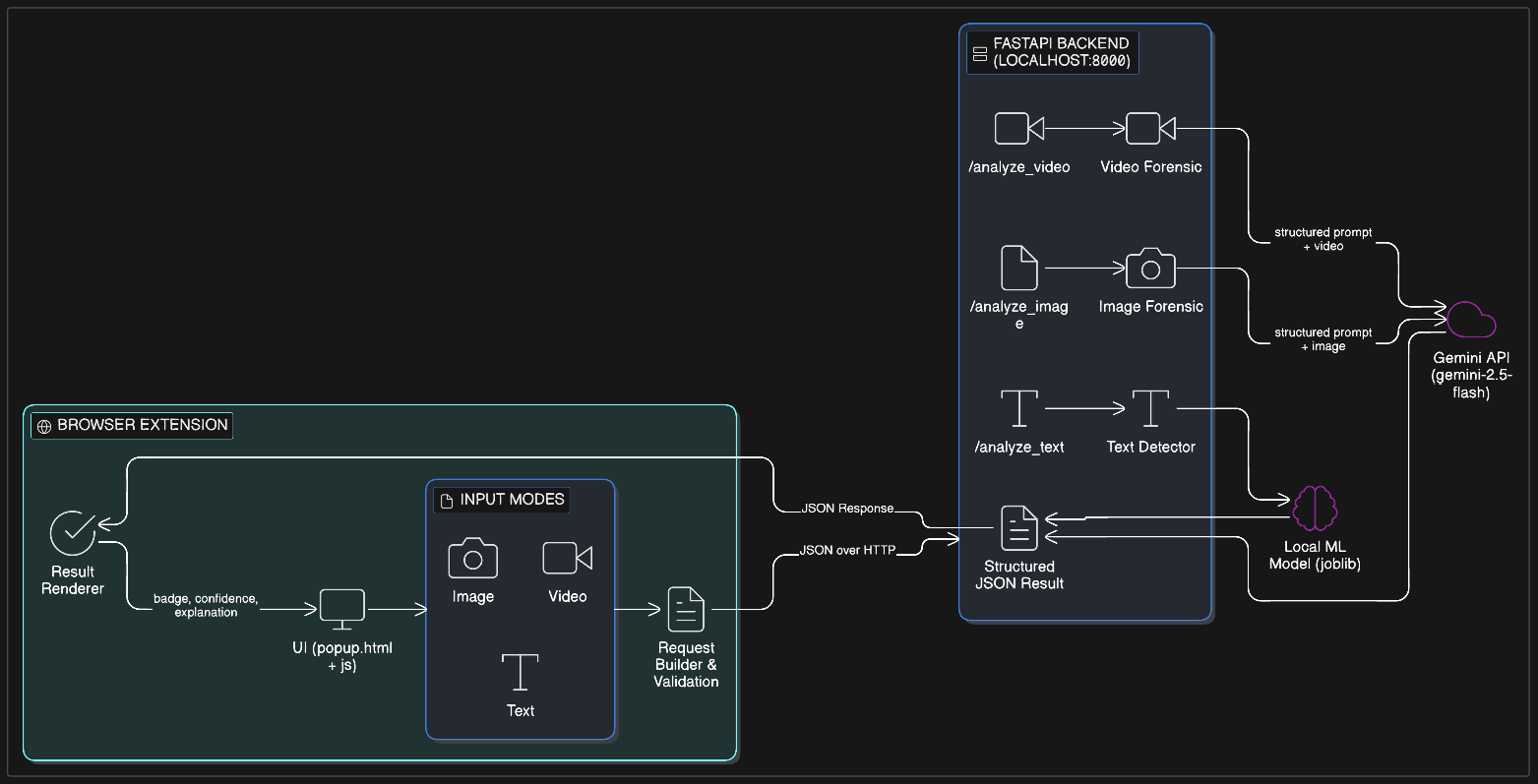
System Architecture

Inspiration
The rapid growth of generative AI tools has made it increasingly difficult to distinguish between human-created and AI-generated digital content. Images, videos, and text produced by modern AI models are now widely shared online without disclosure, raising serious concerns about:
- Misinformation
- Academic integrity
- Fake news
- Digital trust
This project was inspired by a simple real-world question:
“Is the content I am seeing real or AI-generated?”
To address this problem, we built GenDetective, a multimodal AI-content detection system available as both:
- A Chrome browser extension
- A Web dashboard
What it does
GenDetective analyzes images, videos, and text and estimates whether the content is AI-generated or human-created.
The system provides:
Classification
- AI-generated
- Likely AI
- Likely real
- Real
- Inconclusive
- AI-generated
Confidence Score
Human-readable Explanation
Forensic Indicators used in the decision-making process
Users can:
- Upload media through the browser extension
- Use the dashboard interface
- Submit text for analysis
The goal is to make AI detection transparent, explainable, and accessible.
How we built it
GenDetective consists of three main components:
1. Browser Extension
Technologies used:
- HTML
- CSS
- JavaScript
The extension allows users to quickly submit online content for analysis directly from the browser.
2. Dashboard Interface
The web dashboard provides a complete interface for interacting with the detection system.
Features include:
- Image upload and detection
- Video upload and detection
- Text analysis
- Visualization of detection results
3. FastAPI Backend
The backend processes media and performs the AI detection analysis.
Technologies used:
- FastAPI
- NumPy
- OpenCV
- Transformers (CLIP)
- Gemini API
- scikit-learn
The system uses an ensemble detection approach that combines:
- Heuristic analysis
- Machine learning models
- Embedding similarity
- LLM-based reasoning
Challenges we ran into
During development, we encountered several technical challenges:
- Avoiding false positives in compressed media
- Detecting high-quality AI-generated videos
- Handling large video uploads efficiently
- Combining heuristic detection with LLM reasoning
- Maintaining performance inside a browser extension
- Working within limited API usage constraints
Accomplishments that we're proud of
- Built a working multimodal AI detection system
- Created a Chrome extension connected to a backend
- Built a dashboard interface for detection
- Implemented image, video, and text detection pipelines
- Designed an explainable AI detection workflow
- Successfully integrated CLIP + Gemini + ML models
What we learned
Throughout the project, we gained several important insights:
- AI-generated content differs from human content in subtle statistical patterns, rather than obvious visual artifacts.
Key learnings include:
- No single feature can reliably detect AI content
- Detection works best by combining multiple weak signals
- Video detection requires temporal analysis
- Browser extensions require careful performance optimization
What's next for GenDetective
Future improvements planned for the system include:
- Expanding benchmarking datasets
- Improving deepfake video detection accuracy
- Adding frame-level voting detection
- Improving motion realism modeling
- Strengthening text detection robustness
- Deploying the backend to cloud infrastructure
- Publishing the browser extension
- Optimizing dashboard UX and performance
GenDetective aims to help restore trust in digital content by making AI-generated media detectable, explainable, and transparent.
Built With
- chromeapi
- css
- fastapi
- geminiapi
- git
- github
- html
- javascript
- opencv
- python
- pytorch
- scikit-learn
- scipy
- transformers

Log in or sign up for Devpost to join the conversation.