-
-
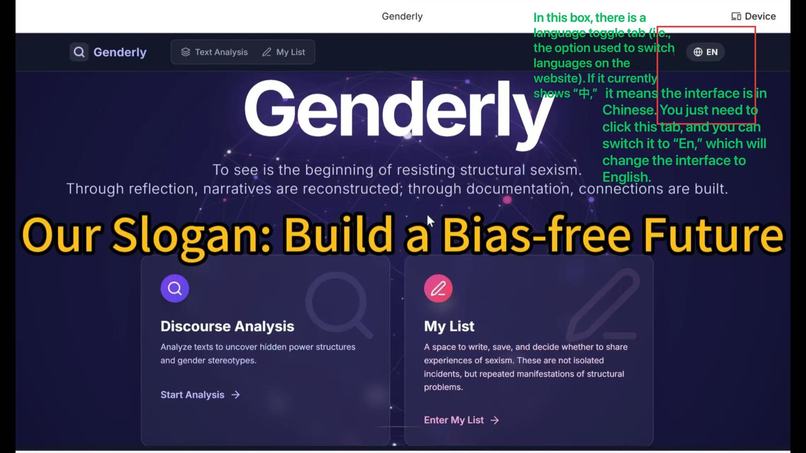
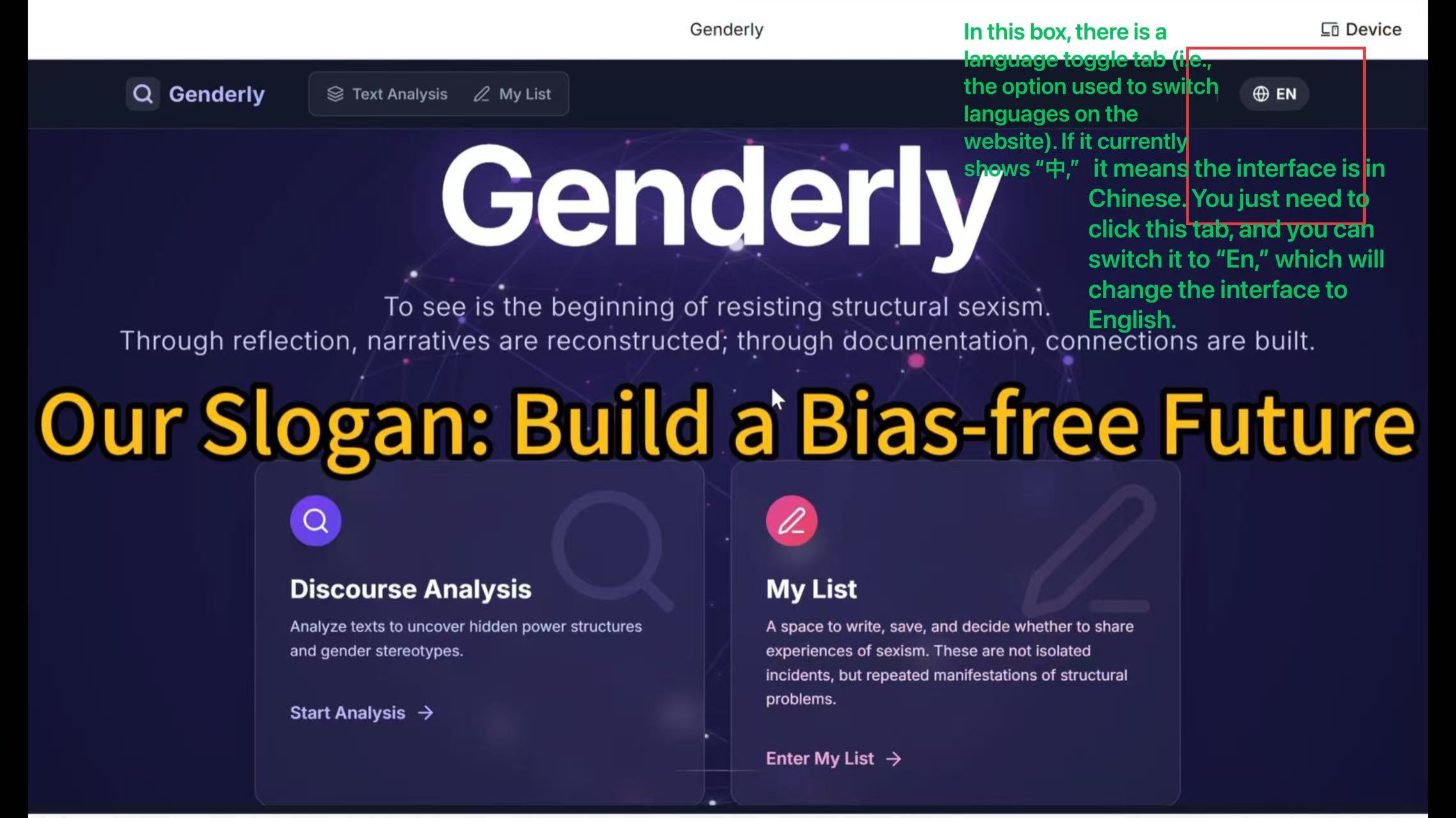
In the upper-right corner, you'll find a language toggle. If it shows “中,” click it to switch it to “En" for the English interface.
Inspiration
The idea for Genderly emerged from my Master’s dissertation research. My academic work examines gender representations in Chinese primary school's Chinese-language textbooks and explores their implications for the localization of Comprehensive Sexuality Education (CSE), particularly gender equality content.
I adopted a Feminist Critical Discourse Analysis (FCDA) approach, which allowed me to move beyond surface-level textual analysis to examine discourse functions and their embedded social practices. Through this lens, I became increasingly aware of how gender-biased or stereotypical narratives exert normative influence on readers in subtle and often unnoticed ways.
In everyday social life, gender inequality does not always manifest through overt conflict. More often, it appears as something 'natural', 'reasonable', and 'routine' within public discourse and narratives. Precisely because of this ordinariness, it frequently goes unnoticed or is even accepted as 'normal.'
Language does not merely reflect reality; it actively shapes how we think and perceive, including our imagination of gender roles, abilities, and values. Biased expressions reinforce stereotypes and allow exclusion and inequality to persist in quieter yet more enduring forms.
When experiences are not recorded, they are treated as individual problems. When narratives are not deconstructed, they continue to be perceived as normal.
This is why we made Genderly and distilled the core of Genderly into three concepts: See. Think. Record.
What it does
Genderly is a text analysis and expression-support platform grounded in a gender perspective. It focuses on two core dimensions:
- In-depth analysis of gendered narratives in texts with specific contexts and characters
- Providing users with a space to record, organize, and optionally share real-life experiences of gender discrimination, bias, or misogynistic harm
Genderly supports not only gender-aware reading practices, but also self-reflection during personal writing and creative processes.
For teachers, writers, screenwriters, and other content creators, texts are not merely vehicles for ideas. They also silently convey assumptions about ideology, power structures, and social roles. Through multi-dimensional analytical perspectives, Genderly offers creators a space to review, examine, and reconstruct their narratives.
Core Features Introduction:
Text Discourse Analysis: This feature helps users identify and deconstruct gendered narrative logics within texts. Through multi-dimensional analysis (power relations, character traits, and social or behavioral roles), users can uncover hidden gender biases and stereotypes. By interacting with the AI assistant, users gradually build their own analytical frameworks and explore how such narratives subtly shape readers’ perceptions of gender, competence, and value. In the suggestion module, Genderly provides rewriting recommendations and reflective questions, encouraging users to move beyond the text itself and consider its broader social implications, such as how narratives contribute to gender expectations, behavioral boundaries, and social norms.
My List: My List is a space where users can record, store, and optionally share their experiences of gender discrimination. And this module is inspired by the Everyday Sexism Project created by Laura Bates. Many experiences that appear incidental or isolated are, in fact, rooted in structural inequalities. In Genderly, recording is not emotional venting, it is a way of turning lived experience into evidence. Users may keep entries private or choose to make them public, allowing these stories to serve as reminders, support, and sources of strength for others. When experiences are articulated, seen, and named, they are no longer dismissed as overthinking.
How we built it
The current version of Genderly is built using Gemini AI Studio. We rely on carefully designed system instructions and structured prompts to constrain the model’s analytical direction and depth, aligning its outputs with both gender studies methodologies and critical thinking logic.
We were positively surprised by Gemini 3’s capacity to process long, detailed, and methodologically structured prompts. Its strong contextual understanding enabled us to embed feminist discourse analysis frameworks into the prompt design, demonstrating Gemini’s potential for supporting domain-specific, theory-driven analytical tasks.
Challenges we ran into
Gemini 3 has demonstrated impressive capabilities in handling long, complex, methodology-driven tasks, allowing us to embed feminist critical discourse analysis frameworks into prompt design and enabling the prompt to perform effectively, highlighting its potential for discipline-specific, theory-driven analytical work.
That said, Genderly currently relies on general-purpose large language model API to deliver text analysis capabilities, enabling rapid validation of product direction and user needs. Even after multiple rounds of prompt optimization, analytical quality remains inconsistent. We have come to realize that existing general-purpose models are insufficient for tasks requiring methodologically rigorous, domain-specific gender discourse analysis, particularly in complex contexts.
In future iterations, we plan to build a dedicated corpus grounded in gender studies methodologies and integrate it with a Retrieval-Augmented Generation (RAG) framework, gradually developing a model system better suited to the demands of feminist discourse analysis.
Accomplishments that we're proud of
Successful Interdisciplinary Integration: We translated Feminist Critical Discourse Analysis (FCDA) into a functional AI tool, bridging the gap between academic studies and practical social applications.
Depth of Analysis: Through rigorous prompt engineering in Gemini AI Studio, we’ve enabled the AI to go beyond surface-level summaries and identify subtle power structures and gendered logic.
What we learned
This project marked my first attempt to translate gender studies theories and methodologies into a concrete, usable tool. The process was consistently surprising and reshaped my understanding of how theory can meaningfully enter everyday life.
I have long believed that gender theory should not remain confined to academia, but actively engage with lived experience. This project allowed me to experience, firsthand, the potential of theory-informed practice.
I collaborated closely with my teammate from a computer science background, and our skill sets proved highly complementary. Along the way, we also connected with other collaborators, forming partnerships that will continue beyond this hackathon.
What's next for Genderly
Looking ahead, Genderly will expand into a web platform combined with a browser extension. While the website platform supports deep reading and reflective writing, the extension integrates into everyday contexts, such as social media platforms or workplace communication. With a simple text selection, users can receive gender-aware analysis and expression support, including:
- Identifying underlying issues and their logic
- Refining language to reduce unconscious bias
- Generating responses that are articulate, assertive, and safe
Built With
- gemini3
- geminiaistudio

Log in or sign up for Devpost to join the conversation.