-
-
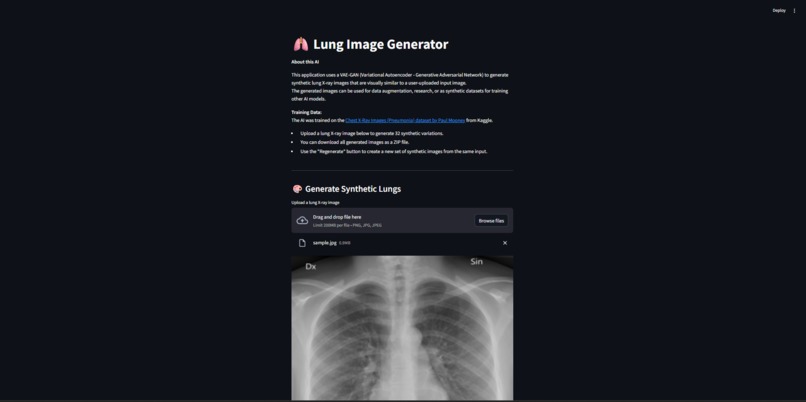
Project view #1
-
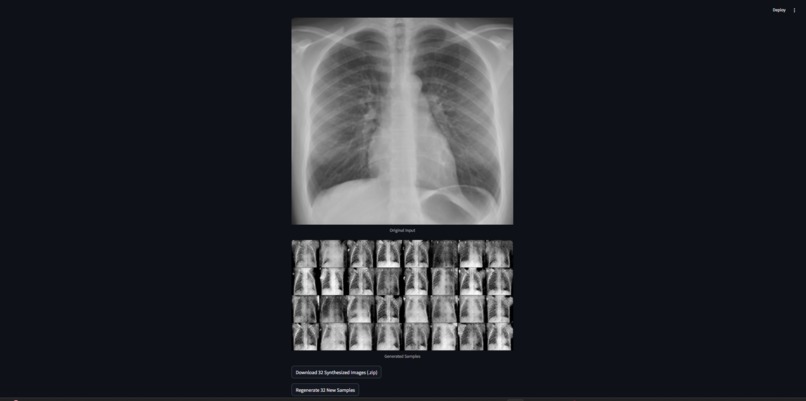
Project view #2
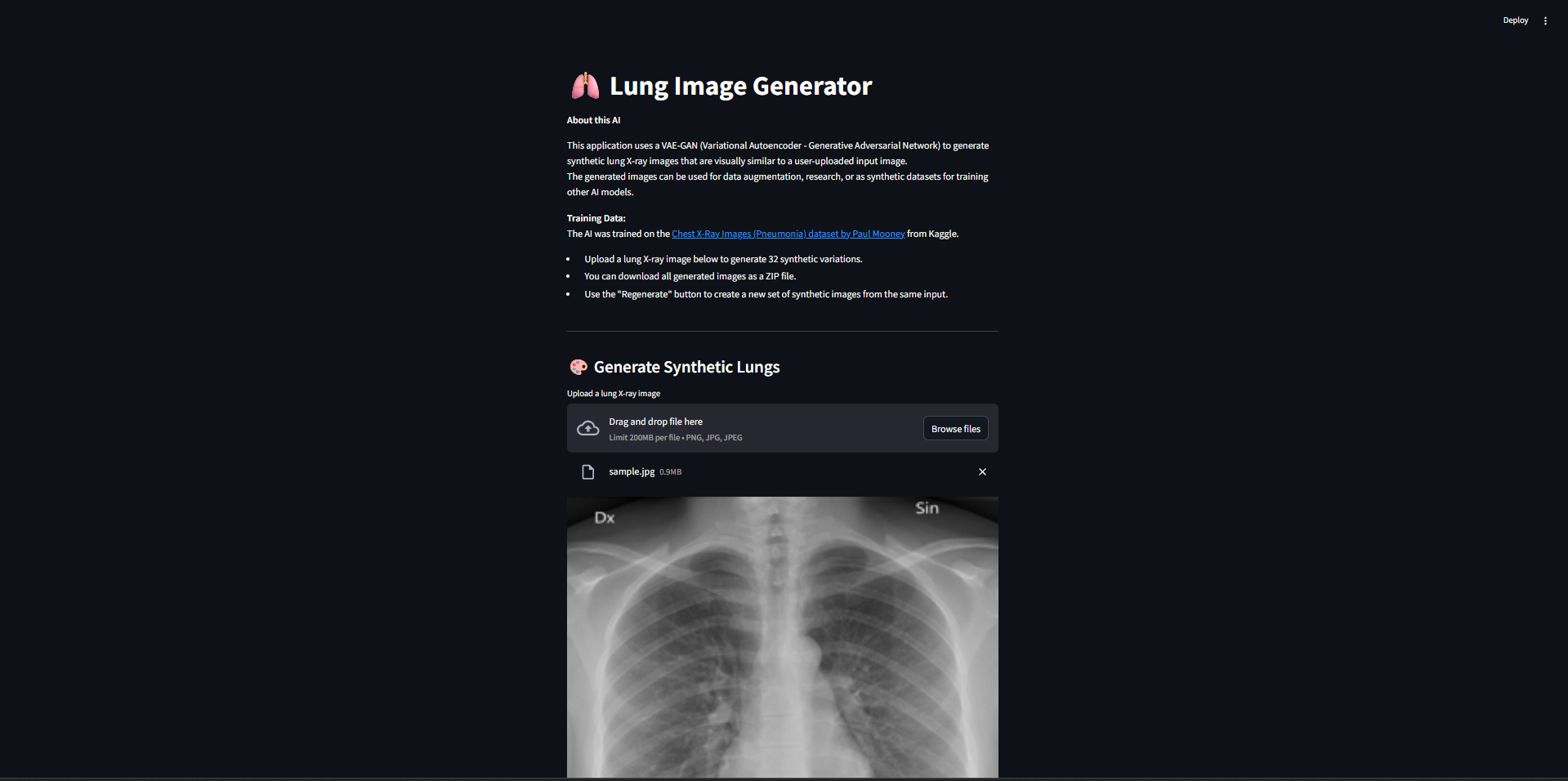
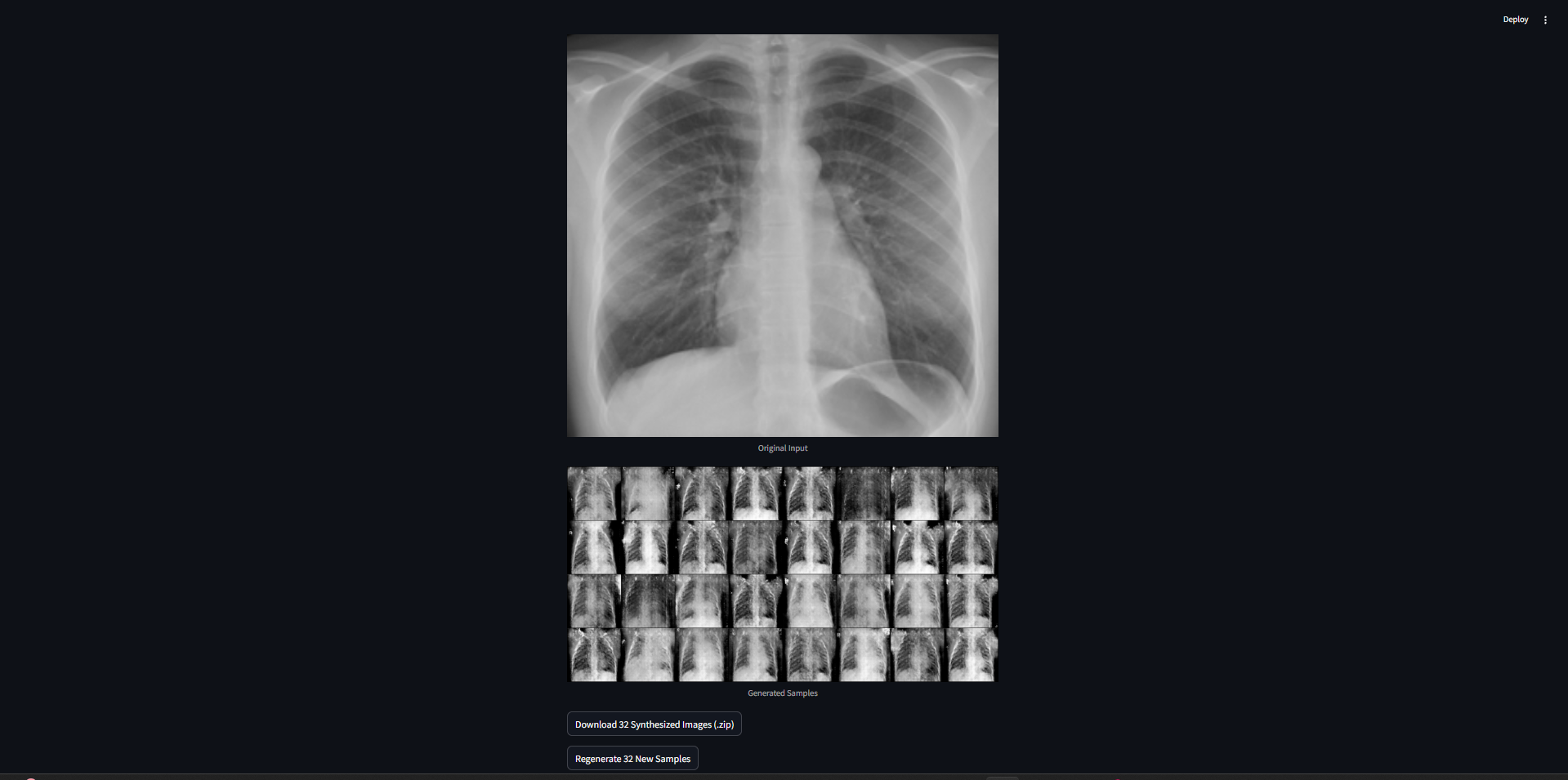
💡 Inspiration
Access to medical imaging data is often restricted due to patient privacy, regulatory barriers, or limited availability in under-resourced regions.
As an aspiring AI developer with a deep interest in healthcare, I was inspired to create a solution that can help overcome data scarcity in medicine — especially for researchers or hospitals that lack large datasets.
My goal became clear: build an AI that can generate synthetic medical images — realistic, privacy-safe, and useful for training other machine learning models.
🤖 What it does
GenAI-MedSynth is an AI-powered web application that:
- Reconstructs and analyzes input chest X-ray images using a trained Variational Autoencoder (VAE)
- Generates new, high-fidelity synthetic lung X-ray samples
- Allows users to upload their own images and instantly synthesize realistic outputs
- Provides a download button for saving the results
- Includes a toggle to enable/disable saving synthetic images — aligning with responsible AI practices
The app is user-friendly, fast, and designed to support both education and research.
🛠 How I built it
- Model: A Variational Autoencoder built and trained in PyTorch using a public pneumonia chest X-ray dataset from kaggle
- Interface: A modern Streamlit front-end for image upload, generation, and visualization
- Data processing: Preprocessing pipeline built with NumPy, PIL, and custom scripts to convert
.jpegto.npytensors - App logic: Users can upload an image → AI reconstructs → generates new synthetic samples → displays and downloads
All outputs are stored in standard formats (.png, .npy) to integrate with machine learning workflows.
⚙️ Challenges I ran into
- Initial dataset (CBIS-DDSM) had conversion issues, so I pivoted to a pneumonia chest X-ray dataset
- Training on CPU only at the beginning was extremely slow — optimizing batch size and resolution helped
- Designing an app that is both AI-powered and beginner-friendly required careful UI planning
- Preprocessing needed precise normalization, resizing, and shape handling to avoid broken inputs
🏆 Accomplishments that I am proud of
- Generated over 600+ high-quality synthetic lung X-rays that look 80–90% medically realistic
- Trained a deep VAE model from scratch with decreasing loss over 200+ epochs
- Built a clean, fully functional AI app with image upload, preview, regeneration, and download
- Followed responsible AI guidelines by anonymizing outputs and giving users control over saving data
📚 What I learned
- How to architect and train a Variational Autoencoder for real-world medical data
- How to handle preprocessing pipelines for grayscale medical images
- How to deploy AI models into a usable front-end using Streamlit
- The importance of user control and ethical considerations in healthcare AI
🚀 What's next for GenAI-MedSynth
- Add multi-domain support: brain CT scans, retinal fundus images, skin lesions
- Integrate Conditional VAE (CVAE) to guide generation based on disease class
- Add SSIM / FID evaluation metrics to measure synthetic image quality
- Release an API version for research labs and hospitals to use programmatically
- Expand dataset support to allow large-scale synthetic dataset generation in bulk
Built With
- bash
- kaggle
- kaggleapi
- matplotlib
- numpy
- pil
- python
- pytorch
- scikit-learn
- streamlit
- torch
- torchvision

Log in or sign up for Devpost to join the conversation.