Inspiration
AI conversation exports often look like ordinary JSON archives, but evidentiary questions depend on structure that a flat transcript can erase: branches, roles, timestamps, missing values, tool and system events, attachment references, and duplicate families.
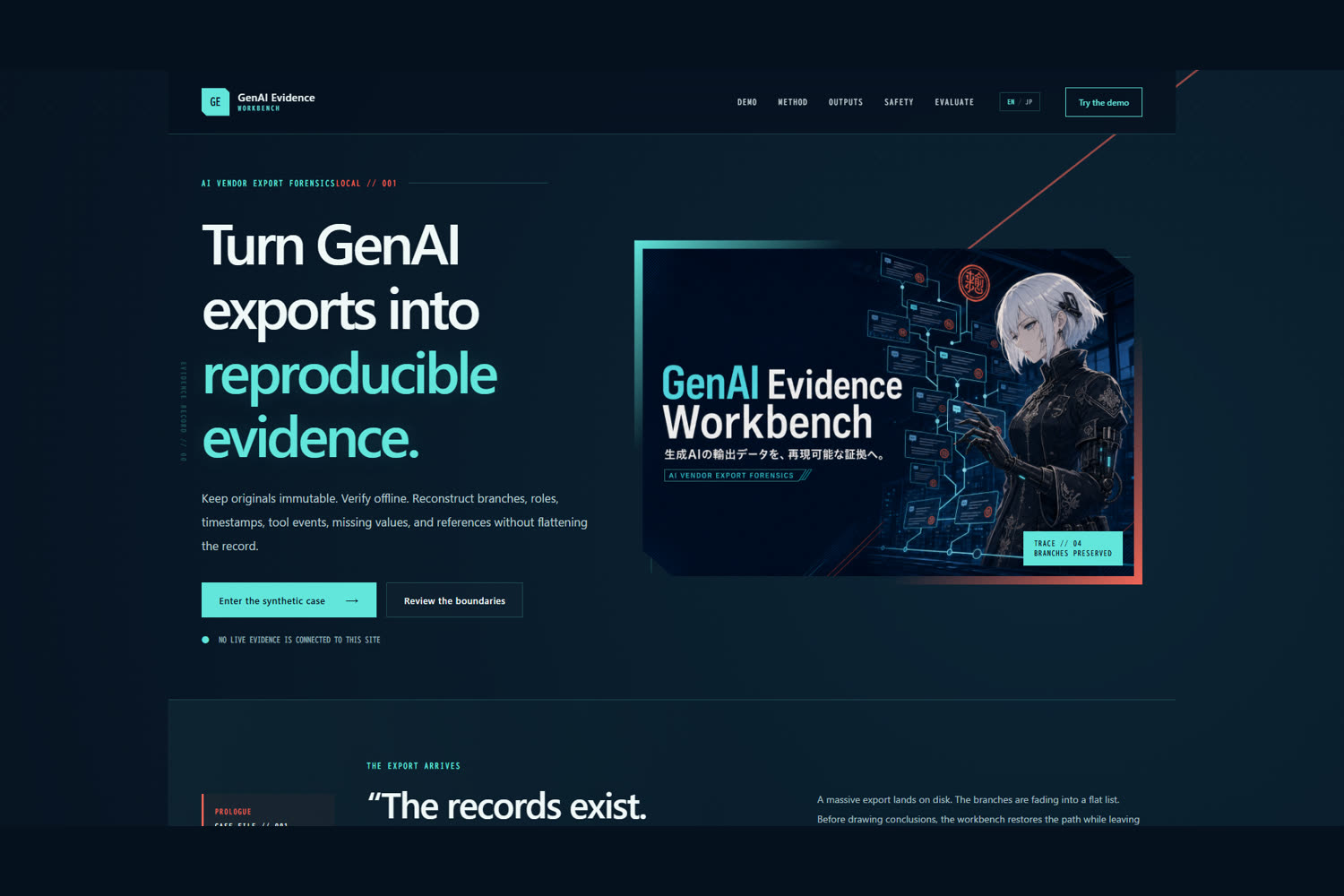
GenAI Evidence Workbench began from a practical need for an offline and reproducible way to preserve that structure. The Build Week challenge was to explain the workflow clearly and interactively without publishing live evidence, sensitive filenames, vendor-specific adapters, detector thresholds, or conclusions that the records cannot prove.
What it does
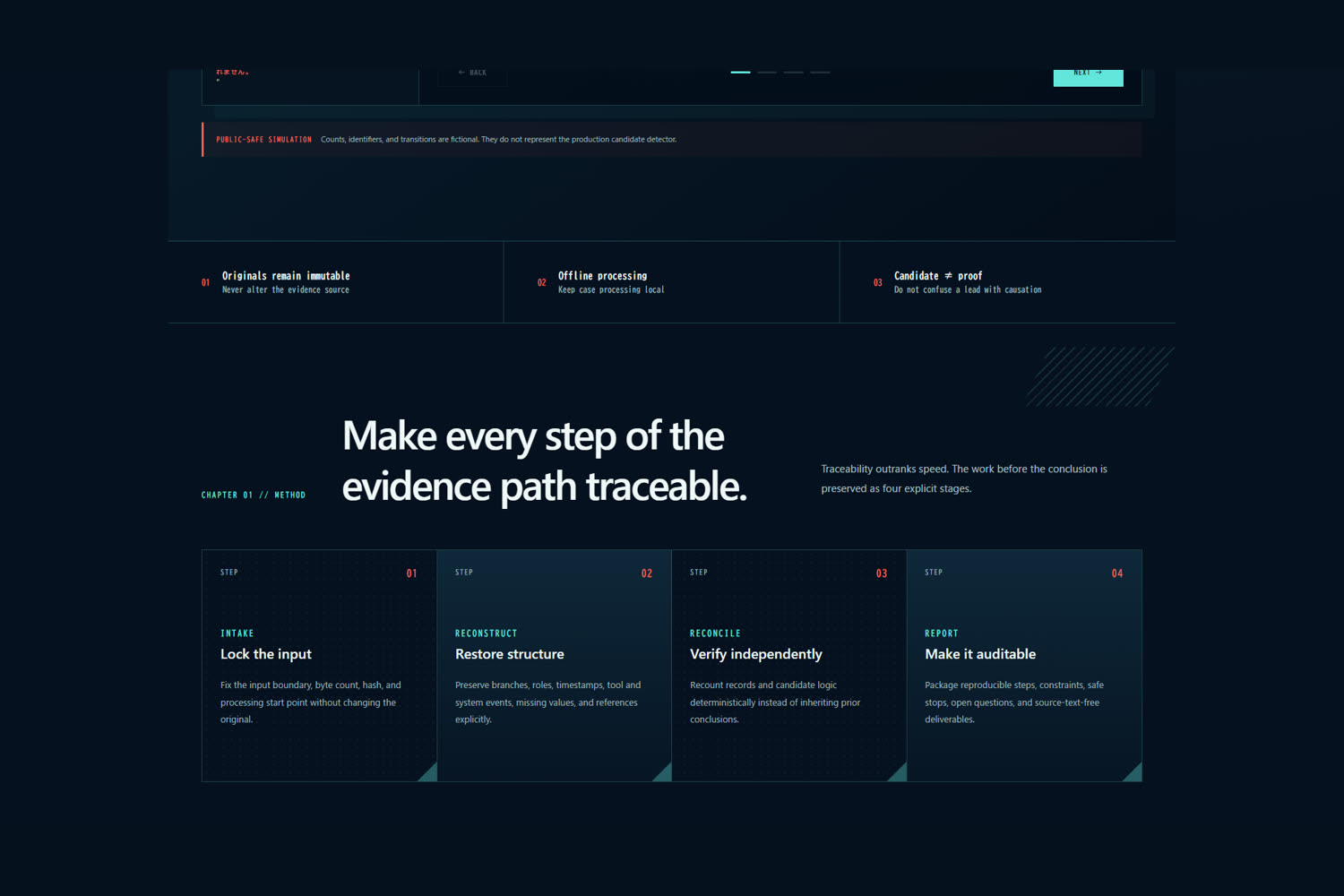
The workbench presents a four-stage evidence path:
Acquire — lock an abstract input and establish its byte-level hash. Restore — preserve branches, roles, timestamps, missing values, and event classes. Reconcile — account for duplicates, attachment references, and candidate relationships without treating them as proof of provenance or causation. Report — produce a reproducible manifest, data dictionary, and audit report.
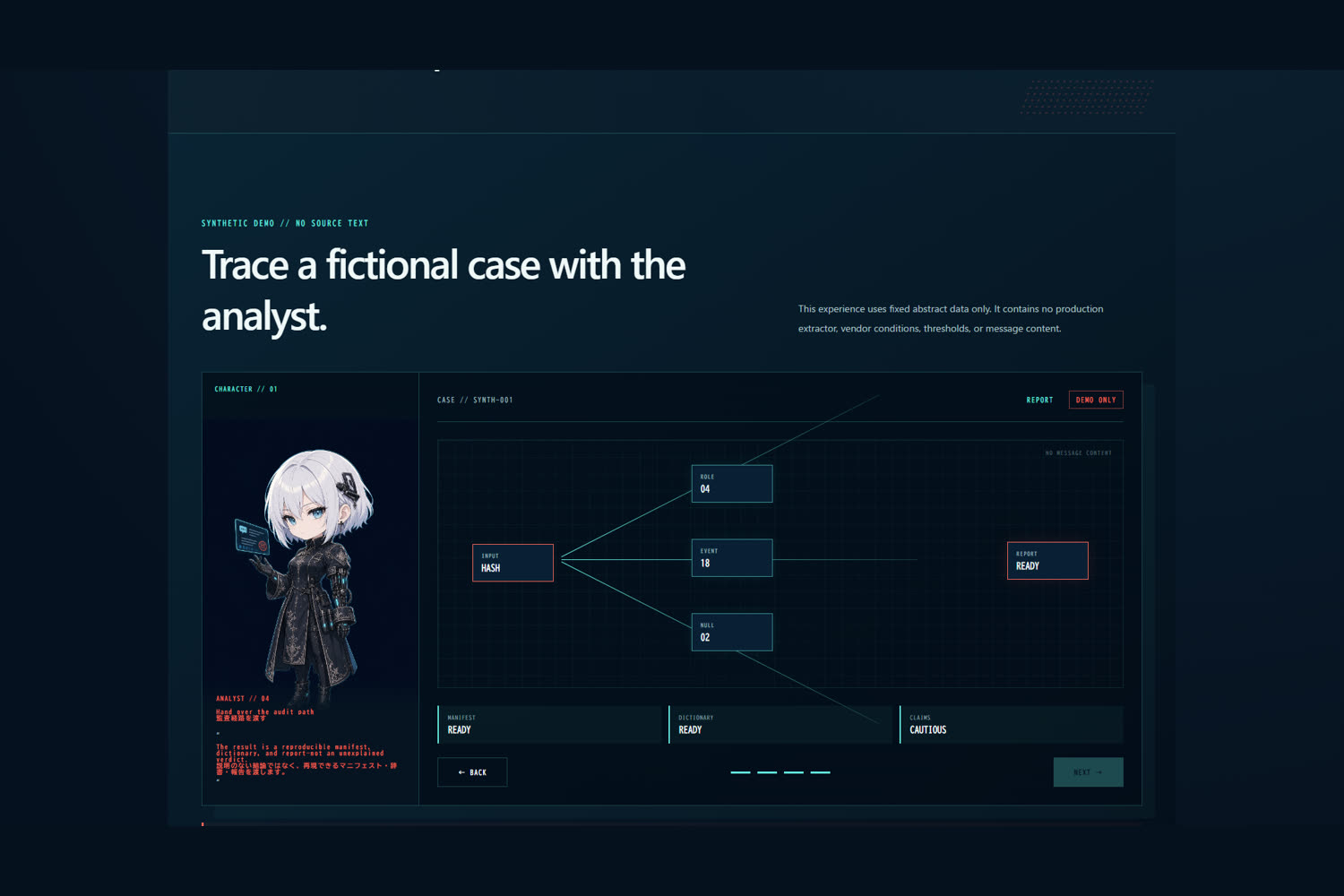
The public Build Week experience uses fixed synthetic counts and abstract nodes. It contains no upload endpoint and cannot receive live evidence. A JP/EN switch presents the same narrative in both languages.
How we built it
The public experience is a responsive React and TypeScript site deployed with Codex Sites. It combines:
a narrative chapter structure; an accessible bilingual interface; a deterministic four-stage synthetic simulator; an original 2D forensic AI analyst and mascot; a public-safe explanation of the offline forensic workflow; a controlled-evaluation proposal for vendor-supplied synthetic or benchmark exports.
The regulated evidence workspace and public submission site are deliberately separated. The private production method remains offline and outside this submission.
How Codex accelerated the work
Codex was the primary development environment for the Build Week extension. It helped:
separate the public website from the regulated evidence workspace; translate forensic policy into product and disclosure requirements; design the narrative information architecture; implement and validate the bilingual React interface; build the deterministic synthetic simulator; generate and refine the original analyst and mascot; identify the risk of exposing proprietary extraction logic; replace that risk with an explicitly synthetic demonstration; prepare the deployment, README, demo video, narration, subtitles, and submission assets.
Human decisions controlled the anime direction, female guide character, evidence-preservation principles, public/private boundary, and controlled-evaluation positioning.
How GPT-5.6 was used
GPT-5.6 was used meaningfully through Codex during the Build Week extension to reason about the safety boundary, translate regulated forensic requirements into a testable public experience, implement the interface, review disclosure risks, and validate the project narrative and build.
GPT-5.6 is not called by the public demo at runtime. No live evidence is sent to GPT-5.6 or any hosted model. This is an intentional privacy and evidence-preservation decision.
Challenges
The hardest problem was not rendering JSON. It was deciding what a public demo must not reveal.
A realistic extractor could disclose vendor-specific adapters, thresholds, candidate-scoring logic, or evidence-derived details. We designed the simulator to teach the workflow using fictional counts and abstract nodes instead.
The second challenge was making hashes, branches, duplicates, safe stops, and audit lineage understandable without implying that a candidate match proves training, leakage, provenance, or causation.
Accomplishments
Created a complete public narrative for a technically sensitive workflow. Built a working bilingual simulator requiring no account, API key, or upload. Established a clear boundary between demonstration, controlled evaluation, and private production logic. Created a distinctive original visual identity that makes audit work approachable. Produced a reproducible, source-text-free testing path for judges.
What we learned
For evidence tooling, restraint is a product feature.
A compelling demo does not need live customer data or exposed extraction logic. It needs a clear chain of decisions, explicit limits, deterministic behavior, and an honest account of what every result can and cannot prove.
Prior work and Build Week work
The underlying private forensic workbench predates Build Week.
During Build Week, Codex and GPT-5.6 were used to create:
the complete public-safe website; the anime-inspired design system and original female analyst; the bilingual narrative interface; the deterministic synthetic simulator; the controlled-evaluation protocol; the public/private disclosure boundary; the Codex Sites deployment; the demo video, English narration, subtitles, and submission materials.
Timestamped Codex task history and the Build Week commit history document this extension.
What GEW does:
Offline, local-first, post-hoc reconstruction and verification of AI execution artifacts, state transitions, and evidentiary claims Independent corroboration of whether AI-reported outcomes (e.g. "confirmed," "succeeded," "verified") correspond to actual execution evidence Detection of state-integrity failures where output from terminated processes survives context compaction, loses its evidential qualifier, and is inherited as confirmed operational state Reproducible evidence paths with byte-identical deterministic verification (Python/Node dual implementation, SHA-256 bundle hashing)
What GEW does not do:
Real-time inline monitoring or request-path enforcement Cryptographic signing of live API traffic Policy-based allow/redact/block decisions on AI requests in transit
Complementary relationship:
Inline enforcement gateways (such as DeepInspect) sit in the request path between users and AI endpoints, producing cryptographically signed audit trails of every API call. GEW occupies a different layer: the failure class it addresses occurs inside the LLM's own state transitions, where corruption happens within the model's internal context rather than on the HTTP request path. No amount of request-level logging can detect this class of failure in principle. The two approaches are complementary, not competing.
What's next
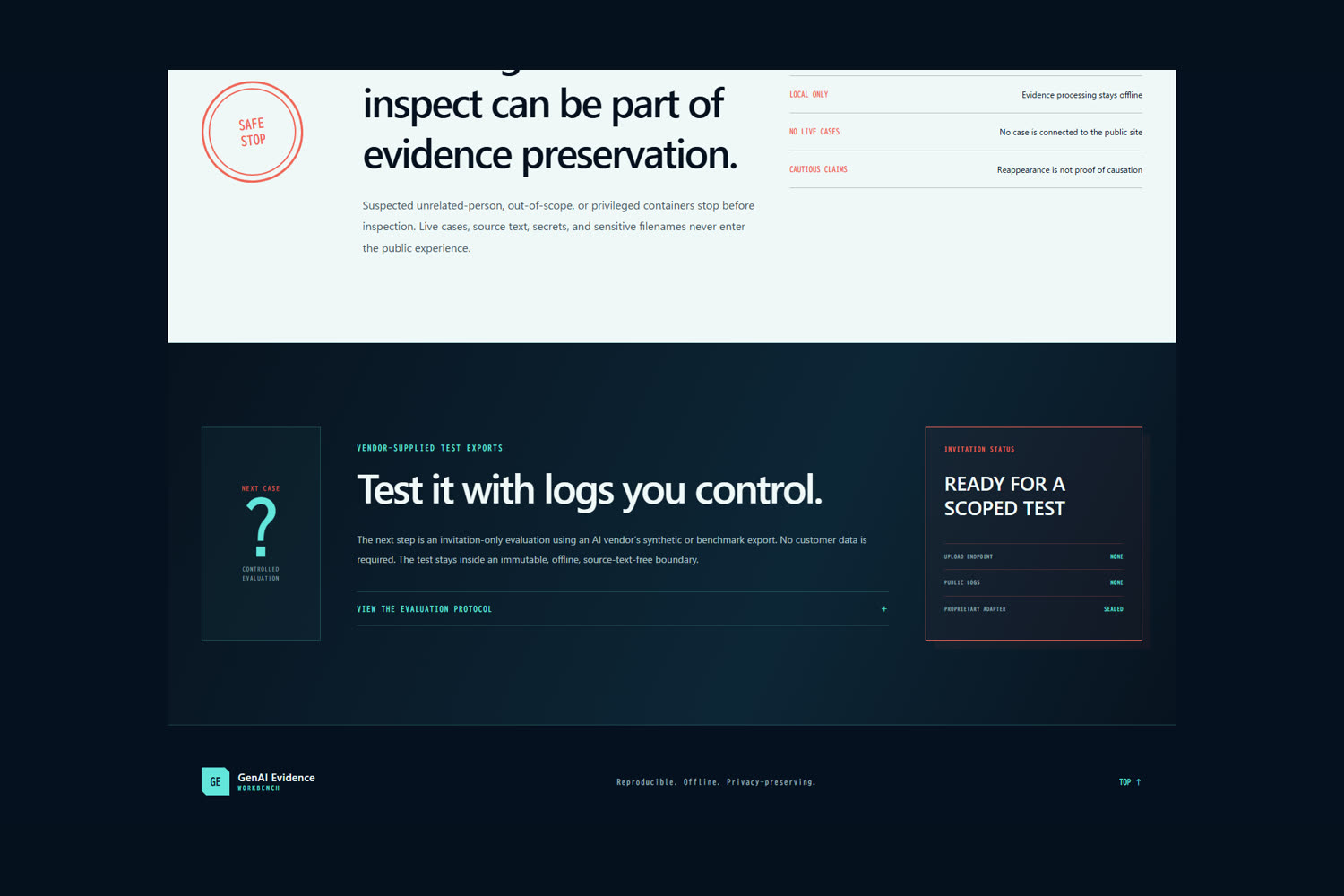
The next step is a controlled evaluation using synthetic or benchmark exports supplied by an AI vendor.
Inputs would be provided through a local read-only path, hashed before interpretation, processed offline inside a scoped workspace, and returned as source-text-free audit results.
No vendor partnership or endorsement is currently claimed.
Post–Build Week update: Evidence-bounded conversational analysis
After Build Week, the private offline workbench was extended with an evidence-bounded conversational analysis layer.
Using a real, read-only 15.6 GiB X archive, the local runner parsed 202,457 canonical records and created a separate confidential analysis corpus containing 123,986 text-searchable records. Two clean corpus builds produced the same byte-identical database, while the original archive and verified evidence artifacts remained unchanged.
The model is never treated as evidence. It can access records only through Workbench-managed deterministic retrieval methods for exact text, dates, record types, IDs, threads, related records, provenance, and record verification.
Every verifiable answer is written to a claim ledger and checked by deterministic code against record existence, content hashes, timestamps, source-archive identity, retrieval receipts, and the complete provenance chain. Fabricated IDs, unsupported assertions, zero-result claims, source-hash mismatches, and claims about records that were never retrieved are rejected.
Research selections are persisted as ordered record-ID sets rather than being held only in model context, so follow-up references remain stable across conversations and context compaction.
This is a post–Build Week private research extension, not part of the judged public demo. The public experience remains synthetic, upload-free, and does not send live evidence to a hosted model.
Built With
- aiimage
- codex
- codexsite
- css
- ffmpeg
- gpt-5.6
- react
- text-to-speech
- typescript
- vinext

Log in or sign up for Devpost to join the conversation.