-
-
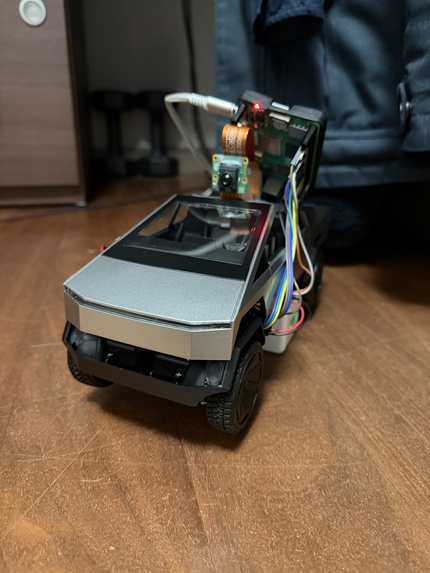
RC car with raspberry pi and battery

Inspiration
Can a large language model actually drive a car?
With multimodal AI rapidly advancing, I wanted to test the limits of general-purpose models by connecting one directly to the physical world. That question became Gemo.
What it does
Gemo is a vision-only autonomous RC car powered by a Gemini-family model.
- Uses a single front-facing camera
- No LiDAR, no maps, no extra sensors
- The AI interprets images and decides how to drive in real time
How I built it
- RC car platform controlled by a Raspberry Pi
- Camera input sent to a Gemini multimodal model
- Prompt engineering + function calling to translate AI decisions into motor commands
- Iterative real-world testing and tuning
Challenges I ran into
- Unstable control requiring tiny, incremental movements
- Frequent crashes due to small perception errors
- Latency and inconsistency from model outputs
- Power and motor control limitations on hardware
- Live models can be unstable or intermittently fail depending on model version, rollout, or API conditions.
Accomplishments that I'm proud of
- Successfully connected a large language model to real-world driving
- Proved that LLM-driven autonomous control is possible, even if imperfect
- Built a complete end-to-end system from AI reasoning to physical motion
What I learned
Just as humans don’t consciously think in language while driving,
autonomous driving may require models specifically designed for driving,
not just general-purpose transformer-based language models.
This experiment highlighted the gap between language reasoning and real-time control.
What's next for Gemo
- Test driving-specialized models
- Fix some malfunctions of Gemini Live Model
- Improve control stability and feedback
- Combine classical control with AI reasoning
- Push further into real-world autonomy experiments


Log in or sign up for Devpost to join the conversation.