-
-
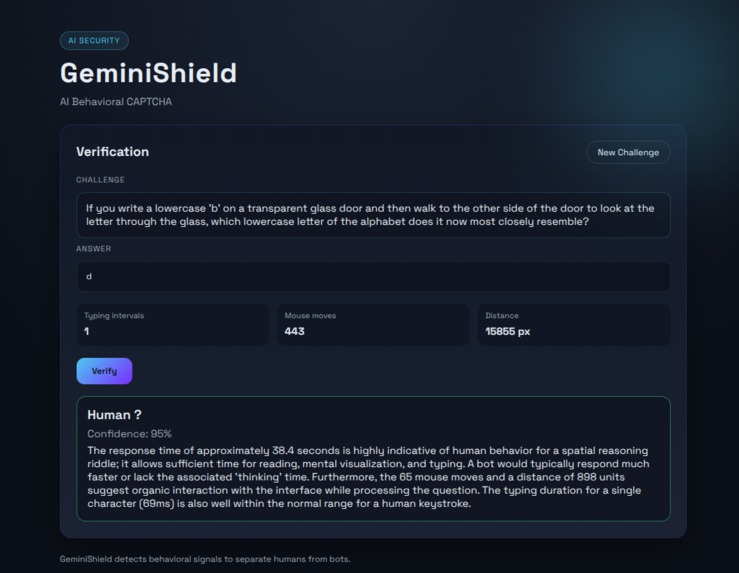
GeminiShield generates an AI CAPTCHA, analyzes user behavior, reasoning, and verifies human authenticity with confidence score in real time.
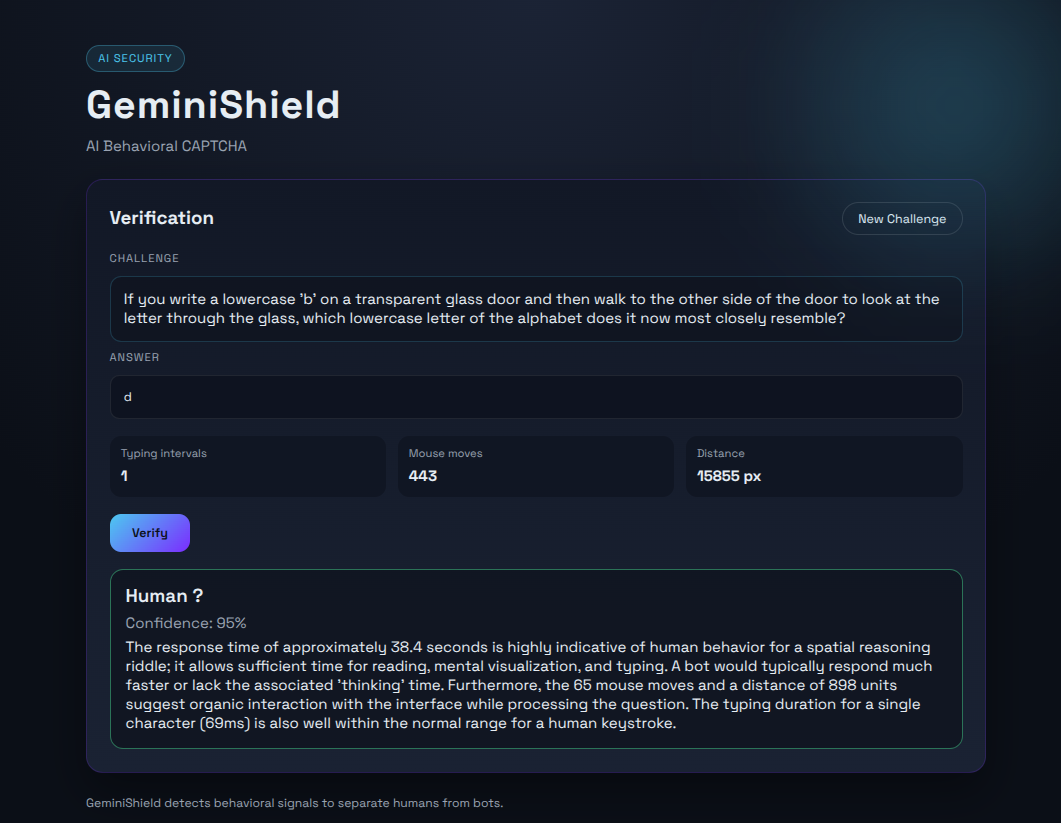
GeminiShield — AI Behavioral CAPTCHA powered by Gemini 3
Inspiration
Traditional CAPTCHA systems rely on static challenges such as distorted text or image selection. However, modern bots powered by advanced AI models can solve these challenges with high accuracy, making them increasingly ineffective. This inspired us to rethink human verification from first principles.
Instead of asking what humans can see, we asked: what makes humans behave differently from bots?
Humans exhibit natural typing delays, hesitation, reasoning patterns, and behavioral inconsistencies. Bots, in contrast, operate with near-perfect speed and deterministic patterns. GeminiShield was inspired by leveraging Gemini 3’s reasoning capabilities to analyze behavioral and cognitive signals, transforming CAPTCHA from a visual test into an intelligent behavioral verification system.
What it does
GeminiShield is an AI-powered behavioral CAPTCHA that verifies whether a user is human or bot by analyzing:
- Cognitive reasoning ability
- Typing speed and timing variation
- Response latency
- Behavioral interaction patterns
Instead of solving static puzzles, users answer dynamically generated reasoning questions. Gemini 3 evaluates both the correctness and the behavioral plausibility of the response.
We compute a human confidence score:
$$ HumanScore = w_1 \cdot ReasoningScore + w_2 \cdot TimingScore + w_3 \cdot BehaviorScore $$
Where:
- $ReasoningScore$ evaluates semantic correctness
- $TimingScore$ evaluates response plausibility
- $BehaviorScore$ evaluates typing patterns
If:
$$ HumanScore > Threshold $$
the user is verified as human.
How we built it
GeminiShield uses a full-stack architecture:
Frontend:
- React (Vite)
- Captures typing intervals using keyboard event timestamps
- Measures response latency
- Sends behavioral telemetry securely to backend
Backend:
- Node.js + Express
- Session-based CAPTCHA management
- Behavioral data processing
- Gemini 3 API integration via
@google/genai
AI Layer:
- Gemini 3 dynamically generates CAPTCHA questions
- Gemini 3 evaluates:
- reasoning correctness
- timing plausibility
- behavioral realism
- Returns human/bot classification with confidence score
Flow:
- User requests CAPTCHA
- Gemini generates dynamic reasoning challenge
- Frontend captures behavioral signals
- Backend sends behavioral + cognitive data to Gemini
- Gemini returns human confidence score
- User is verified or blocked
Challenges we faced
1. Designing CAPTCHA that AI bots cannot easily bypass
Since Gemini itself is powerful, we needed to design challenges that rely not only on correctness but also on behavioral timing and interaction patterns.
2. Behavioral signal collection
Capturing accurate typing intervals required precise event timing using:
$$ \Delta t_i = t_i - t_{i-1} $$
These intervals form a behavioral signature used in classification.
3. Structured AI evaluation
Ensuring Gemini returned structured JSON responses required careful prompt engineering and response validation.
4. Real-time performance
We optimized API calls and frontend telemetry collection to maintain low latency and seamless user experience.
What we learned
Through this project, we learned:
- How to integrate Gemini 3 API into production systems
- Prompt engineering for structured AI reasoning
- Behavioral biometrics fundamentals
- Real-time behavioral telemetry collection
- Secure session management
- AI-driven security system design
We also learned that AI is not just a tool for generating content—it can fundamentally transform cybersecurity and authentication systems.
Impact and future potential
GeminiShield represents a new category of CAPTCHA: AI-native behavioral verification.
Potential applications include:
- Login protection
- Fraud prevention
- Bot mitigation
- API abuse prevention
- Secure authentication systems
In the future, this can evolve into continuous authentication using behavioral biometrics.
Conclusion
GeminiShield demonstrates how Gemini 3 can be used not just to generate intelligence—but to defend systems using intelligence.
It replaces static puzzles with dynamic behavioral verification, making bot detection smarter, adaptive, and future-ready.

Log in or sign up for Devpost to join the conversation.