-
-
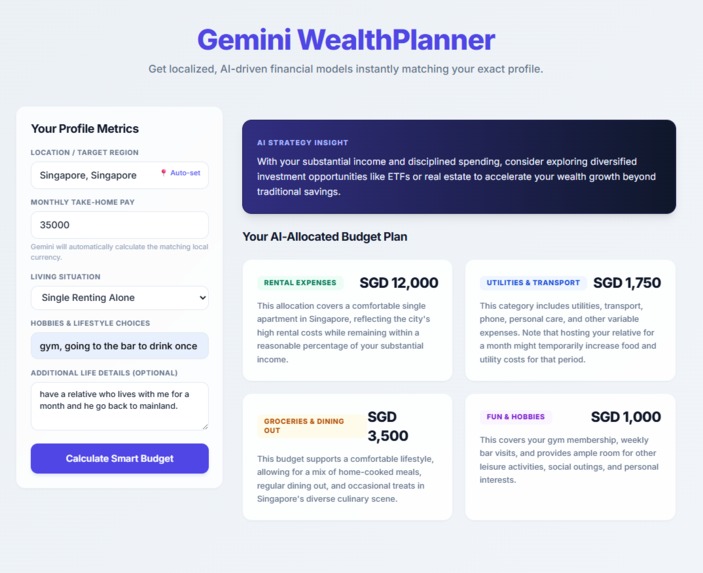
Demonstration of the Panel
💡 Inspiration
Traditional budgeting apps rely on arbitrary, fixed percentages (like the classic 50/30/20 rule) that fail spectacularly in the real world. A single professional renting an apartment in Tokyo faces a completely different baseline economic matrix than a student living in New York or an expat relocating to Singapore. We wanted to eliminate the static spreadsheet entirely. Our inspiration was to build a fluid, context-grounded financial sandbox that acts as an autonomous local advisor—giving users instant, hyper-localized fiscal clarity based on live market realities rather than pre-designed templates.
🌌 What it does
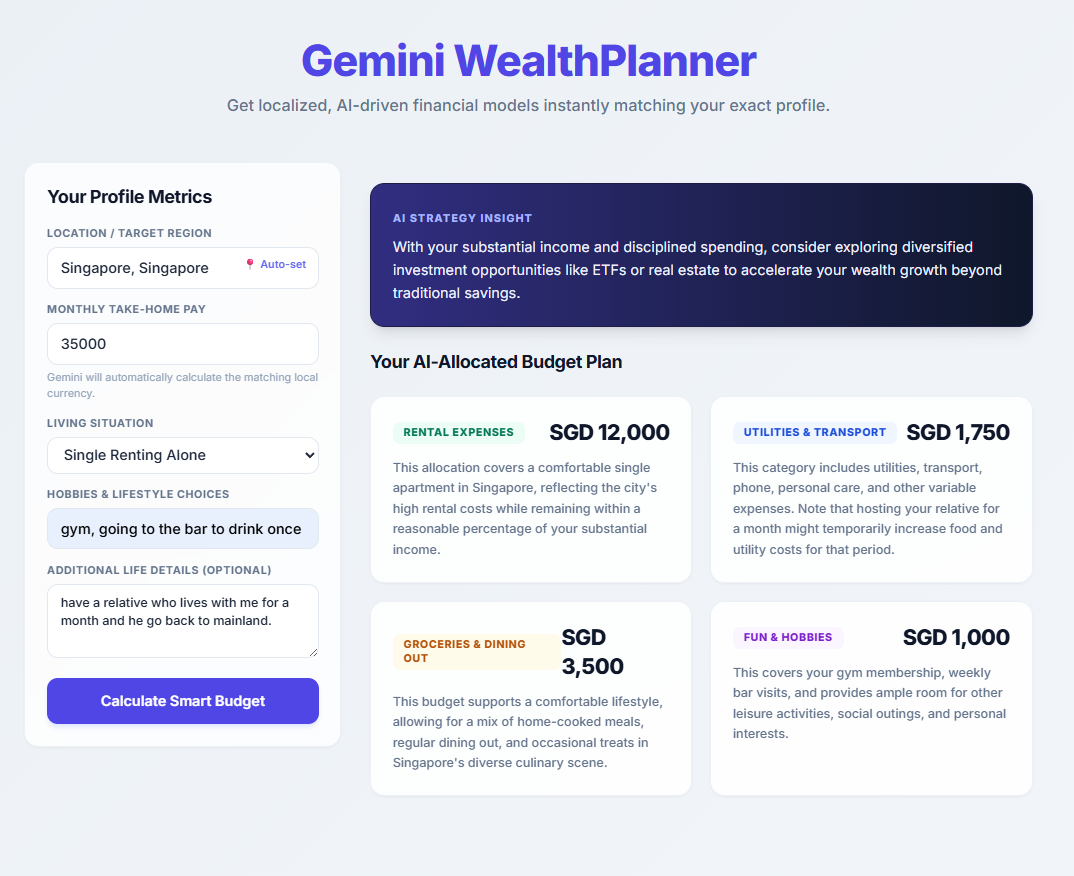
Gemini WealthPlanner acts as a Universal Financial Compiler Engine. Instead of forcing unique personal situations into rigid data blocks, it ingests unstructured user variables—such as location, exact salary parameters, dynamic hobby expenses, and complex domestic living conditions. The system automatically handles network-layer geolocation resolution to establish a regional anchor. It then programmatically queries live web search databases to analyze current regional rent, utilities, and grocery data, synthesizing a tailored, real-time glassmorphic dashboard native to the target region's local currency.
🛠️ How we built it
The platform is engineered using a decoupled, asynchronous multi-layer pipeline:
- The Core Backend: Built using Python's high-performance
FastAPIframework to handle lightning-fast HTTP transactions. - The Intelligence Layer: Implemented via the official Google Gen AI SDK utilizing
gemini-2.5-flash. We leveraged strict Pydantic JSON schemas to convert raw, open-ended context into a reliable flat payload layout that maps directly to the user interface. - The Grounding Loop: Integrated
Serper.devto execute autonomous real-time search queries behind the scenes, scraping live local market cost indices to ground the model's generation logic. - The Fluid Frontend: Developed as a light, premium responsive user workspace featuring pure Tailwind CSS animated gradient keyframes, glassmorphic layout grids, and native JavaScript
Intl.NumberFormatengines for accurate real-time currency formatting.
⚡ Challenges we ran into
One of our biggest hurdles was tackling data environment friction during local testing. Standard cloud geolocation scrapers heavily restrict or block local server endpoints (127.0.0.1), causing sudden API exceptions and dropping the application into manual fallback modes. We solved this by creating an intelligent failover loop that intercepts internal loopback signatures, routes out to independent public network echoes via ip-api.com, and dynamically captures the host's actual public connection point before dispatching to the main data processing engine.
🏆 Accomplishments that we're proud of
We are incredibly proud of building a zero-bias allocation matrix that successfully captures implicit personal nuances. During testing, passing highly specific text constraints—such as a temporary visiting relative moving into a household for a single month—did not fragment the system. Instead, the model intelligently parsed the unstructured statement, identified the short-term utility and grocery inflation requirements, dynamically adjusted the JPY output metrics, and seamlessly delivered localized financial guidance to accommodate the guest.
🎓 What we learned
Building this sandbox gave us deep insight into the power of strict type-validation schemas with large language models. We learned that decoupling semantic reasoning from raw text streams and enforcing a structured data handshake between FastAPI and gemini-2.5-flash eliminates hallucination vectors entirely. It allowed us to use a lightweight, rapid-response model to handle complex mathematical allocations reliably while ensuring the front-end layout never breaks from unexpected data shapes.
🚀 What's next for Gemini WealthPlanner V1
The initial release establishes a powerful context-grounded foundational engine. The next phase involves integrating multi-currency portfolio tracking, expanding the grounding architecture to scrape live regional investment accounts (such as Japan's NISA limits or local pension systems), and building a time-series predictive canvas so users can simulate long-term wealth compounding over a 5 to 10-year horizon directly inside the terminal interface.
Disclaimer: This platform provides automated financial modeling estimations based on public search indexes and is intended purely for organizational and educational purposes; it does not constitute formal, certified financial planning or investment advice.

Log in or sign up for Devpost to join the conversation.