-
-
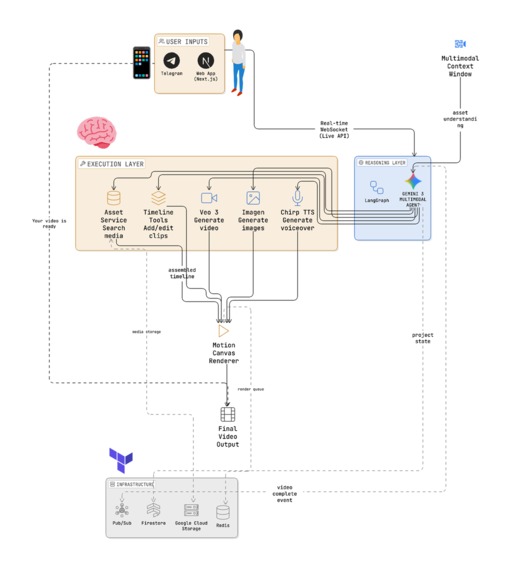
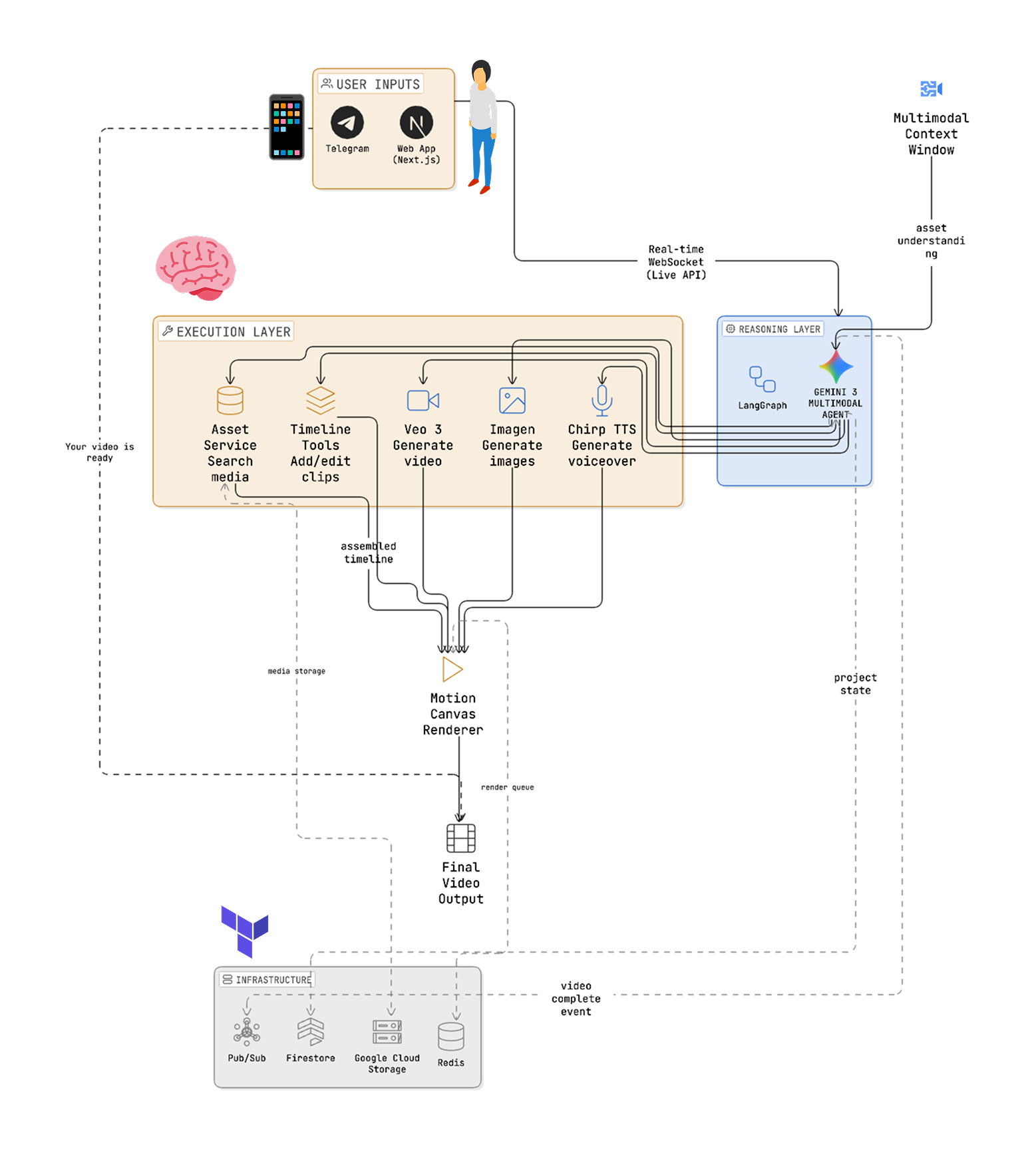
Architecture Diagram
-
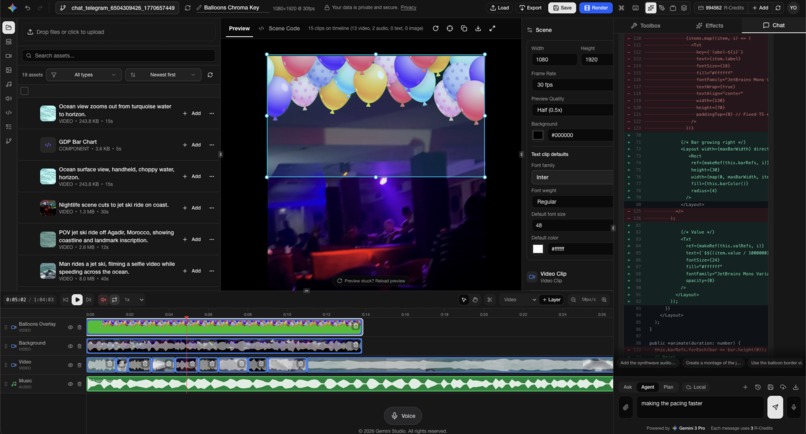
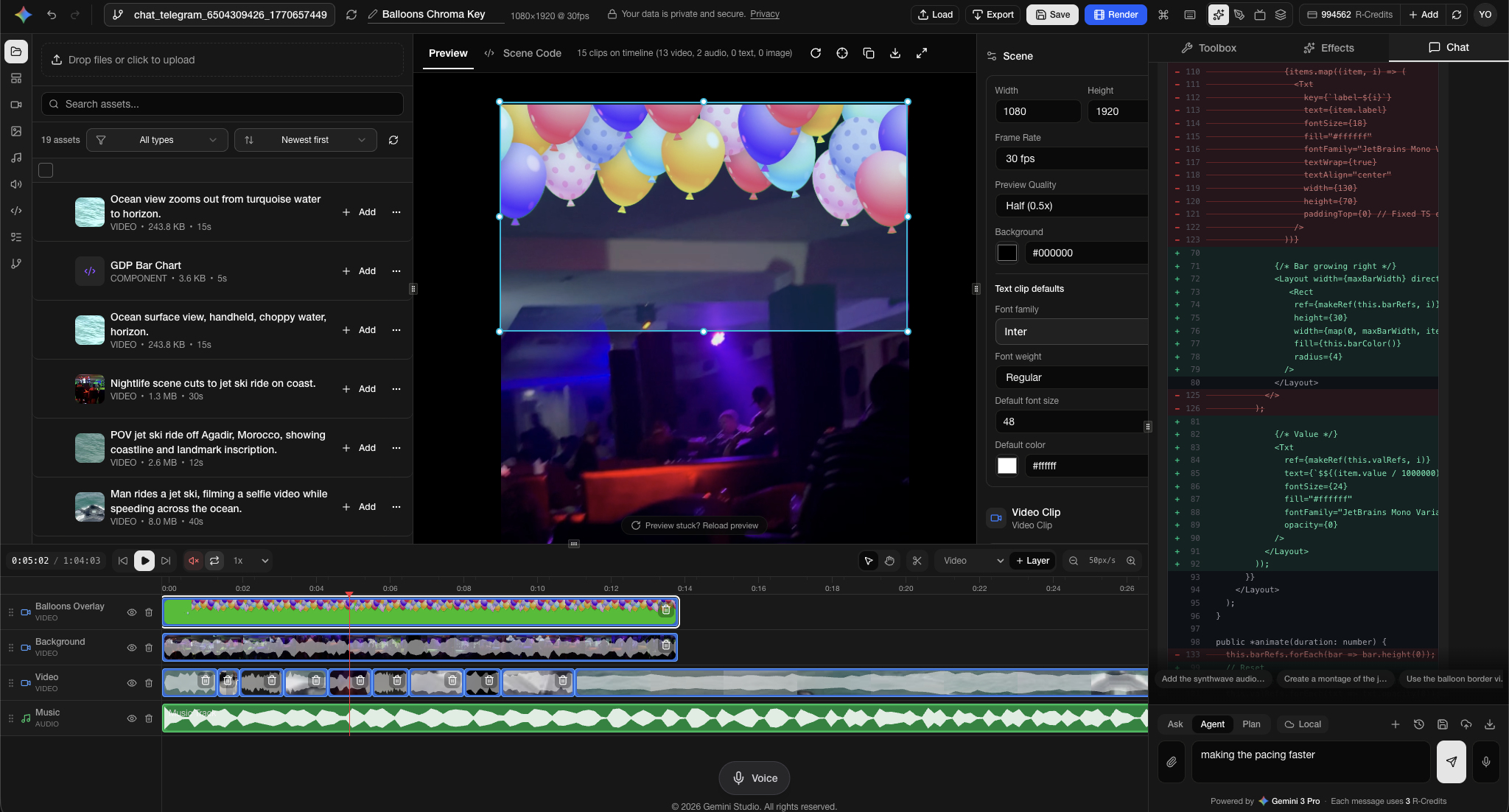
Gemini understands Assets Semantically, Removes Green Screen
-
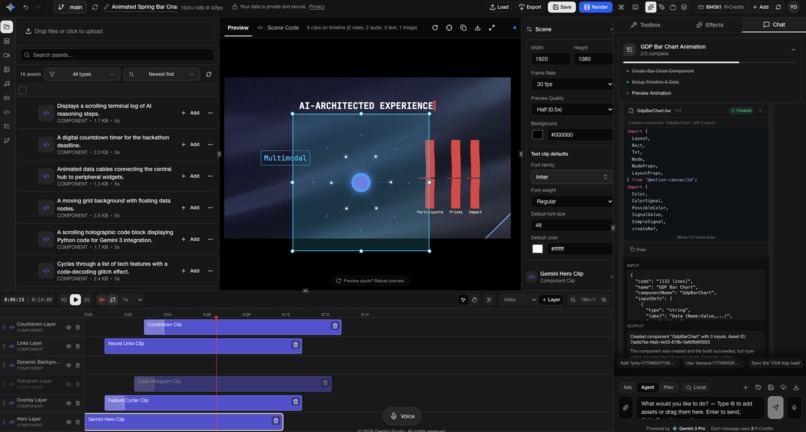
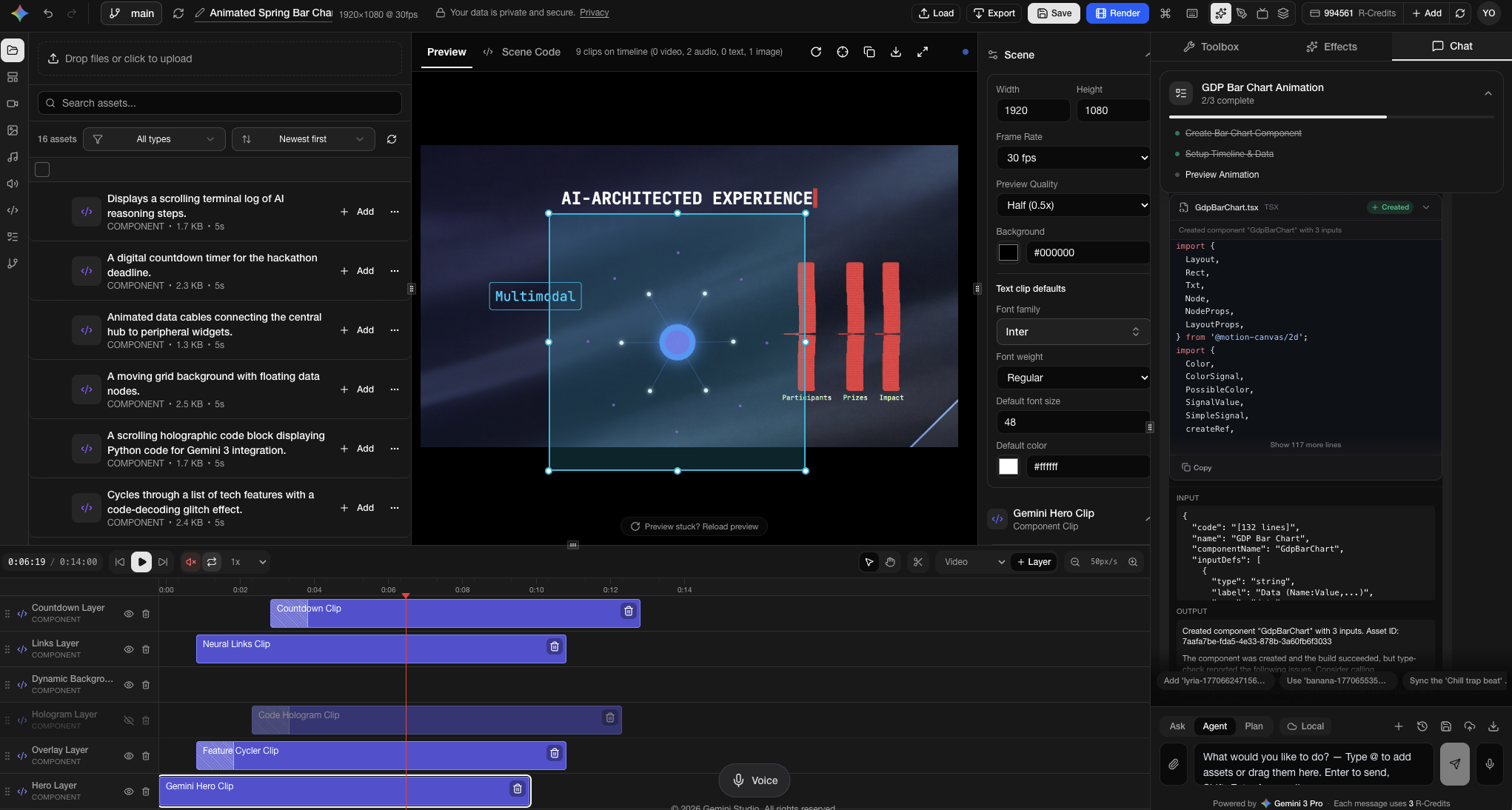
Custom Components on Video
-
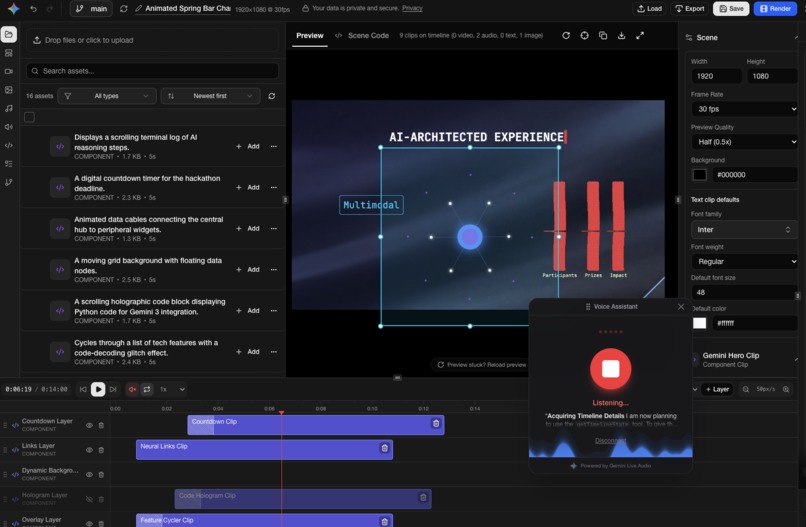
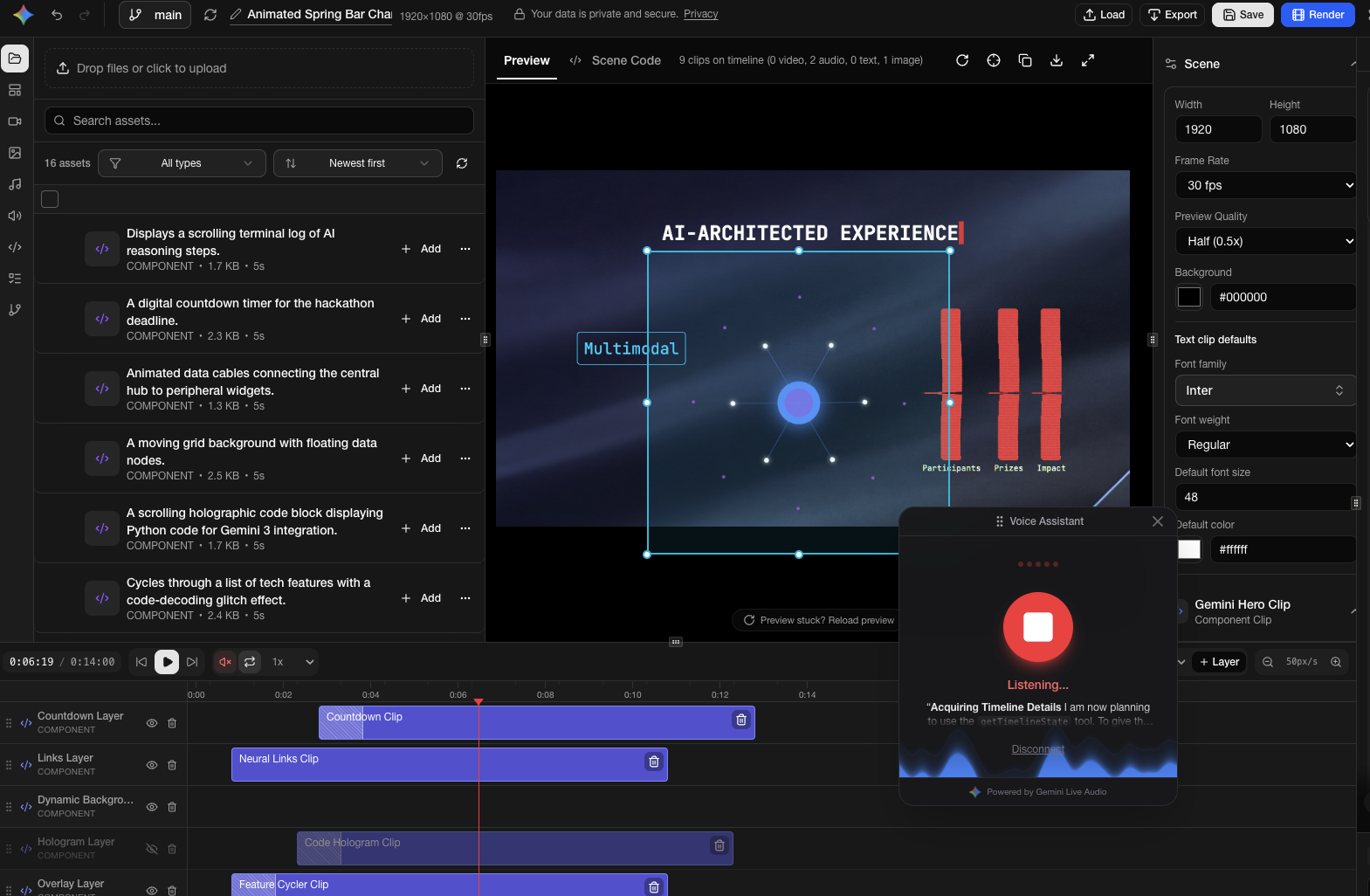
Live Chat API with Function Calls
-
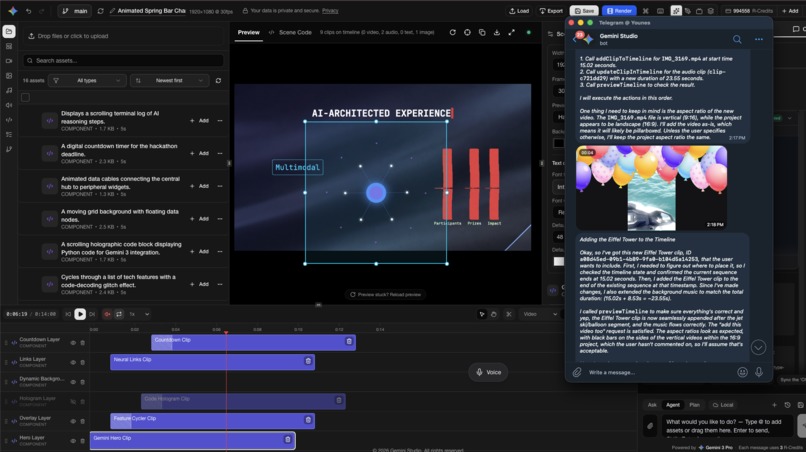
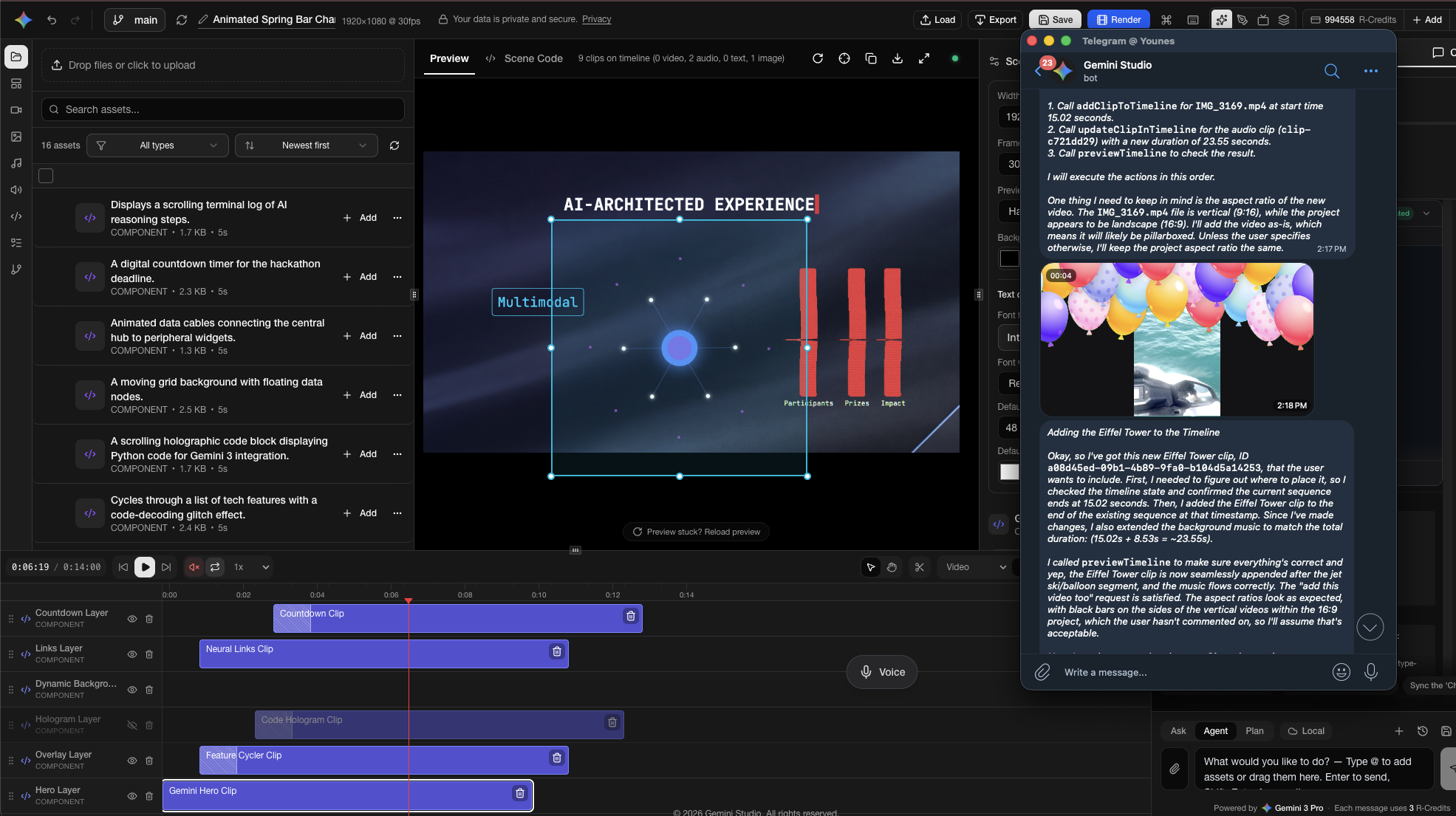
Cloud Agent Continuity on Telegram Integration
-
The Execution Layer for Agentic Video
-
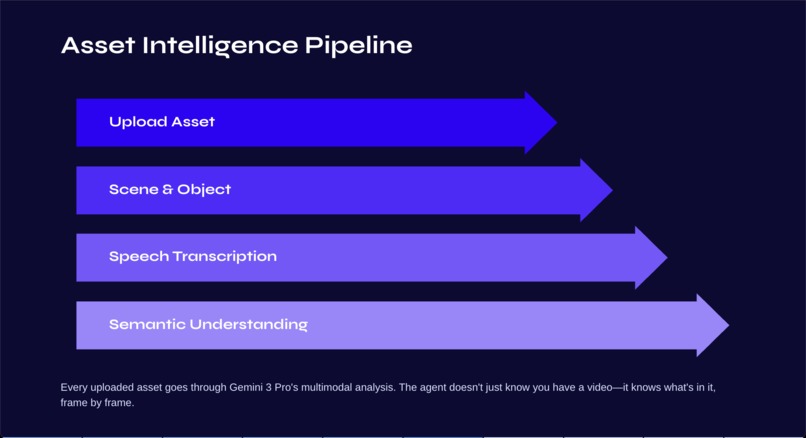
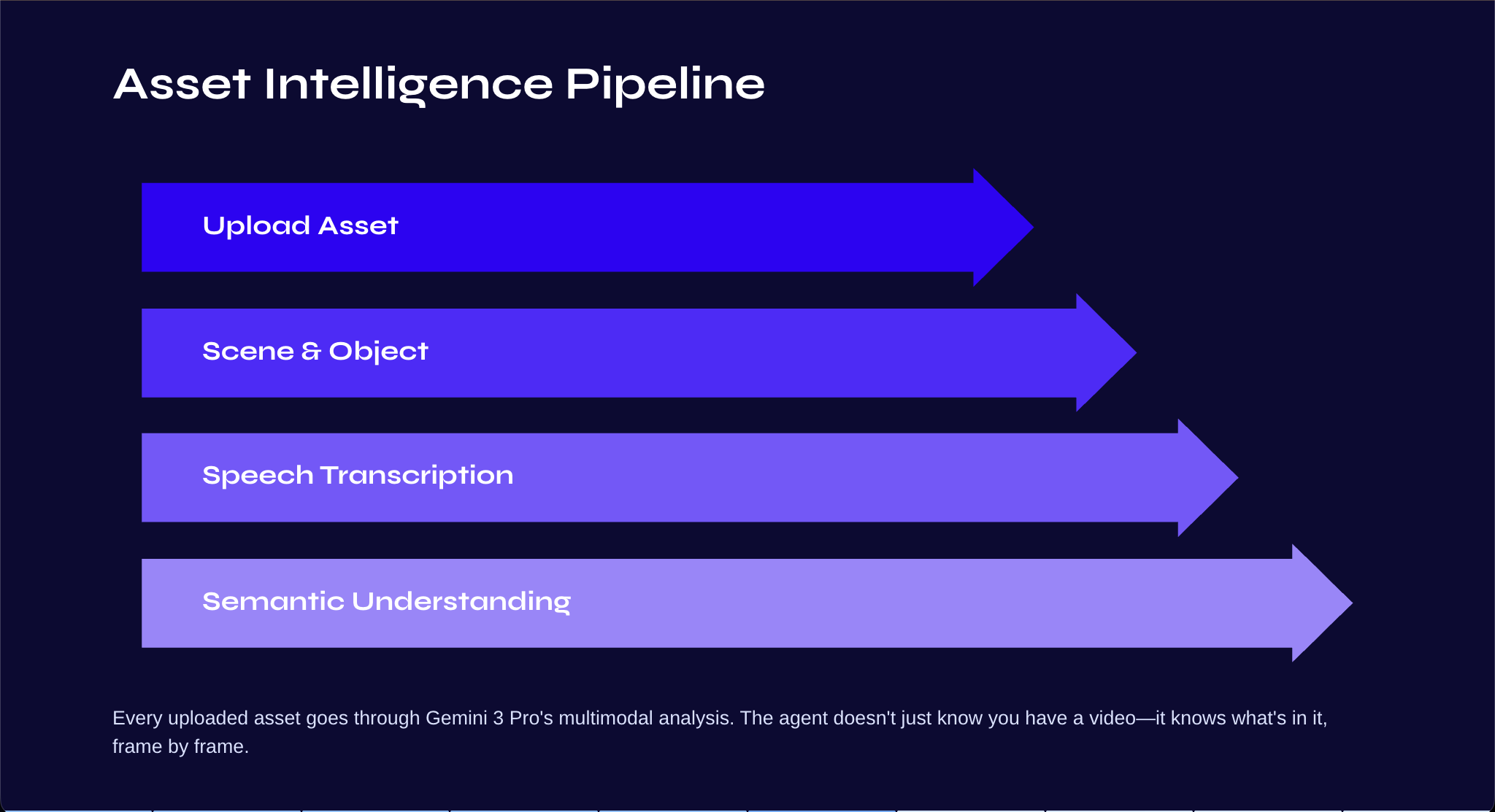
Asset Intelligence Pipeline
-
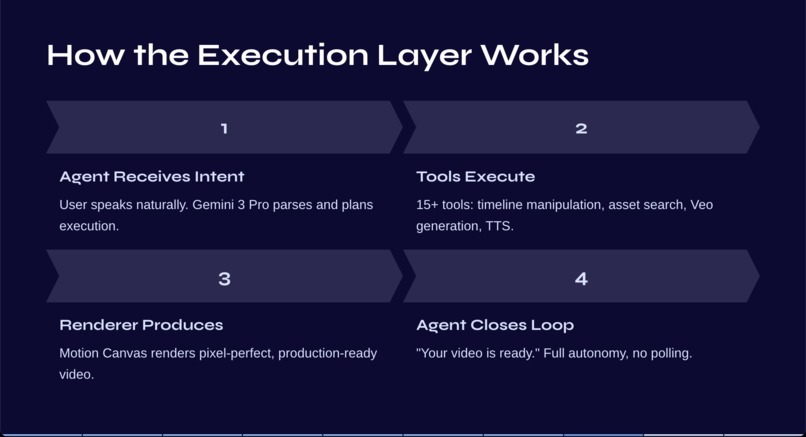
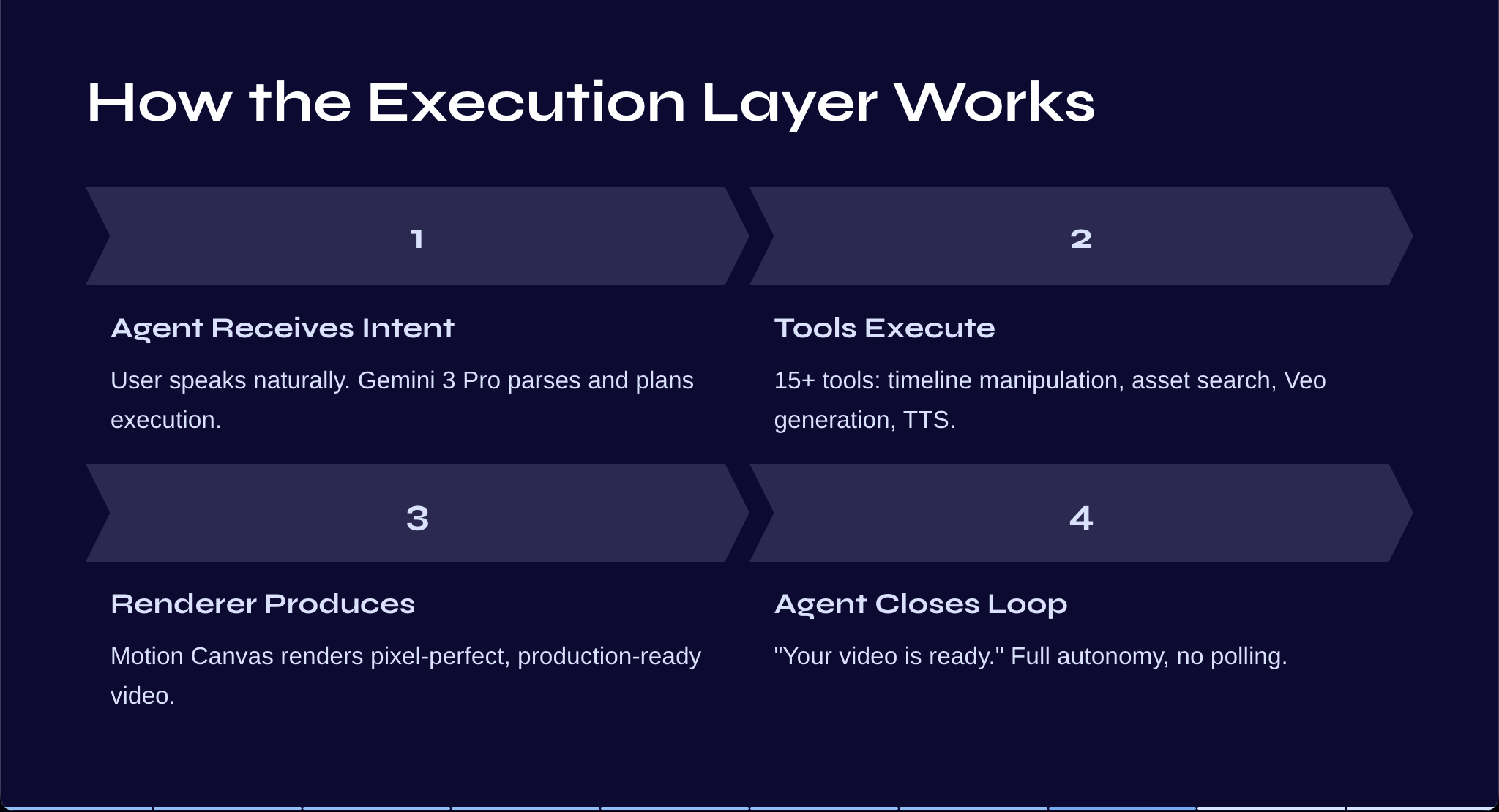
Execution Layer
-
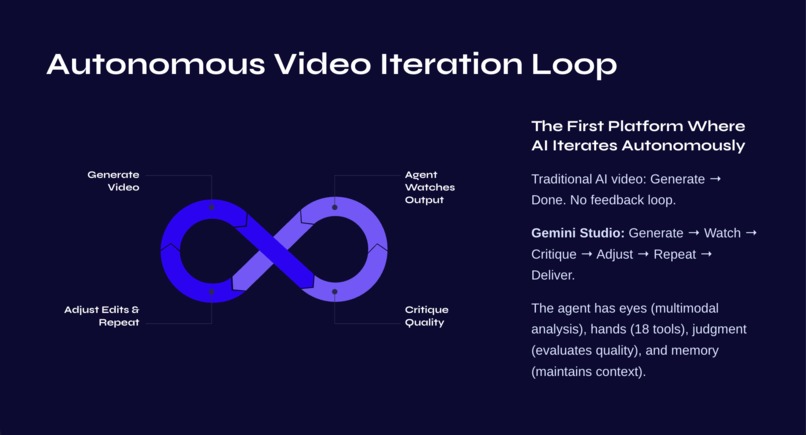
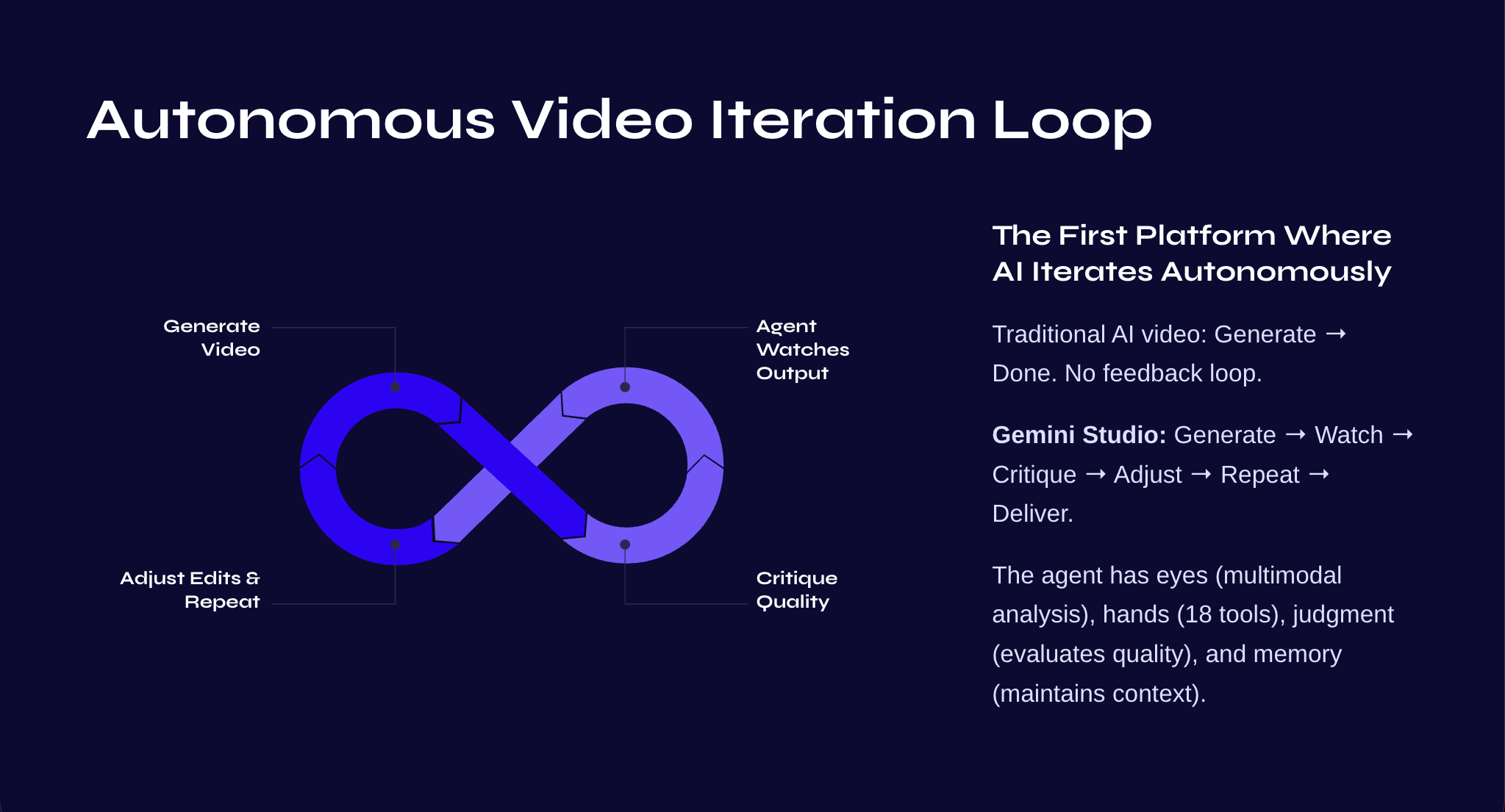
Autonomous Video Iteration Loop
-
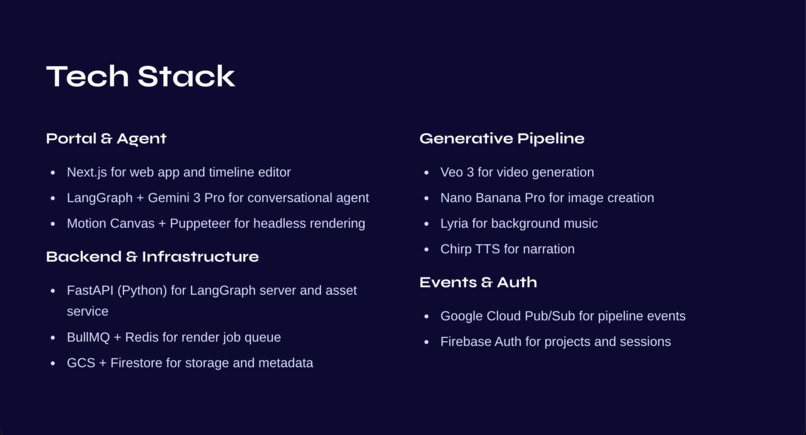
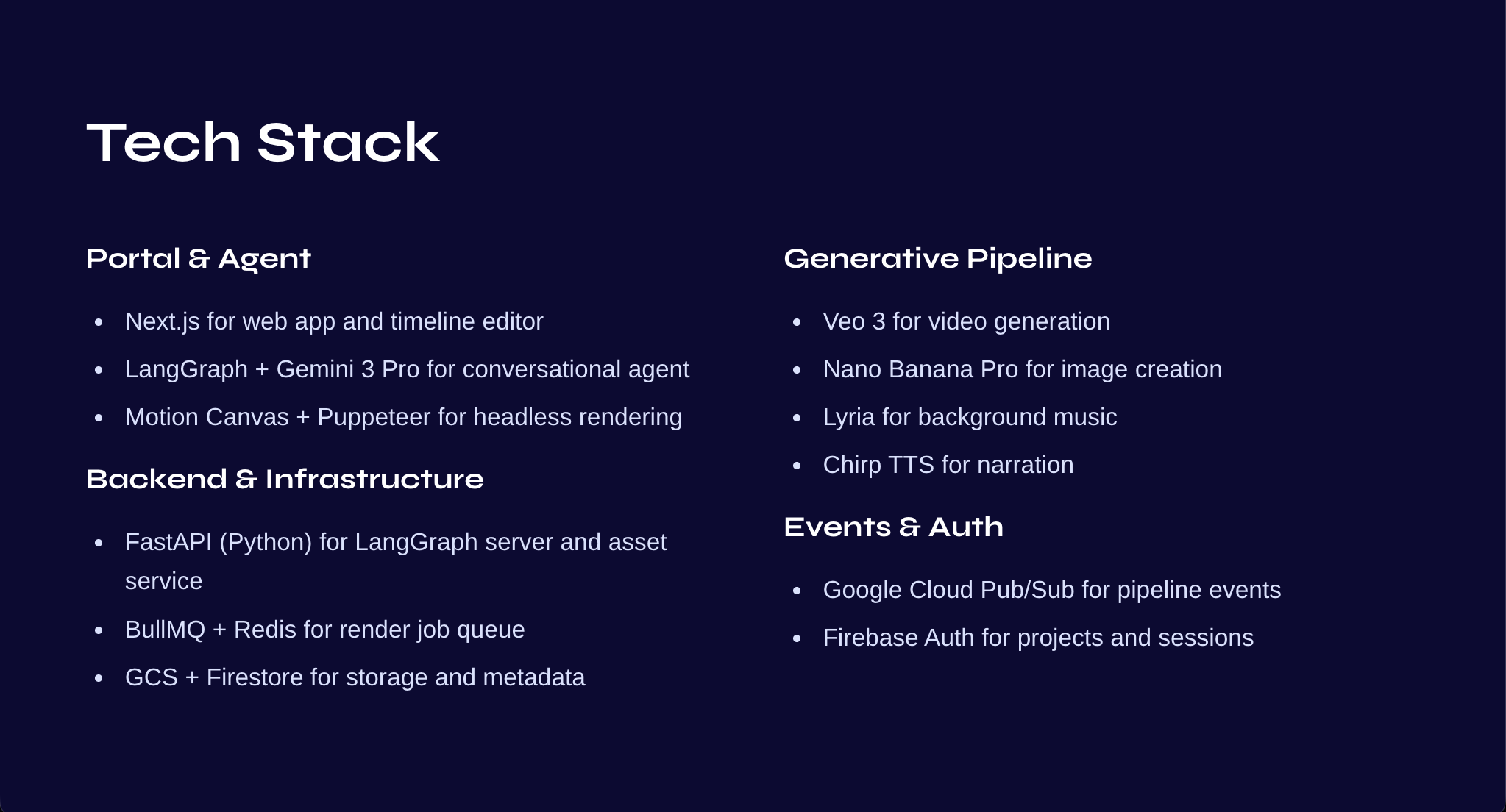
Tech Stack
-
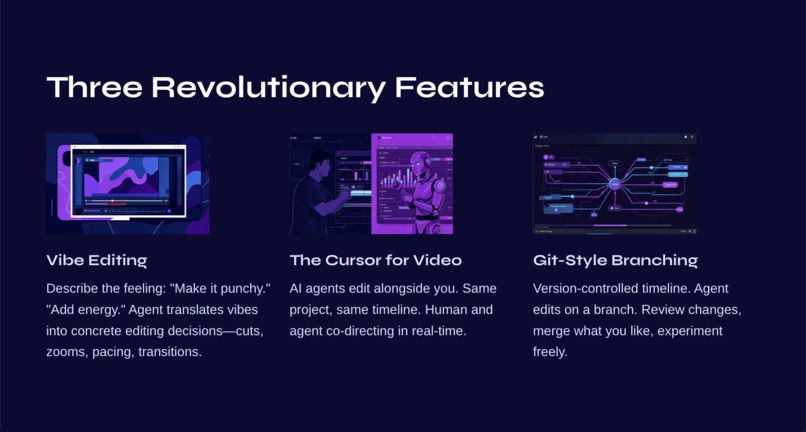
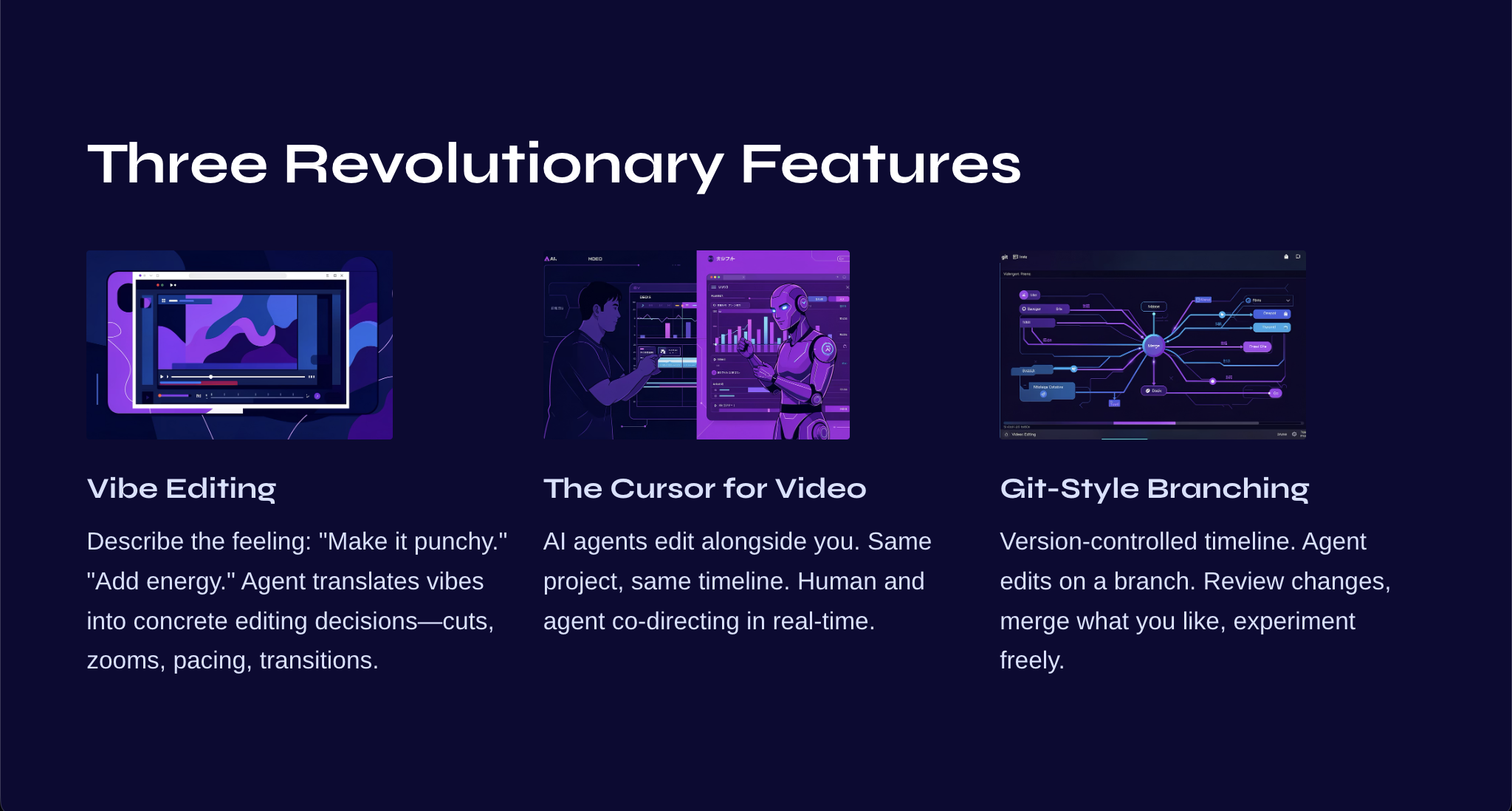
Three Revolutionary Features
✨ Inspiration

Every AI video tool generates pixels. Gemini Studio generates code.
The problem is real and expensive. Research shows that knowledge workers spend 2.5 hours per day (30% of their workday) just searching for information.[^1] For video editors, file organization alone can waste 35% of production time.[^2] Meanwhile, the $191.55 billion creator economy[^3] is bottlenecked by editing complexity—70% of creators spend 10 hours or less per week creating content, meaning efficiency directly determines output.
[^1]: IDC. (2001). "The High Cost of Not Finding Information." https://computhink.com/wp-content/uploads/2015/10/IDC20on20The20High20Cost20Of20Not20Finding20Information.pdf
[^2]: Rev. "Is Your Team Wasting Time Editing Videos?" https://www.rev.com/blog/media-and-entertainment/is-your-team-wasting-time-editing-videos
[^3]: DemandSage. (2025). "41+ Creator Economy Statistics 2026." https://www.demandsage.com/creator-economy-statistics/
The bottleneck in AI video isn't generation—it's programmability. Raw AI clips lack narrative structure, precise timing, and composability. Templates hit a ceiling. UI automation is brittle. Code is the only medium expressive enough to capture the nuance of high-end video production.
Gemini Studio is the execution layer that turns plain-English intent into executable TypeScript—making video production a deterministic, version-controlled, agent-driven workflow.
🧩 The Insight: Code > Pixels

LLMs are better at writing code than they are at clicking buttons.
Gemini Studio is the first video platform where the agent writes Motion Canvas components from scratch. Not templates, not presets, but freeform TypeScript with signals, generators, and a full animation runtime.
| Traditional AI Video | Gemini Studio (Code-First) |
|---|---|
| Black Box | Git-Style Version Control |
| Fixed Templates | Infinite Design Space (Agent writes components) |
| Brittle UI Automation | Deterministic Programmatic API |
| Fire & Forget | Closed Loop (Render → Watch → Iterate) |
This is "Vibe Coding" for Video.
- You say: "Make it punchy."
→ The agent writes code that tightens cuts, speeds up transitions, and adds energy. - You say: "Add a glitch effect on every 5th character."
→ The agent writes a custom generator function to execute that exact logic.
No template can do this. Only code can.
🎬 What It Does
Gemini Studio is the deterministic engine that gives Gemini 3 Pro the hands to program video.
1. Code-First Motion Graphics (The Moat)
The agent doesn't select effects from a dropdown. It compiles real-time TypeScript.
Example workflow:
- User: "Add a progress ring that fills to 75% based on this data."
- Agent: Writes a TypeScript component using
d3-scaleand Motion Canvas signals:
export class DataProgressRing extends Node {
  @signal() declare readonly percentage: SimpleSignal<number>;

  *fillTo(target: number, duration: number) {
    yield* this.percentage(target, duration);
  }

  public constructor(props?: DataProgressRingProps) {
    super({...props});
    this.add(
      <Circle
        startAngle={-90}
        endAngle={() => -90 + (this.percentage() * 3.6)}
        lineWidth={12}
        stroke={'#00ff00'}
      />
    );
  }
}
- Result: Compiles in ~130ms, renders at 30fps, pixel-perfect and data-driven.
2. Semantic Asset Resolution
Stop renaming files DSC_0043.mp4. The agent sees your footage.
- User: "Use the drone shot over the water."
- Gemini 3 Pro: Uses its 1M token context window to ingest hours of raw footage, analyze the visual content frame-by-frame (87.6% on Video-MMMU)[^4], and resolve "drone shot" to the exact Clip ID.
- Result: Natural language mapping to precise media assets. No manual tagging. No filename conventions.
[^4]: Google DeepMind. (2025). "Gemini 3 Pro." https://blog.google/products-and-platforms/products/gemini/gemini-3/
3. Autonomous Iteration (The Real Magic)

The agent watches its own work.
- Agent generates code → compiles → renders video
- Gemini 3 Pro analyzes the output using
media_resolution=high[^5] - Agent identifies issues: "That transition is too slow"
- Locates the code:
yield* circle().scale(2, 0.3) - Adjusts parameters:
0.3→0.15 - Recompiles and validates the fix
[^5]: Google Gemini 3 Pro Docs: https://ai.google.dev/gemini-api/docs/media-resolution
No other platform can do this. The agent has vision (multimodal understanding), hands (30+ tools), and judgment (reasoning). It produces quality output, not just output.
4. Git-Style Branching for Video
Collaborating with an AI agent shouldn't destroy your timeline.
- Branching: The agent forks your timeline to try an idea (e.g.,
feat/faster-pacing) - Review: You preview the render on the website or on the go via cloud agents (which communicate using Telegram Bots)
- Merge: If you like it, you merge the code back to
main. If not, you discard it.
Timeline state is version-controlled code, not opaque UI state.
🛠️ How We Built It (Gemini 3 Native)

Gemini Studio is code-to-video infrastructure. Every layer is designed for programmatic control.
🧠 1. The Brain: Gemini 3 Pro
We leverage the specific strengths of the Gemini 3 architecture:
- Native Video Understanding: The agent ingests 50+ minutes of 4K footage directly into the 1M token context window. It doesn't rely on captions; it watches the video to understand pacing and vibe.
thinking_level=high: Used for complex narrative planning and component architecturethinking_level=low: Used for rapid timeline edits and simple operationsmedia_resolution=high: Used during the QA phase, where the agent watches its own render to spot issues
⚡ 2. The Compiler: Custom esbuild Pipeline
Video iteration needs to be fast. We built a custom compilation engine:
- <130ms Hot Reload: We replaced Vite (3.5s compile) with a custom esbuild pipeline—25× faster
- LRU Cache: Repeated compiles with identical inputs return in 0ms
- Error Correction Loop: If the agent writes invalid code, the compiler captures the stack trace and feeds it back to Gemini 3 Pro, which self-corrects and recompiles
🎨 3. The Renderer: Headless Motion Canvas
- Deterministic: The same code produces the exact same frame, every time
- Headless: Runs in cloud-based Puppeteer instances (distributed via BullMQ/Redis)
- Production-ready: Agent-written TypeScript produces broadcast-quality video
📐 4. Component Plugins: Beyond Static Shapes
The agent can generate data-driven visualizations using first-class libraries:
- d3-geo, d3-shape, d3-scale, d3-hierarchy: Animated maps, charts, graphs
- simplex-noise: Procedural backgrounds, organic motion
- chroma-js: Color scales, accessible palettes
Example: "Animate a bar chart from this CSV" → Agent writes d3-scale + Motion Canvas code that maps data to pixel positions.
😤 Challenges We Overcame
Vision → Code → Vision Loop: The hardest part was closing the loop. We had to teach Gemini 3 Pro to watch a video, identify a pacing issue (Vision), translate that into a
yield* waitFor(0.2)adjustment (Code), and validate the fix. This required extensive prompt engineering utilizing Gemini 3's multimodal reasoning.Multimodal Code Generation: Teaching Gemini 3 Pro to translate what it sees in video into executable Motion Canvas code. We built schemas that map visual concepts (pacing, composition, motion) to TypeScript primitives (signals, tweens, generators).
Deterministic Rendering: LLMs can be unpredictable. We built a validation layer that "lints" the agent's code before it hits the renderer, ensuring it adheres to the Motion Canvas API. Compiler errors feed back to the agent for self-correction.
Production Economics: Building a credits system that accurately tracks compute costs across rendering (Puppeteer instances), compilation (esbuild workers), Gemini API calls, and generative media (Veo/Imagen/Lyria).
🏆 Accomplishments
First Programmable Video Engine for LLMs: We proved that agents can write professional-grade video animation code from scratch—complete Motion Canvas components with signals, generators, and custom logic.
Autonomous Self-Correction: The agent can watch its own output using Gemini 3 Pro's native video understanding (87.6% Video-MMMU), critique it ("text is too small"), locate the relevant code, and fix it without human intervention.
Native 1M Token Context Usage: Successfully ingesting 50+ minutes of raw 4K footage, allowing for "Chat with your Footage" editing. The agent remembers specific visual details across an entire project.
Natural Language Asset Resolution: Users say "use the drone shot over the water" and Gemini 3 Pro's multimodal reasoning resolves which clip and which frame—no filenames, no manual tagging.
25× Compilation Speed: esbuild-based compiler (130ms vs. 3.5s) enabled true "vibe coding" for video—describe it, see it, adjust, repeat.
Production Infrastructure Built: Not just a demo. Full billing system, distributed rendering, CI/CD pipeline, enterprise security. Ready to launch.
🧠 What We Learned
Code is the right abstraction for AI-driven video.
LLMs are trained on code. They're excellent at writing TypeScript. But what makes Gemini Studio possible is Gemini 3 Pro's multimodal reasoning:
- Sees footage natively (video understanding, 1M token context)
- Writes code that references what it saw (natural language → visual understanding → executable TypeScript)
- Watches its own renders (analyzes output video at high resolution)
- Closes the loop (vision → code adjustment → improved output)
This unlocked:
- Determinism: Same code → same output
- Version control: Timeline state is diffable, branchable, mergeable
- Iteration: Agent can read its own code, understand it, and adjust it
- Infinite expressiveness: No template ceiling
- Semantic asset control: Agent references footage by content, not filename
The insight that will reshape the industry: Generative video should produce code informed by vision, not just pixels.
📊 Market Opportunity
The video editing software market was valued at $2.29 billion in 2024, projected to reach $3.73 billion by 2033.[^6] Yet 95% of tools still rely on manual timeline manipulation—a paradigm unchanged since the 1990s.
[^6]: Straits Research. (2025). "Video Editing Software Market Size & Outlook, 2025-2033." https://straitsresearch.com/report/video-editing-software-market/
McKinsey research shows generative AI could automate 60-70% of work activities,[^7] with 57% of U.S. work hours already automatable with existing technology. Our platform makes video production programmable and automatable at scale.
[^7]: McKinsey Global Institute. (2023). "The Economic Potential of Generative AI." https://www.mckinsey.com/capabilities/mckinsey-digital/our-insights/the-economic-potential-of-generative-ai-the-next-productivity-frontier
What we enable:
| Current Workflow | With Gemini Studio | Time Saved |
|---|---|---|
| Manual asset search: 2.5 hrs/day | Semantic resolution: instant | ~99% |
| Applying effects: 1-2 hours | Agent writes components: 2-5 min | ~95% |
| Iterating on pacing: 2-4 hours | Autonomous loop: 15-30 min | ~85% |
🔮 What's Next
- Beta launch with 100 hand-selected creators
- Component Marketplace MVP: Agents can publish generated components (e.g., "GlitchText", "DataBar") to npm—other agents import and reuse them
- Code-to-Video API: Public REST API—developers send text prompts, get back programmable video
🎯 Investment Opportunity

What we're building: The execution layer that makes AI agents capable of professional video production at scale. Market: $3.73B video editing software + $191.55B creator economy.
Business Model
- Freemium: Free tier → $19-29/mo Pro → $99-199/mo Enterprise.
- Pay-per-video: $5-15 per rendered video.
- API: Usage-based pricing ($0.10/min + Gemini API costs).
- Marketplace: 30% platform fee on component sales.
Why Open Source? (The Moat)
We use an Open Core strategy (like GitLab, MongoDB, or Elastic).
- Network Effects: By opening the engine, we encourage developers to build components.
- Marketplace Lock-in: We take 30% of every component sale in our marketplace.
- Cloud Revenue: Most teams will choose our managed cloud platform over self-hosting DevOps complexity.
The Ask
We are seeking partnership with Google's AI Futures Fund to scale from beta (100 users) to market leader (100K+ users) in 18 months.
Built by Younes Laaroussi
Try it Live: https://www.geminivideo.studio/
Repo: https://github.com/youneslaaroussi/geministudio
Note for judges: There's a link internally in the submission with a token that auto-adds 100k credits for testing purposes, please use that instead.
Built With
- bullmq
- fastapi
- firebase
- gemini-3-pro-api
- google-cloud
- langgraph
- lyria
- motion-canvas
- nano-banana-pro
- next.js
- redis
- veo-3


Log in or sign up for Devpost to join the conversation.