Inspiration
Traditional project management tools are "dumb" repositories. They tell you what needs to be done, but they don't understand how to do it or how a single sick leave cascades through a complex timeline. We were inspired to build Gemini PM: The Autonomous Scrum Master to move from "Task Tracking" to "Logistics Reasoning." We wanted a tool that doesn't just store a schedule but mathematically and logically fights to save it when reality hits.
What it does
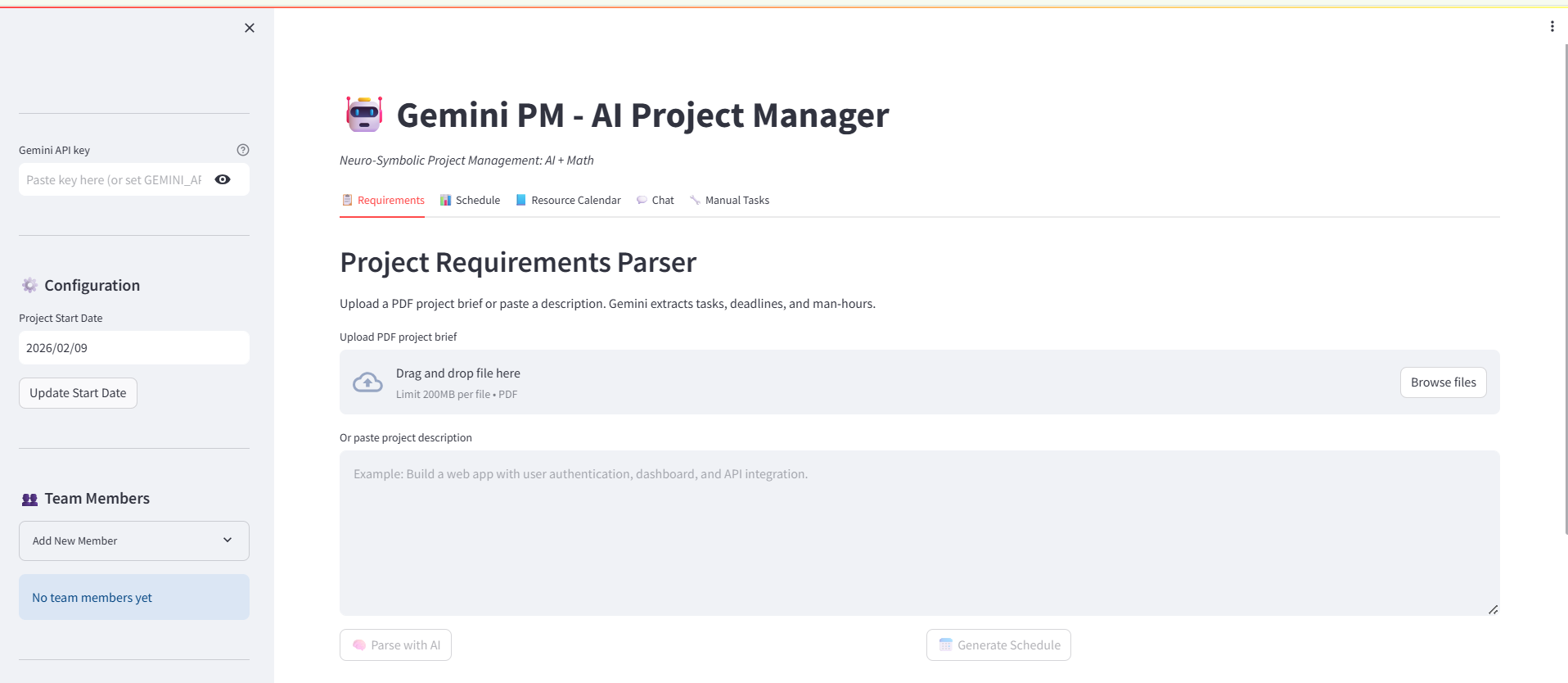
Gemini PM leverages the native Deep Reasoning of the Gemini 3 API to solve the "three-body problem" of project management: balancing shifting requirements, limited resources, and fixed deadlines.
Key Gemini 3 Features Used: Dynamic Thinking Levels: We utilize thinking_level: high for initial project intake. Gemini 3 analyzes raw requirement docs (PDF/Images) to extract tech stacks and features, automatically assigning complexity-based man-hour estimates.
Stateful Thought Signatures: To maintain a consistent "train of thought" during complex re-scheduling, we pass Thought Signatures back into the conversation. This ensures that when a user adds a requirement, the AI remembers previous resource constraints (like a dev's vacation) without "reasoning drift."
1M+ Token Context Window: We drop the entire project history, dependency maps, and resource logs into a single context window. This allows the agent to reason across the whole timeline to find optimization gaps that traditional algorithms miss.
Native Code Execution: When a timeline becomes over-allocated, Gemini 3 writes and executes Python scripts internally to simulate various "what-if" scenarios, returning the most mathematically feasible schedule.
How we built it
We built the frontend using Streamlit for rapid prototyping and interactive data visualization. The backend is a Python-based agentic loop that communicates with the Gemini 3 Pro model. We used Plotly to render dynamic Gantt charts that update in real-time as Gemini 3 modifies the underlying project JSON state. The application is deployed on Hugging Face Spaces for easy, public accessibility.
Challenges we ran into
The biggest challenge was "The Ripple Effect"—ensuring that a 2-hour delay in a backend task correctly shifted the 15 dependent frontend tasks without violating the final deadline. We solved this by moving from simple prompting to a Structured Output (JSON) workflow, where Gemini 3 acts as a state machine.
Accomplishments that we're proud of
We successfully built an AI that can "read the room." It doesn't just move tasks; it provides PM Insights. For example, it can proactively suggest: "You are 20% behind; I recommend cutting the 'Dark Mode' feature to ensure the 'Core API' is ready for the client demo."
What we learned
We learned that Gemini 3 is uniquely capable of "vibe coding" and logic reasoning. By setting the thinking_level parameter, we could balance the "speed" needed for chat and the "deep thought" needed for complex mathematical scheduling.
What's next for Gemini PM: The Autonomous Scrum Master
We plan to integrate Google Search Grounding so the AI can look up real-time industry benchmarks for task complexity. We also want to implement Agentic Vision so users can simply upload a photo of a whiteboard session and have it instantly converted into a functional, resource-balanced project plan.
Built With
- gemini-api
- hugging-face
- plotly-express
- python
- streamlit

Log in or sign up for Devpost to join the conversation.