-
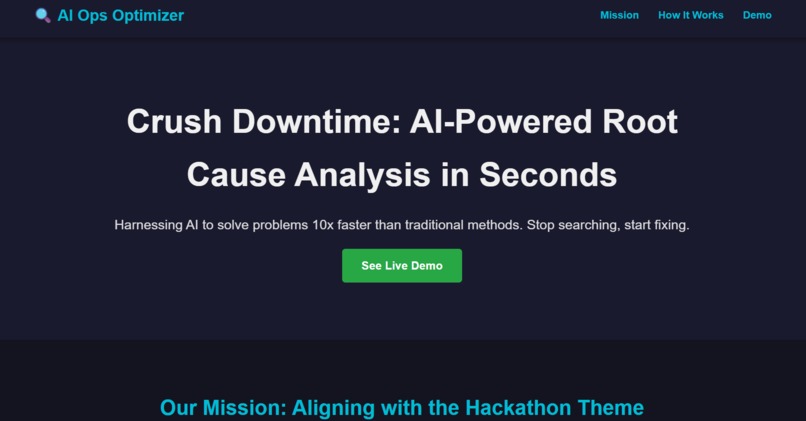
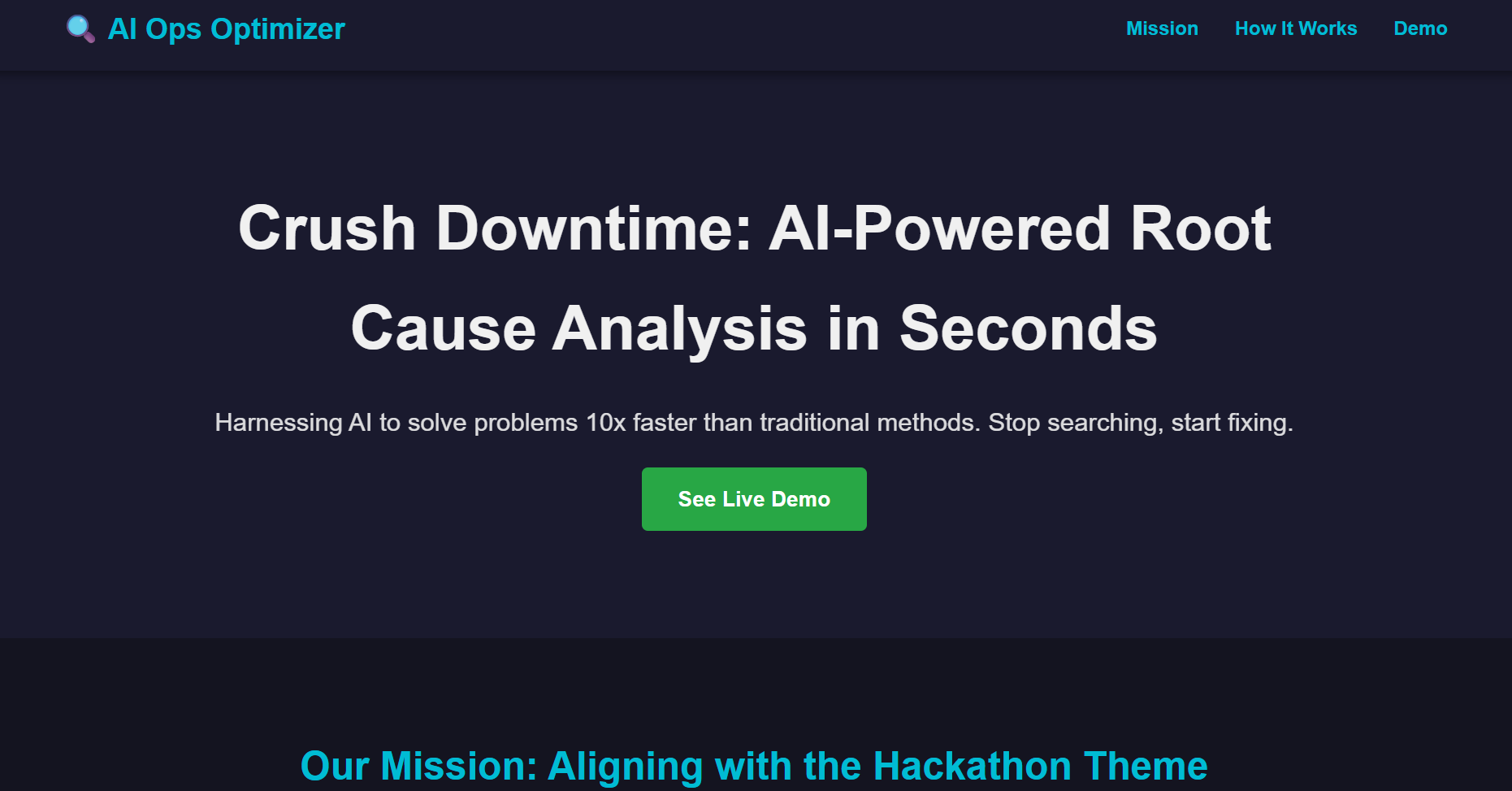
front view
-
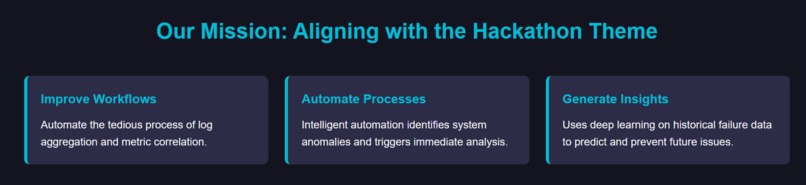
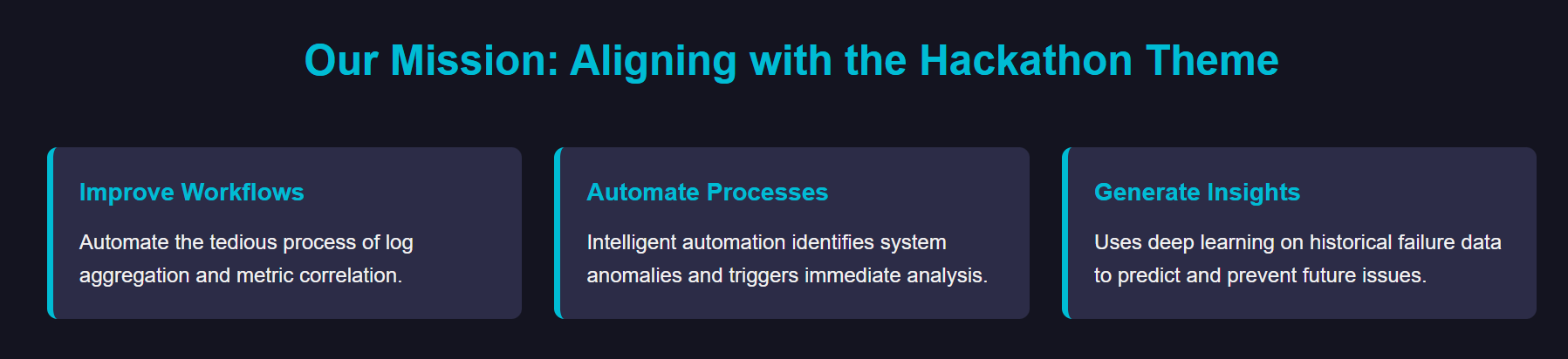
OUR MISSION
-
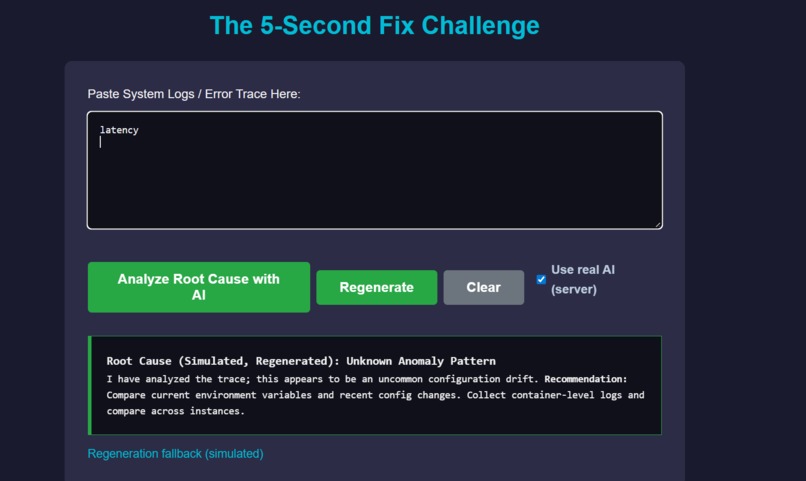
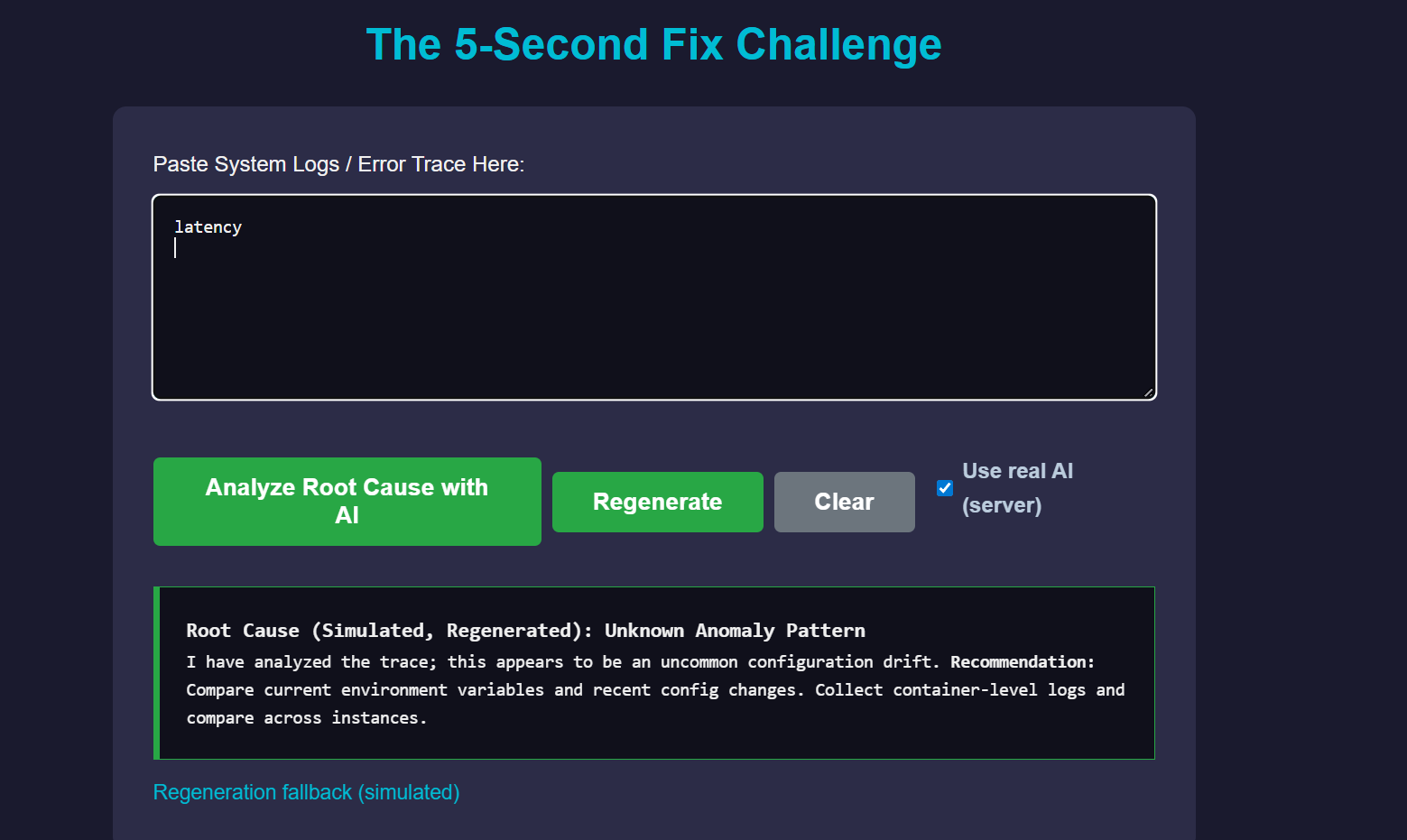
5-Second Fix Challenge
Inspiration
Presentation & Demo Inspiration The difference between a good hackathon project and a winning one is often the narrative and the demo.
The Clock: In your demo section, show a countdown clock that starts when the user hits "Analyze" (or when a simulated alert comes in). Dramatize the speed: "Root Cause Found in 4.1 seconds!"
The Before/After: Show a screen recording or diagram of the "Before" (engineer scrolling endlessly through log files) vs. the "After" (the clean, immediate solution provided by the AI).
Confidence Score: In the analysisMeta section, instead of always showing 99.8%, let the confidence score vary based on the input. If the input is clear, show 95%+. If the input is vague, show 70% and follow up with a clarification prompt.
Example: "Confidence: 72% - Require more data on database connection pool configuration."
What it does
Core Functionality
- Data Ingestion and Contextualization
- Root Cause Analysis (RCA)
- Actionable Solution Generation
How we built it
- Frontend: The User Experience (UI)
- Backend: The Secure AI Gateway
- AI Core: The Intelligence Engine
Challenges we ran into
- Challenge: Achieving AI Precision and Reliability
- Challenge: Security and Front-end Architecture
- Challenge: Handling Diverse and Large Data
Accomplishments that we're proud of
- Crushing MTTR with AI Precision Achievement: We successfully reduced the time required for Root Cause Analysis (RCA) from potentially hours of manual searching down to under five seconds in our demo.
Why it Matters: This isn't just a time saving; it's a dramatic reduction in Mean Time To Resolution (MTTR). By providing an immediate, actionable diagnosis, we proved the concept of moving from reactive log-sifting to proactive, AI-driven fixing.
- Building a Secure and Robust Architecture Achievement: We implemented a secure, professional architecture that prevents the exposure of our critical assets.
Why it Matters: We didn't take the shortcut of putting the API key in the front-end. We built a robust system using a Node.js backend proxy to securely handle the Gemini API key and enforce a clean separation of concerns. This demonstrates production-readiness and a strong understanding of modern web security principles.
- Engineering Deterministic AI Output (JSON Contract) Achievement: We mastered prompt engineering to force the powerful but unpredictable LLM into becoming a reliable engineering tool, delivering structured data.
Why it Matters: We ensured the AI wasn't just generating long, conversational text. By forcing the output into a strict JSON format (with clear fields for root_cause_summary, recommended_solution, and severity), we guaranteed the front-end could reliably parse and display the information, making the AI's output structured, reliable, and immediately consumable by the end-user
What we learned
- Mastering the SRE Mindset and Persona Engineering We learned that simply using an LLM is not enough; you must teach it to think like an expert.
The Lesson: We gained deep experience in persona-driven prompt engineering, moving from asking general questions to giving the Gemini model a specific, high-level role: "You are an expert Level 3 SRE who only provides actionable, structured analysis."
The Skill: We learned how to use the model's instruction-following capabilities to ensure our output was not just creative, but deterministic and reliable, which is essential for any production engineering tool.
- The Criticality of Secure Backend Design We solidified our understanding of cloud security boundaries in AI-powered web applications.
The Lesson: For any real-world AI tool, the API key is the single most valuable secret and must never touch the front-end. This reinforced the necessity of the backend proxy pattern.
The Skill: We gained practical experience quickly spinning up a secure Node.js/Express server solely to manage and protect sensitive API credentials and handle the asynchronous communication with the AI service.
- Efficiency Through Structured Data Contracts We proved that a clear data contract between front-end and back-end is vital, especially when the back-end is an LLM.
The Lesson: Relying on the LLM to output simple text blocks would have led to brittle code and frequent parsing failures. By agreeing on a strict JSON output schema (root_cause_summary, recommended_solution), we made the front-end development incredibly stable and fast.
The Skill: This process taught us how to design and enforce robust data contracts within a system where one of the core components (the AI) is inherently flexible and variable.
What's next for gemini hackthon
- Technical Deep Dive: Multimodal Analysis
- Product Readiness: Streaming & Tooling


Log in or sign up for Devpost to join the conversation.