📖 Project Story
About the Project
Gemini Bug Hunter was born out of a simple but uncomfortable realization:
most developers care about security, but most security tools don’t care about developers.
Traditional AppSec tools are often noisy, complex, expensive, or detached from daily development workflows. They overwhelm developers with false positives, cryptic warnings, and long reports that rarely explain why something matters or how to fix it effectively. As a result, security becomes something developers avoid instead of embrace.
The idea behind Gemini Bug Hunter was to flip that dynamic.
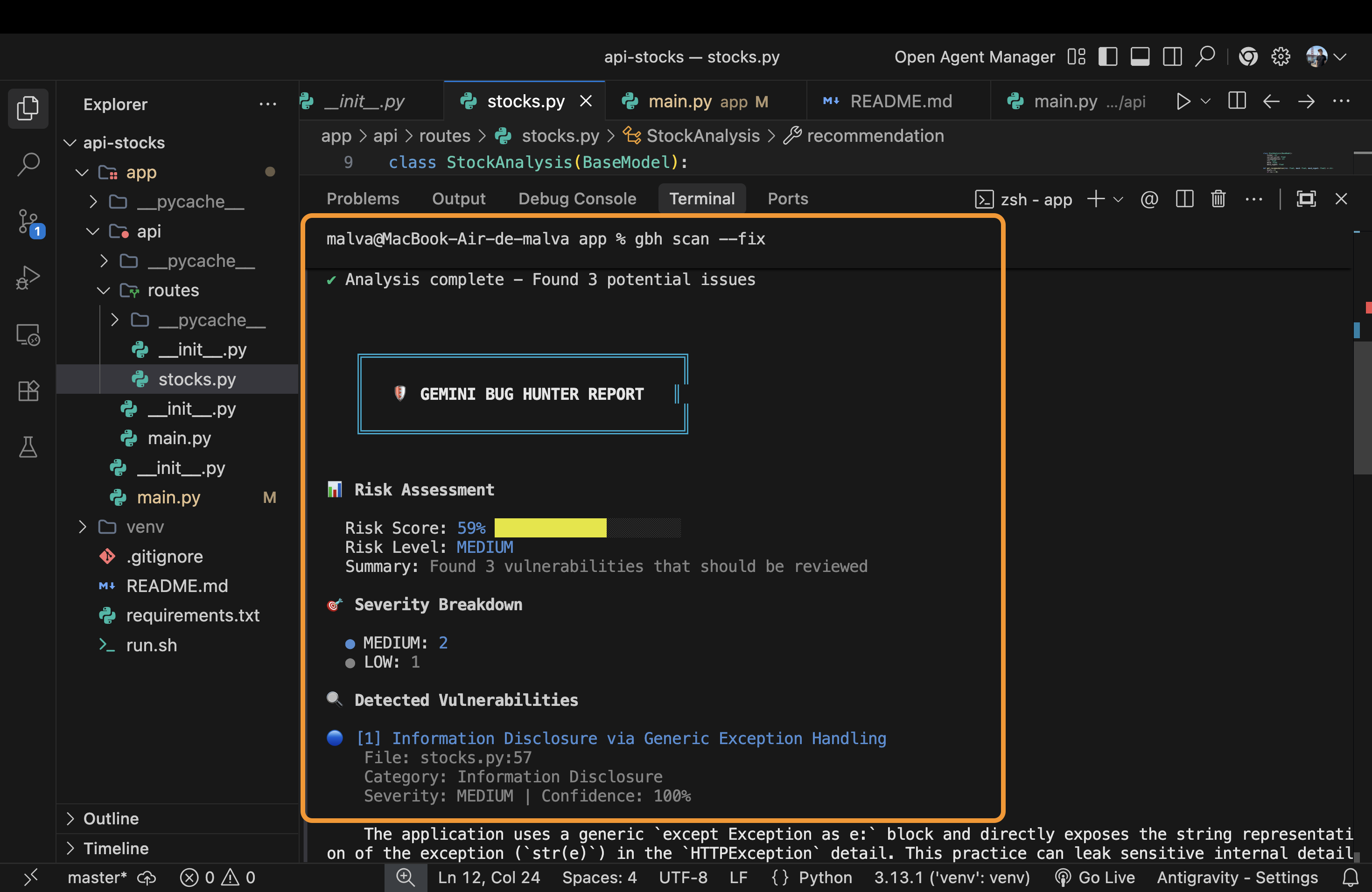
Instead of building another static analyzer, I wanted to create a developer-first security companion—a CLI tool that feels like having a senior ethical hacker sitting next to you in your terminal. A tool that doesn’t just detect vulnerabilities, but thinks, explains, and guides.
💡 Inspiration
The inspiration came from three worlds colliding:
- Modern AI-native developer tools like Gemini CLI and Claude Code
- Real-world application security workflows used by ethical hackers and AppSec teams
- Personal experience seeing how security is often treated as an afterthought due to poor tooling and bad DX
I asked myself:
What if security tools explained risks the way a human expert would?
What if fixes were suggested in context, with real reasoning behind them?
That question became the foundation of Gemini Bug Hunter.
🧠 What I Learned
Building this project taught me several important lessons:
- AI is most powerful when it augments reasoning, not replaces it
- Developers trust tools that are clear, honest, and deterministic
- Security explanations matter just as much as detection accuracy
- Good prompts are a form of software architecture
I also gained a deeper appreciation for structured AI outputs, prompt contracts, and how critical it is to design systems where AI responses are predictable and machine-parseable.
🛠️ How the Project Was Built
Gemini Bug Hunter is a Node.js-based CLI where Gemini 3 API acts as the core intelligence engine.
At a high level, the workflow looks like this:
[ \text{Source Code} \rightarrow \text{Sanitization} \rightarrow \text{Prompted Analysis} \rightarrow \text{Structured JSON Output} \rightarrow \text{Risk Scoring + Fixes} ]
The system:
- Collects and sanitizes source code
- Chunks it intelligently to preserve context
- Sends structured prompts to Gemini 3
- Receives deterministic JSON responses
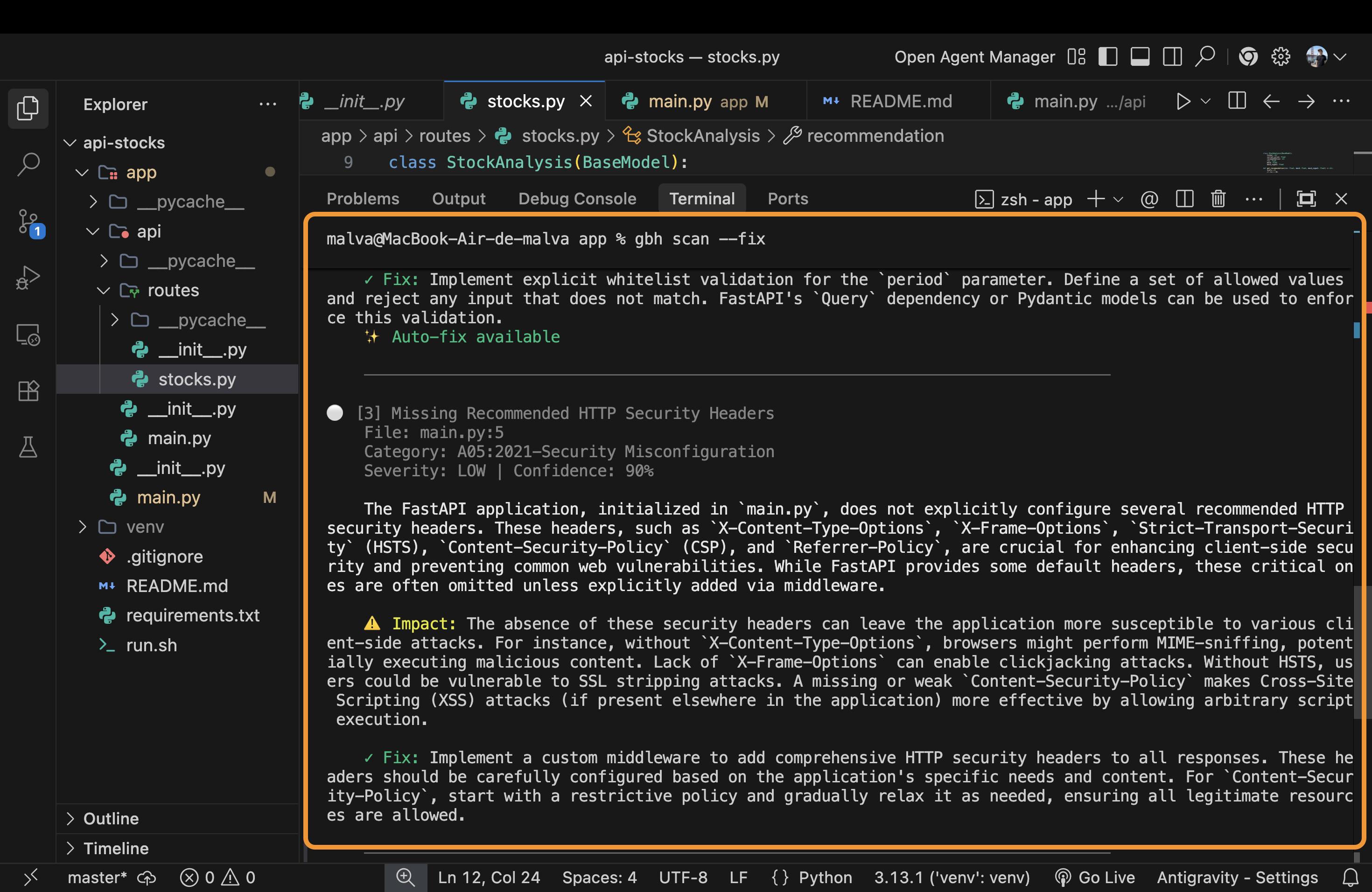
- Generates human-readable reports
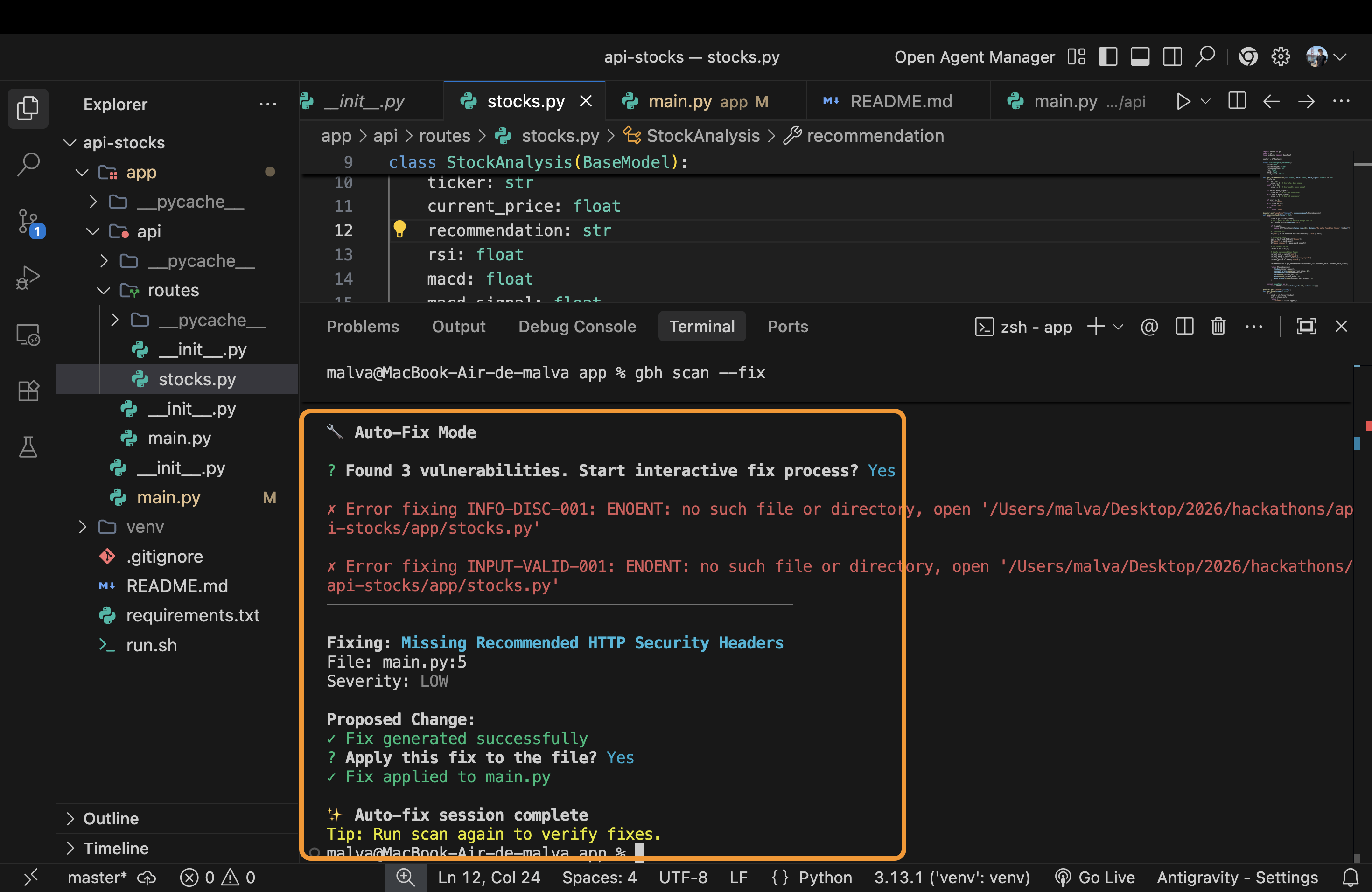
- Offers safe auto-fixes when possible
Security logic is driven by prompt engineering, not brittle heuristics. This allows the tool to reason about vulnerabilities the way a real security engineer would—considering exploitability, impact, and context.
⚠️ Challenges Faced
The biggest challenges were not technical—they were conceptual:
- Designing prompts that minimize hallucinations
- Ensuring vulnerability detection is accurate, not speculative
- Balancing AI flexibility with deterministic outputs
- Handling privacy and security when sending code to an external model
- Making security feel helpful instead of scary
Another challenge was resisting feature bloat. The goal was not to build everything, but to build the right things with clarity and intention.
🚀 Final Thoughts
Gemini Bug Hunter is an experiment in AI-first security tooling—a belief that security tools can be both powerful and friendly, intelligent and trustworthy.
Ultimately, this project is about lowering the barrier to secure software.
If developers understand risks clearly and can fix them confidently, security stops being a blocker and starts becoming a habit.
That’s the future Gemini Bug Hunter is aiming for.

Log in or sign up for Devpost to join the conversation.