Inspiration Large language models often feel like black boxes. We see the final answer, but not the reasoning, tradeoffs, or alternatives that led to it. Gemini Arena was inspired by the idea that understanding how an AI reasons can be more valuable than the answer itself. We wanted to turn Gemini’s reasoning process into something observable, interactive, and even competitive.
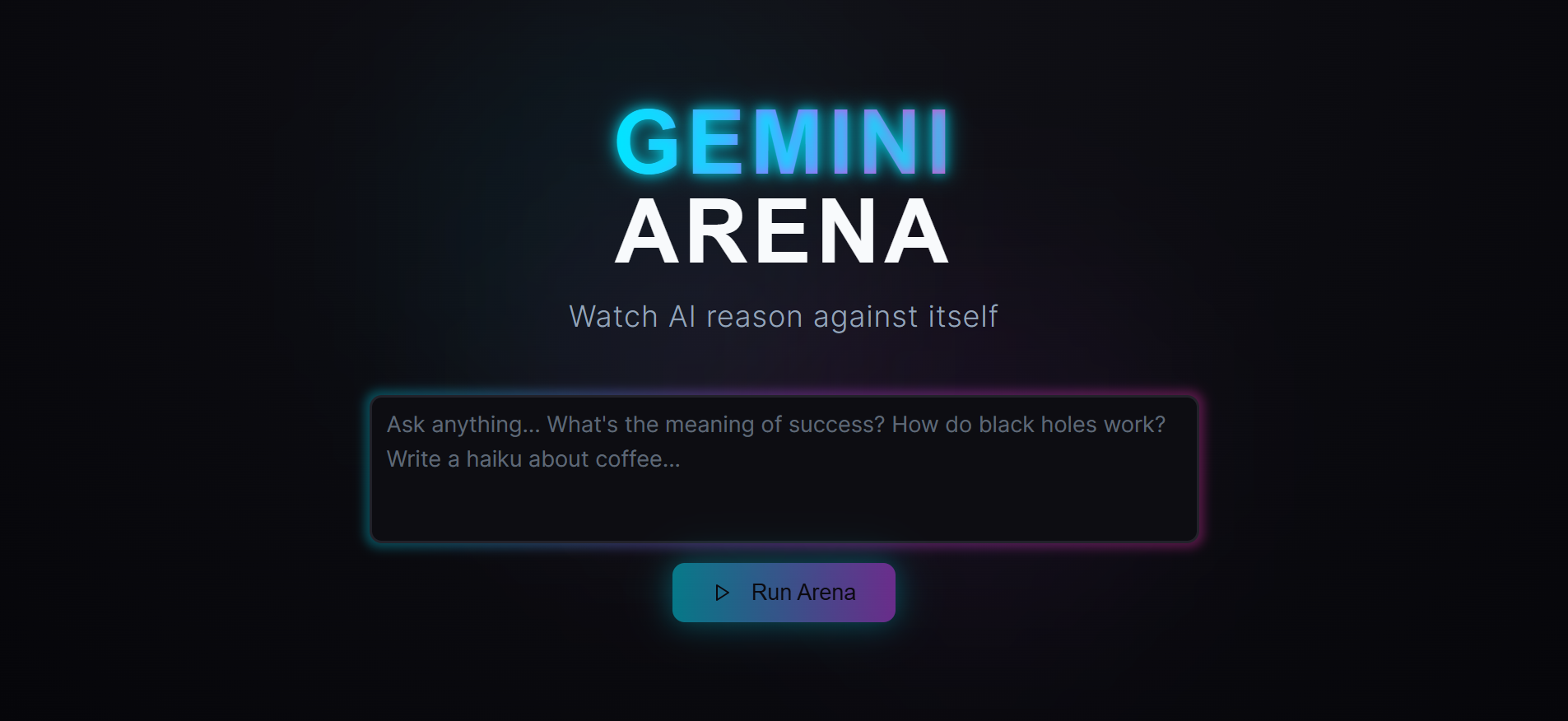
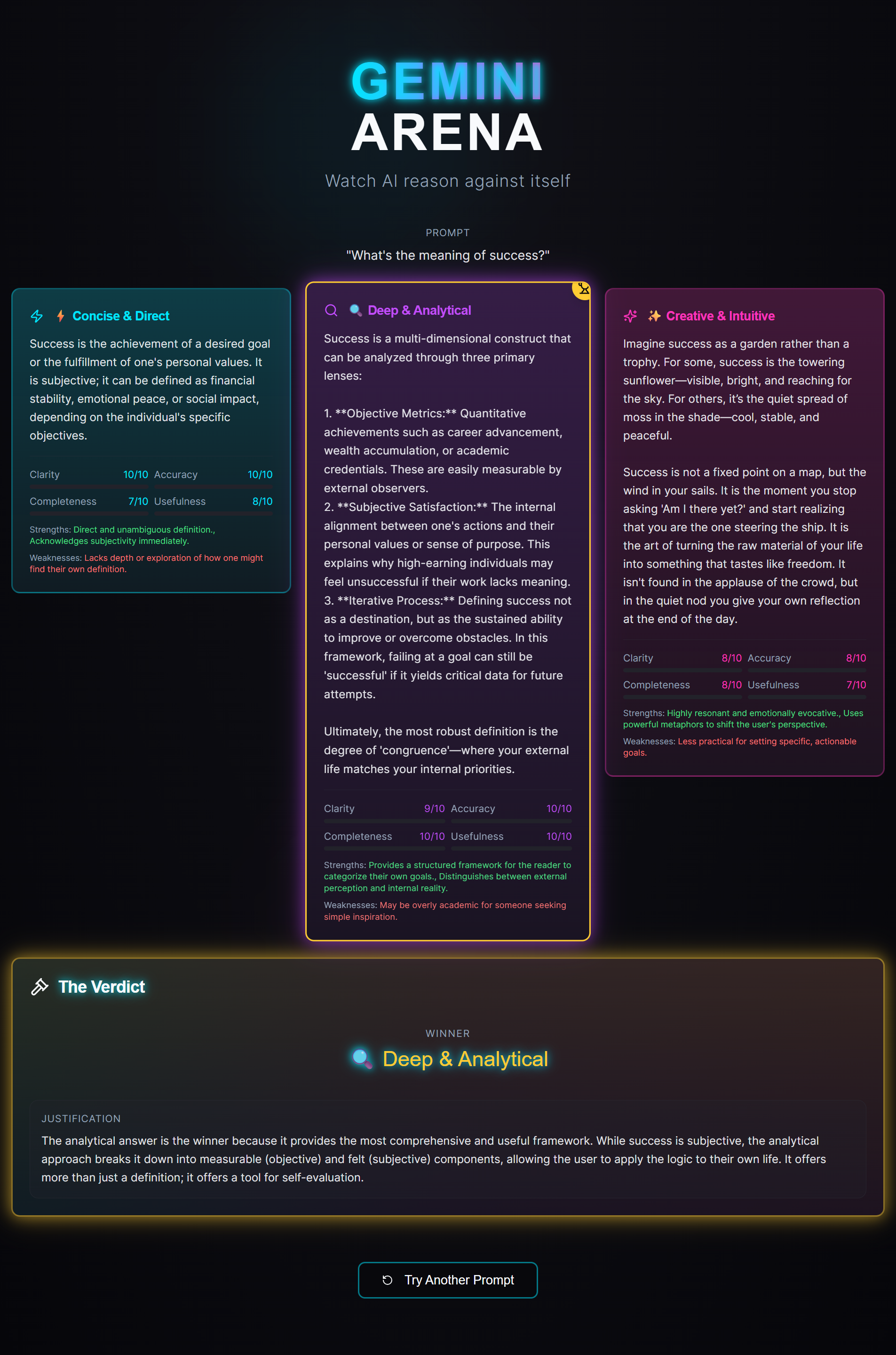
What it does Gemini Arena is a reasoning arena where multiple AI strategies compete against each other on the same prompt. A user submits a task, question, or challenge, and Gemini generates three distinct answers using different approaches such as concise, analytical, and creative reasoning.
After generating the answers, Gemini evaluates them across clarity, accuracy, completeness, and usefulness, explains the strengths and weaknesses of each, and declares a winner. Users can immediately try new prompts to see how different reasoning styles perform.
How we built it The project was built as a web application using Lovable for rapid development and Google Gemini as the core reasoning engine. Gemini is used in a structured, multi-stage prompt that first generates multiple distinct solutions and then switches roles to evaluate and judge those solutions.
The frontend is designed to make reasoning visible. Each answer is clearly separated, and the judgment section explains the decision process transparently. The app is fully stateless, fast to reload, and optimized for repeated experimentation.
Challenges we ran into One major challenge was preventing the answers from converging into similar outputs. This required careful prompt constraints to enforce genuinely different reasoning strategies. Another challenge was ensuring the judging phase remained consistent and fair rather than vague or self-contradictory.
We also had to balance depth with speed so users could quickly experiment without long waiting times.
Accomplishments that we're proud of We are proud of creating an experience where Gemini’s reasoning is exposed rather than hidden. The arena format makes AI behavior easier to understand and compare, and the self-judging mechanism demonstrates Gemini’s ability to reason about its own outputs in a structured and transparent way.
What we learned We learned that large language models can act as both problem solvers and evaluators when guided with the right structure. We also learned that constraining roles and evaluation criteria is essential for producing meaningful comparisons rather than generic responses.
What's next for Gemini Arena Future improvements include adding new arena modes such as debates, optimization challenges, and collaborative tasks, as well as allowing users to customize evaluation criteria. We also plan to experiment with visualizing score breakdowns and tracking how different strategies perform over time.


Log in or sign up for Devpost to join the conversation.