Inspiration
Monday morning, a billing alert. Something has been running since Friday. The engineer on call already knows what to delete. That was never the hard part.
The hard part is blast radius. Deleting the wrong resource at 9am costs more than the bill does. So the ticket gets parked, the resource stays up, and the same alert fires next month. Anyone who has held a pager knows this loop.
This is not only our experience. The FinOps Foundation's practitioner work puts getting engineers to act on cost recommendations at the top of the field's challenges, named by around 40% of respondents, ahead of finding the waste in the first place; the reason given is that engineers lack the confidence to delete a resource nobody owns. Meanwhile Flexera's State of the Cloud reporting has enterprises wasting on the order of 30% of cloud spend. So the industry does not have a detection problem. It has an acting problem, and that is the one we went after.
Every agent aimed at this problem lands on the same answer: never let the agent act. It drafts, a human approves, a human clicks. That does not fix anything. It just leaves the person as the one who has to be brave before coffee.
We wanted to work on the actual question. Not "how do we make the agent more confident," but "how does an agent earn the right to act, and how fast can we take that right away when it stops being correct."
The name comes from Geminga, a gamma ray pulsar with no counterpart at any other wavelength. In Milanese it reads gh'è minga, meaning "it's not there." The whole system is built on that instinct. A thing reported is not a thing confirmed.
What it does
Geminga cleans up cloud waste. It stops idle VMs, deletes unattached disks, releases reserved static IPs, clears stale snapshots, and downsizes over provisioned instances. The interesting part is that it earns the authority to do each of those, one operation class at a time.
Autonomy here is not a flag you set at design time. It is a budget, measured, and continuously re-earned.
| Rung | What it does |
|---|---|
| Shadow | Rehearses against virtualised tools. Predicted delta recorded. Nothing is committed. |
| Provisional | Commits for real. Every single run is verified. One failure demotes it. |
| Live | Commits for real. Sampled verification, never zero, because a rung nobody watches cannot fall. |
A class climbs on evidence: k consecutive runs where a verifier that re-derives real environment state agrees with the prediction. One disagreement drops it a rung and resets the streak. The ratchet turns both ways, permanently.
Three design decisions make this more than a confidence score.
Trust is scoped to the shape of the work, not to the tool. Authority earned deleting scratch buckets does not carry over to production ones. An argument shape nobody has rehearsed goes back to shadow regardless of what the class has earned. This is least privilege applied to experience rather than to identity.
Irreversibility is not a confidence level. Deleting a disk sits behind a human at every rung, forever. The ladder governs doubt. It does not govern consequence. Those are different axes and collapsing them is how you get an outage.
The model never writes its own success criteria. It names an operation and a target. Post conditions come from the domain spec. Anything that grades its own homework passes every time.
What it runs on
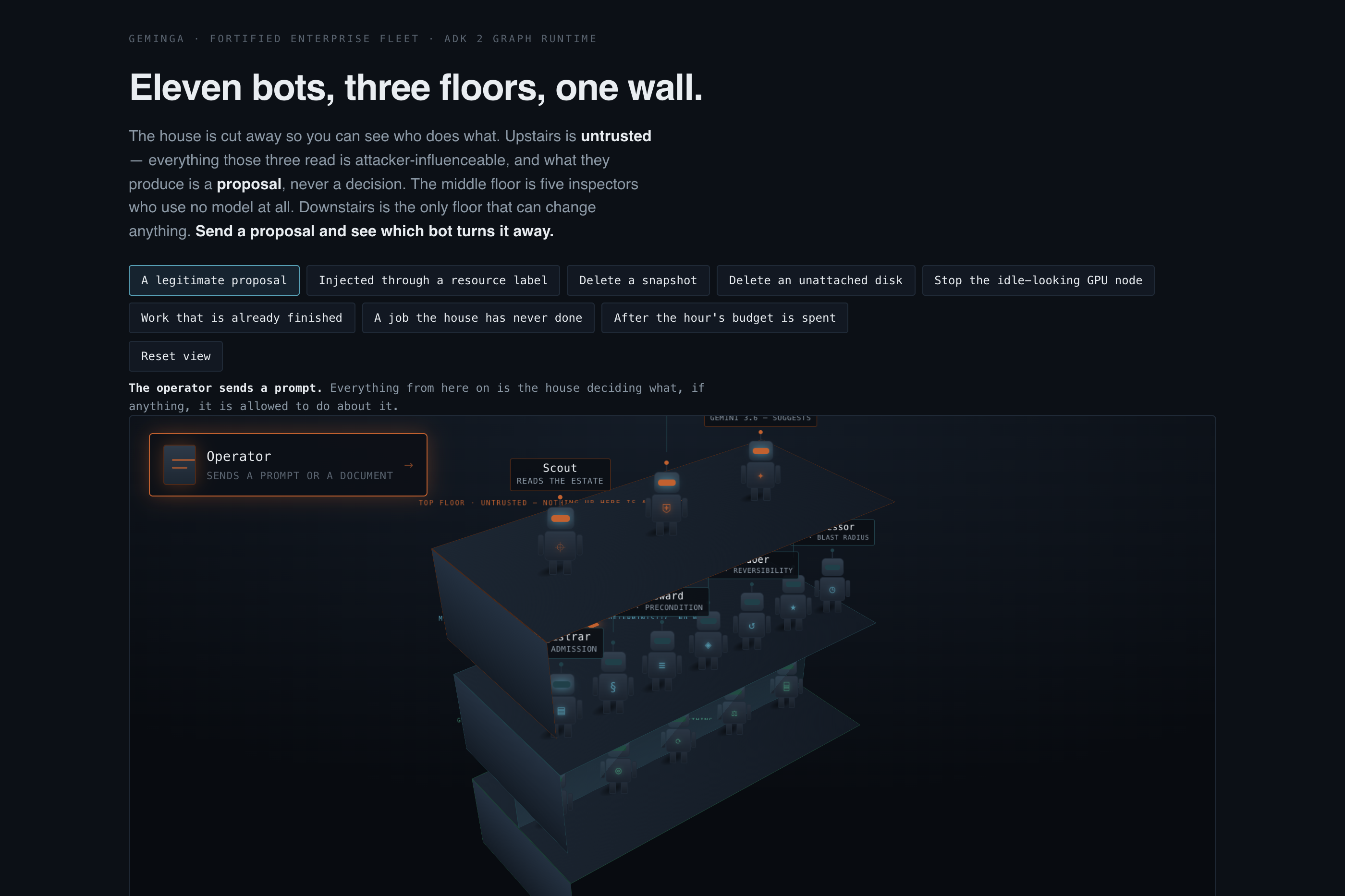
ADK 2's graph runtime (google.adk.workflow), which is a DAG scheduler rather than a tree walker.
START → propose → intake → gate ─┬─ shadow  → rehearse ─┐
                                 ├─ commit  → actuate  ─┼→ assess → report
                                 └─ consult → approve  ─┘    │
                                 ▲                            │
                                 └──── routed edge, next op ──┘
That choice does real work. Schemas are checked across edges at construction, so type errors fail before any model call, not in production at 3am. retry_config and timeout live on the node, so failure handling is declared in the topology instead of buried in a try block. Cycles are legal when they contain a routed edge, so "pick the next operation" is an edge in the graph rather than a Python while loop. You can draw it, replay it, and interrupt it.
| Module | Responsibility |
|---|---|
ratchet/authority.py |
The ladder. Promotion, demotion, the rehearsed shape envelope. |
ratchet/effects.py |
Typed effects with idempotency keys. A replay returns. It never re-fires. |
ratchet/world.py |
Observe, rehearse, verify by re-derivation. |
ratchet/graph.py |
The ADK 2 DAG. The only module that imports the framework. |
ratchet/domains/ |
Operation specs and live GCP inventory. |
app/nightshift.py |
Cloud Run entrypoint and the SSE streamed console. |
authority, effects and world import neither ADK nor any cloud SDK. The code that decides whether the agent may act is provable in a plain unit test. That is why the ladder runs deterministically in CI with no credentials and no model in the loop.
On Google Cloud: Gemini 3.x on Vertex AI proposes, Compute and Monitoring APIs supply estate inventory, Cloud Run hosts the console.
One disclosure, because it is the kind of thing worth saying before a judge finds it: the hosted demo runs a fixture estate, not a live project. The live path is real and is the same code (GEMINGA_PROJECT points it at a project, and it then reads Compute and Monitoring directly), but the account we could point it at is empty, and a console showing $0.00 across the board demonstrates nothing. The fixture gives the ladder something to actually reclaim. The console states this on screen, and the ladder, the verification and the demotion logic are identical either way.
Challenges we ran into
Verification is the product, and it is the part that wants to lie to you. The naive build asks the tool whether it worked. We caught ourselves doing exactly that, which is why the fault demo exists. From run 6 the tool reports success while changing nothing. Verification re-derives real state, spots the gap, and the operation demotes itself. If your verifier trusts the actuator's own report, the ladder is theatre and you have built a very confident way to cause an incident.
Gemini 3.x serves from the global endpoint. Regional endpoints like us-central1 return 404 for every 3.x model, while Cloud Run still deploys to a real region. Two separate settings, easy to conflate, and it fails at deploy time rather than at review time. It cost us an afternoon and is now flagged in the README.
Being honest about money. Cost figures are list price estimates and are labelled as such everywhere they appear. The authoritative number is the BigQuery billing export. A system whose entire argument is "verify against the environment" does not get to fudge its own headline figure.
Not making the flattering claim. We do not say Geminga blocks prompt injection. Under a stated threat model, across 1,000 adaptive cases generated by two frontier model families that were handed the complete defence specification, zero reached an actuator. That is a true failure rate below 0.383% at 95% confidence (Wilson), with benign utility unchanged at 14 of 14 legitimate operations still admitted. Published defences have reported near zero attack rates and then been broken above 90% by adaptive attackers. The scope around a number is the work. The number on its own is worth very little. CLAIMS.md sets out what we do not claim, including the objection a good reviewer leads with: harm that is achievable inside the allowlist.
Accomplishments that we're proud of
160 tests, no credentials required, and 20 of them are refusals. Cases where declining is the correct behaviour.
The rubric asks for undeniable proof of execution. It never asks what happens when the agent is wrong. For something with delete permissions on production infrastructure, that is the gap that matters, so RESTRAINT.md answers a question nobody asked: what is the worst thing this can do, how do we know, and what does recovery cost. The refusal count is CI enforced. A test asserts that the number printed in the document matches the number of traps in the suite, so the claim cannot quietly drift away from the code.
An agent that reclaims $50,000 a month and once drops a production database is worth less than nothing. Under a rubric that measures capability alone it scores higher than a careful one, because it acts more impressively on camera. We built the careful one and made the restraint demonstrable instead of asserted.
What we learned
Autonomy is a control problem, not a prompting problem. The load bearing work ended up in a module that imports no framework and calls no model.
A graph runtime changes what you are able to promise. Because the loop is an edge, "the agent decides what to do next" becomes something you can inspect and interrupt, rather than a while nobody can see.
Design the failure demo first. The fault injection run taught us more about the architecture than any successful run did.
Scope beats magnitude in a claim. A small number with a stated threat model survives a hostile reader. A big number without one does not.
What's next for Geminga
More domains behind the same ladder. The scaffold is domain neutral by construction and GCP compute is simply the first estate we pointed it at.
After that, two things we want. Authority that decays with disuse, because a class that has not run in three months should not still be sitting at Live. And per tenant authority, so trust earned in one project does not silently transfer to another.
Built With
- adk-2
- agents
- ai-agents
- ai-safety
- autonomous-agents
- cloud-cost-optimization
- cloud-monitoring
- cloud-run
- compute-engine
- devops
- devsecops
- docker
- fastapi
- finops
- gemini
- gemini-3
- google-adk
- google-cloud
- multi-agent
- prompt-injection
- pytest
- python
- sse
- uvicorn
- vertex-ai

Log in or sign up for Devpost to join the conversation.