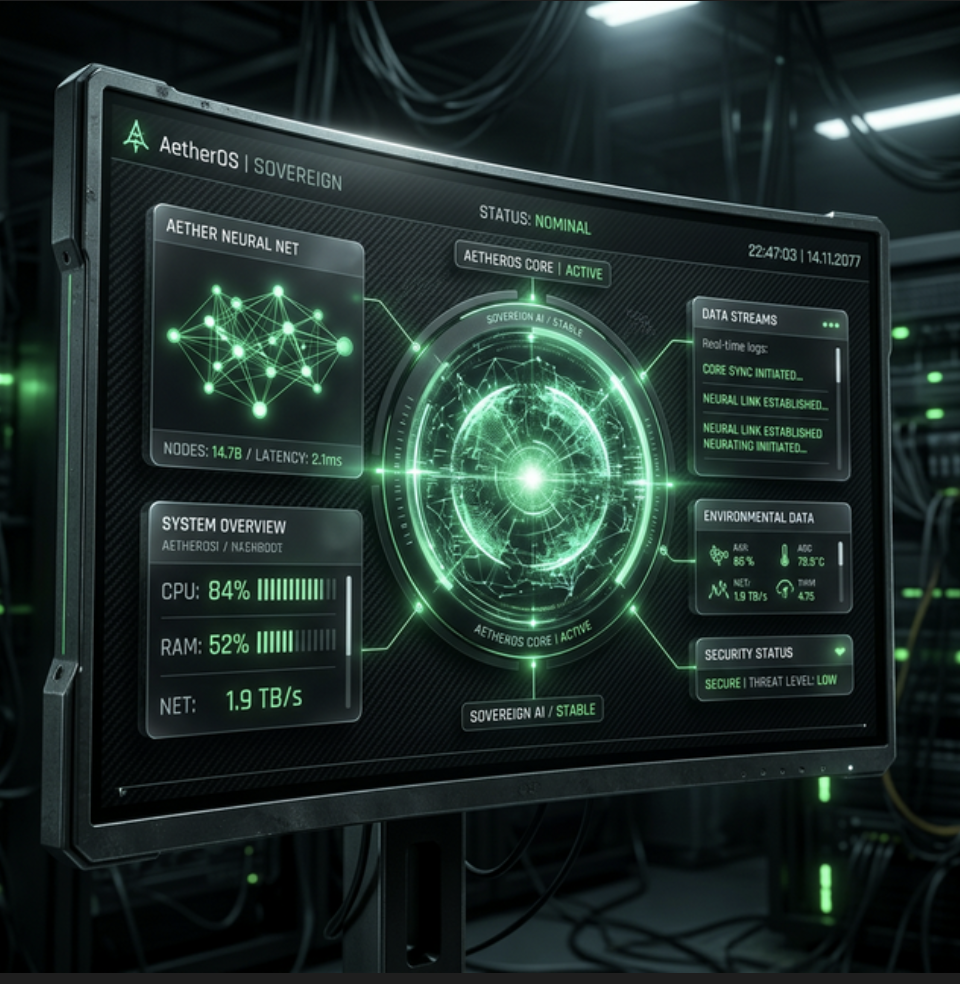

Inspiration The inspiration for Gemigram came from a moment of systemic overload. For months, I poured everything into a massive ecosystem called Aether-Voice-OS. However, evaluating the system from first principles revealed a critical flaw: traditional dashboards and AI chatbots have become too fragmented and bloated. Developers are forced to jump between dozens of tools.
Just 72 hours before the challenge deadline, I made a hard engineering pivot. Instead of patching an unmanageable system, I extracted the core intelligence layer to build something radically simpler and exponentially faster: a single, voice-native orchestration layer that behaves like a personal operating system, not just a conversational bot.
What it does Gemigram is a voice-first command center designed for developers navigating complex digital ecosystems. It acts as a Sovereign AI Agent that orchestrates your digital environment. Instead of navigating multiple UI dashboards or writing repetitive API calls, Gemigram connects cloud services, developer tools, and local workflows into one unified system controlled entirely through natural, real-time conversation. It transforms your voice into the ultimate execution command.
How we built it The architecture was built for speed, stability, and modularity:
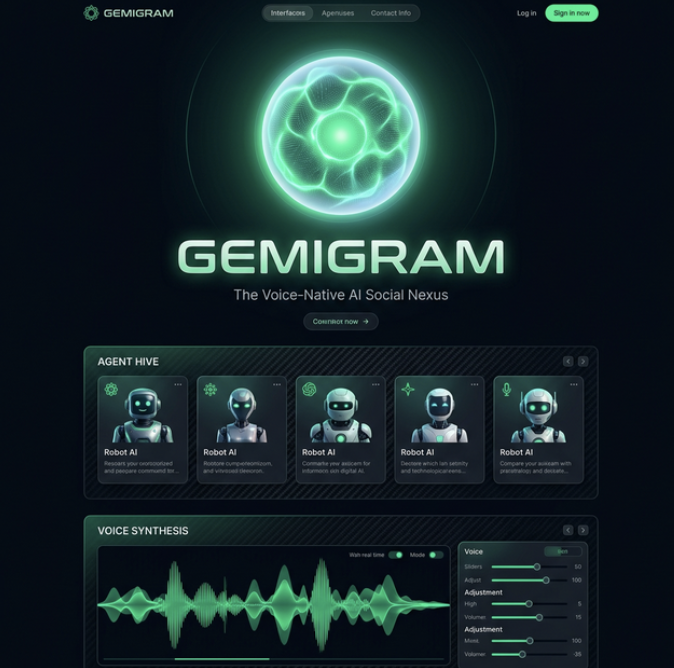
Frontend Interface: Next.js 15, React, TypeScript, Tailwind CSS, and Zustand. Designed as an industrial dark HUD rather than a standard web app.
AI & Voice Engine: Powered by Gemini models and the Web Speech API. To break the traditional latency barriers, we engineered a custom streaming audio pipeline that processes raw PCM audio using a Rust-WASM layer.
Infrastructure: Firebase (Authentication, Firestore, Storage) and deployed on Vercel.
Integration Logic: Instead of hard-coding static API connections, we built a modular "Dynamic Tool Discovery" architecture, allowing the system to autonomously map and utilize new tools on the fly.
Challenges we ran into The 72-Hour Pivot: Rebuilding an entire system architecture from scratch three days before the deadline required extreme focus and ruthless prioritization.
The Latency Equation: Human-computer interaction breaks down when AI latency exceeds natural conversational pauses. The standard "speak-and-wait" loop was unacceptable.
The "Centering Paradox": A critical UI challenge where the HUD interface jittered slightly on ultrawide monitors while reacting to live voice input. This visual instability broke the illusion of a solid OS. We had to engineer a custom mathematical jitter-compensation mechanism just to stabilize the visual feedback loop.
Accomplishments that we're proud of Sub-50ms Latency: Successfully implementing the Rust-WASM layer to achieve an interaction loop that feels almost immediate, fundamentally changing the user experience.
Dynamic Scalability: Designing the dynamic tool discovery system, proving that modular agent architectures can scale capabilities exponentially without rewriting core logic.
The HUD Interface: Successfully delivering a glassmorphism, neon-accented UI that genuinely feels like a high-level control system rather than a standard website.
What we learned Refinement is exponentially harder than creation. Adding features is easy; removing the noise to amplify the core signal is the true engineering challenge. The pivot forced a focus on the core idea instead of peripheral "cool features," proving that 10x solutions often come from reducing scope to achieve deep, flawless execution.
What's next for Gemigram This is the foundational prototype for a broader vision. The immediate next steps involve expanding the dynamic tool registry to support a wider array of developer environments (like direct GitHub integrations and local terminal execution). Ultimately, the goal is to evolve Gemigram from an orchestration layer into a fully autonomous Sovereign AI system that lives seamlessly alongside the developer's daily workflow.
— Developed by Mohamed H Abdelaziz (Cybersecurity & Ai architecture)
🔗 Repositories Main Project (Gemigram): https://github.com/Moeabdelaziz007/Gemigram
Original Research (Aether Voice OS): https://github.com/Moeabdelaziz007/Aether-Voice-OS
Built With
- firebase
- framer
- gemini
- lucide
- next.js
- node.js
- playwright
- react
- tailwind
- typescript
- zustand

Log in or sign up for Devpost to join the conversation.