Inspiration
The inspiration behind Gemetra-MNEE came from observing critical inefficiencies in global financial infrastructure that affect both businesses and individuals at scale.
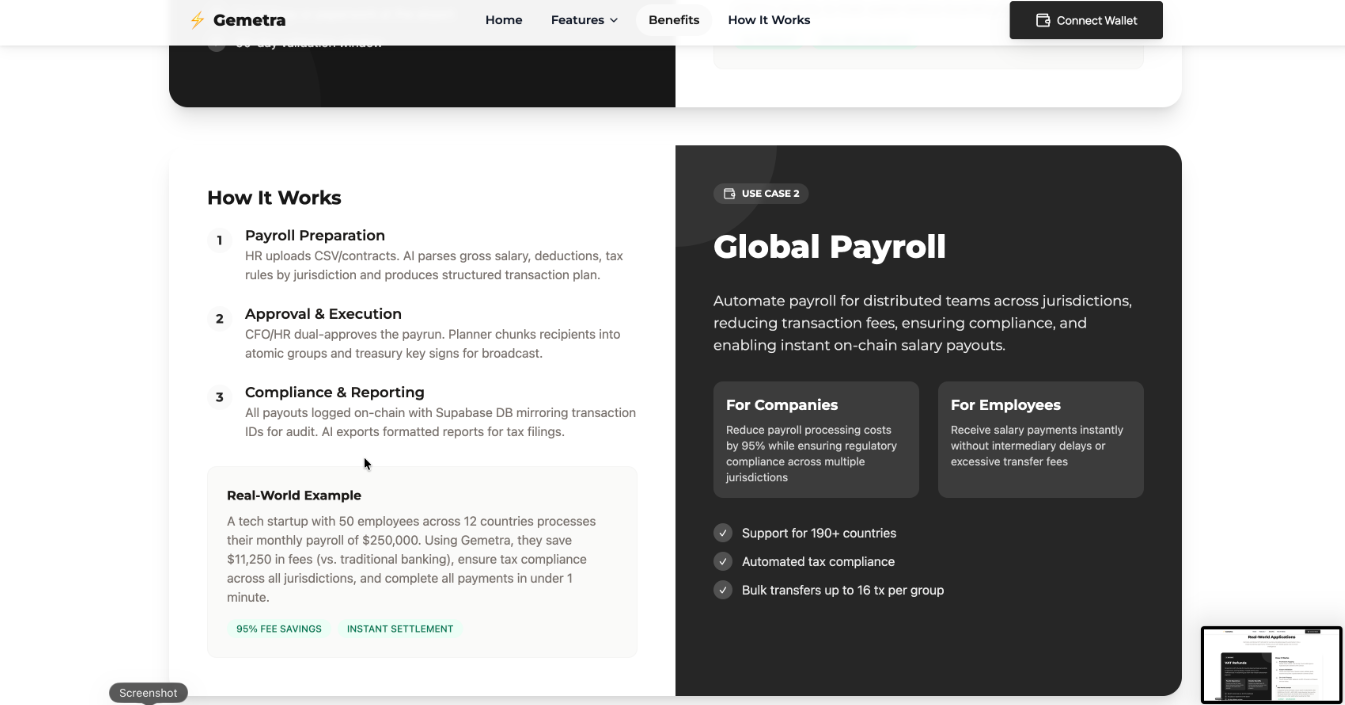
One of the biggest issues is cross-border payroll, a $2 trillion market where companies still rely on outdated systems. Businesses lose 2–5% in transaction fees, face 3–5 day delays, and deal with hidden foreign exchange costs that reduce employees’ actual salaries. There is also a lack of transparency—employees often cannot verify payments until they are completed.
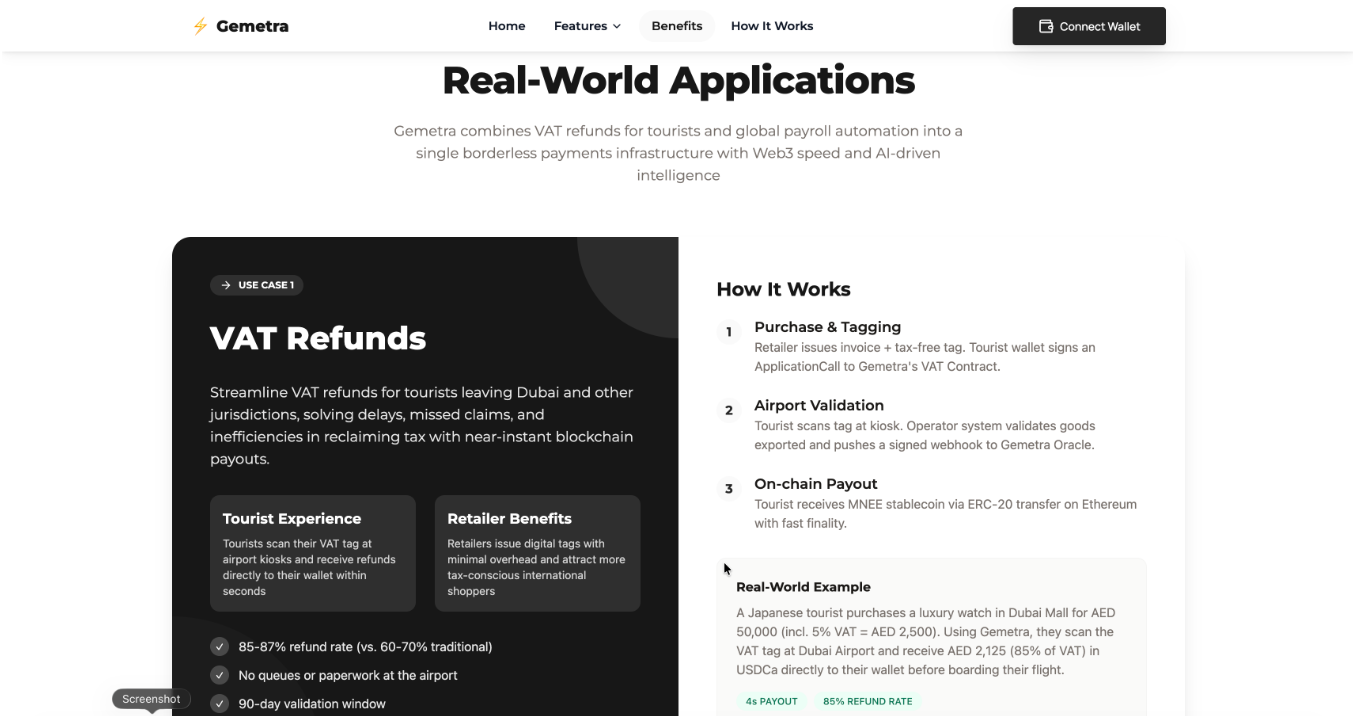
At the same time, the VAT refund ecosystem is highly inefficient. Every year, tourists lose over $200 billion in unclaimed VAT refunds due to manual processes, long queues at airports, complex regulations, and high processing fees.
We realized that these problems share a common root: inefficient, non-transparent, and non-automated financial systems.
This led us to explore how blockchain and programmable money (MNEE) could solve these challenges. We envisioned a platform that could make payments instant, automated, transparent, and globally accessible, eliminating inefficiencies and unlocking massive economic value.
What it does
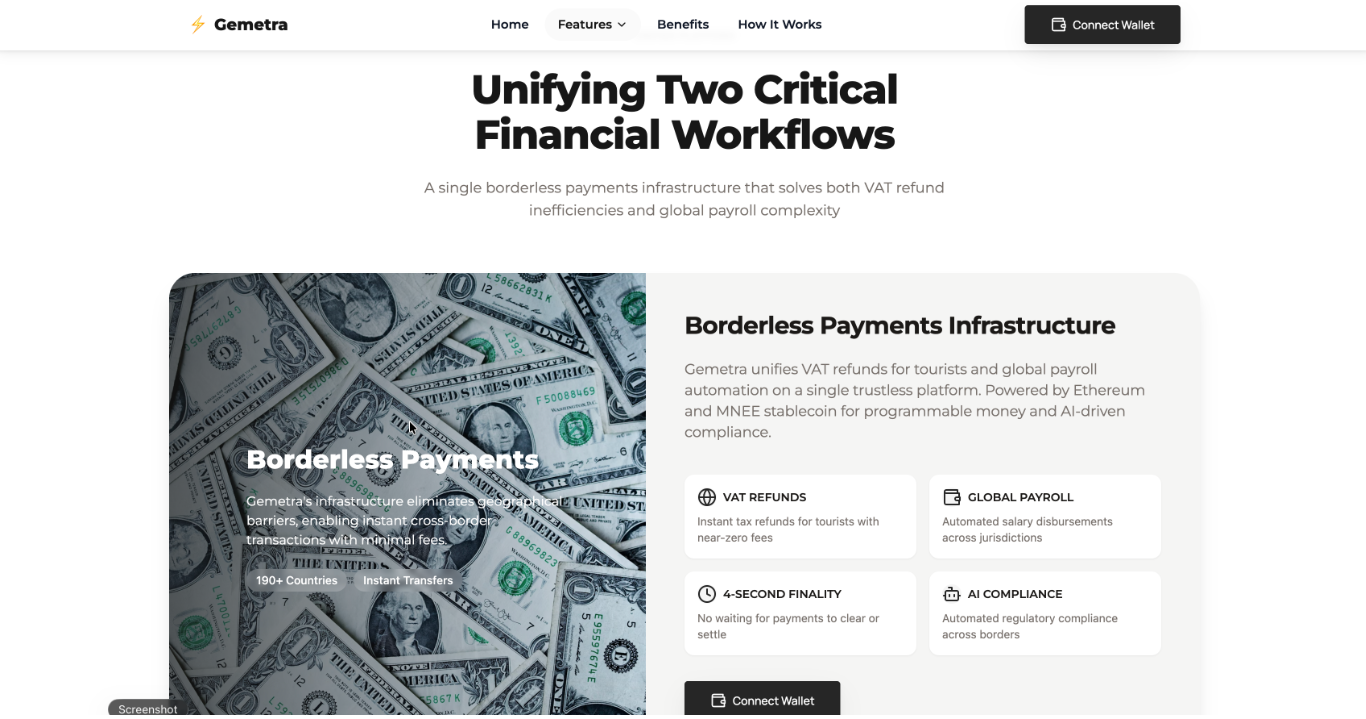
Gemetra-MNEE is a comprehensive financial infrastructure platform designed to modernize global payments using blockchain technology.
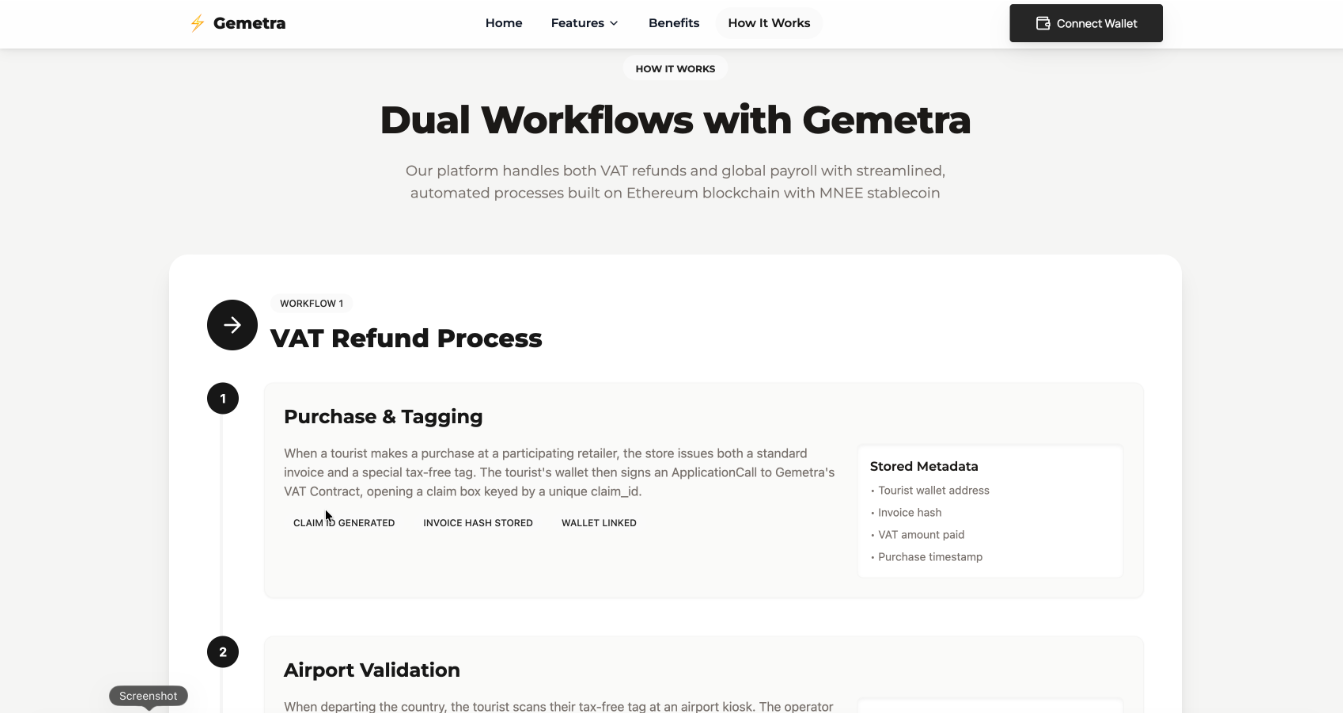
🌍 VAT Refund Automation
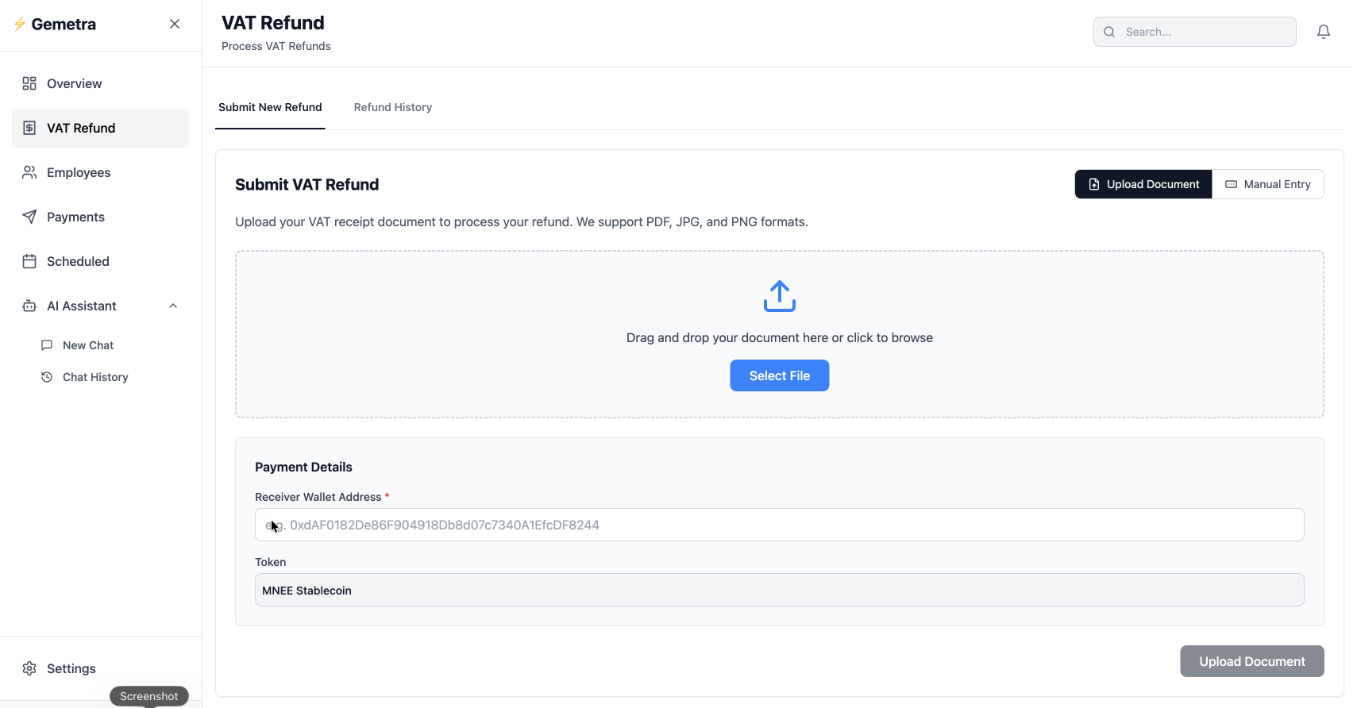
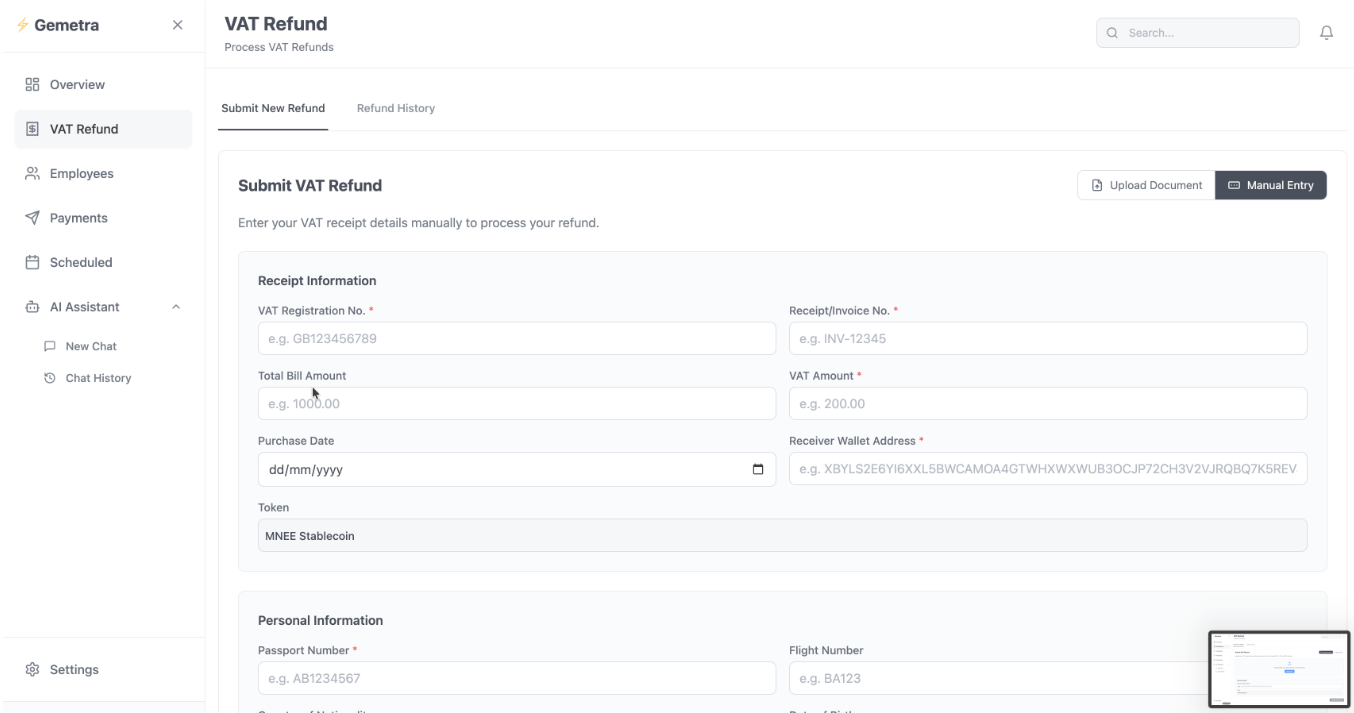
Tourists can upload receipts digitally, and our system uses AI to validate eligibility and calculate refunds. Once approved, payments are instantly sent in MNEE stablecoins directly to their wallets. This eliminates paperwork, queues, and delays while ensuring complete transparency through blockchain records.
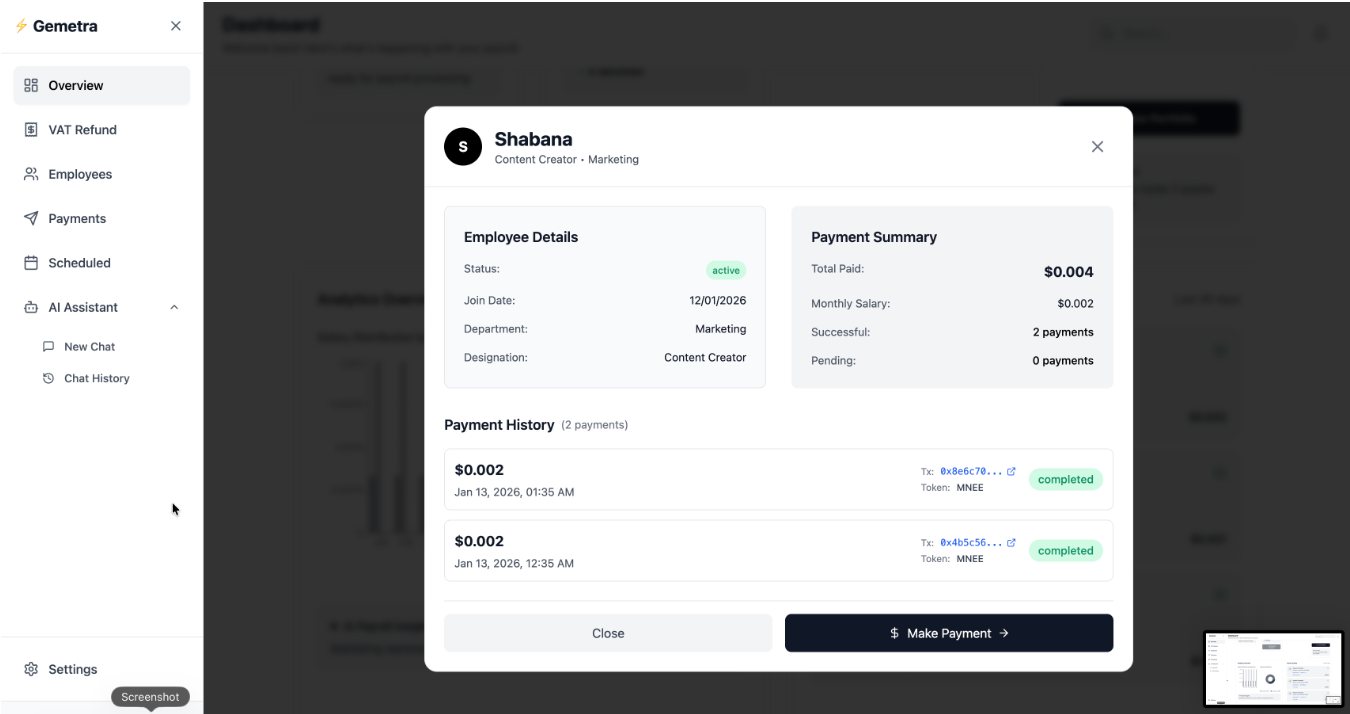
💼 Enterprise Payroll Automation
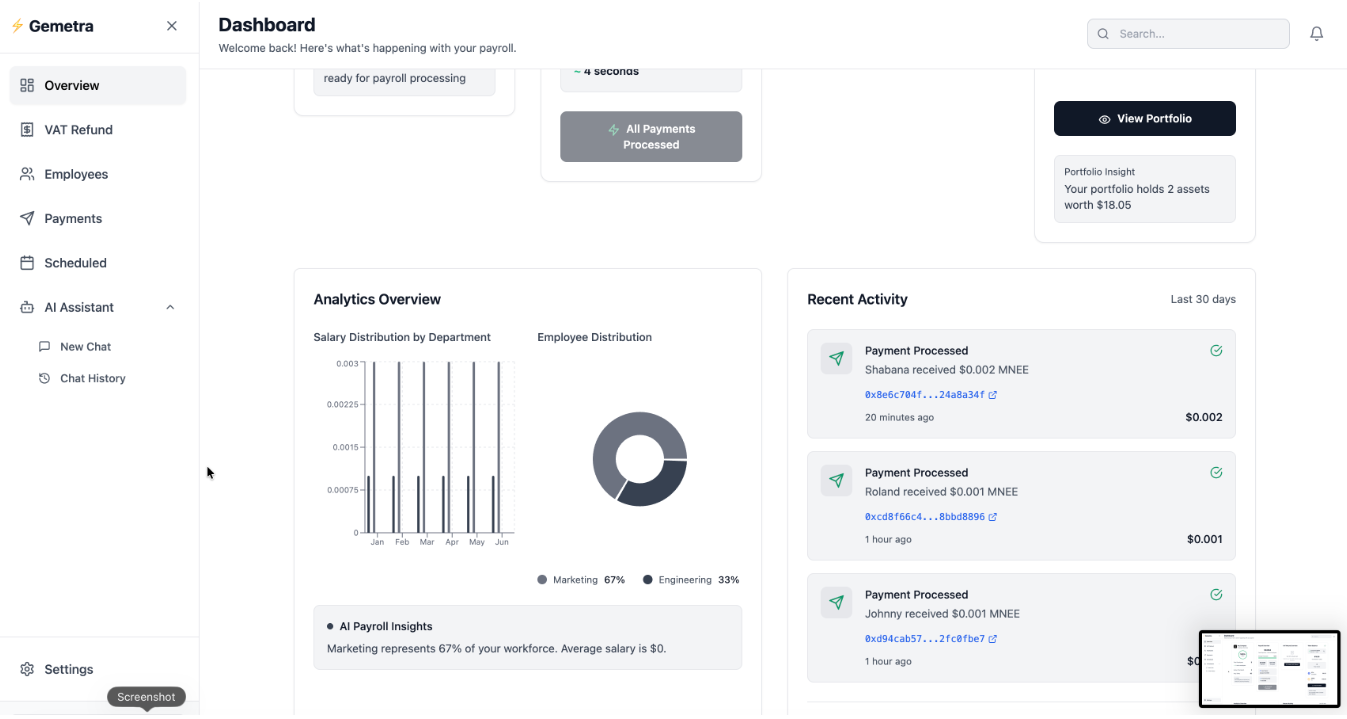
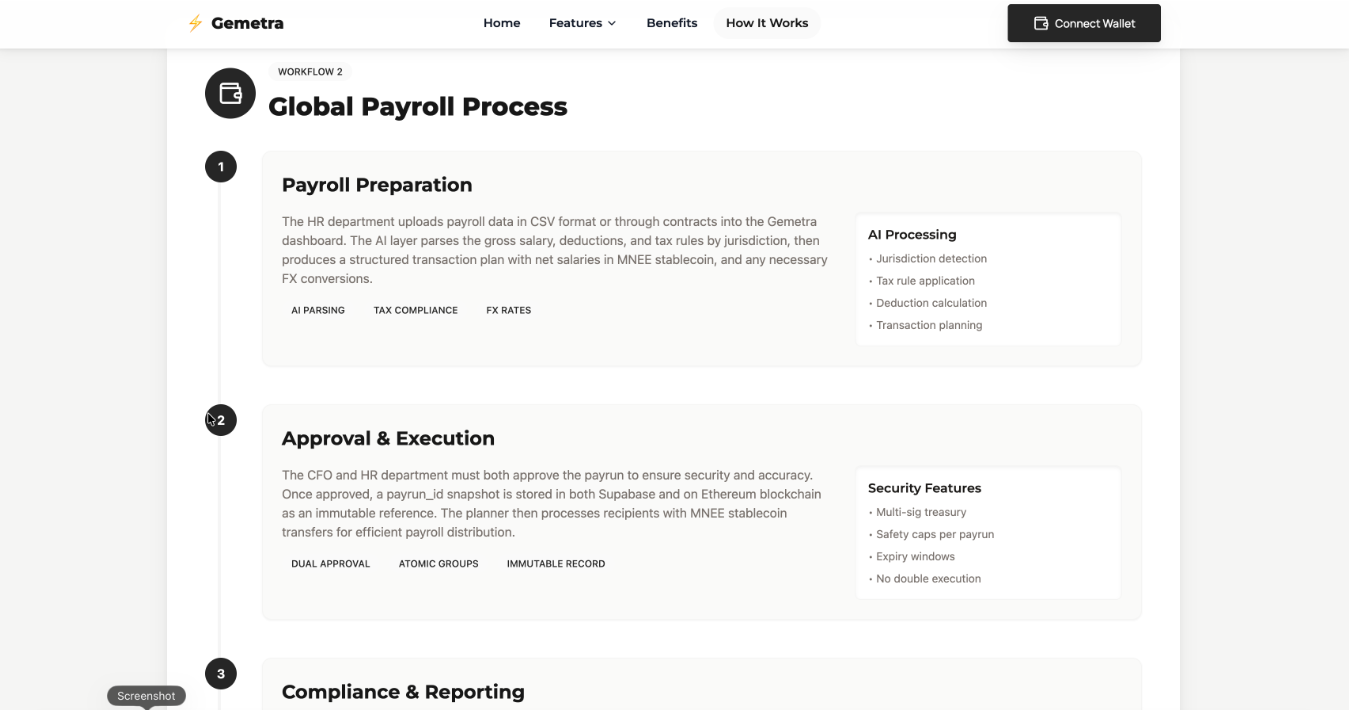
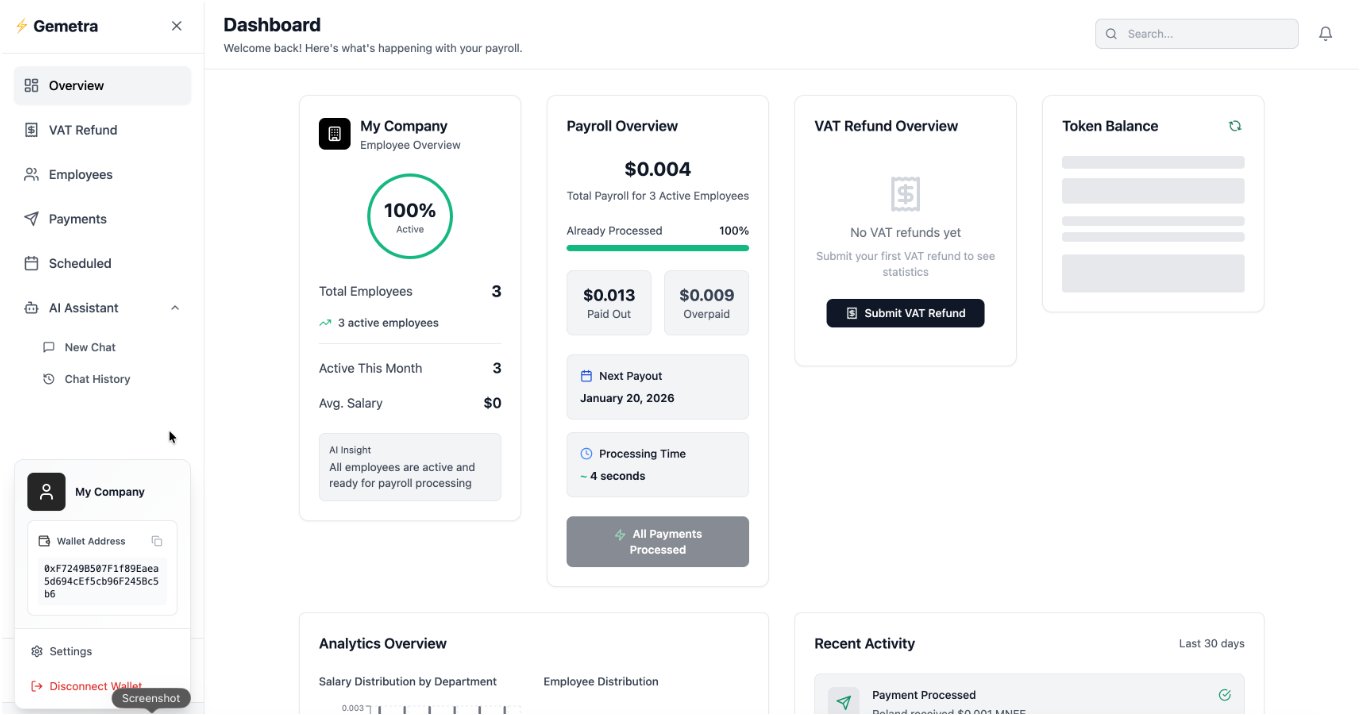
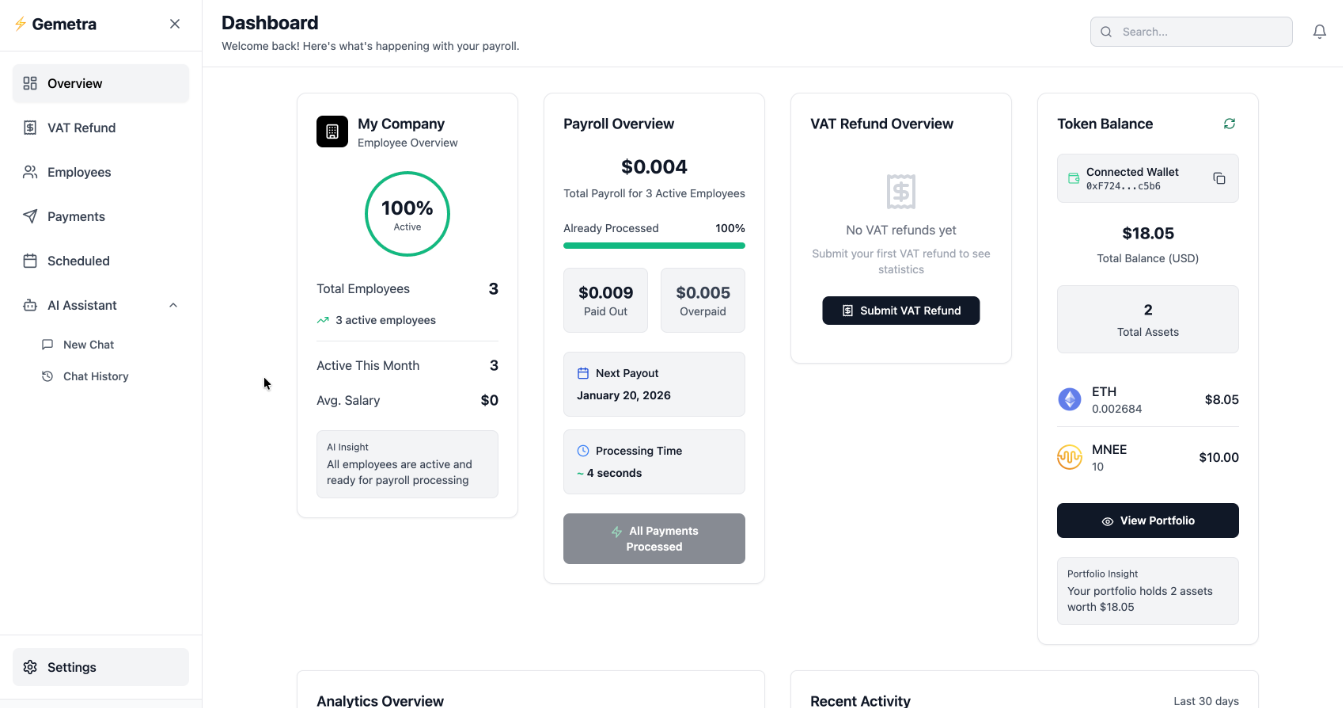
Companies can upload employee payroll data via CSV or APIs. The system automatically calculates salaries, taxes, and deductions, then processes instant global payments using blockchain. Every transaction is verifiable, ensuring trust and compliance.
🔁 Scheduled & Recurring Payments
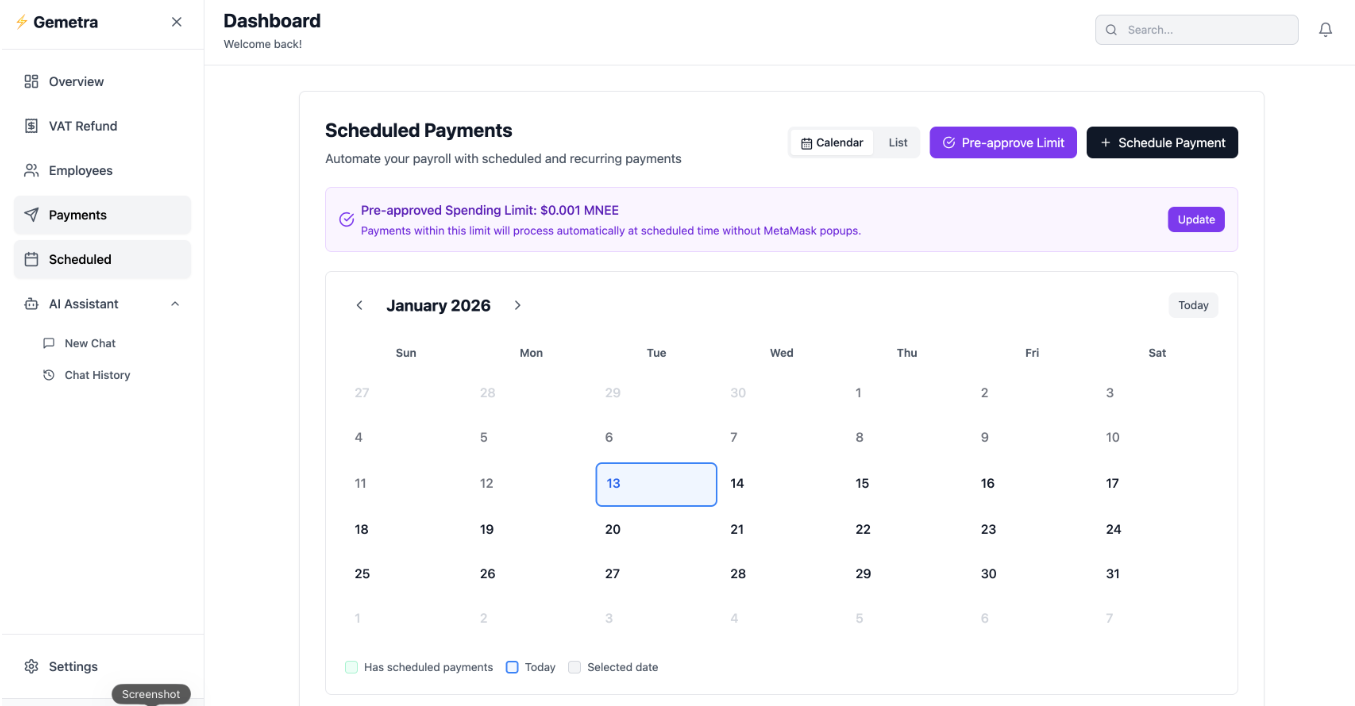
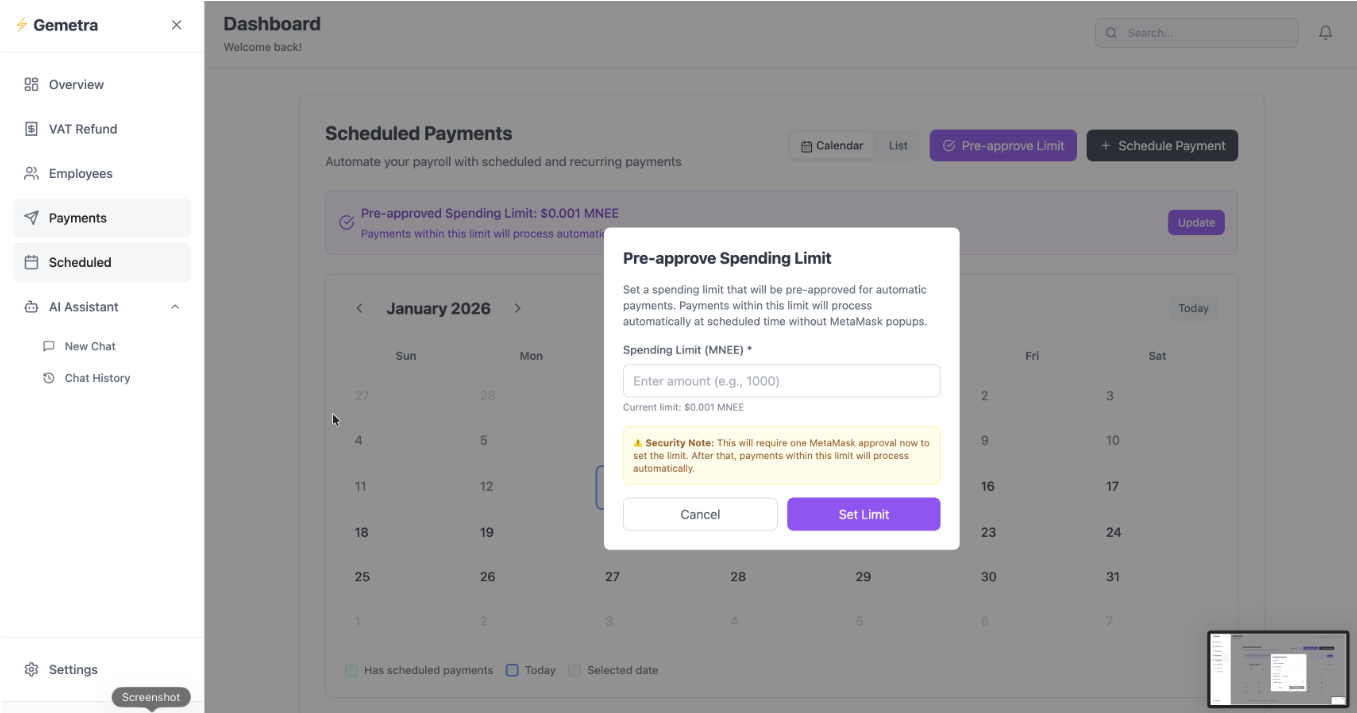
Businesses can automate recurring payments such as salaries, subscriptions, or vendor payments. With a pre-approval system, payments execute automatically within defined limits, reducing manual effort and preventing delays.
🏛️ VAT Admin Dashboard
Government authorities get a centralized dashboard to view, verify, and manage VAT refund claims. It includes advanced filtering, real-time updates, and export capabilities, ensuring compliance and operational efficiency.
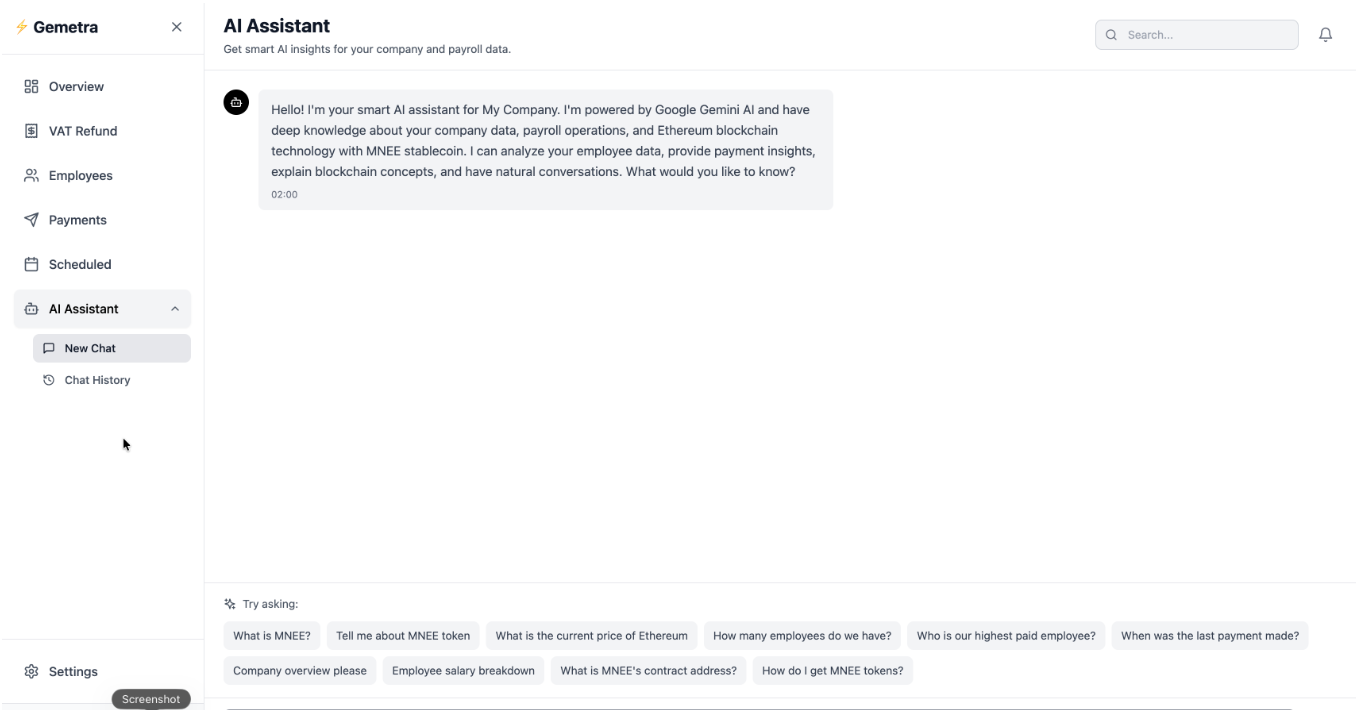
🤖 AI Financial Assistant
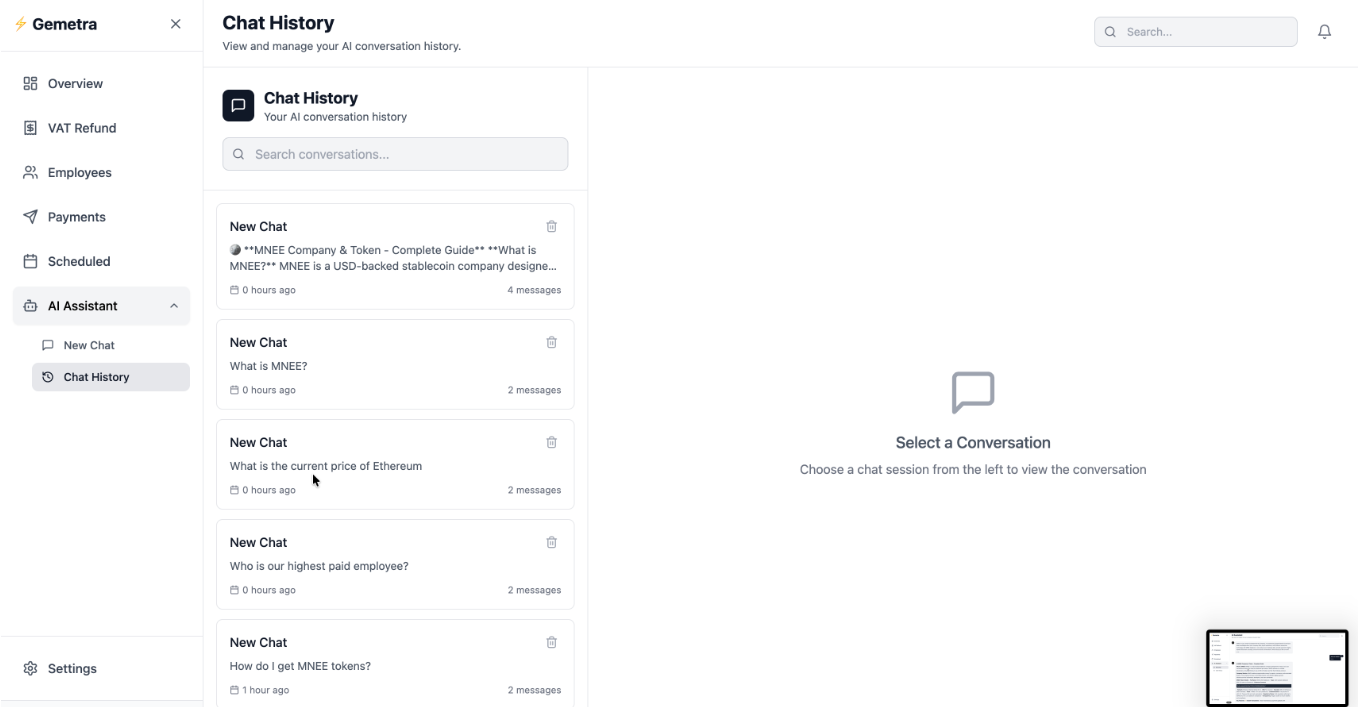
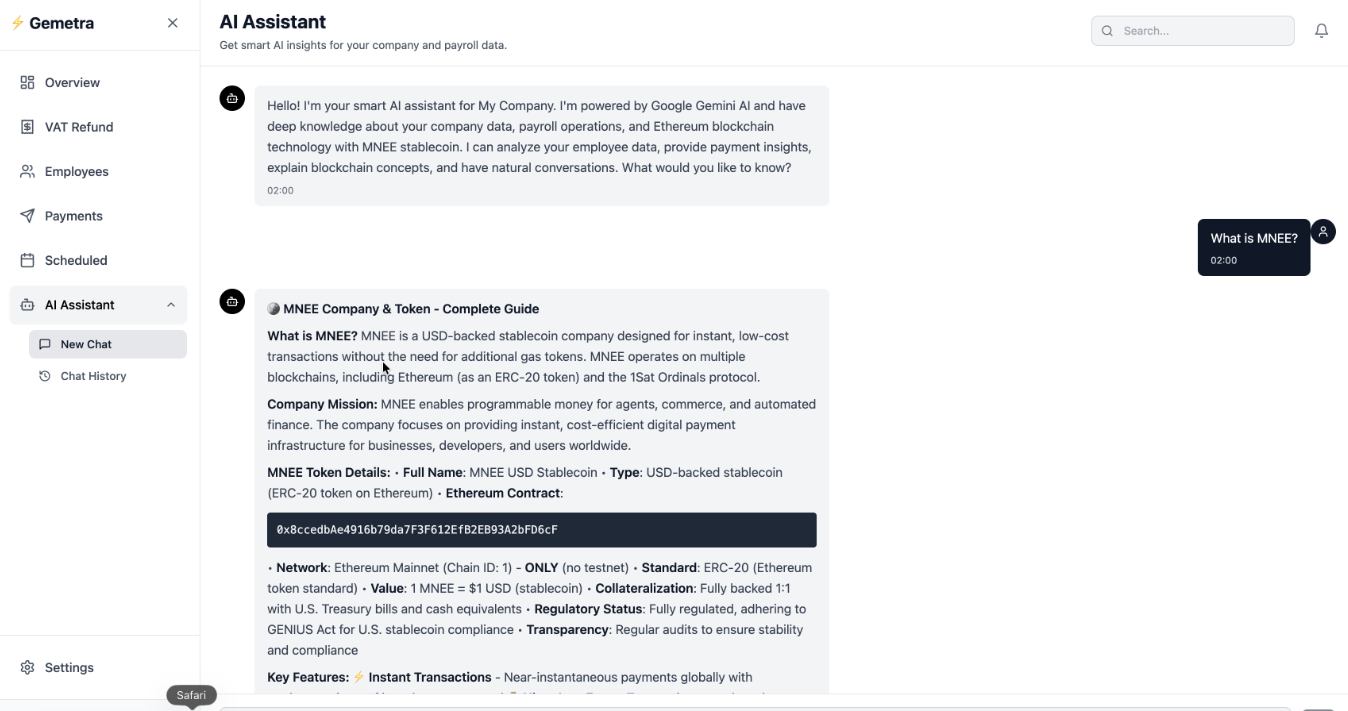
An intelligent assistant powered by AI helps users analyze financial data, answer queries, and provide insights. It reduces manual analysis and improves decision-making.
🎯 Points & Rewards System
Users earn points for transactions, which can be converted into MNEE tokens. This gamification increases engagement and builds user loyalty.
How we built it
We built Gemetra-MNEE using a modern, scalable, and production-ready architecture.
The frontend was developed using React with Vite, styled using Tailwind CSS, and enhanced with Framer Motion for smooth and intuitive user interactions.
The backend is powered by Supabase (PostgreSQL), which provides secure data storage, real-time updates, and Row-Level Security (RLS). We used JSONB storage to handle flexible VAT refund data while maintaining query efficiency.
For the blockchain layer, we integrated Ethereum Mainnet and used the MNEE stablecoin to enable instant, low-cost transactions.
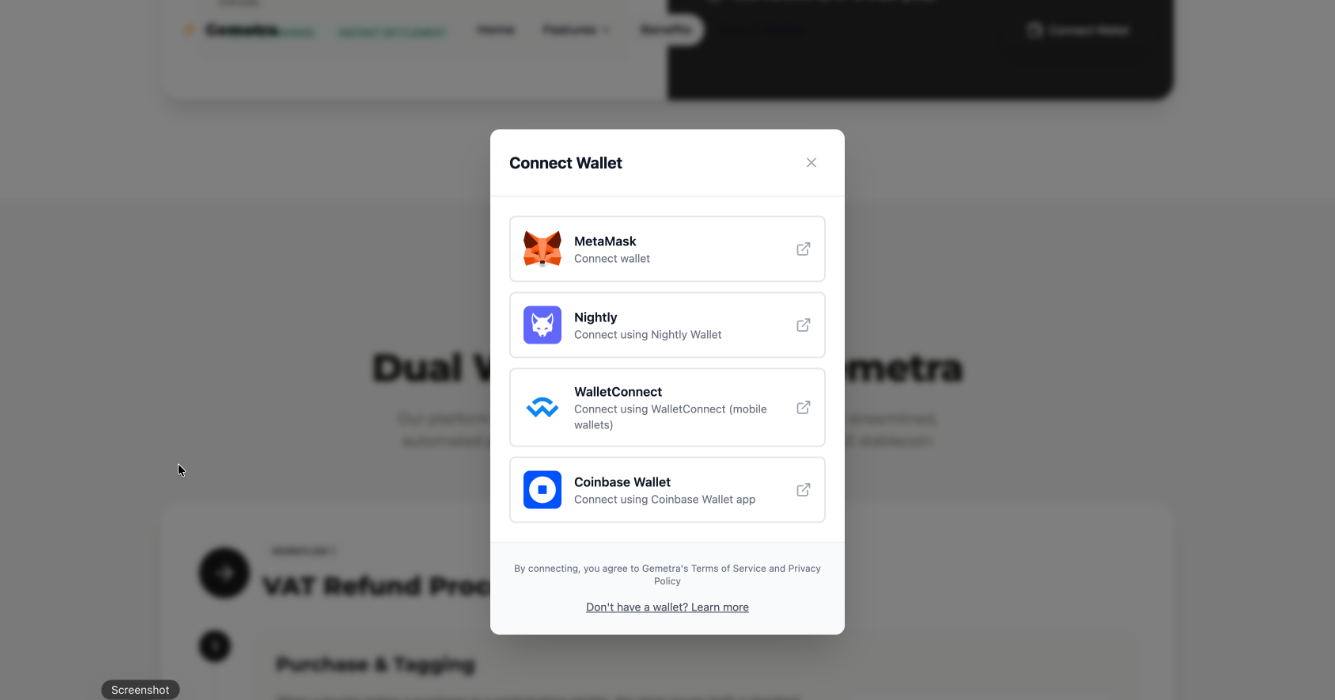
We implemented wallet-based authentication using Wagmi, allowing users to connect with MetaMask, WalletConnect, Coinbase Wallet, and more—eliminating traditional login systems.
To enhance intelligence, we integrated Google Gemini AI, enabling automated payroll calculations, financial insights, and conversational assistance.
We also incorporated QR code generation (EIP-681 standard) to simplify mobile wallet transactions.
The key innovation lies in leveraging programmable money, allowing us to create automated payment workflows that execute without manual intervention—something not possible in traditional financial systems.
Challenges we ran into
One of the biggest challenges was building trust in automated financial systems. Businesses are naturally hesitant to allow automated payments without control. We solved this by introducing a pre-approval system, where users define spending limits, ensuring both automation and security.
Ensuring payment reliability was another challenge, especially for bulk transactions. We addressed this by assigning individual blockchain transaction hashes to each payment, making every transaction traceable and verifiable.
Simplifying complex blockchain technology for non-technical users was also difficult. We focused heavily on UI/UX design, creating an interface that hides complexity and feels similar to traditional banking applications.
Managing VAT refund data required flexibility and compliance. We solved this by using JSONB storage, allowing us to store detailed, structured data efficiently.
Transitioning to wallet-based authentication required significant backend changes, including database migrations and updated security policies.
Finally, supporting multiple wallets and ensuring seamless integration across them required careful implementation using Wagmi and custom UI handling.
Accomplishments that we're proud of
We are proud to have built a real-world, production-ready financial platform that goes beyond a prototype.
Unlike many hackathon projects, we integrated real blockchain transactions on Ethereum Mainnet, enabling actual value transfer instead of simulations.
We successfully developed enterprise-grade features such as scheduled payments, payroll automation, and compliance-ready dashboards.
The VAT Admin Dashboard stands out as a government-ready solution, providing full visibility and control over refund systems.
We also created a user-friendly interface that makes complex blockchain operations accessible to non-technical users.
Additionally, we achieved full integration of AI, blockchain, and cloud infrastructure, resulting in a powerful and scalable system.
What we learned
Through this project, we learned that automation is one of the biggest unmet needs in financial systems. Businesses are actively looking for ways to reduce manual work and increase efficiency.
We also discovered that transparency is a major competitive advantage. Blockchain not only improves trust but also simplifies auditing and compliance.
Another key insight was that user experience determines adoption. Even the most advanced technology will fail if it is not easy to use.
We learned that cost savings are a strong driver of adoption, especially when businesses can immediately see financial benefits.
Finally, we realized the immense potential of programmable money, which enables entirely new financial workflows and business models.
What's next for Gemetra
In the short term, we plan to enhance the platform with features such as bulk VAT approvals, AI-powered fraud detection, multi-signature approvals, and automated tax compliance systems.
In the medium term, we aim to expand into e-commerce integrations, creator economy tools, and marketplace escrow systems, enabling broader adoption across industries.
In the long term, we envision building AI-driven financial ecosystems, where autonomous agents manage treasury operations, optimize cash flow, and execute transactions across multiple blockchains.
Our ultimate goal is to transform Gemetra into a global financial operating system, powering the next generation of transparent, automated, and intelligent financial infrastructure.
Built With
- coinbase-wallet
- csv/api-integration
- eip-681-qr-codes
- ethereum-mainnet
- framer-motion
- google-gemini-ai
- jsonb
- metamask
- mnee-stablecoin
- nightly
- react-(vite)
- row-level-security-(rls)
- smart-contracts
- supabase-(postgresql)
- tailwind-css
- typescript
- wagmi
- walletconnect

Log in or sign up for Devpost to join the conversation.