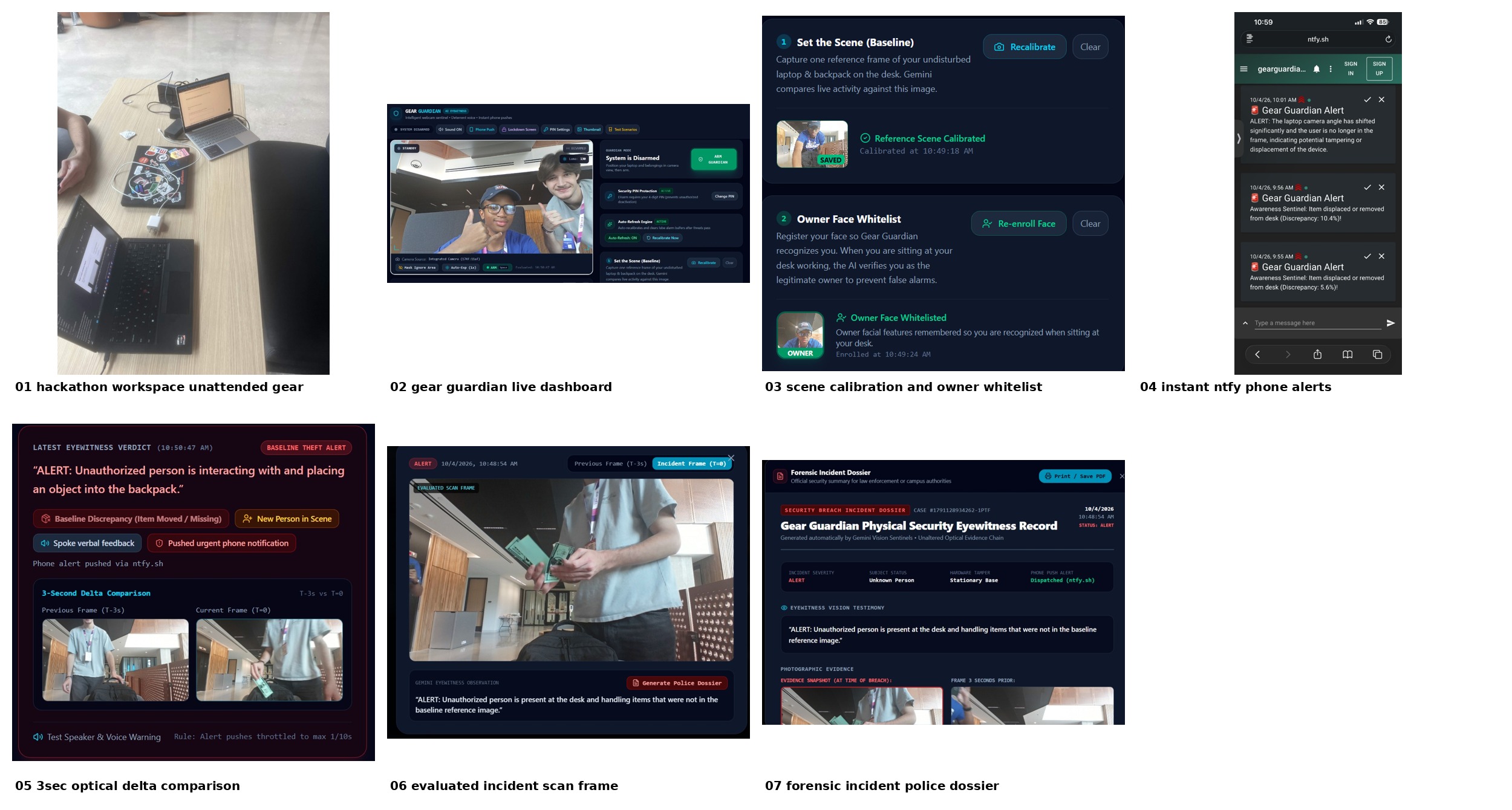
What it does Gear Guardian transforms your laptop's built-in webcam into an intelligent anti-theft workstation sentry with zero extra hardware: Calibrated Baseline Scene Memory: When you step away, Gear Guardian captures a baseline snapshot of your workspace. Powered by Gemini Multimodal Vision, it doesn't just look for generic pixel movement—it tracks your specific belongings (backpacks, headphones, iPads, chargers) to verify if they have been displaced or removed. Registered Owner Whitelist: Enrolls the legitimate owner's face into browser memory so you can return, code, and eat at your desk without triggering false alarms. Interactive ROI Exclusion Masking: Hackers can click and drag directly on the camera canvas to paint hatched "ignore zones" over busy walking aisles or doorways, guaranteeing that passing foot traffic never triggers alarms. Dynamic Auto-Exposure & Low-Light Engine: Continuously measures room luma and applies real-time photometric gain curves so the AI can see clearly in dimly lit hackathon venues and late-night library corners. Multi-Tiered Active Deterrence: If an opportunist lingers near your gear, the laptop speaks a firm voice warning ("Security notice: This workstation is actively monitored. Please step away."). If gear is lifted or moved, it triggers a fullscreen strobe and a pulsing high-decibel siren. Zero-Setup Phone Push Notifications: Pushes instant mobile alerts with the culprit's photo directly to your smartphone via encrypted ntfy.sh channels in under a second—no app installation or account signup required. Kiosk Lockdown & 4-Digit Security PIN: Traps system hotkeys (Escape, Spacebar, F11) in fullscreen mode so a thief cannot casually close the tab or mute the volume without your PIN. Chain-of-Custody Police Dossier: Automatically compiles legal-grade incident reports featuring side-by-side pre-theft and incident snapshots, hardware telemetry, and ISO timestamps ready for campus security. How we built it Frontend & Hardware Interface: Built using React 18, TypeScript, and Tailwind CSS. We utilized the HTML5 Canvas 2D API with GPU acceleration to sample WebRTC video frames and render a live cybersecurity HUD with targeting reticles and ROI exclusion zones. Photometric Luma Engine: To handle changing ambient lighting, we engineered an edge luminance analyzer downscaling frames to a grid and calculating perceptual luminance via the ITU-R BT.709 standard:
When ambient light drops below , a real-time exposure gain factor is computed and applied to the video stream: Multimodal AI Reasoning: Powered by Google Gemini Multimodal Vision (@google/genai). Rather than sending isolated snapshots, our backend constructs a temporal evaluation combining the baseline reference scene, the previous frame, the current frame (with masked zones burned in), and the owner facial whitelist. Physical Tamper Detection: Integrated the browser’s DeviceOrientationEvent and DeviceMotionEvent telemetry to monitor angular tilt:
If an opportunist tilts the laptop, picks it up, or attempts to close the lid, an immediate hardware alert triggers even if the webcam is covered. Acoustic Synthesizer & Mobile Dispatch: Synthesized high-decibel dual-oscillator alarm waveforms directly using the Web Audio API ( sweep) and integrated natural vocal warnings via the Web Speech API. For mobile dispatch, we routed high-priority webhook events via encrypted ntfy.sh channels. Challenges we ran into The Packed Hackathon Aisle Problem: In a venue with hundreds of people, hackers are constantly walking in the background. Traditional motion detection fired alarms every 30 seconds. We solved this by developing our Interactive ROI (Region of Interest) Masking Tool, allowing users to paint ignore zones over hallways so Gemini strictly focuses on the desk surface. Learning New Technologies Under Time Pressure: As college freshmen, connecting client-side WebRTC video feeds, browser hardware gyroscopes, and cloud multimodal AI within 24 hours was a steep mountain to climb. We had to quickly learn how to manage asynchronous streams, downsample frames to avoid browser lag, and handle device permissions gracefully. Preventing Thieves From Muting the Alarm: An alarm is useless if an opportunistic thief can just press the laptop's volume key or hit Esc. We spent several late-night hours engineering an aggressive Kiosk Lockdown Mode that traps keyboard events and requires a 4-digit PIN to silence or disarm. Accomplishments that we're proud of Building a Real Project as First-Time Freshmen: Stepping outside our comfort zones, attending our very first hackathon, and building a full-stack, AI-powered system from scratch in 24 hours. True Spatial Reasoning Over Naive Motion: Teaching Gemini to understand actual human intent: recognizing the difference between someone walking past with a slice of pizza versus someone reaching over to snatch a backpack. Empowering New Hackers: Creating a solution that removes a major psychological barrier for freshmen and newcomers who want to attend hackathons and study in public spaces without gear anxiety. Zero-Friction Mobile Pairing: Enabling full phone notifications in under five seconds just by scanning a QR code, without downloading anything from the App Store. What we learned How to build real-world AI applications using Google Gemini's multimodal vision and temporal context. How to manipulate WebRTC streams, canvas pixel buffers, and browser audio synthesizers completely client-side. The power of sensor fusion in web browsers—combining webcam vision with accelerometer gyroscope physics. That being freshmen was actually our superpower: our genuine beginner anxiety gave us the exact perspective needed to solve a problem that more experienced developers overlooked. What's next for Gear Guardian Table Mesh Defense: Allowing neighboring hackathon tables to link their webcams into a cooperative perimeter defense network across the venue. Bluetooth Proximity Auto-Arming: Automatically arming the sentry when your smartwatch or phone steps more than 15 feet away, and seamlessly disarming as you walk back. Campus Police Integration: Partnering with university safety departments so students can choose to relay verified incident dossiers and suspect photos directly to campus security with one click.

Log in or sign up for Devpost to join the conversation.