About the Project
What Inspired Us
We've been experimenting with 3D Gaussian Splatting since the technique first emerged from research labs into practical tools. There's something magical about taking a casual video with your phone and watching it transform into a photorealistic, explorable 3D scene. The math is elegant, the results are stunning, but the creation process felt... disconnected.
The real spark came during a late-night rewatch of Iron Man. You know the scene: Tony Stark stands in his workshop, grabs a holographic engine component out of thin air, rotates it with his hands, and tosses it aside when he's done. We've seen that scene a hundred times, but this time it hit different. We paused and looked at our Gaussian Splatting experiments on screen, then at the VR headset gathering dust on the desk.
That. We want that.
The way the digital and real coexist without friction.
What We Learned
The technology is surprisingly mature, but the workflow is not. Current tools force you through command-line scripts, parameter tuning, and manual cleanup. The gap between "captured data" and "usable asset" is hours of technical work. Current tools are designed for programmers and not the creatives who would actually be using them.
How We Plan to Build It
Core Renderer
We're adapting Gaussian Splatting for real-time mobile VR. The challenge is optimization - maintaining photorealistic quality while rendering millions of 3D Gaussians at 72fps on Quest's mobile GPU. We're implementing tile-based rasterization, level-of-detail streaming, and foveated rendering to focus compute where the eye actually looks.
Hardware Integration
MX Ink becomes the primary creative instrument. Pressure controls material density - light touches deposit delicate details, heavy presses build solid mass. Tilt and orientation shape the brush. Haptic feedback provides texture sensation: the resistance of stone, the give of clay, the fluidity of water. We're designing interaction patterns that make digital creation feel physical.
AI Collaboration
Generative AI handles the tedious, technical work while preserving creative control. Sketch a rough outline, provide a voice or text prompt, and AI fills in photorealistic detail within your specified boundaries. The human guides composition and intent; the machine handles execution. Export paths to standard formats ensure the output is production-ready, not just a prototype.
Challenges We Anticipate
Latency and flow
Creative tools fail when there's perceptible delay between action and result. We're implementing predictive tracking and aggressive optimization to maintain the illusion of direct manipulation. Any stutter breaks the spell.
Memory constraints
High-quality Gaussian Splats are data-heavy. Quest's shared memory architecture requires careful streaming and compression strategies. We're exploring neural compression techniques to reduce file sizes without visible quality loss.
Defining a new language
No established patterns exist for "painting with photorealistic light." We'll need to discover through iteration: What should haptic feedback feel like for different materials? How do you select and manipulate 3D data in mid-air? What are the equivalent of "brush strokes" when your paint is volumetric? This requires continuous prototyping and user testing.
Physical-digital alignment
Mixed reality only works when virtual objects feel anchored to real space. Tracking drift, lighting mismatches, and occlusion errors destroy immersion. We're building robust spatial anchoring and real-time environmental understanding to maintain the illusion.
Why This Matters
Gaussian Splatting represents a fundamental shift in how we represent 3D reality. It's not polygons or voxels - it's light itself, captured and replayed. But technology alone doesn't change industries. Interface does.
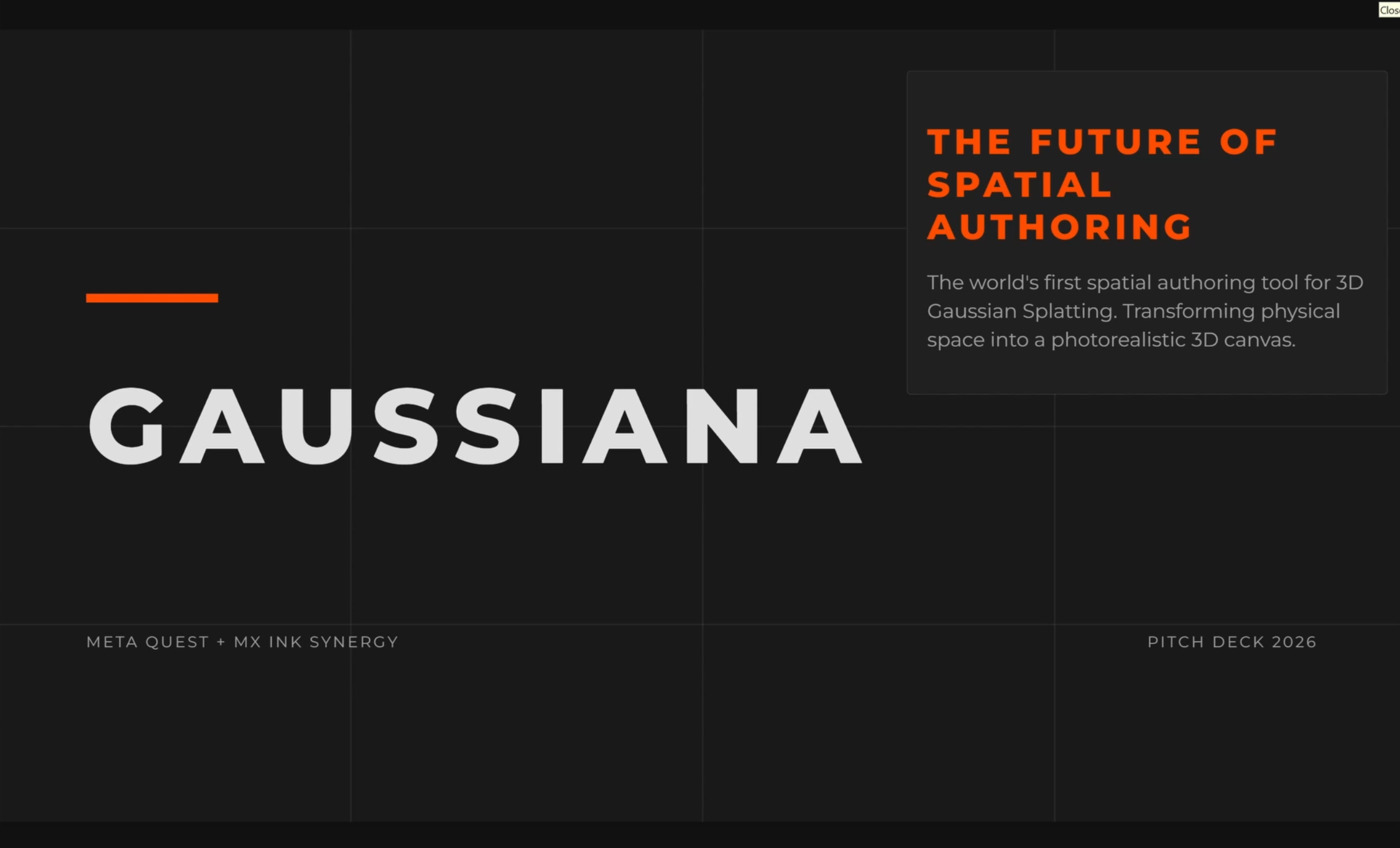
We believe Gaussiana can be the interface that makes this technology accessible to millions of creators. The difference between a research demo and a creative revolution is often just the quality of the tools. With Logitech's hardware and Meta's platform, we have the components. We need the partnership to assemble them.
Built With
- 3d
- gaussian
- three.js


Log in or sign up for Devpost to join the conversation.