-
-
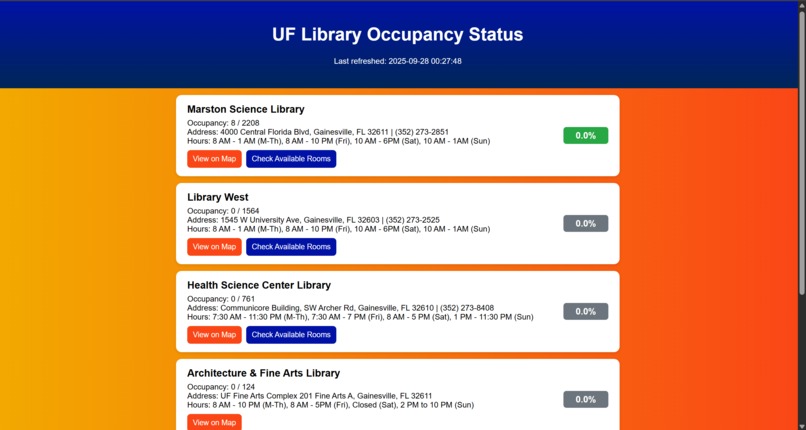
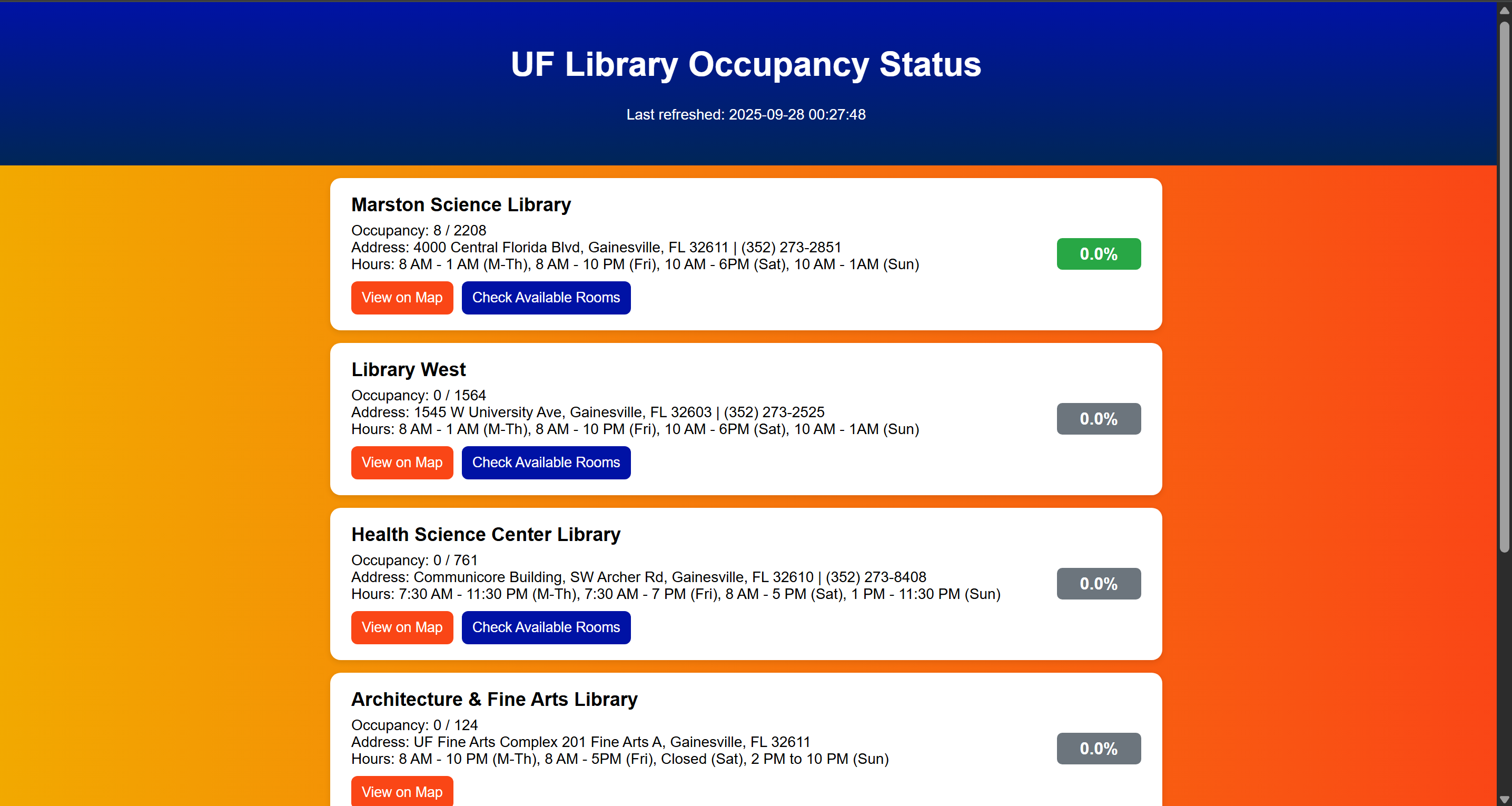
Website Screenshot
Inspiration
Our idea came from personal experience—going to Marston Library to brainstorm for this hack-a-thon, only to be quickly kicked out of a reserved study room because we had no easy way of knowing it was booked. Upon further research, we discovered how disjunct the library websites were when attempting to find frequently needed information, especially between libraries. Our team aspired to solve that problem by creating a single resource that makes cross-library information and booking simple and accessible.
What it does
This website puts everything you need to know about UF’s libraries all in one place. Instead of having to dig through four or five different sites, you can quickly find simple information like each library’s hours, phone number, and Google Maps location. Additionally, you can benefit from a live occupancy tracker that sorts your library options, helping you choose where to study and instantly reserve a room with the date and time pre-filled. This reduces time spent on searching for information exponentially as well as increasing student and faculty satisfaction in regards to interacting with these libraries.
How we built it
As beginner coders, this project was built through a combination of AI-assisted coding and hands-on-learning. We utilized web scraping to gather information, experimented with frameworks (ultimately landing on Flask), and pieced everything together with a focus on usability.
Challenges we ran into
Some of the biggest challenges we faced were:
1) Due to numerous last minute changes and cancelations, our Frankenstein team was formed last minute, beginning as a group of strangers without knowledge of our strengths or weaknesses to create an application.
2) With little experience in full-stack development, our team struggled to understand time-commitment and learning-requirements for each delegated task.
3) As novice coders, deciding which framework to use to combine our front and back end was a massive road block for our team, even halfway before the project before discovering Flask.
4) We had to resort to data scraping since the API was inaccessible and the website only rendered data on the client side rather than server side.
Accomplishments that we're proud of
As our entire team's first hack-a-thon, are are proud to have finished this website with all the features we originally wanted to implement. Despite the challenges, we were able to deliver a complete and functional project.
What we learned
Throughout the process, we learned a lot of new tools and skills, including:
- Git and GitHub
- Flask (to some extent)
- Web scraping
- How to set up a virtual environment
- The
datetimeandtimelibraries in Python - Team collaboration and project organization
- Website deployment techniques
What's next for GatorSpaces
Our next step is deployment. We want to make GatorSpaces a real tool that students at UF can use to save time and stress when navigating frequently used library resources.

Log in or sign up for Devpost to join the conversation.