-
-
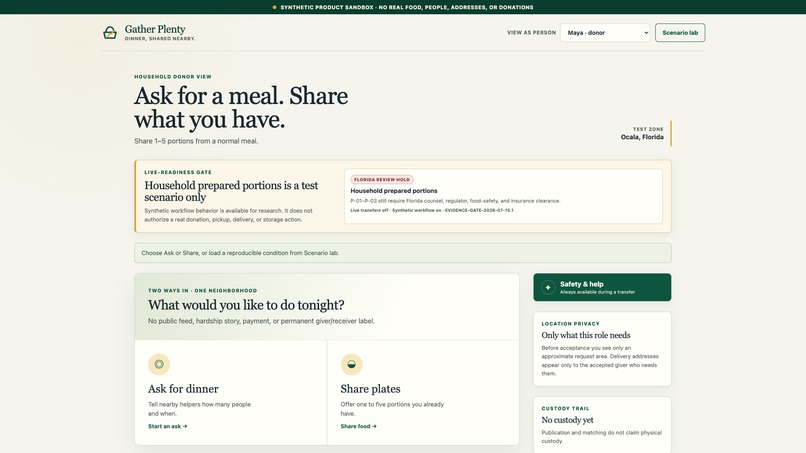
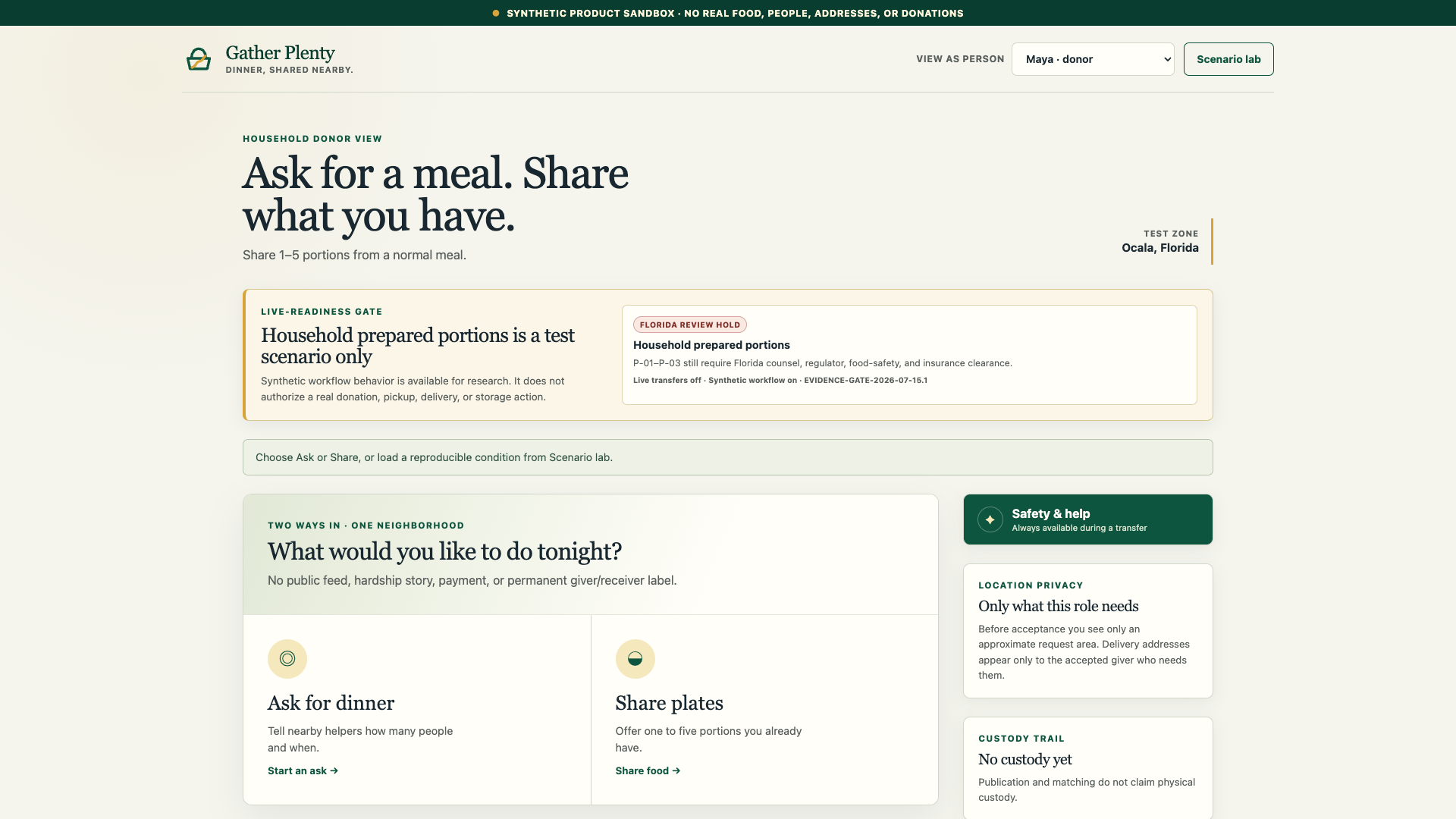
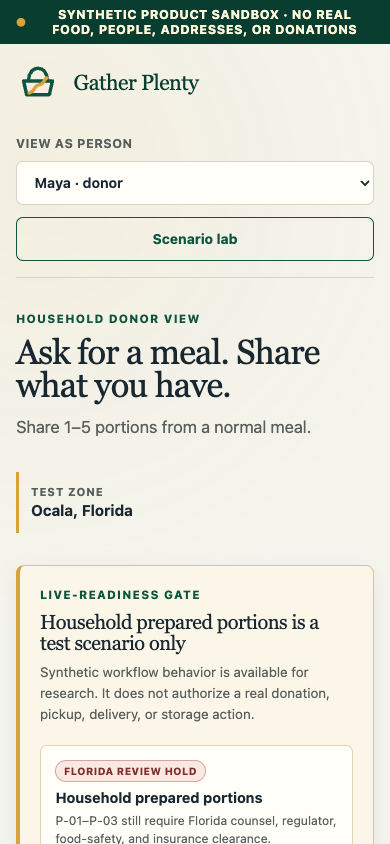
Equal Ask and Share entry point in the synthetic product sandbox.
-
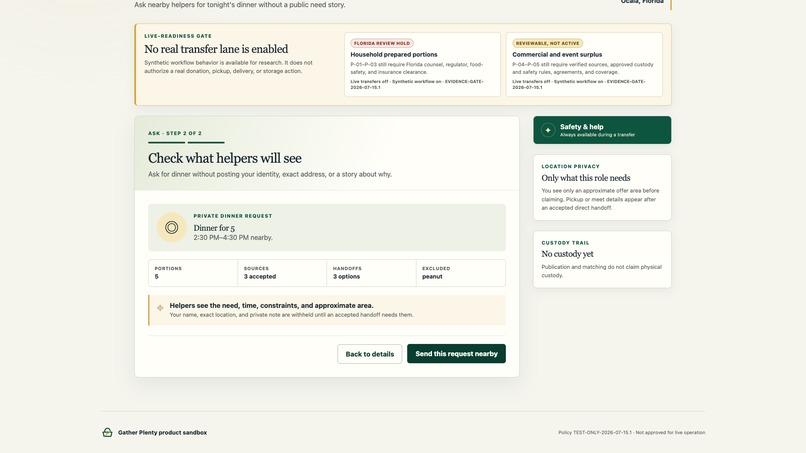
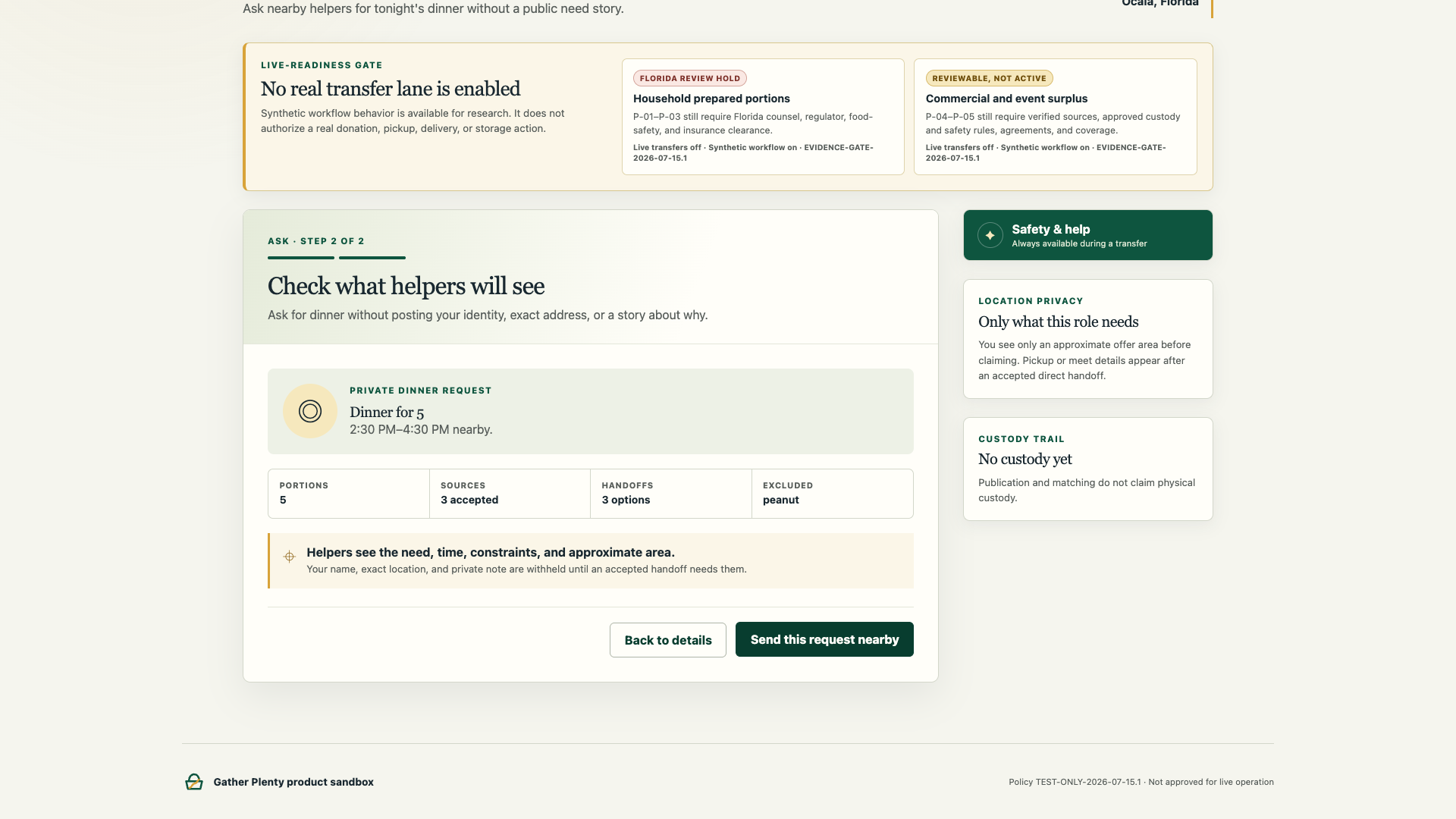
Private request review showing portions, timing, general area, and travel.
-
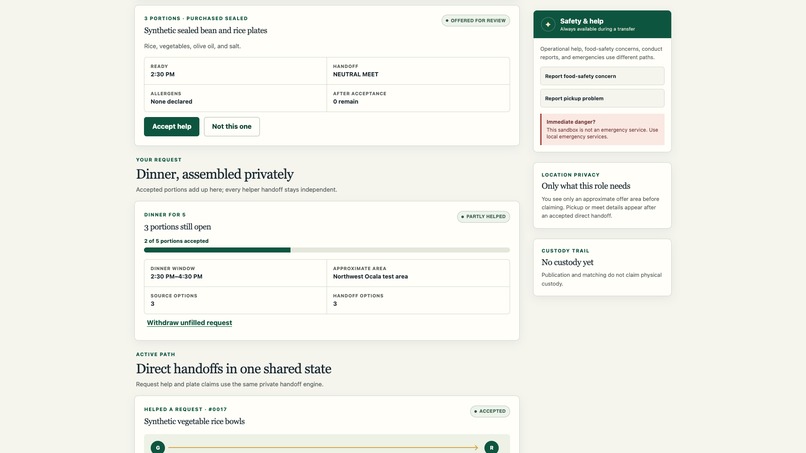
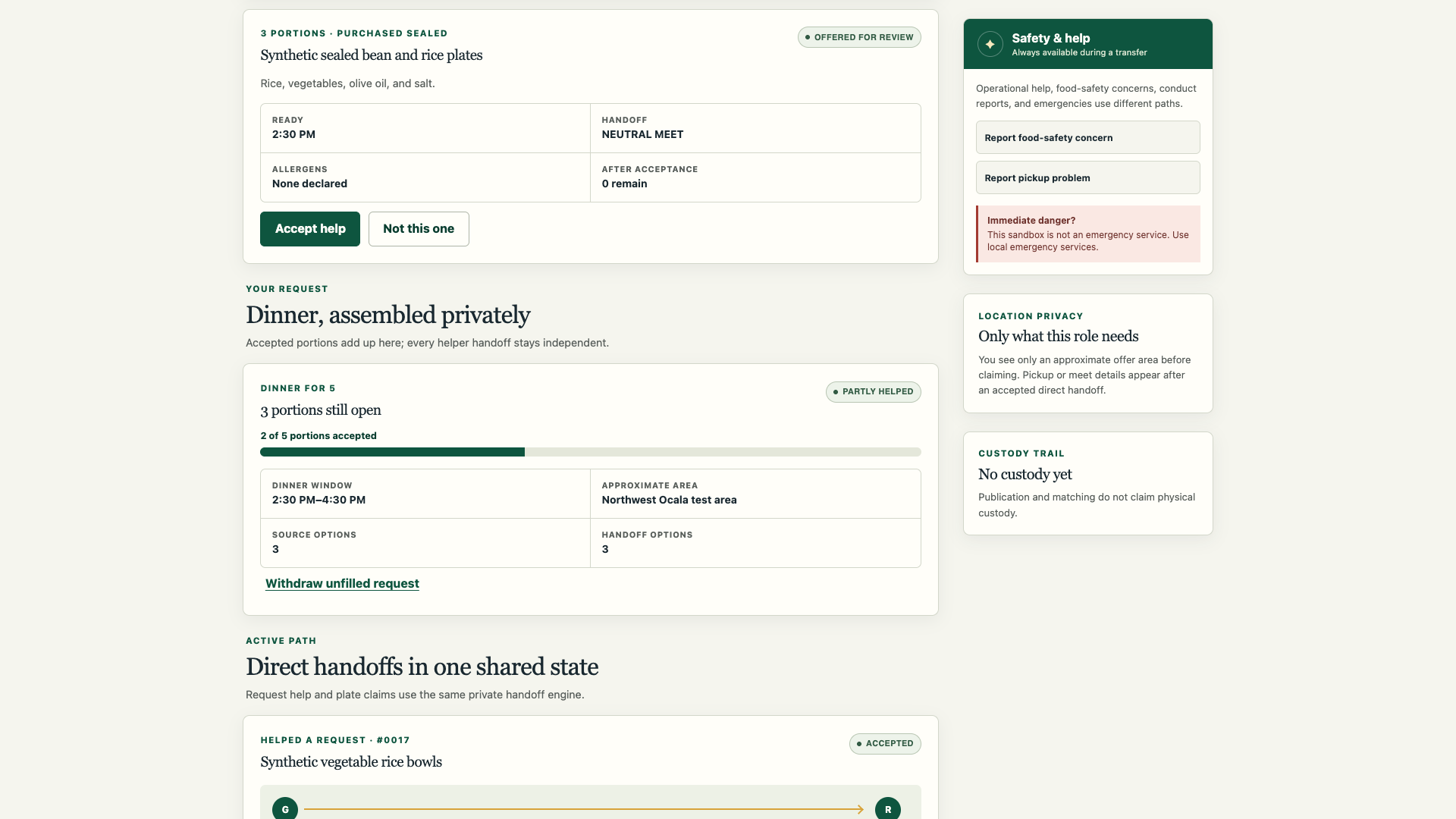
Two neighbors combine partial help to complete one five-portion request.
-
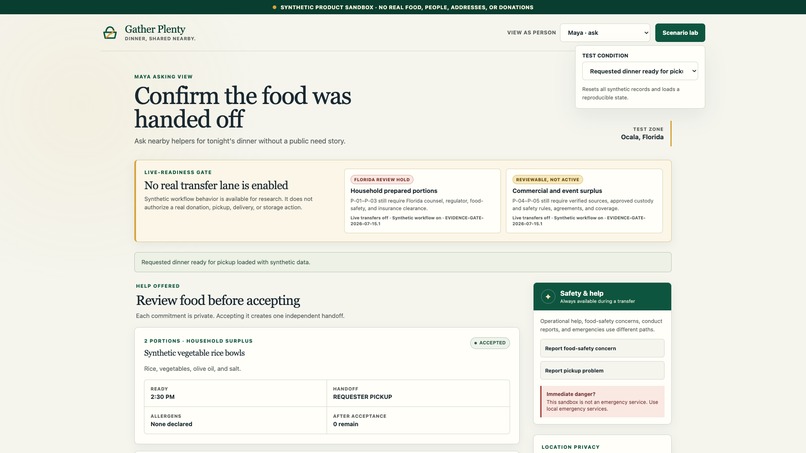
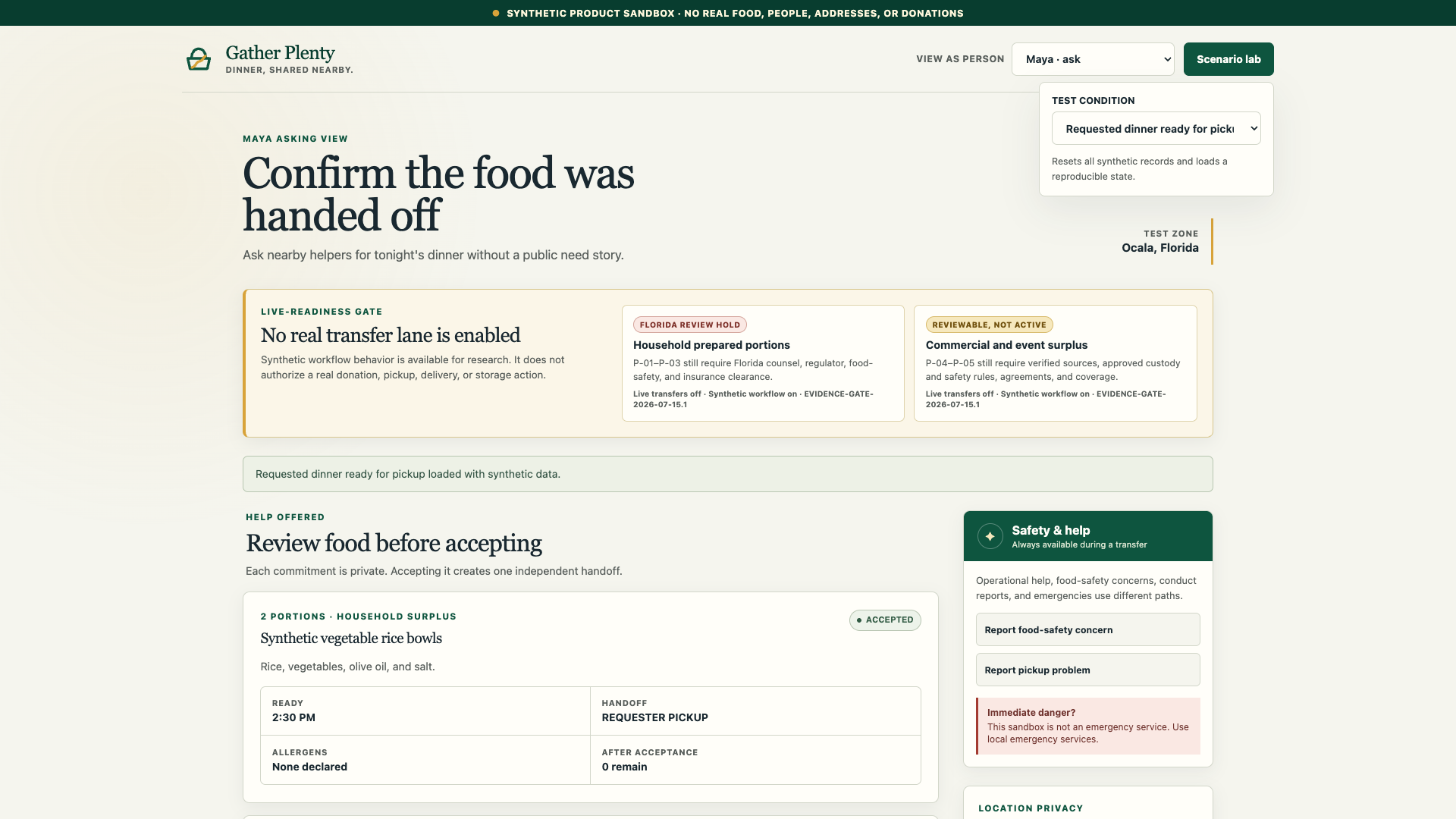
Exact handoff details appear only to the assigned participant who needs them.
-
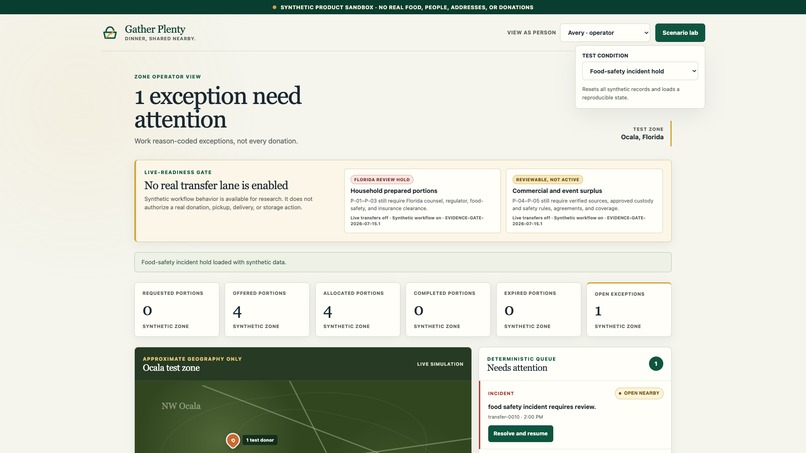
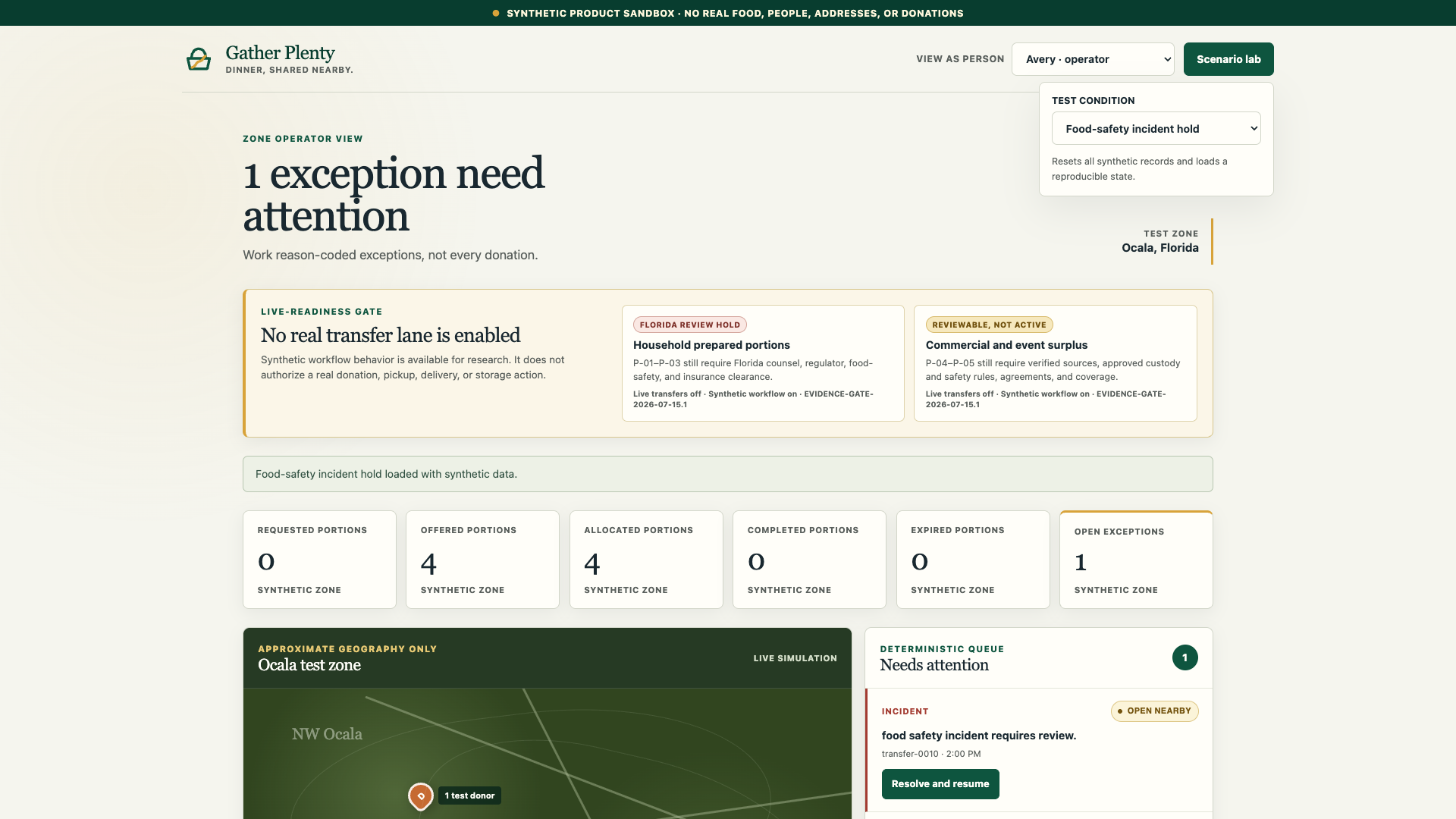
A reason-coded incident hold protects the handoff while preserving an audit trail.
-
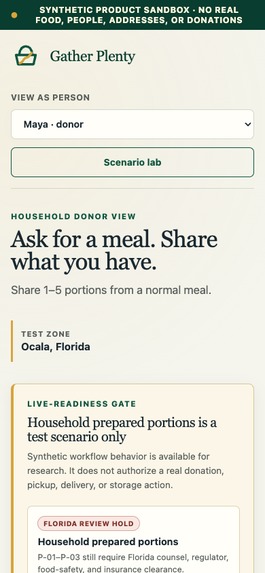
The complete Ask and Share entry experience at iPhone width.
Try it in 60 seconds
No account is required. Open the live synthetic demo, choose Ask for dinner, and set the portions and meal window. Then use View as person and capability to become a nearby helper. Open Scenario lab and load the partial-commitment condition to see two neighbors complete one five-portion request while private details remain scoped to each handoff.
Inspiration
Food abundance and food need often exist within a few streets of each other, but the coordination tools are awkward. Asking can feel public and stigmatizing. Sharing a few extra plates can feel operationally complicated. Gather Plenty treats both actions as ordinary parts of the same neighborhood system.
What it does
Gather Plenty gives every participant equal access to Ask and Share. A neighbor can request one to five dinner portions without publishing a personal need story, or offer one to five extra portions from a normal meal. Private matching supports partial fulfillment, so two neighbors can complete a five-portion request together.
The product coordinates quantities, timing, alerts, privacy, and handoff. It also models consent, expiration, cancellation, protected location release, notification failures, incident holds, and reason-coded operational exceptions.
The public scenario lab is deliberately synthetic. Judges can switch among participant capabilities, reset reproducible conditions, and walk both sides of a meal handoff without creating an account or using real people, addresses, or food.
How we built it
Gather Plenty is an installable React and TypeScript PWA. The public demo uses a deterministic scenario engine, while the separate invite-only alpha uses Supabase, PostgreSQL, and PostGIS.
I built the matching flow around requests, offers, commitments, and partial fulfillment. Transactional commands prevent over-allocation, and row-level security keeps an exact handoff location visible only to the person who needs it.
The release checks cover the main participant flows, partial-allocation races, database permissions, PWA packaging, responsive layouts, and dependency health. Cloudflare serves the public app and the no-account judge route at gatherplenty.org.
Codex and GPT-5.6
I built Gather Plenty with Codex as my primary engineering partner, using GPT-5.6 throughout the eligible Build Week work. I made the product calls: Ask and Share stay equal; nobody has to publish a need story; exact locations appear only when a handoff needs them; multiple neighbors can fill one request; and this pilot stays free and synthetic until the real-world safety and legal work is complete.
Codex helped me turn those choices into working product slices and tests. It refined the participant experience, reconciled the hosted Supabase implementation, configured Cloudflare delivery, added the public no-account judge route, and helped me stay honest about what is live versus simulated.
The qualifying work is recorded in Codex session 019e42d5-7e1d-7dd0-8803-30d5f1da8331. During that task, Codex used GPT-5.6 to help build, test, and ship the participant experience and judge route.
Challenges
The hard part was not drawing a marketplace screen. It was making partial portions, role changes, private locations, cancellation, expiry, and failure recovery behave coherently while keeping the everyday experience simple. A second challenge was preserving a credible path to production without pretending that technical readiness resolves real-world legal, food-safety, insurance, and operating questions.
Accomplishments
- One coherent consumer experience for asking, sharing, helping, claiming, and handoff.
- A five-portion request can be completed safely by two independent helpers.
- Deterministic scenarios cover partial fulfillment, direct handoff, expiry, incidents, notification outages, and operator exceptions.
- Durable invite-only authentication and transactional Postgres boundaries.
- Privacy-scoped exact-location release with immediate cutoff when a handoff closes.
- An installable mobile PWA delivered at a custom production domain.
- A public no-account demo that cannot create users, access private records, or enable live food.
What we learned
The product only feels simple when the hard cases are handled underneath it. I learned that the number of portions, who can see a location, and what happens after a partial match all have to remain obvious when something goes wrong, not only when the happy path works.
The scenario lab helped me find those rough edges early. Codex then helped turn each product decision into code and a repeatable test.
What's next
First, five people will complete twelve synthetic end-to-end sessions on their own phones. We will fix the completion blockers, connect measured transactional notifications, and then open one invitation-only synthetic neighborhood cell. A real-food pilot remains a separate, professionally reviewed activation decision.
Built With
- cloudflare
- codex
- gpt-5.6
- postgis
- postgresql
- pwa
- react
- supabase
- typescript
- vite
- vitest


Log in or sign up for Devpost to join the conversation.