-
-
Poster
-
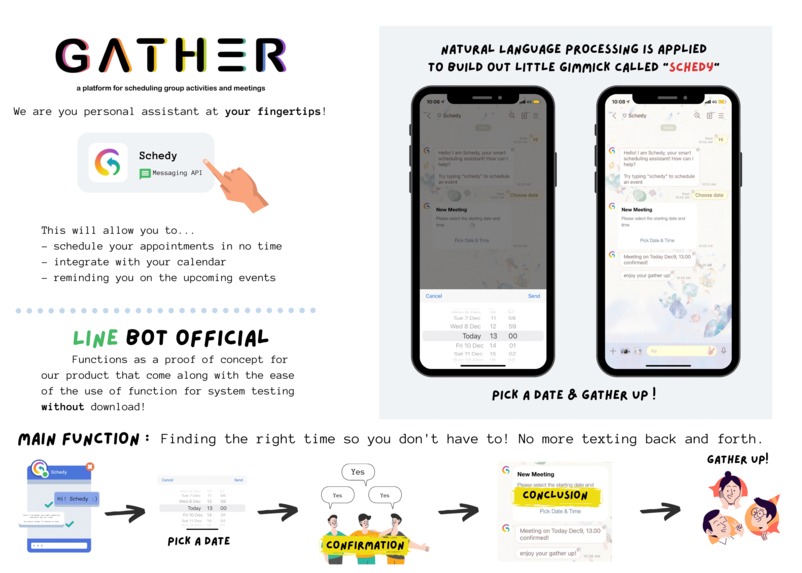
image gallery 1
-
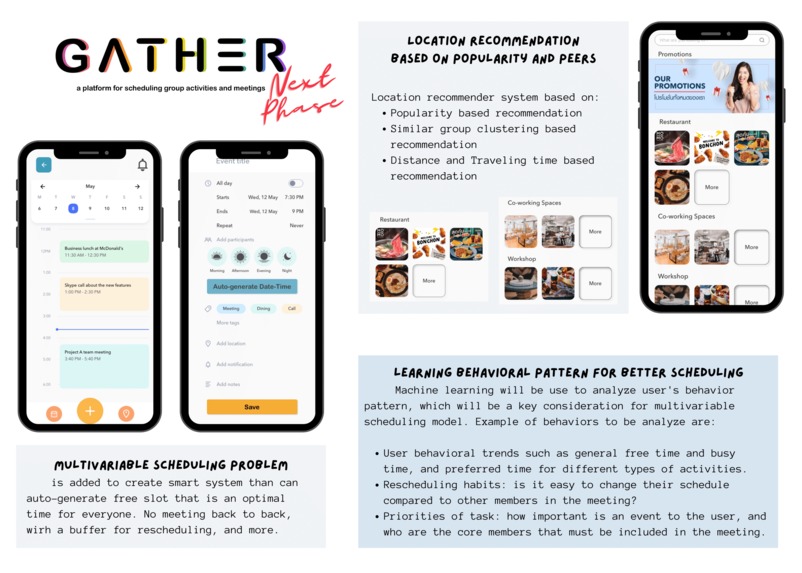
image gallery 2
Inspiration
In today’s world where collaboration is one of the keys to success, especially for us students, when there are so many group projects you need to work on and friends you need to meet. so scheduling for us students is not mainly for work, but it's the integration between work and play.
From our survey of 360 participants, we found that 20% of group activities are cancelled or postponed… where group activities in this case refer to casual outgoing with friends or group project meetings, not to mention the tedious process of scheduling and planning itself
This daunting problem happens because often times, there is no initiation in the group, and even if there is an initiator in the group, people might not engage in the discussion, making it impossible to pick the right time when everyone is free. Furthermore, sometimes it can be hard to come to a conclusion, especially when everyone schedules clashes. In some situations, we might even just postpone it for forever
There are 3 major pain points
- Finding the right time when everyone is free
- Members can be unresponsive, making discussion impossible
- Sometimes you’ll never know who’s coming until the actual date and it is very hard to confirm their status
What it does
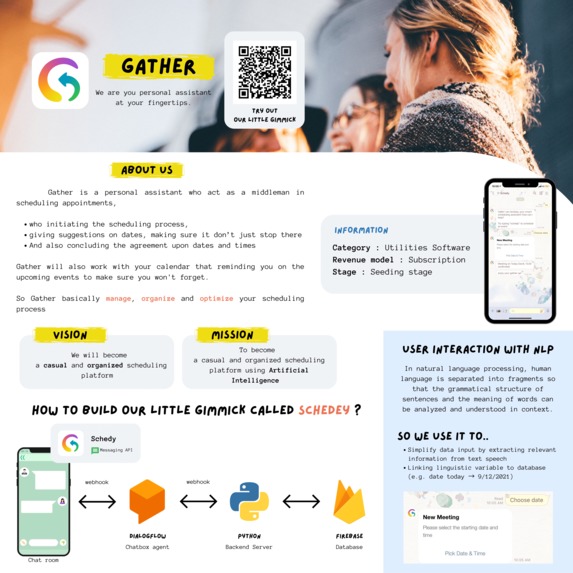
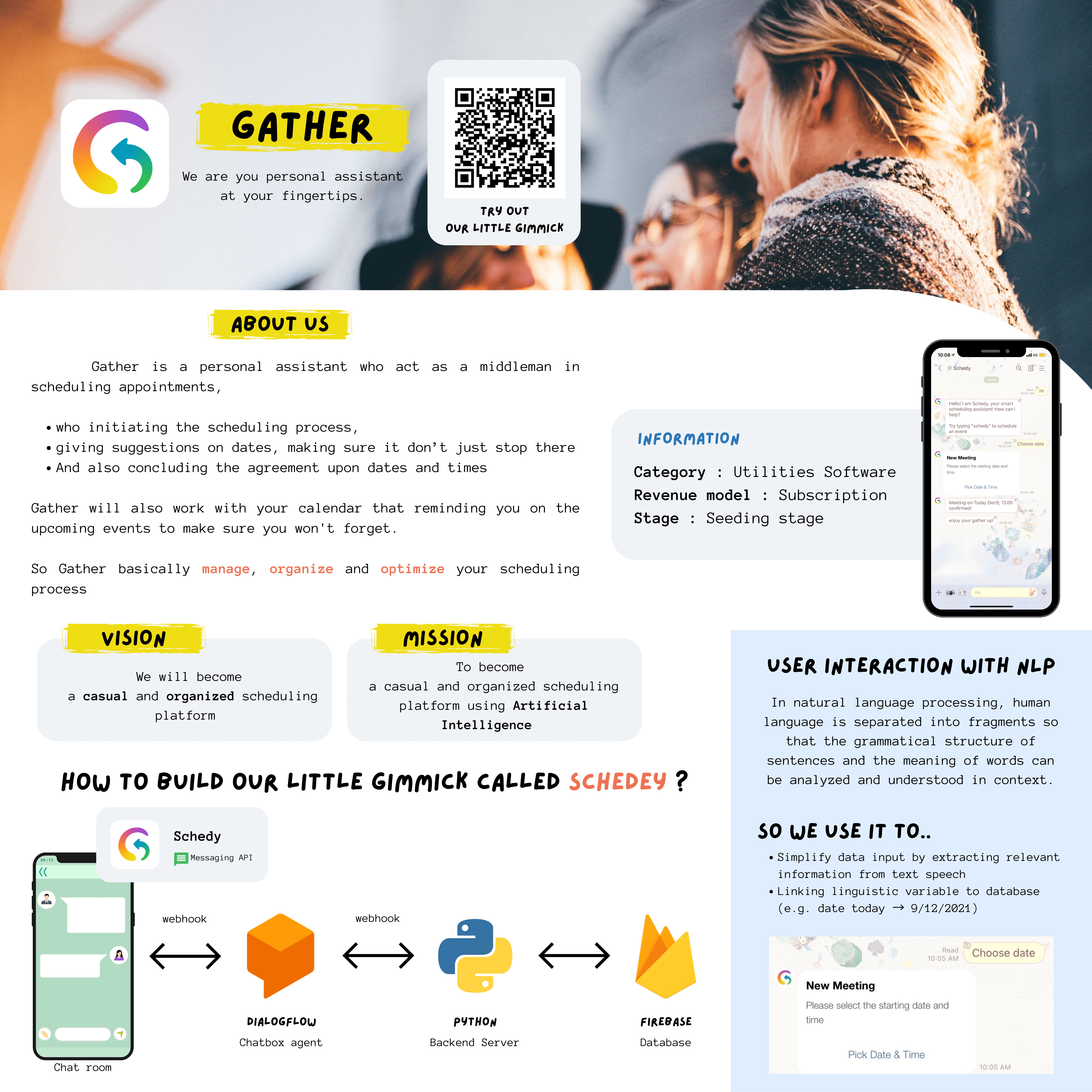
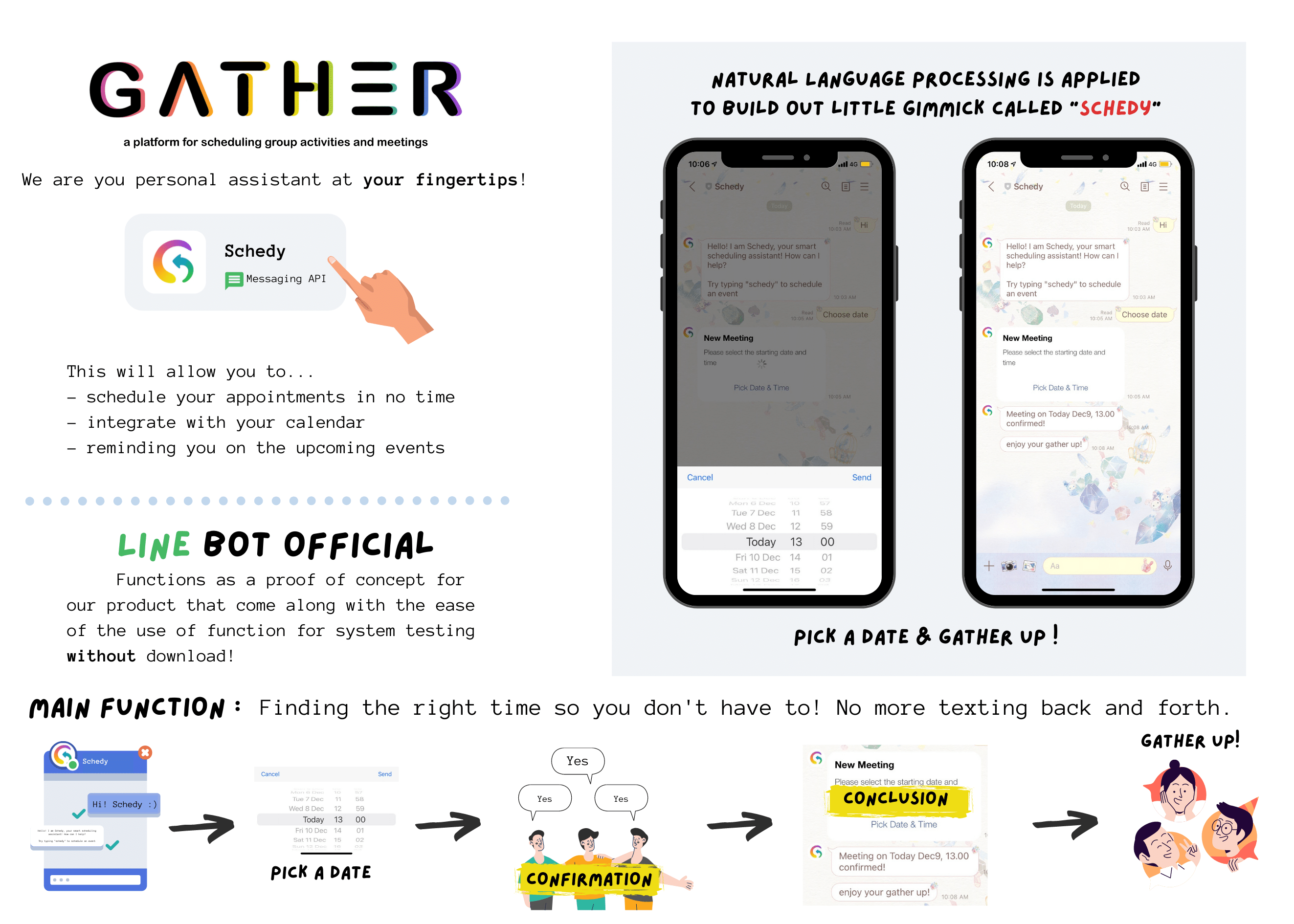
You can think of gather as a personal assistant. Our system will act as a middleman in scheduling appointments, initiating the scheduling process, giving suggestions on optimal dates, making sure it don’t just stop there, and concluding the agreed upon dates and times.
Gather will also work with your calendar, reminding you when the event approaches, making sure you won't forget. We manage, organize and optimize your scheduling process so you can "Do more and talk less".
How we built it
There are 4 main parts: line bot, dialogflow (messaging API), backend system (python, flask) and firebase (database). First, we made a simple flowchart to see what action our bot need to take. Then, we created a line bot and use webhook to link it with dialogflow. In dialogflow, we set up entities and intents that we need to implement. We also list out training phrases to map users input with different intents and specify the action and the response of each intent. (see more details in the slide)
For data to be analyzed and utilized in the back end, we connected it with firebase. However, as this project is conducted in parallel with our startup project, we are still in the process of developing our smart system that find the right time for everyone. One its done, it will be somewhat like what we show in the video/live demo. Therefore, the main focus of this project is rather exploring Natural Language Processing and utilizing it as an extension of our main product that will be launching soon!
Challenges we ran into
The biggest challenge of this project is the time constraint and novelty of exploration in this area. Although our product main value is on the smart system, most of the early progress so far was on UXUI, validations and prototypes. We have developers in our team, but they are focused on creating the MVP, thus it gotta be us (business and design people) who will explore this AI project, ironically.
Our approach to this is to explore platforms that are low-code or codeless due to limited time to learn everything. Although this works, it limits the customizability we are looking for.
Apart from the main challenges in technical side, as we are also working on this startup along side, there are few challenges regarding business aspects, such as high customer acquisition cost. Therefore, we also hoping that this AI projects can be evolved into a gimmick/useful function that create more interests in our product.
Accomplishments that we're proud of
As aforementioned, this project is not developed by the tech-side of our team but business and design people, we are glad that we can use this opportunity to explore of AI tools and have a better understanding of it. In a way, it also broadens our horizon of ideations, which will be really useful in the continuation of this project. By exploring more in these area, it also challenges us to revise many ideas that we settled on earlier, improving iteratively.
What we learned
We learned how to use DialogFlow for our LineBot, automating response and creating a function that users can utilize in day to day life. We also explored other tools in the software structure, namely LINE Front-End Framework (LIFF), which make User Interface more user-friendly. By exploring different ideas, we also learned how AI can be utilized for different aspect in the business, from process improvement to even better marketing.
What's next for Gather
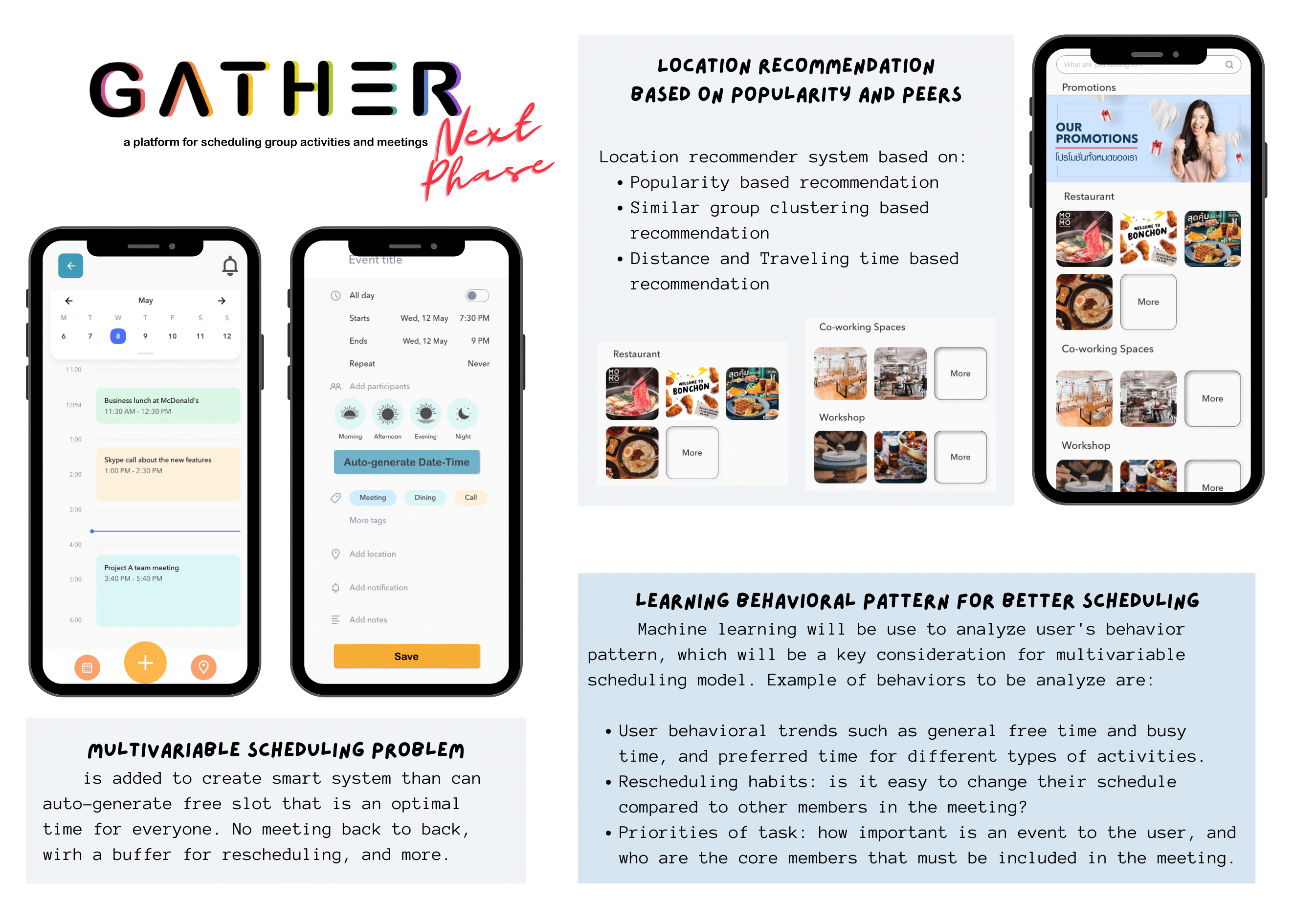
From our initial research and ideation, we are listed out several usage of AI where these are equally interesting, although we focus on scheduling problem as this is our main direction at the moment. However, we are also shifting a bit toward location-related function, such as Location Recommendation based on popularity and peers. In the next step, we will still continue working on the Line Bot and try to come up with new gimmicks for users to try.
Regarding business side, we will be developing the new MVP that we plan, where the project we created in this AI course can be an extension to the MVP. We will also be finishing up our branding and revising the business model by this year so stay in tuned!
Social Media Handles
Instagram: @gatherofficial.ig Facebook: Gather.official LinkedIn: Gather - Scheduling Platform
Built With
- dialogflow
- firebase
- gather
- linemessagingapi


Log in or sign up for Devpost to join the conversation.