-
-
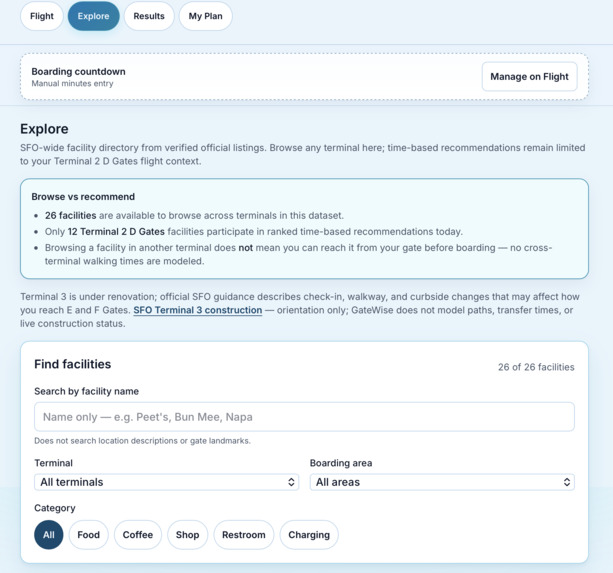
Discover airport amenities, explore facility details, and find places worth visiting before boarding.
-
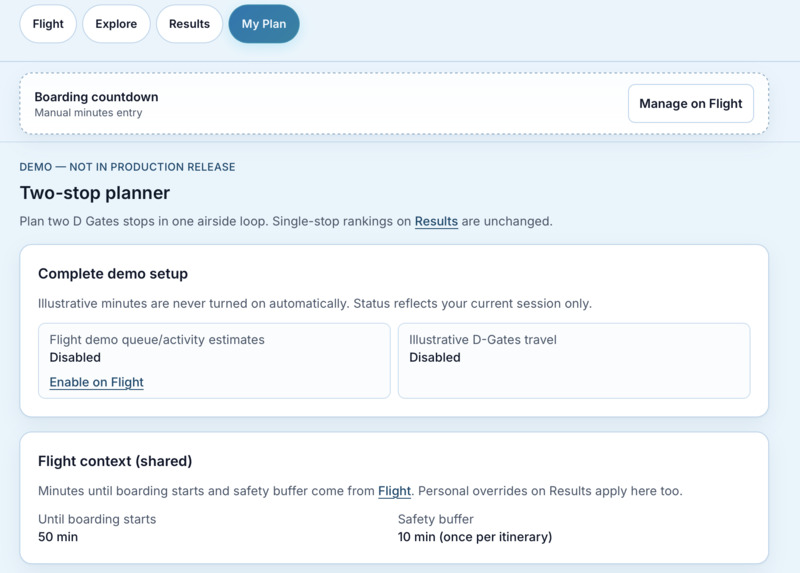
Plan visits to two airport amenities and compare their combined time requirements before boarding.
-
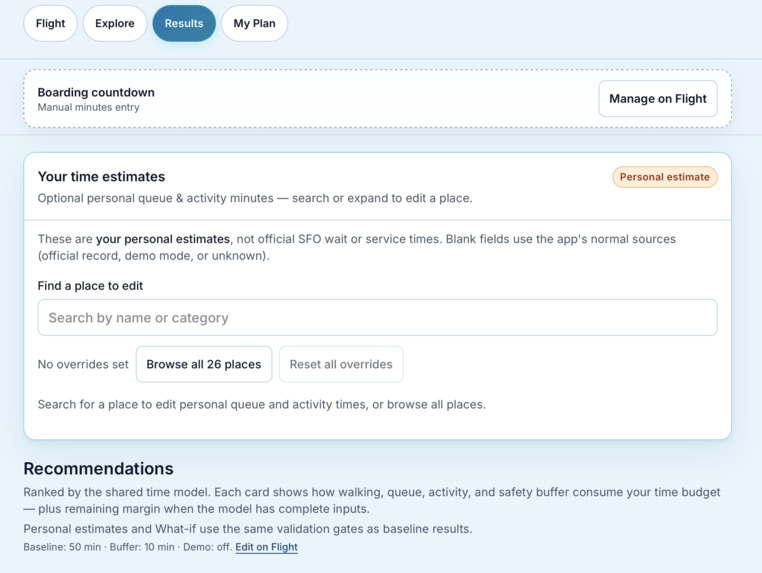
Evaluate airport activities using boarding time, queue and activity estimates, and a safety buffer.
-
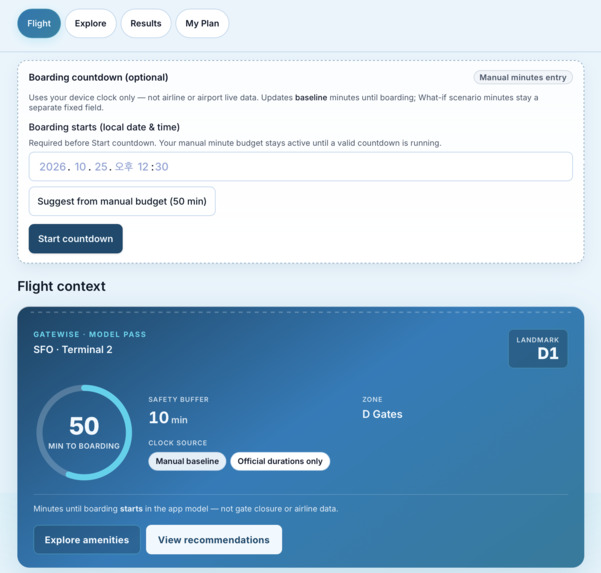
Track your boarding countdown and see how much time you have to explore before your flight.
Inspiration
Airports are full of opportunities to grab a meal, explore a shop, or relax before a flight. But travelers often face one important question:
"Do I actually have enough time before boarding?"
Traditional airport directories tell travelers what is available, but they rarely help determine whether visiting a particular place fits within the time remaining before boarding.
A restaurant might be nearby, but how long will the queue take? What if a traveler wants to visit two places? How much time should be reserved to return to the gate?
We built GateWise to transform airport downtime from guesswork into a more informed, personalized decision.
Our mission is simple: Make the Most of Your Time Before Boarding.
What It Does
GateWise is a time-aware airport companion that helps travelers discover amenities and evaluate which activities fit into their available time before boarding.
Our application currently supports San Francisco International Airport (SFO), with a focus on Terminal 2 D Gates for time-based recommendations.
Key features include:
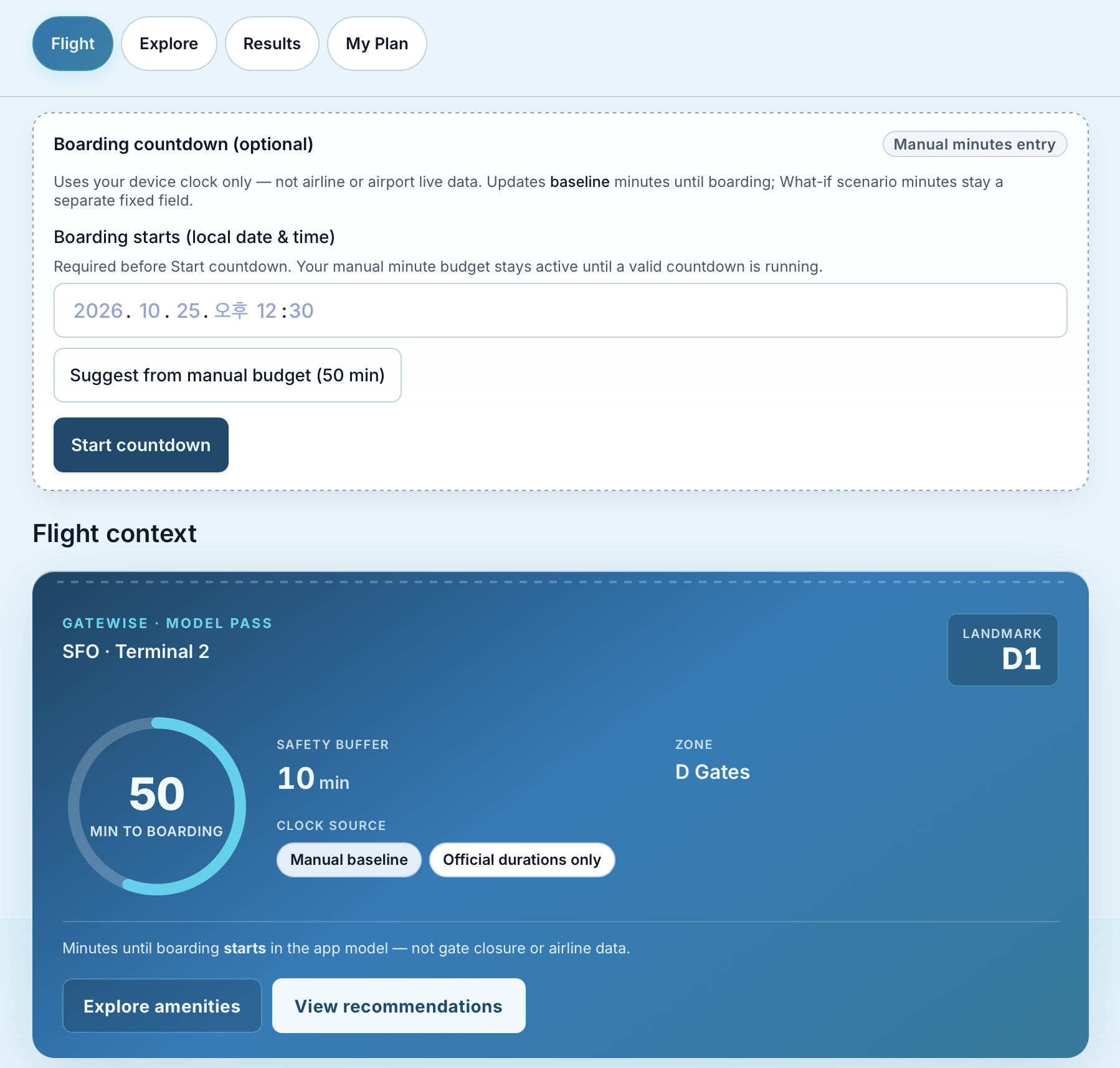
Flight & Boarding Countdown
Travelers can establish their boarding-time context and see how much time remains. GateWise uses boarding time rather than scheduled departure time as the planning deadline.
Airport Amenity Discovery
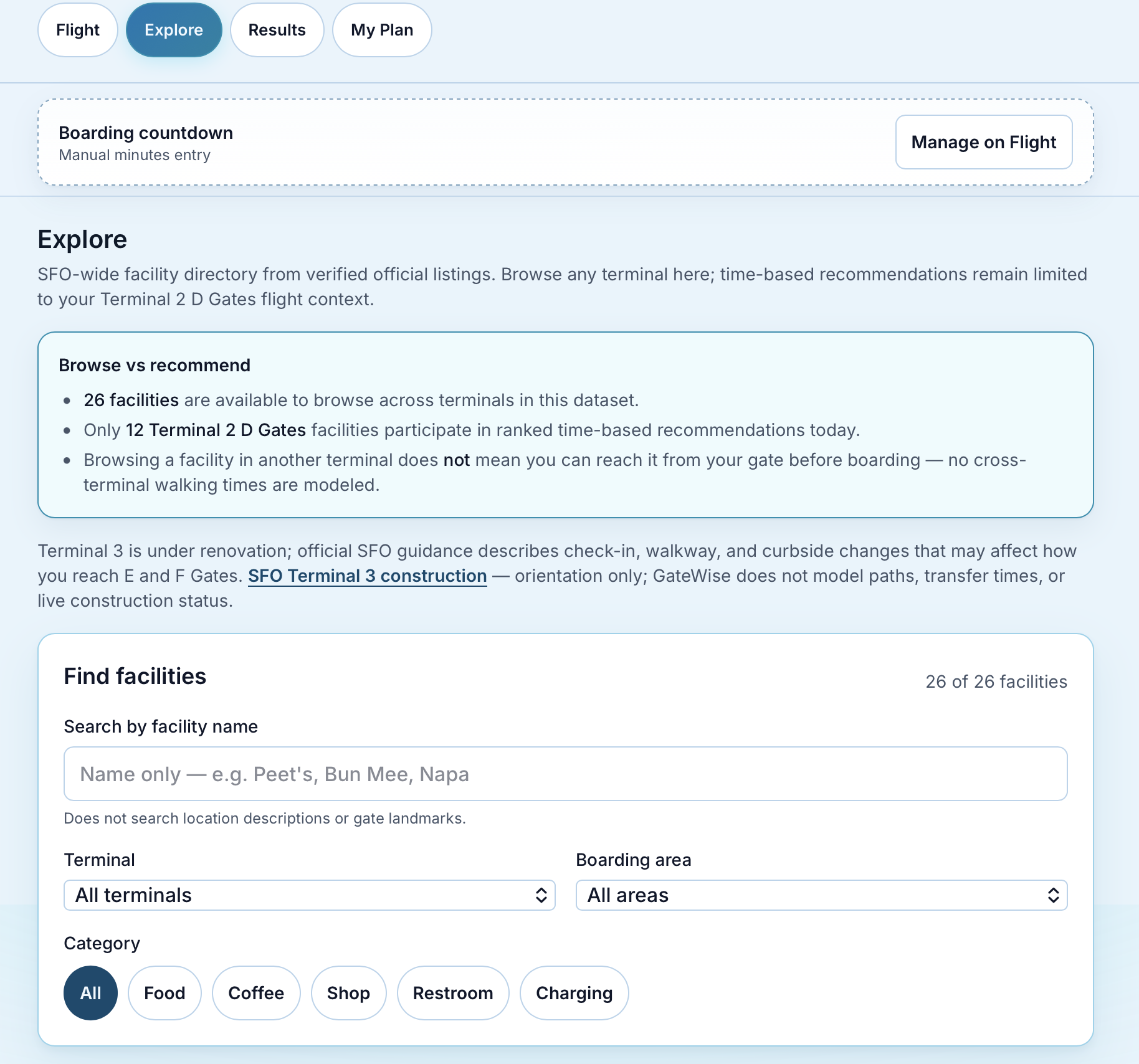
Explore 26 airport facilities, browse details, and discover dining, shopping, and other amenities.
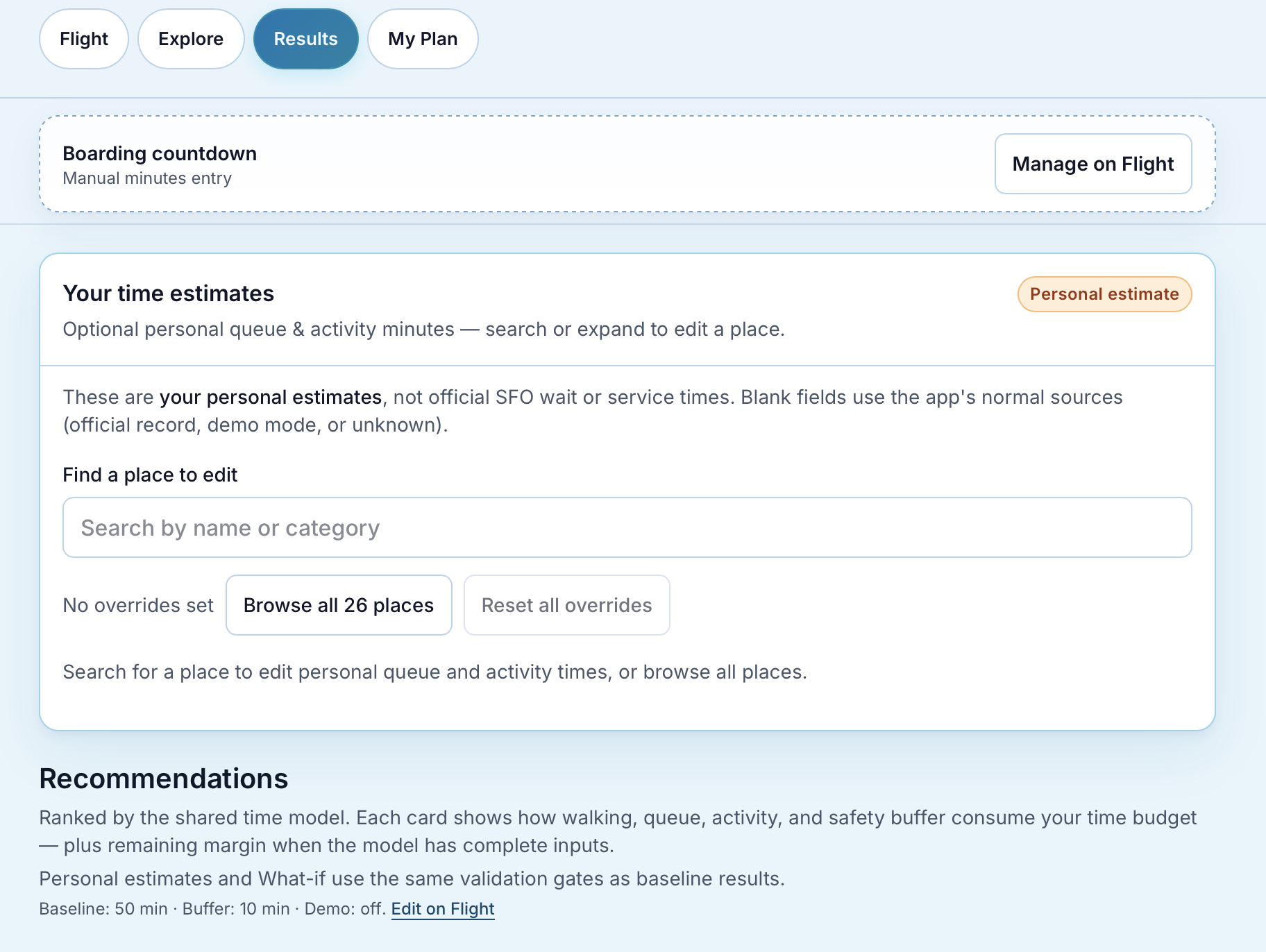
Personalized Time-Based Recommendations
GateWise evaluates eligible facilities using available time, walking assumptions, queue estimates, activity duration, and a safety buffer.
Activities are classified as:
- Feasible: Enough time remains within the model.
- Tight: The activity fits but leaves limited time.
- Over Budget: The estimated activity exceeds the available time.
- Unknown: Required timing information is unavailable.
What-if Simulator
Travelers can adjust planning assumptions and compare baseline recommendations against alternative scenarios.
A plan that initially looks feasible might become tight or over budget when the available time decreases or queue estimates increase.
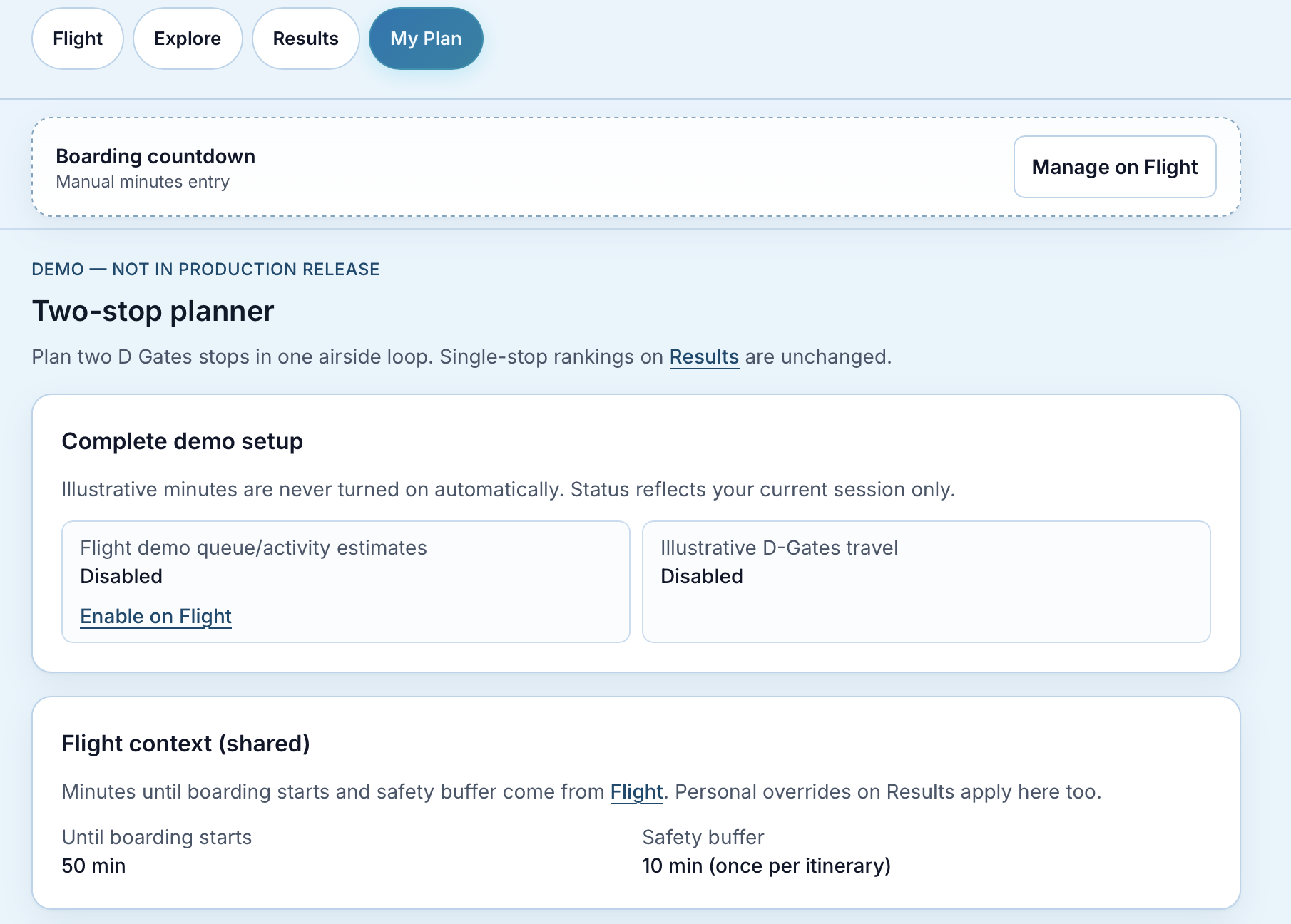
Two-Stop Planner
GateWise can evaluate a combined itinerary involving two facilities, accounting for both activities and the modeled travel between destinations.
The planner supports explicit demonstration travel assumptions while keeping missing real-world travel information Unknown by default.
Location Guidance
We integrated source-backed location evidence from official SFO facility listings and airport map information.
The interface displays supported gate-area labels, location confidence, and source references without pretending to know exact indoor routes or measured walking distances.
Responsive Experience
GateWise provides a mobile-friendly interface designed around the needs of travelers moving through an airport.
How We Built It
We developed GateWise as a web application using Next.js, React, TypeScript, Tailwind CSS, and Vercel.
We organized the application around several components:
- A responsive frontend for airport selection, flight context, facility exploration, and planning.
- A facility directory with clearly separated discovery and recommendation eligibility.
- A time-budget calculation engine for feasibility recommendations.
- A What-if engine for comparing planning scenarios.
- A Two-Stop Planner for evaluating combined itineraries.
- A source-backed location evidence layer.
- Automated unit and end-to-end testing.
Our recommendation model evaluates the relationship between available boarding time and the total time required for a proposed activity.
The calculation accounts for the applicable modeled travel, queue time, activity duration, and safety buffer.
Instead of treating missing inputs as zero, GateWise explicitly identifies uncertain results.
We used Vitest for automated unit tests and Playwright for browser-based end-to-end testing.
Our final product release passed 945 unit tests and 23 end-to-end tests, alongside TypeScript, lint, and production-build verification.
We also used GitHub feature branches and independent engineering reviews to develop, test, and integrate functionality safely.
Challenges We Ran Into
1. Reliable Airport Walking Times
One of our biggest challenges was determining how long it actually takes to walk between airport facilities.
Although official airport maps provide useful location information, they do not necessarily provide verified walking routes, precise facility entrances, or measured travel times.
Rather than inventing accurate-looking numbers, we separated verified location evidence from synthetic demonstration travel assumptions.
2. Handling Missing or Uncertain Data
Real airport planning involves uncertainty.
Queue estimates, activity durations, and walking times may not always be available.
We designed GateWise to return Unknown when necessary rather than silently substituting zero or presenting an unsupported recommendation.
3. Building a Reliable Two-Stop Planner
Evaluating two destinations is more complicated than evaluating each independently.
The planner must account for the combined time budget, interfacility travel, both queues, both activities, and the relevant return travel.
Independent adversarial testing identified several boundary-condition defects, including zero remaining boarding time and adjusted queue values.
We corrected these issues and verified the engine through regression tests.
4. Delivering a Consistent Mobile Experience
We needed to keep detailed time calculations, facility information, and location guidance understandable on smaller screens.
We refined responsive layouts, modal keyboard navigation, and accessibility behavior through repeated testing.
Accomplishments We're Proud Of
We are especially proud of:
- Turning a familiar airport-directory concept into an actionable time-budget planning experience.
- Supporting both single-stop and two-stop itinerary evaluation.
- Building an interactive What-if comparison experience.
- Keeping simulation assumptions explicit instead of presenting them as measured airport data.
- Integrating official location evidence while preserving uncertainty.
- Delivering a fully deployed, mobile-friendly application.
- Using independent testing to identify and correct real defects before our final release.
What We Learned
Building GateWise taught us that creating a useful recommendation system requires more than implementing calculations.
The trustworthiness of the inputs matters just as much as the algorithm itself.
We learned how to balance ambitious features with data availability, separate simulation from verified information, build resilient user interfaces, and use automated testing to validate edge cases.
We also gained experience coordinating parallel development, integrating independent work, and preparing a production release under hackathon constraints.
What's Next for GateWise
Our next steps include:
- Integrating validated indoor walking routes and measured travel-time data.
- Exploring authorized real-time flight and queue information.
- Expanding recommendation coverage to more terminals and airports.
- Improving location-aware activity planning.
- Enhancing personalization and itinerary optimization.
Our long-term vision is to make GateWise a useful airport companion that helps travelers make better decisions about how to spend their time.
GateWise doesn't just show you where to go. It helps you decide whether you have time to go.
Built With
- css3
- github
- html5
- javascript
- next.js
- node.js
- react
- tailwind-css
- typescript
- vercel
- vitest

Log in or sign up for Devpost to join the conversation.