-
-
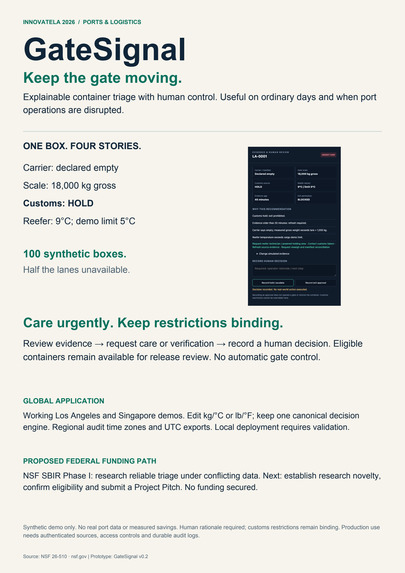
GateSignal poster: human-controlled port triage, global portability, and a proposed federal funding pathway.
-
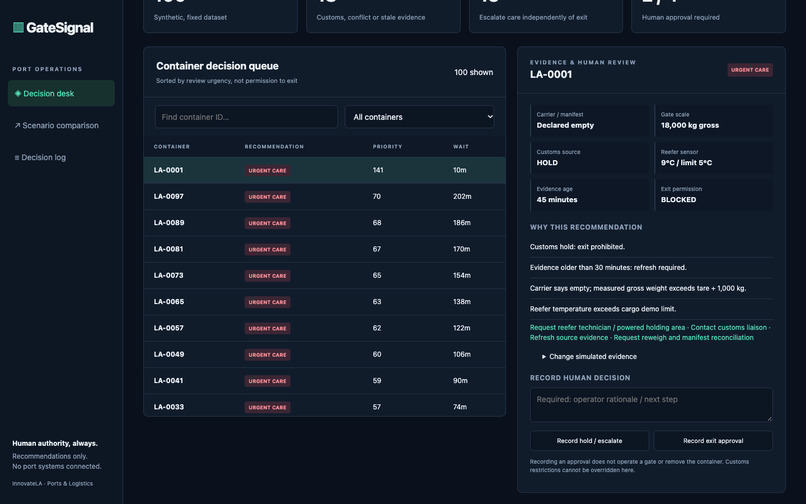
Synthetic-data demo: conflicting cargo evidence triggers urgent care and human review while customs restrictions remain binding.
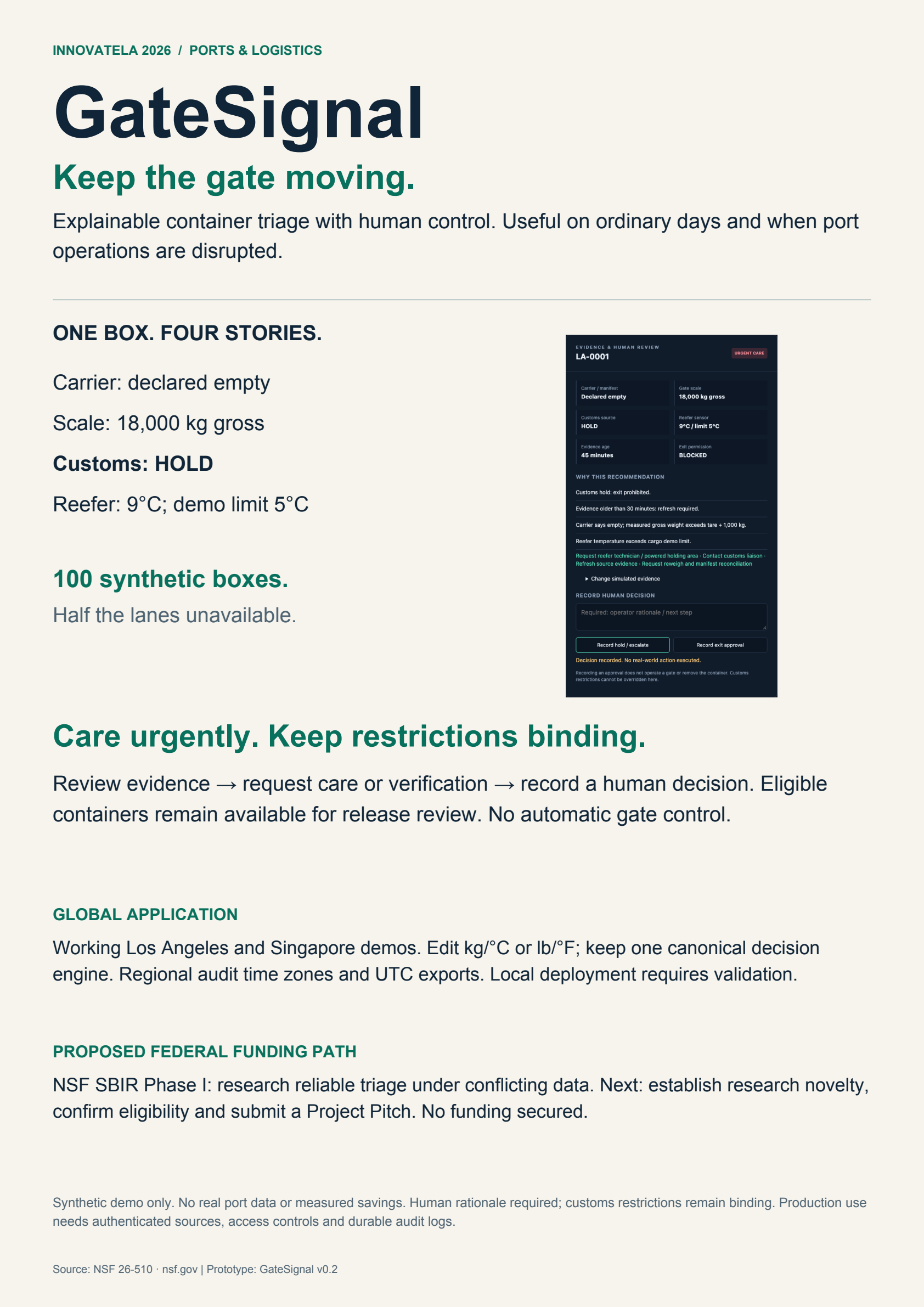
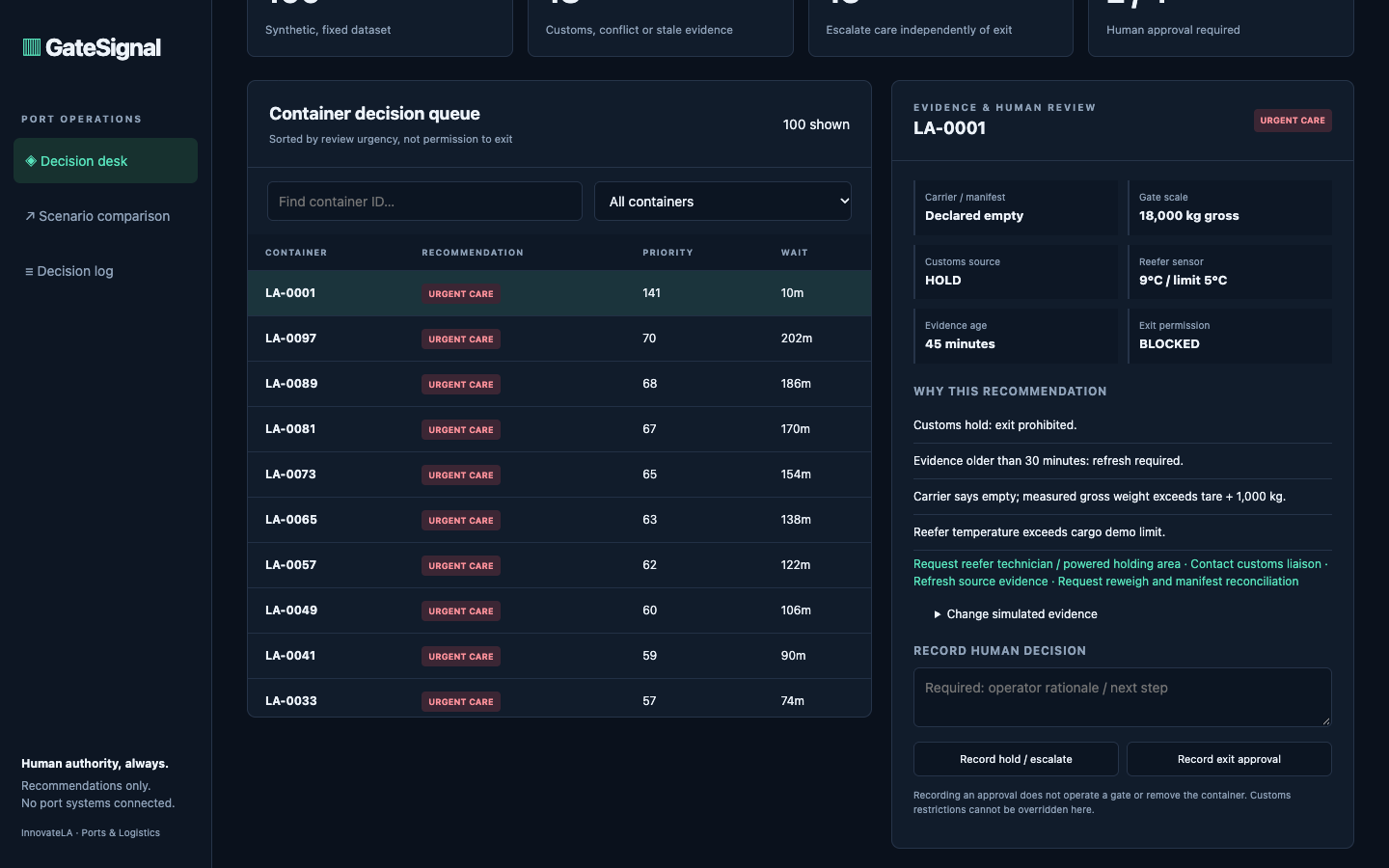
Inspiration A terminal planner faces one container with four conflicting signals: the carrier says empty, the scale says heavy, customs says hold, and the reefer is warming. Meanwhile, other containers need the gate and half the lanes are unavailable.
GateSignal helps the planner choose a proportionate response: prioritize urgent cargo care, verify conflicting evidence, preserve customs restrictions, and keep other eligible containers available for human review.
What it does GateSignal is an interactive browser prototype using 100 synthetic containers. It identifies weight discrepancies, customs restrictions, stale evidence, and refrigerated cargo above its demo temperature limit.
It separates cargo urgency from permission to exit. A warming container receives urgent-care priority without bypassing a customs hold. Operators can edit simulated evidence, recompute recommendations, adjust available lanes, record a reasoned human decision, and export evidence and decisions together.
Recording an approval does not operate a real gate or release a container.
How we built it We built the application with HTML, CSS and JavaScript, separating the deterministic decision engine from the interface. The downloaded demo runs offline without API keys or external model services.
The prototype uses transparent rules rather than an AI model making release decisions. OpenAI Codex/ChatGPT assisted with implementation, writing and testing.
Dual-use fit On ordinary days, terminal planners and shipper coordinators can use the workflow to review routine exceptions and reconcile records. During disruption, a terminal duty supervisor can use the same workflow to prioritize cargo care when gate capacity is reduced.
These are intended customer roles, not confirmed customers.
Adapting to the three twists Twist 1 — Federal funding: We identified NSF America’s Seed Fund, SBIR Phase I, as a proposed federal R&D pathway. Next steps are to establish research novelty beyond the current rules prototype, verify company and investigator eligibility, and submit a Project Pitch. We have not applied for or secured funding.
Twist 2 — Global application: We added working Los Angeles and Singapore demonstration profiles, kg/°C and lb/°F display and input conversion, and regional audit timestamps. The engine retains canonical kg/°C values. This demonstrates portability; local policies and workflows still require validation.
Twist 3 — Poster: We produced a printable A3 poster showing the evidence conflict, human decision process, global adaptation and proposed funding pathway.
Challenges and what we learned The main challenge was separating urgency from authority: urgent cargo care must not cancel a customs restriction. We also needed consistent units and explicit time zones for the global adaptation.
The prototype passed 14 engine checks and 18 browser checks covering restrictions, stale evidence, zero lanes, exports, regional profiles and unit conversion.
Results and limitations All data is synthetic. The capacity comparison is a toy model, not measured port performance. Holding space, staffing, movement time and powered-bay capacity are not modeled. We claim no proven real-world delay, cost or emissions savings.
The decision log lasts only for the current page session and must be exported before closing or resetting.
What’s next Validate the workflow with terminal planners, agree local policies, replay authorized historical cases, and measure recommendation errors and operator decision time. Operational use would require authenticated sources, access controls, durable audit records and capacity-aware cargo-care planning.
Responsible use Misuse could include unjustified cargo holds or mistaking recommendations for customs authority. We label simulated data, require human rationale, block restricted exit approvals, and connect to no real gates.
Tools used HTML, CSS, JavaScript, Node.js, OpenAI Codex/ChatGPT, Playwright, Google Chrome, OpenAI Artifact Tool, ReportLab, pypdf and pypdfium2.
No IBM Bob use or Terminal49 API integration is claimed.
Poster — Twist 3
View or download our printable poster: https://drive.google.com/file/d/1t_fbF51N9KS1FC1ahjrTq3DzfTalt3si/view?usp=sharing
Built With
- chatgpt
- codex
- css
- html
- javascript
- node.js
- playwright

Log in or sign up for Devpost to join the conversation.