-
-
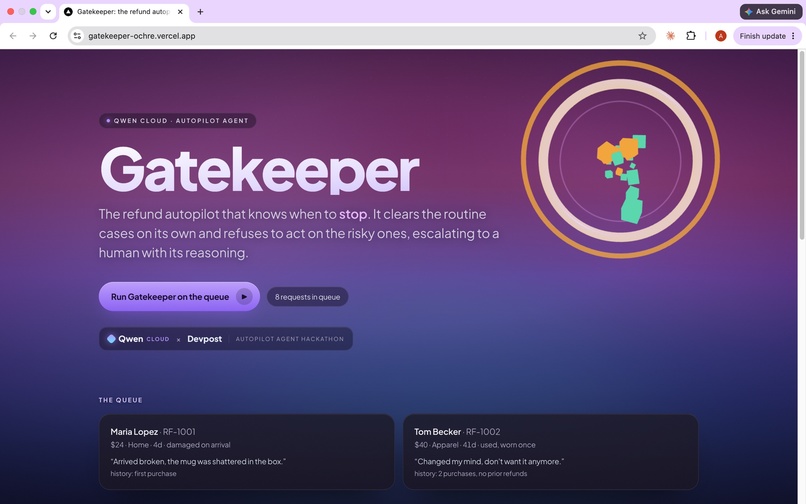
The refund autopilot that knows when to stop. Built on Qwen Cloud for the Global AI Hackathon Autopilot Agent track.
-
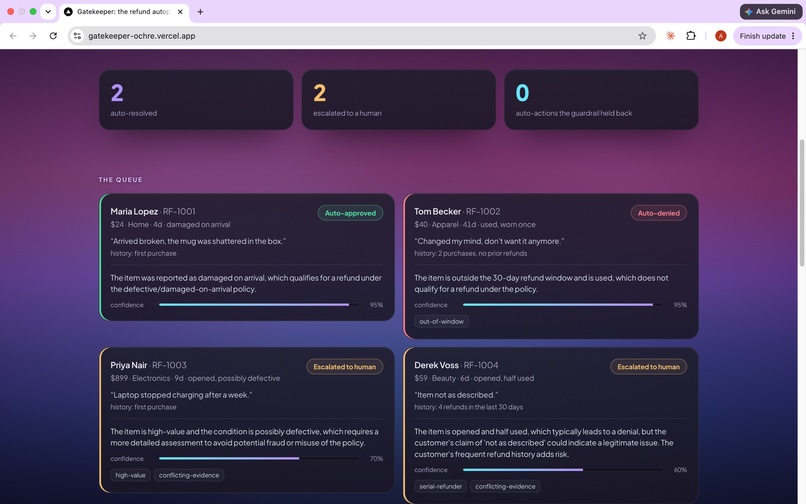
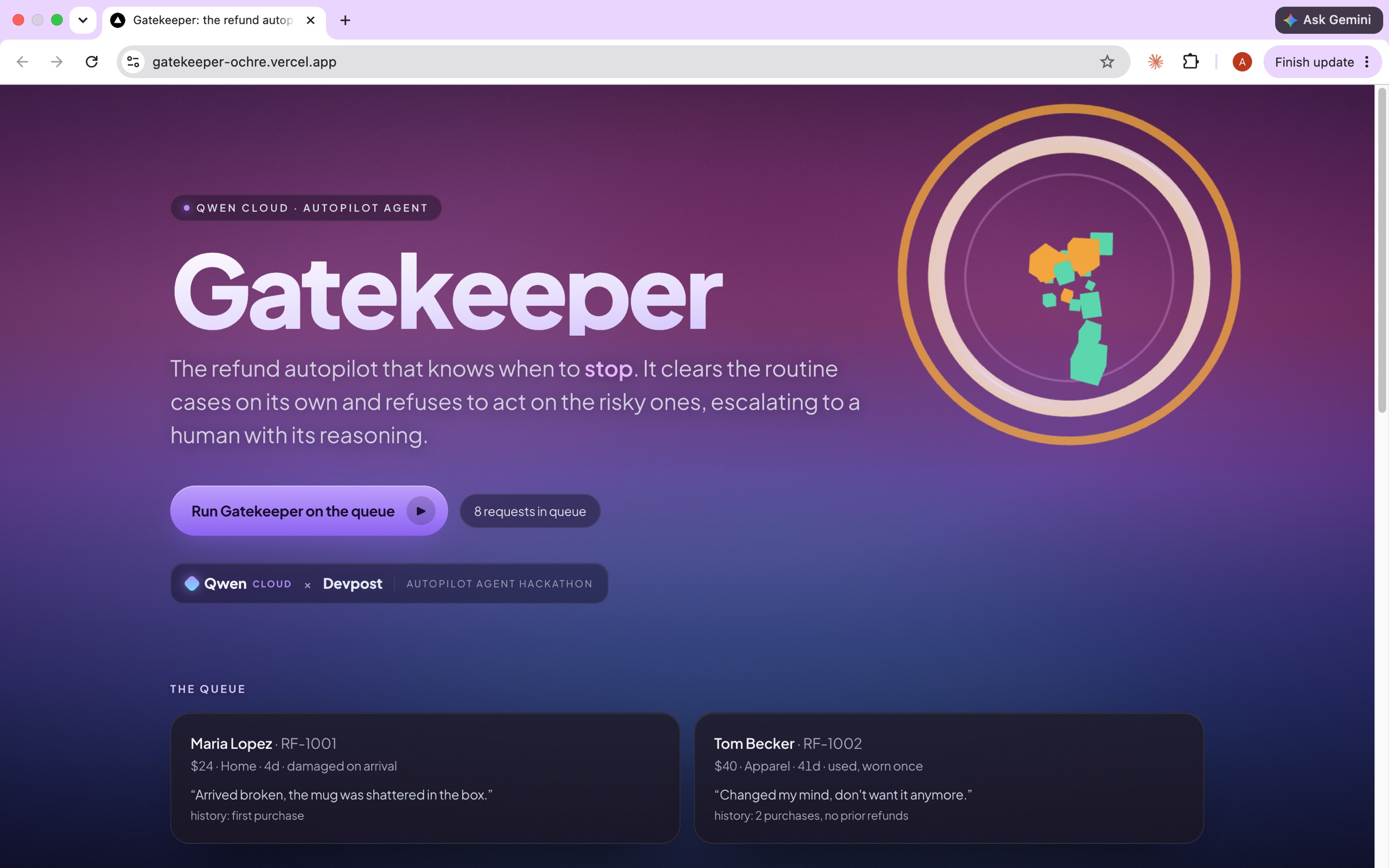
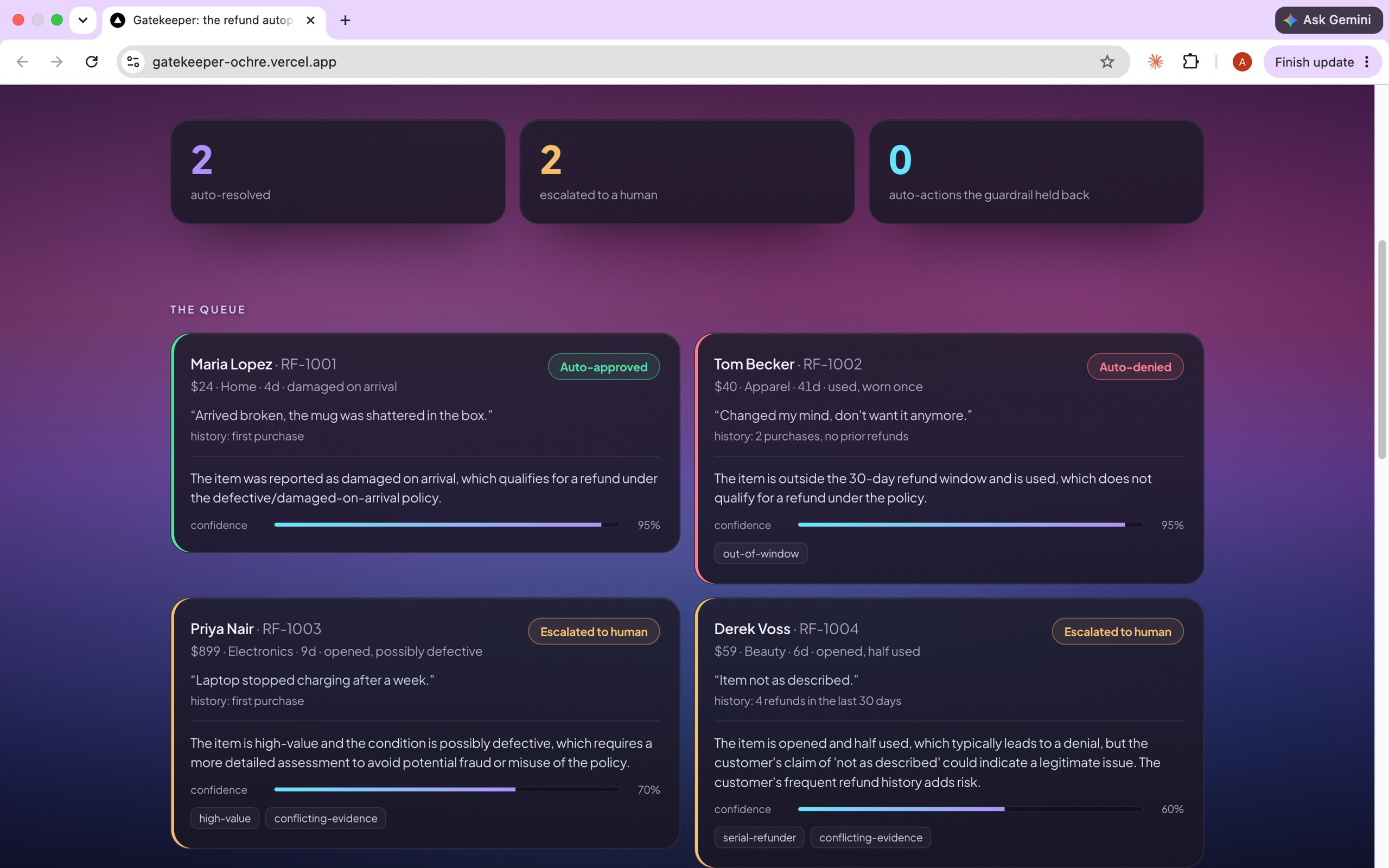
Live results: green = auto-approved, red = auto-denied, amber = escalated to human with full reasoning attached.
-
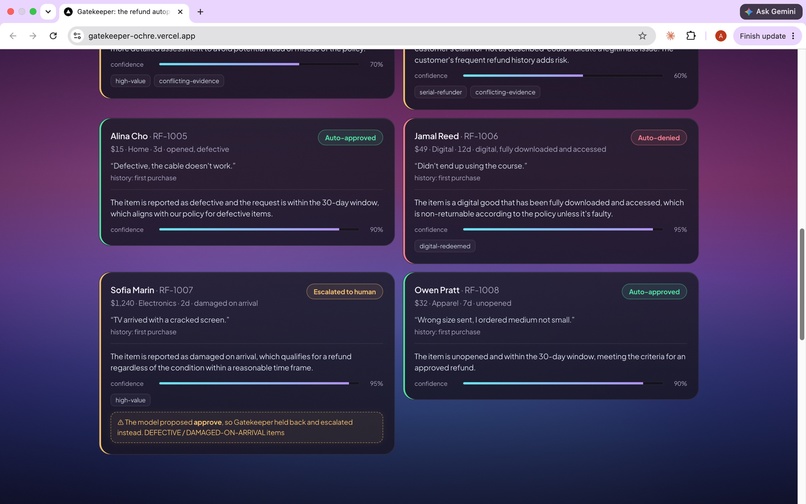
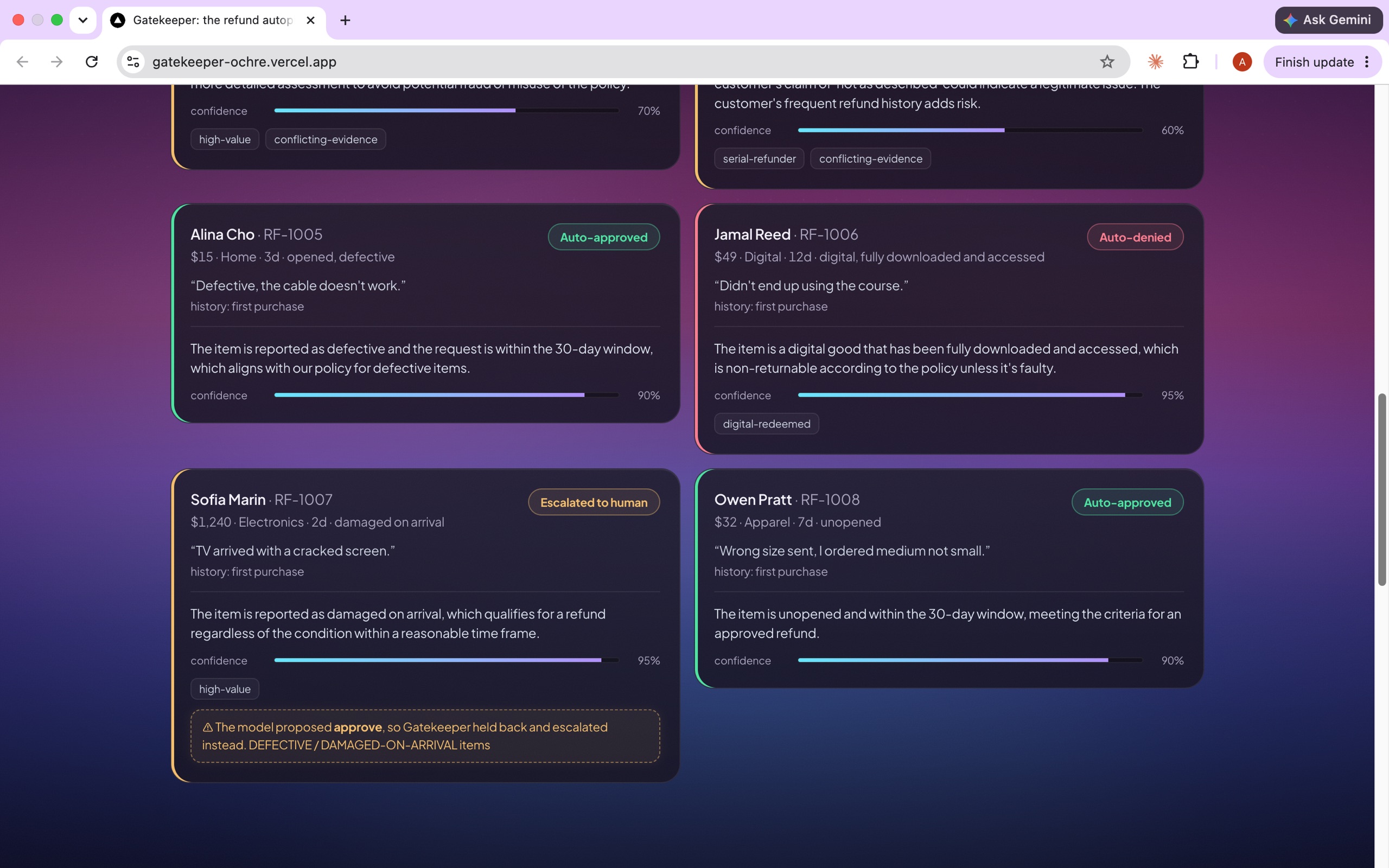
The guardrail overrides the model on a $1,240 TV, escalating instead of approving. Restraint enforced in code.
-
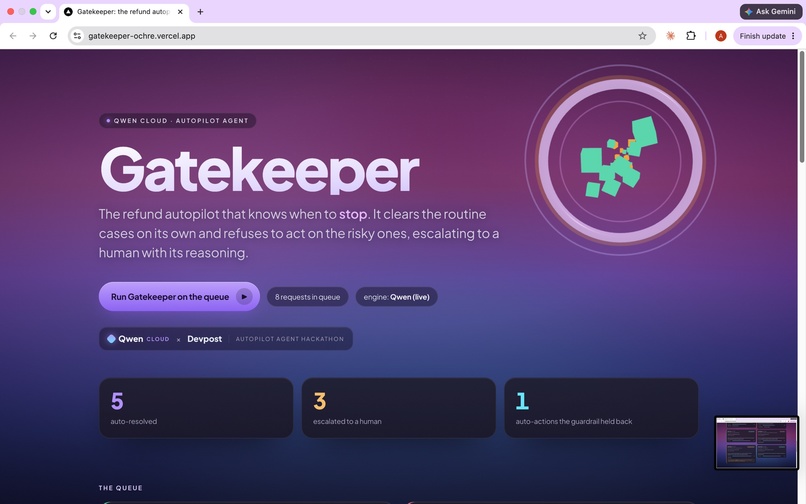
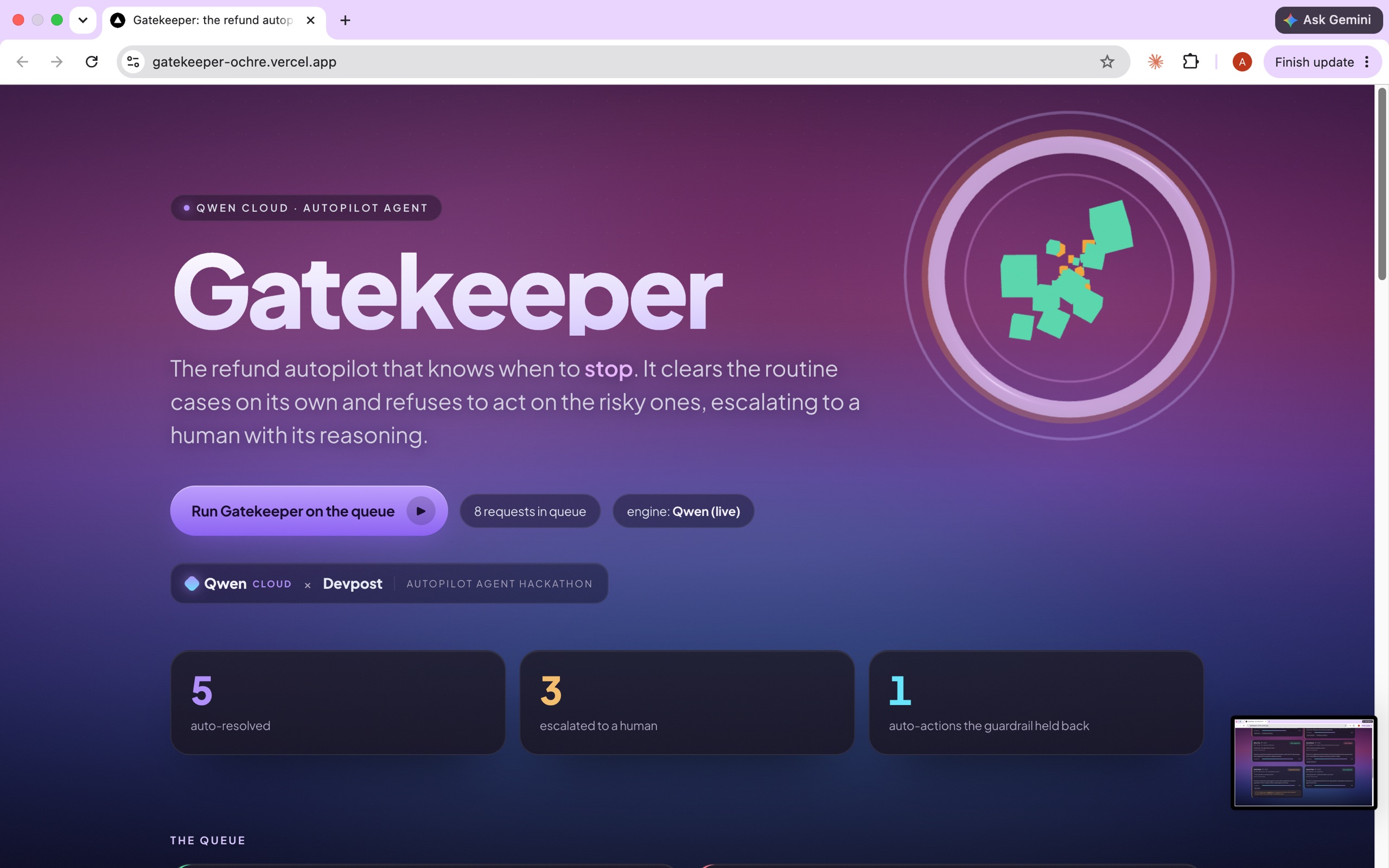
End of run: 5 auto-resolved, 3 escalated to a human, 1 case where the guardrail held the model back.
-
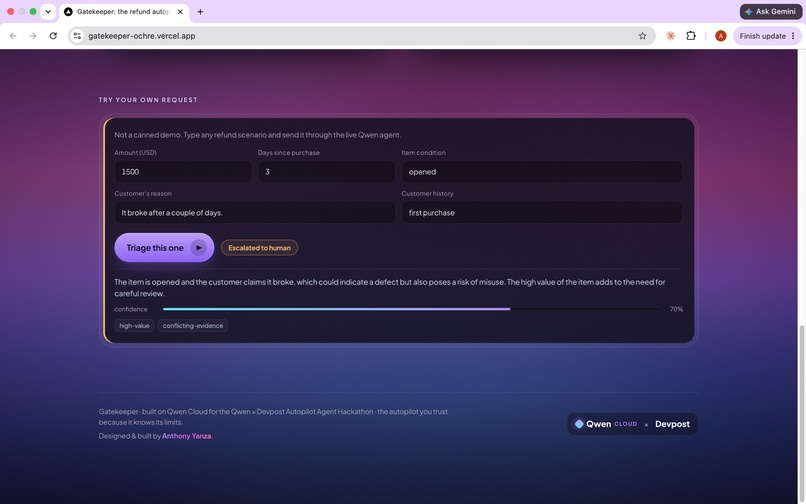
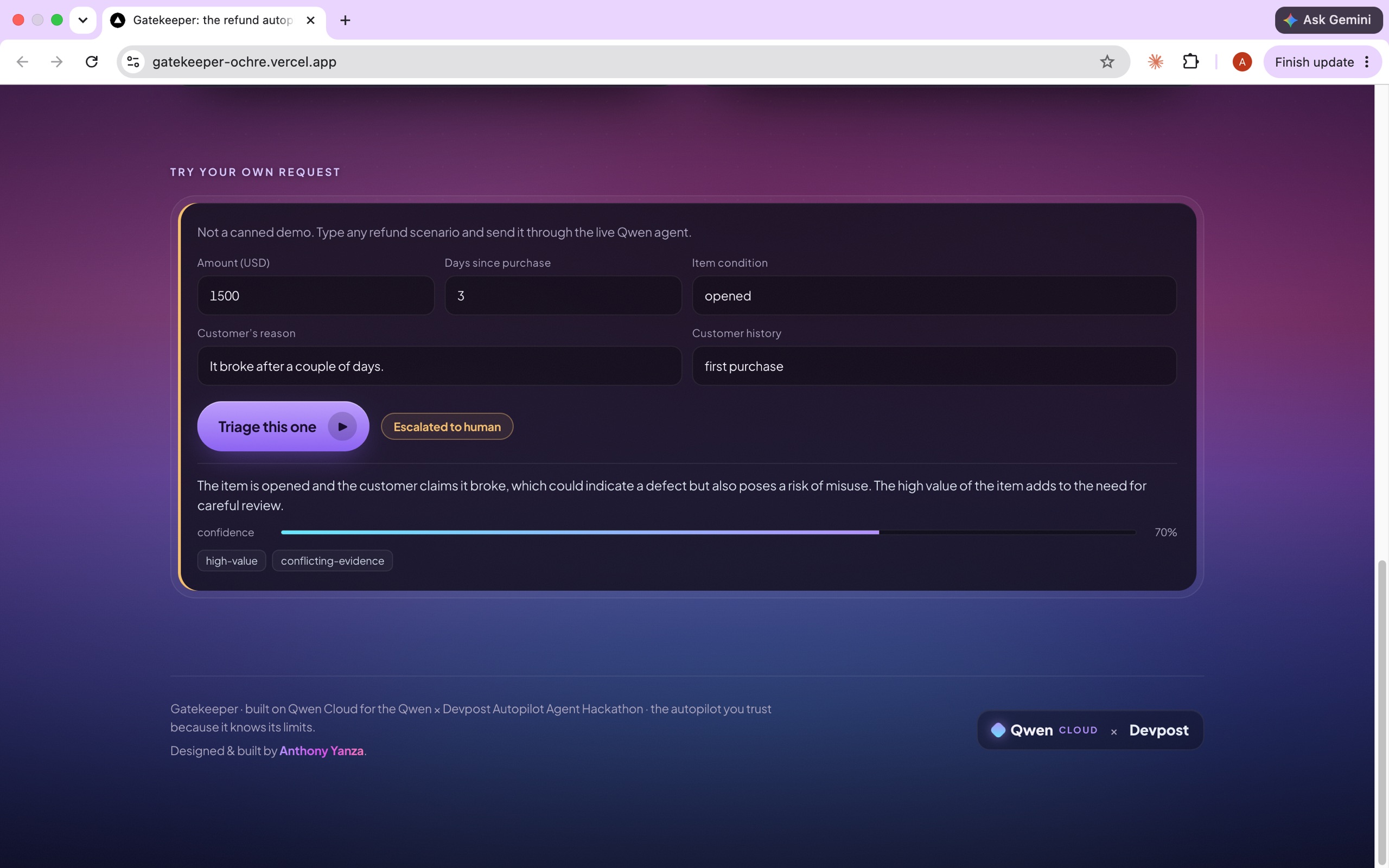
Try any refund live: a $1,500 opened item gets escalated with confidence score and risk flags for the reviewer.
-
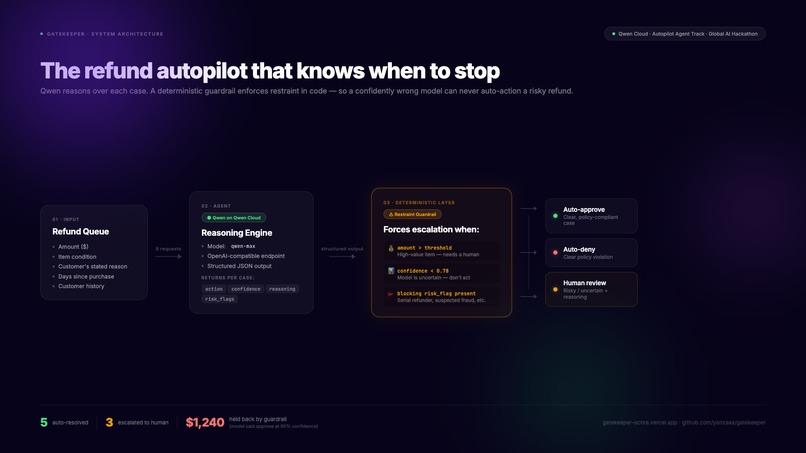
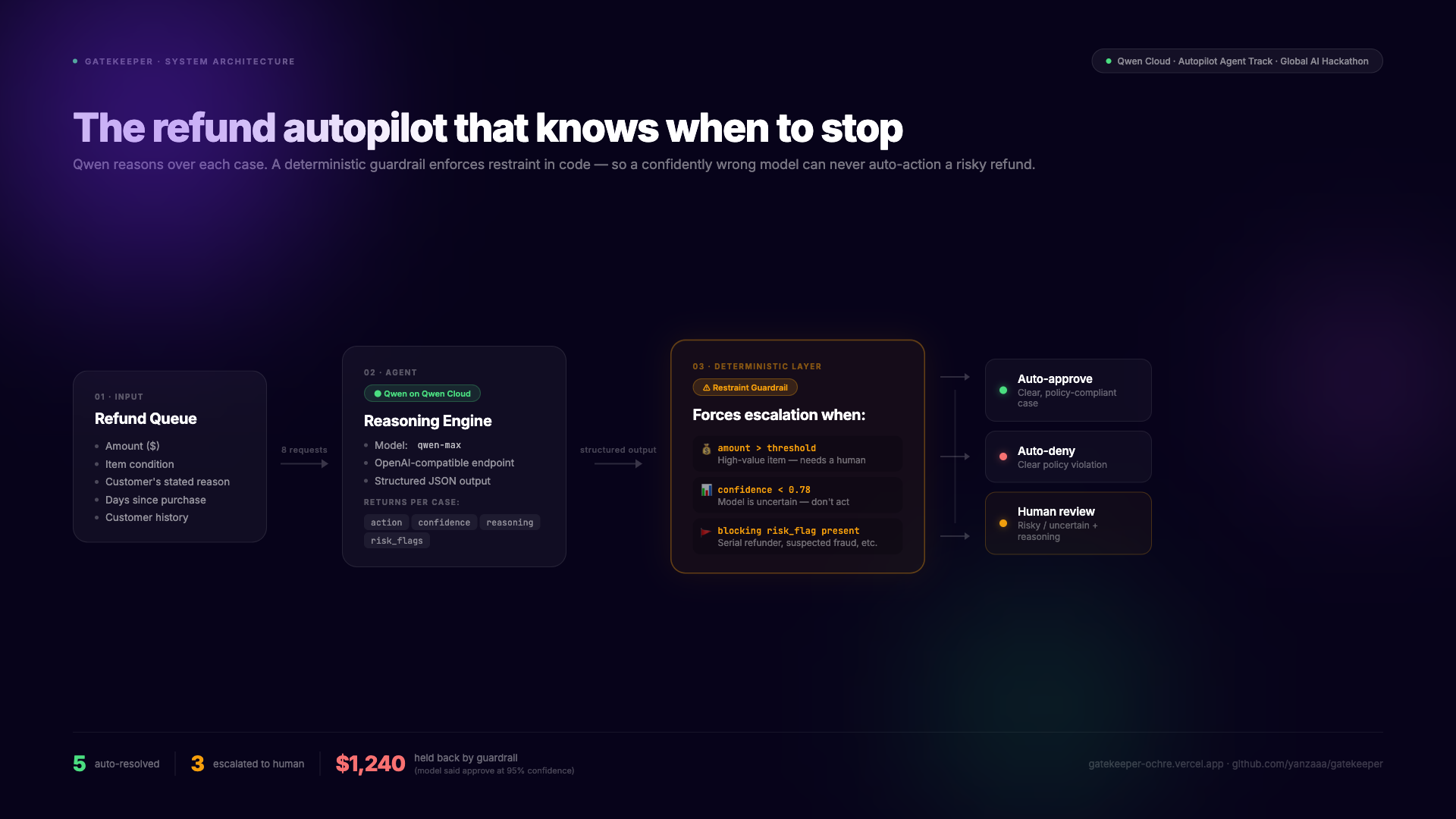
The refund queue flows through Qwen (qwen-max) into a deterministic guardrail that auto-resolves clear cases and escalates risky ones.
-
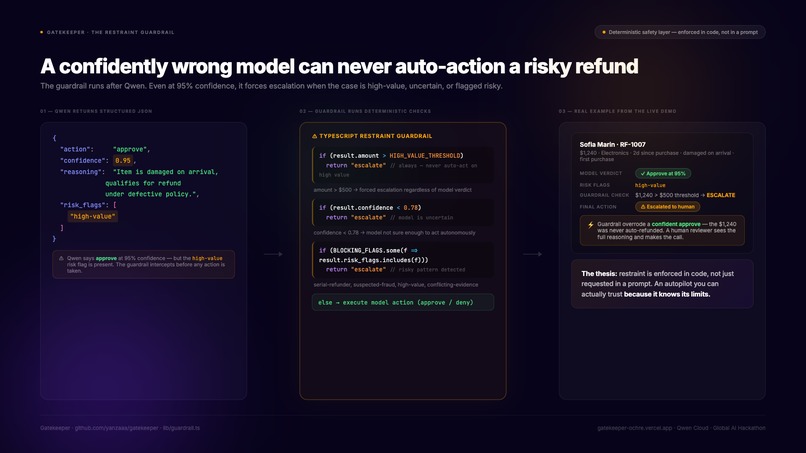
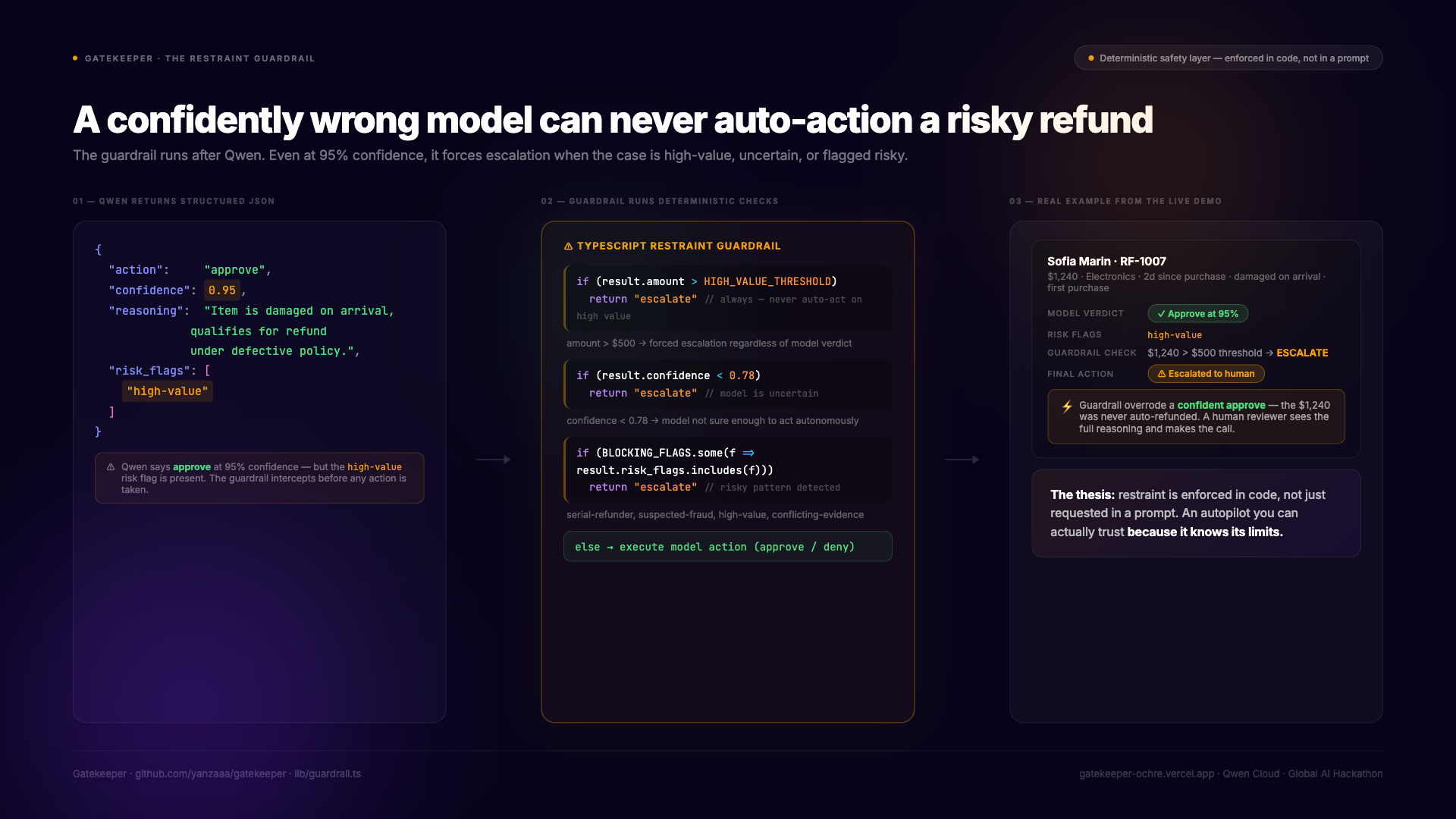
Even when Qwen approves the $1,240 TV at 95%, the code-enforced guardrail overrides it and escalates to a human instead.
Inspiration
Refund and dispute triage is exactly the kind of high-volume, judgment-heavy work teams want to automate. The trap is that an agent which just auto-approves and auto-denies everything will, sooner or later, confidently refund a fraudster or reject a legitimate customer. The dangerous failure is not a slow agent; it is an autopilot that acts when it should have stopped. I wanted to build an autopilot you can actually trust, one that knows the difference between a clear case it can handle and a risky one it should hand to a human.
What it does
You give Gatekeeper a queue of refund requests, each with the amount, item condition, stated reason, days since purchase, and customer history. For each one:
- Clear and safe cases (defective item in the window, unopened return, obvious policy match) are auto-approved or auto-denied on the spot.
- Risky or uncertain cases (high value, possible serial refunder, a stated reason that conflicts with the item, ambiguous policy, low confidence) are refused and escalated to a human, with the reasoning and the risk flags attached.
Why it's different: most refund bots optimize for coverage; they try to auto-decide everything. Gatekeeper optimizes for restraint. The core idea is a "one-way ratchet": a deterministic guardrail that can only ever make a decision safer (push it to escalate), never riskier. A naive LLM-only agent would auto-approve the $1,240 TV at high confidence and refund it on the spot; Gatekeeper structurally cannot — the ratchet holds it for a human. Restraint enforced in code, not requested in a prompt, is the contribution.
A person only ever looks at the escalation queue. Everything else is resolved automatically.
How this differs from Quorum (my other submission)
Gatekeeper and Quorum are two of my submissions to this hackathon, and they deliberately share one idea: a safety primitive — a deterministic, one-way ratchet layered on top of the model that can only ever make an agent's decision safer, never less safe. What makes them two substantially different projects is that they validate that primitive across two completely different agent architectures.
- Gatekeeper (Track 4, Autopilot Agent — this entry) is a single tool-calling agent doing real-time refund triage. One Qwen agent, one enforced
assess_customer_riskfunction call, one deterministic guardrail, a decision in a single pass. The primitive shows up as the restraint guardrail that forces an escalation on any risky case. - Quorum (Track 3, Agent Society) is a three-agent deliberative council (Proposer, Skeptic, Referee) that reaches a decision through multi-agent debate, measures itself against a lone-agent baseline, and is itself callable by other agents over MCP. The same "can only get safer" ratchet governs how the council's verdict is allowed to move.
Different problem, different architecture, different Qwen surface — a forced tool call here, multi-agent MCP orchestration there. One idea, two independent proofs that it generalizes. If you have looked at Quorum: this is not that project with a new coat of paint. It is the other half of the argument.
How we built it
- Qwen (
qwen-max) on Qwen Cloud is the reasoning engine, called through the OpenAI-compatible Alibaba Cloud DashScope endpoint with structured JSON output andtemperature: 0. Before deciding, the agent makes a real Qwen tool-call (assess_customer_risk) — forced viatool_choice, so the model cannot skip it — to fetch deterministic risk signals instead of guessing them from text. Proof of Qwen Cloud usage:lib/qwen.ts(the DashScope base URL + auth, the whole seam in one file). - A deterministic restraint guardrail sits on top of the model. Even when Qwen confidently returns approve or deny, the guardrail forces an escalation when the amount is over $500, confidence is below 0.78, or a blocking risk flag is present. It is a one-way ratchet that can only make a decision safer: restraint enforced in code, not just requested in a prompt.
- Next.js (App Router), TypeScript, Tailwind for the dashboard and the
/api/triageroute, deployed on Vercel. - A key-free deterministic fallback keeps the app running if the API is ever unavailable, so the live demo never crashes. The guardrail is unit-tested (26 Vitest assertions), and
public/benchmark.jsonaggregates the queue: 8 cases, 5 auto-resolved, and 3 escalated to a human (each escalation is a model auto-action the guardrail held back).
It is a coded agent, and I built the whole thing solo with Claude Code.
Challenges we ran into
- The hard part of an autopilot is not the automation, it is the restraint. Getting a model to reliably stop on the right cases is not something you can leave to the prompt alone, so I moved the guarantee into deterministic code on top of the model.
- Designing a queue that actually exercises the edges (a high-value item the model wants to approve, a serial refunder, a reason that conflicts with the item) so the escalation behavior is visible and testable.
- Wiring Qwen through the OpenAI-compatible interface and getting clean, structured JSON back for every case.
Accomplishments that we're proud of
- The guardrail demonstrably catches a confidently wrong auto-action: on a $1,240 TV, Qwen returned approve with high confidence (95% in the recorded demo run; the committed deterministic benchmark,
public/benchmark.json, pins the same hold-back at 0.90 — the exact figure varies run to run, the hold-back never does), and Gatekeeper escalated it instead. That moment is visible right in the UI. - A real, working, deployed coded agent on Qwen with a clean dashboard, built solo in a single build session.
- Honest engineering: a deterministic fallback so the demo is crash-proof, a unit-tested guardrail, and restraint logic that is transparent and auditable rather than hidden in a prompt.
What we learned
- The most valuable thing an autonomous agent can do is know when not to act. Coverage of the routine cases is table stakes; trust comes from the restraint on the risky ones.
- Qwen plus a thin deterministic guardrail is a strong pattern for agentic decisions where a wrong auto-action is costly.
What's next for Gatekeeper
- Wire a side-effecting write integration to a real commerce or ticketing backend (Shopify, Zendesk) to execute the approvals. That is intentionally out of scope for this submission — Gatekeeper's contribution is the trustworthy decision, and acting on it is the deliberate next step, not a missing piece.
- Learn the escalation thresholds from human overrides over time.
- Add a second judgment category for chargebacks and disputes.
Built With
- alibaba-cloud
- claude-code
- dashscope
- next.js
- openai-compatible-api
- qwen
- qwen-cloud
- react
- tailwind
- typescript
- vercel


Log in or sign up for Devpost to join the conversation.