-
-
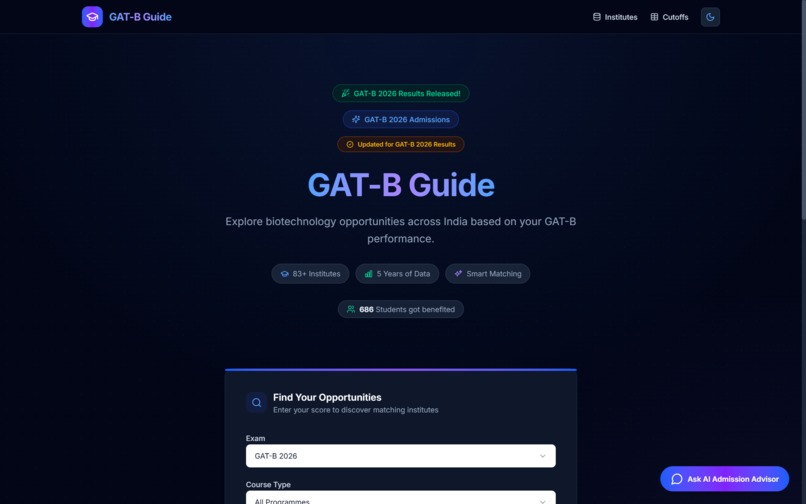
Home Page1
-
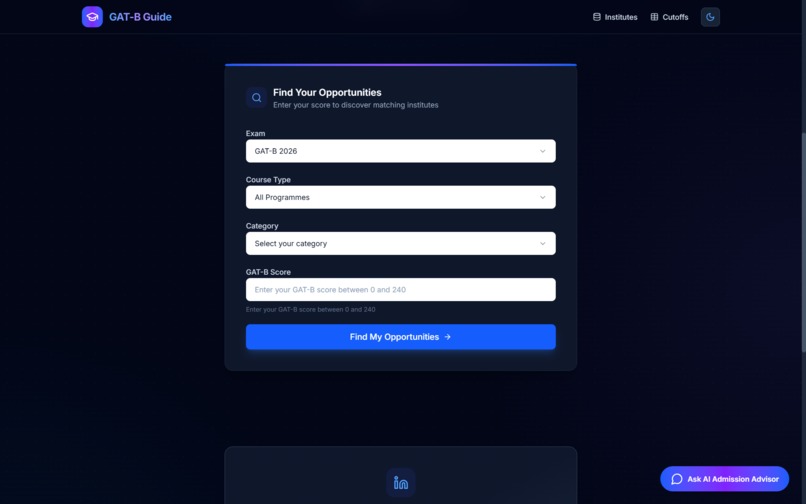
Home Page2
-
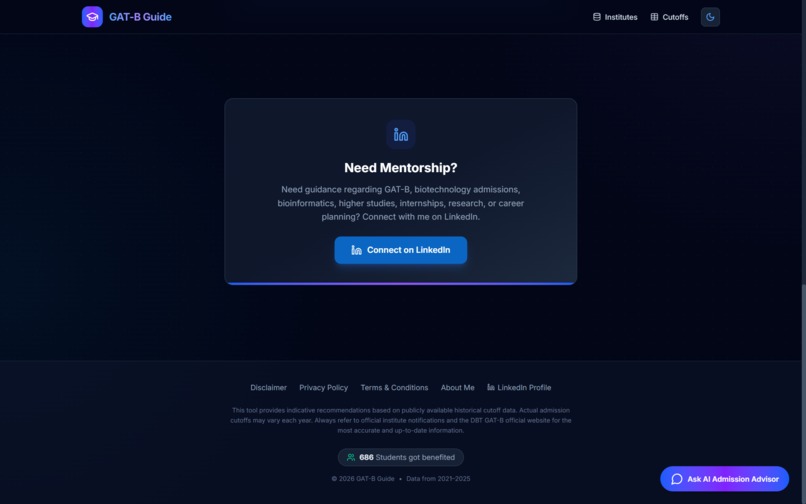
Home Page3
-
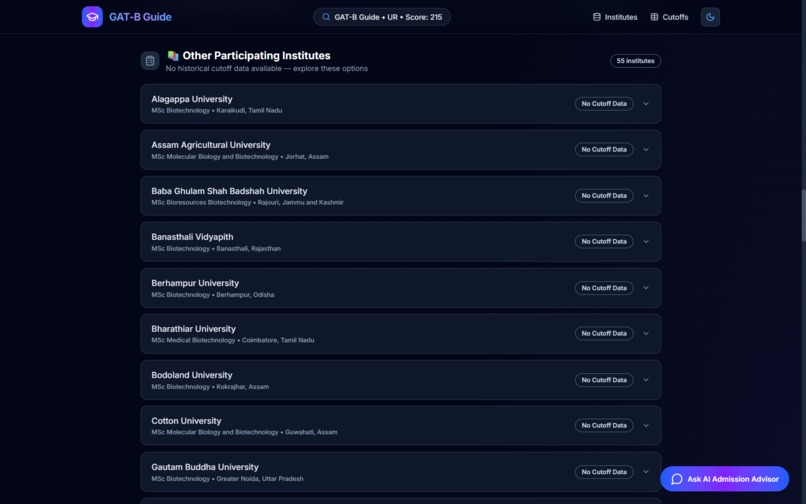
Result Page1
-
Result Page2
-
Result Page3
-
Result Page4
-
Result Page5
-
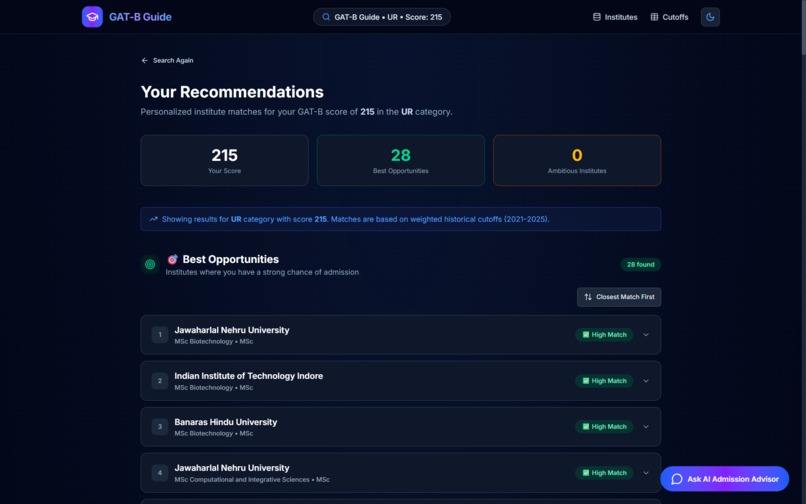
Result Page6
-
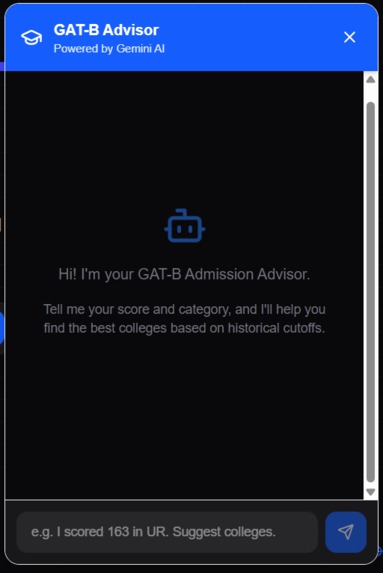
AI Advisor
-
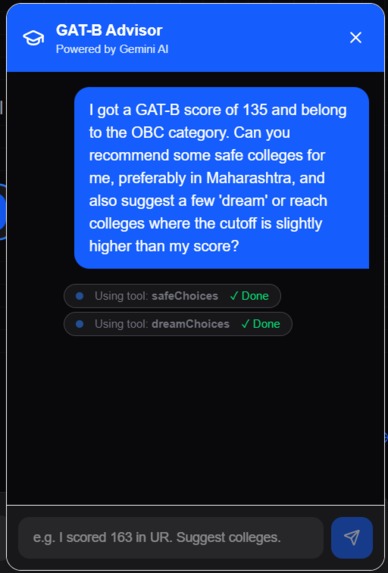
AI Advisor
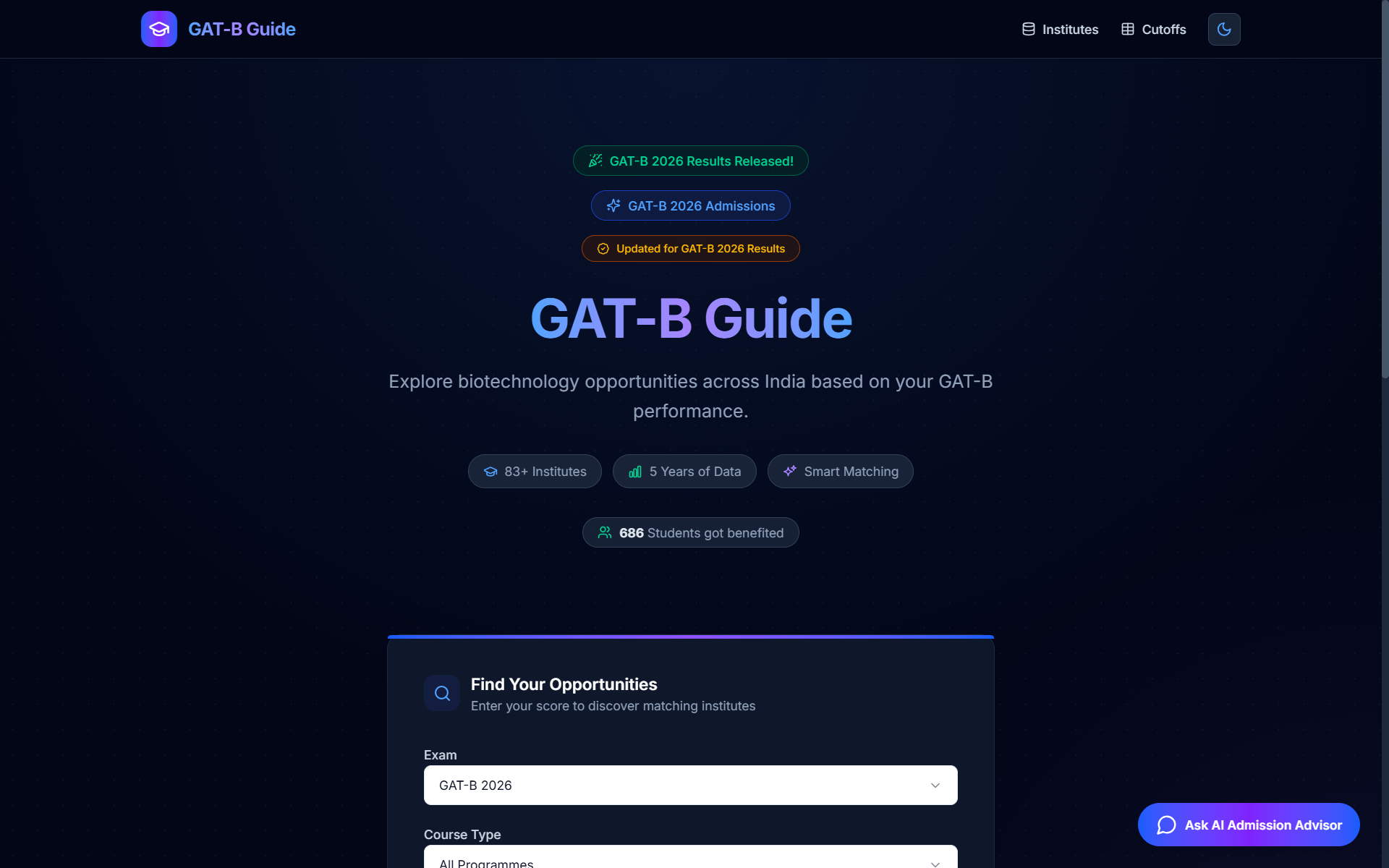
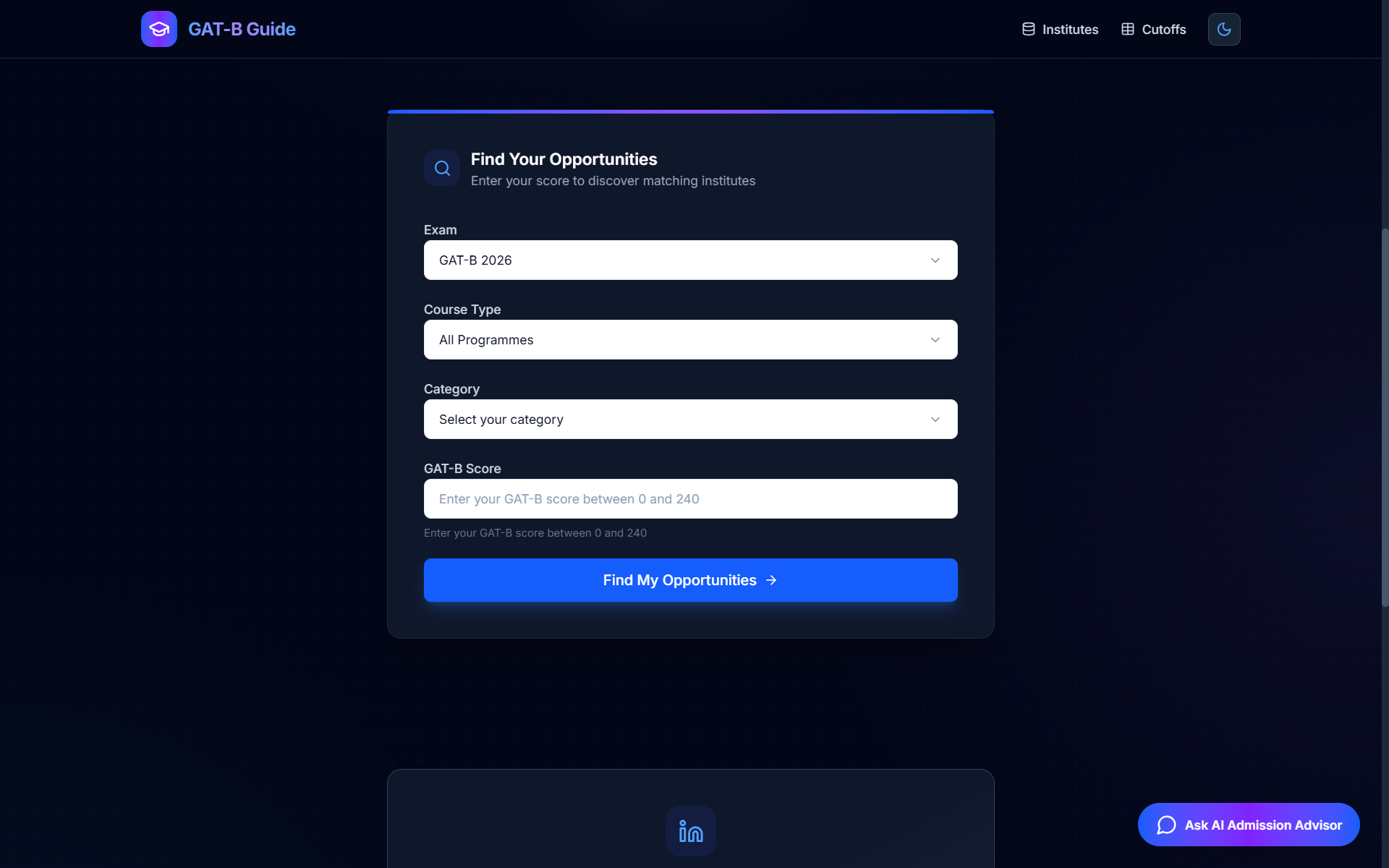
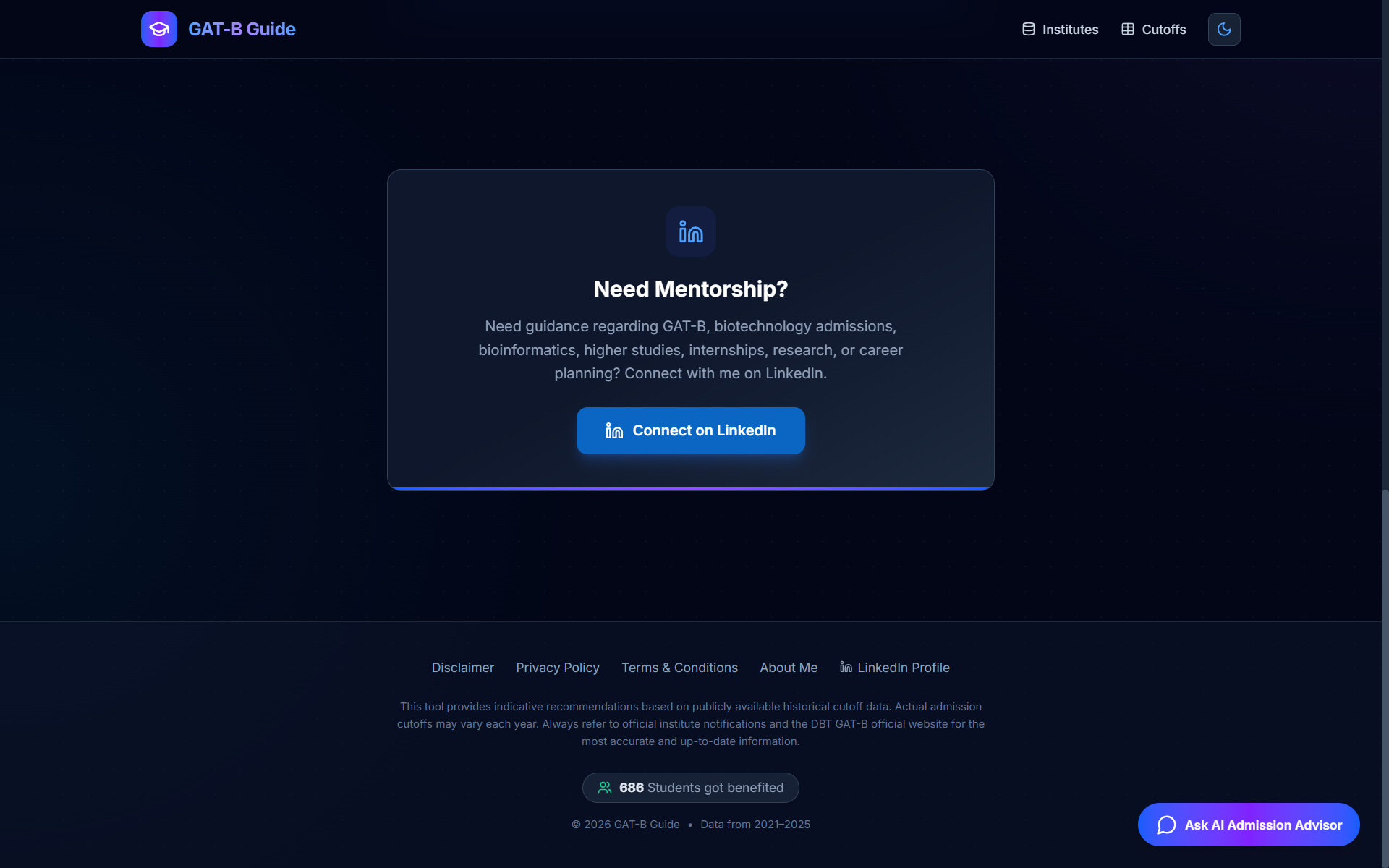
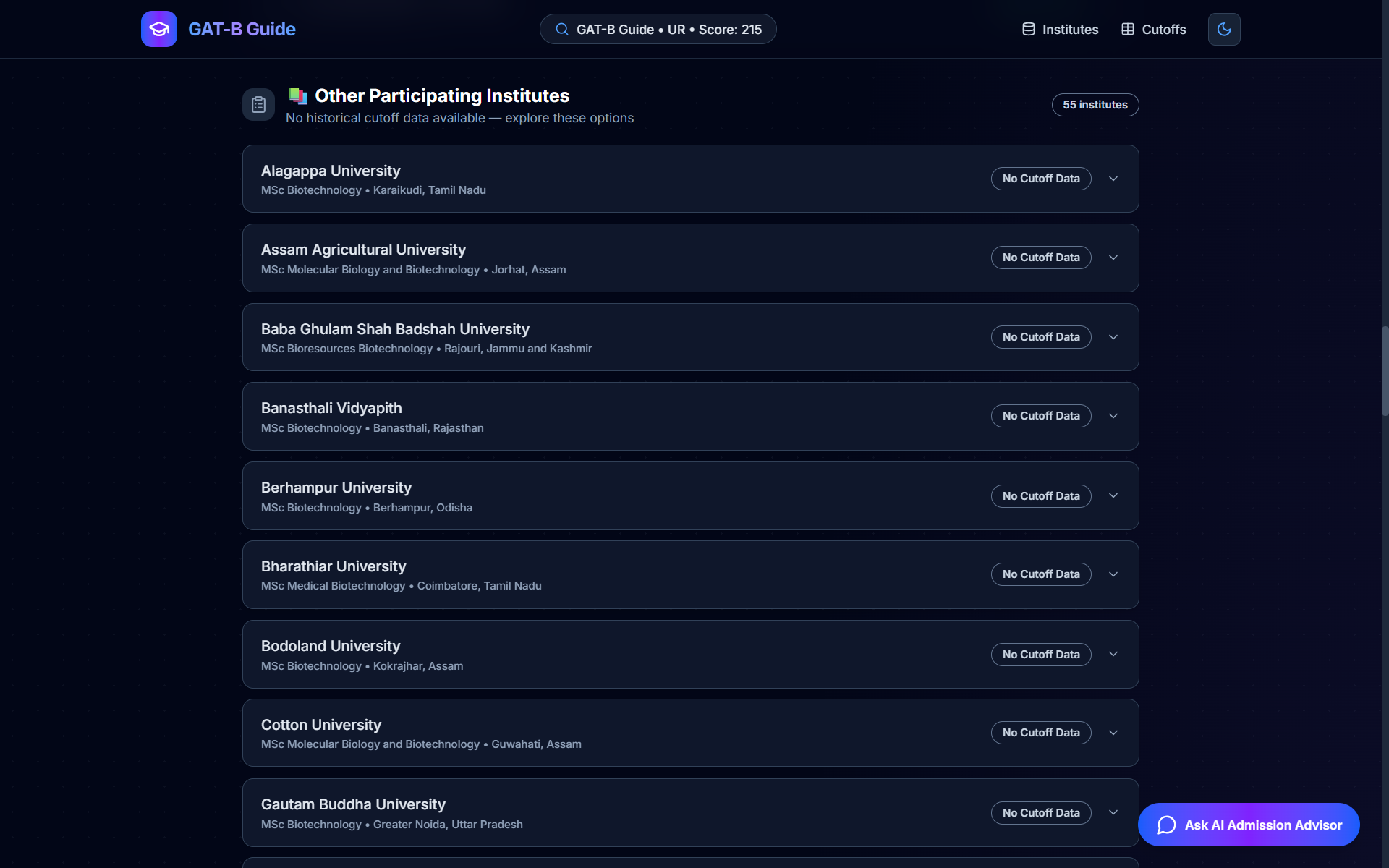
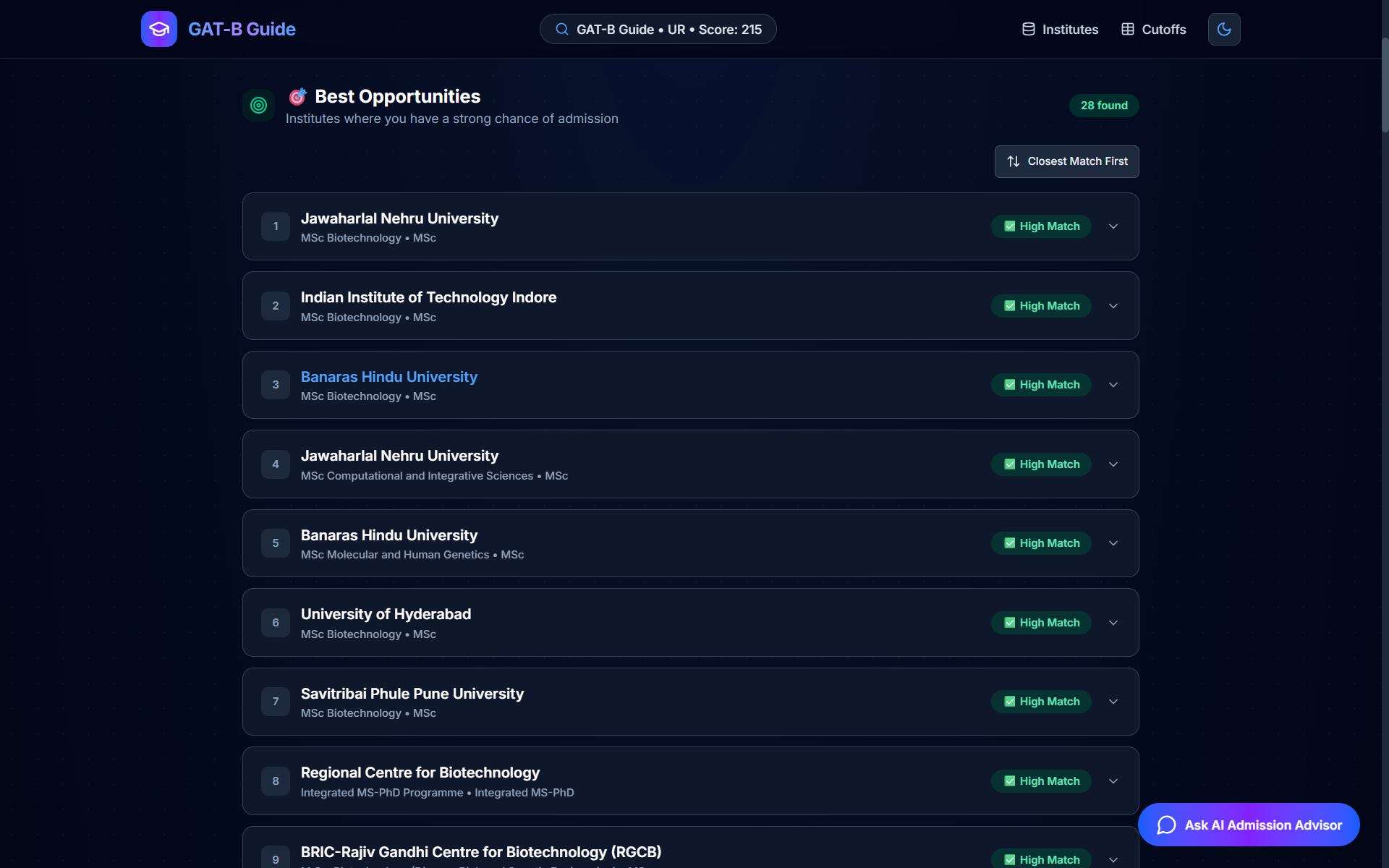
GAT-B Guide — AI Admission Advisor
The Problem
Every year, biotechnology students across India qualify the Graduate Aptitude Test–Biotechnology (GAT-B) and face a difficult question:
"I have this score. Where should I apply?"
The information needed to answer that question is scattered across university websites, admission brochures, PDFs, historical cutoff documents, student discussions, and videos.
Students have to manually compare:
- Institutes
- Programmes
- Eligibility
- Seats
- Historical cutoffs
- Admission processes
- Research opportunities
I experienced this problem myself during my own GAT-B admission journey.
Coming from a non-premier-institute background, I realized that the problem was often not a lack of ability. It was a lack of clarity, accessible information, and personalized guidance.
That became the motivation behind GAT-B Guide.
What I Built
GAT-B Guide is an AI-powered admission guidance platform designed specifically for biotechnology aspirants.
The platform combines a structured database of GAT-B institutes and historical cutoff information with a Gemini-powered AI Admission Advisor.
Students can provide information such as:
- GAT-B score
- Category
- Preferred course type
- Research interests
- Geographic preferences
- Admission constraints
- Personal priorities
Instead of forcing students to search through hundreds of pages, they can simply explain their situation conversationally.
For example:
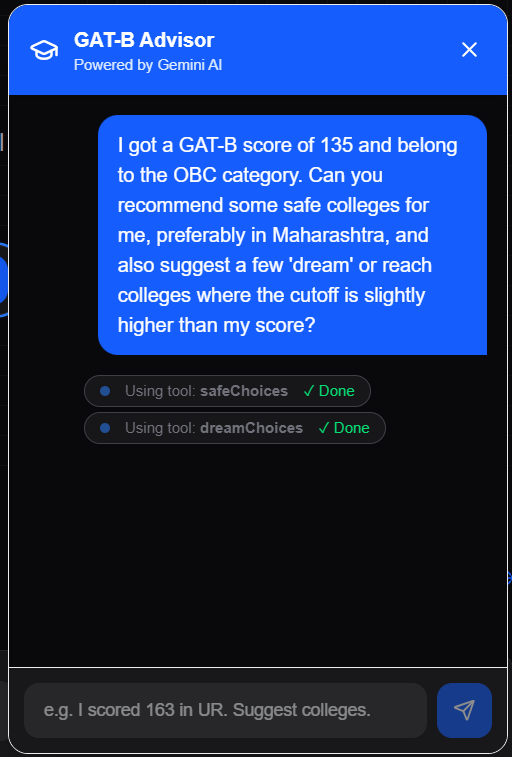
"I scored 175 in UR. I am interested in molecular biology, prefer North India, and would rather avoid interview-based programmes. What should I apply to?"
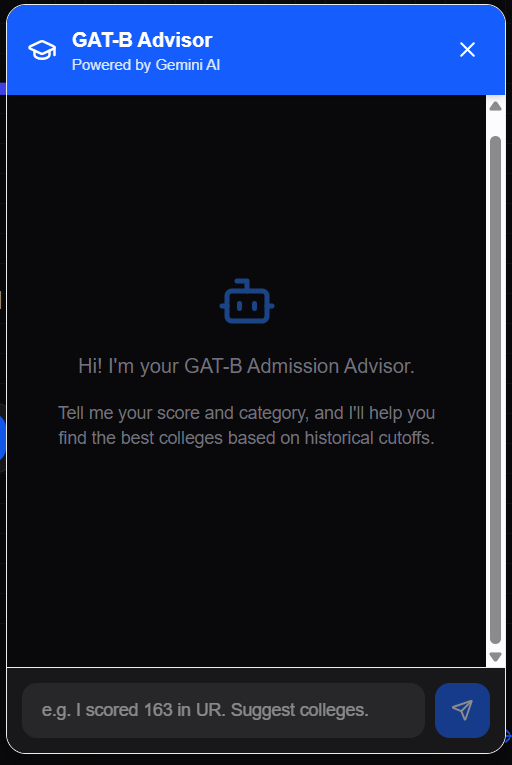
The AI Advisor can then reason about the student's situation and provide personalized guidance based on the information available through the platform.
Why AI Matters
A conventional admission portal can filter data.
An AI advisor can understand context.
Students rarely describe their admission situation using fixed database filters. They explain their circumstances naturally.
The Gemini-powered Admission Advisor acts as the conversational reasoning layer between the student and the structured admission knowledge available in GAT-B Guide.
It can help students:
- Discover suitable institutes
- Compare programmes
- Interpret historical cutoff trends
- Understand eligibility
- Compare MSc and MTech options
- Explore research interests
- Understand interview-based admissions
- Develop an application strategy
- Ask follow-up questions
The goal is to make admission guidance feel more like speaking with an informed senior or mentor than searching through PDFs.
The Data Behind the AI
Building the AI interface was only one part of the project.
A significant part of the work involved collecting, cleaning, standardizing, and organizing publicly available admission information.
The platform contains information such as:
- Participating institutes
- Programmes
- Degree types
- Seat information
- Eligibility requirements
- Admission links
- Historical cutoff data
- Research-related information
- Additional institute information
- Discussion resources
Historical cutoff information is particularly valuable because it gives students context for interpreting their current score.
However, reliable historical cutoff information is not available for every institute.
Instead of inventing missing information, GAT-B Guide explicitly identifies institutes where historical cutoff data is unavailable.
This distinction is important because admission guidance should be useful without pretending to be certain.
Recommendation Intelligence
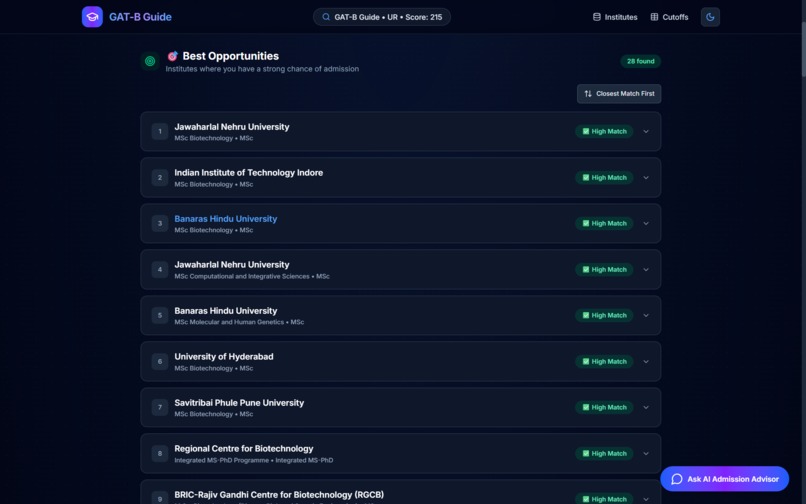
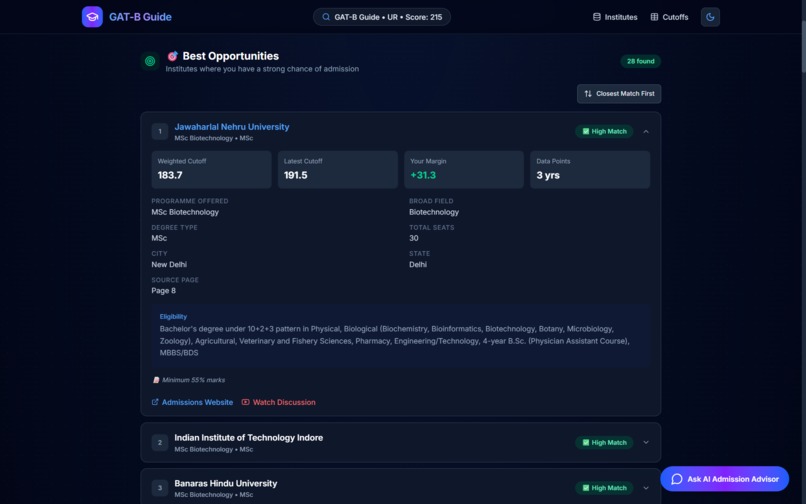
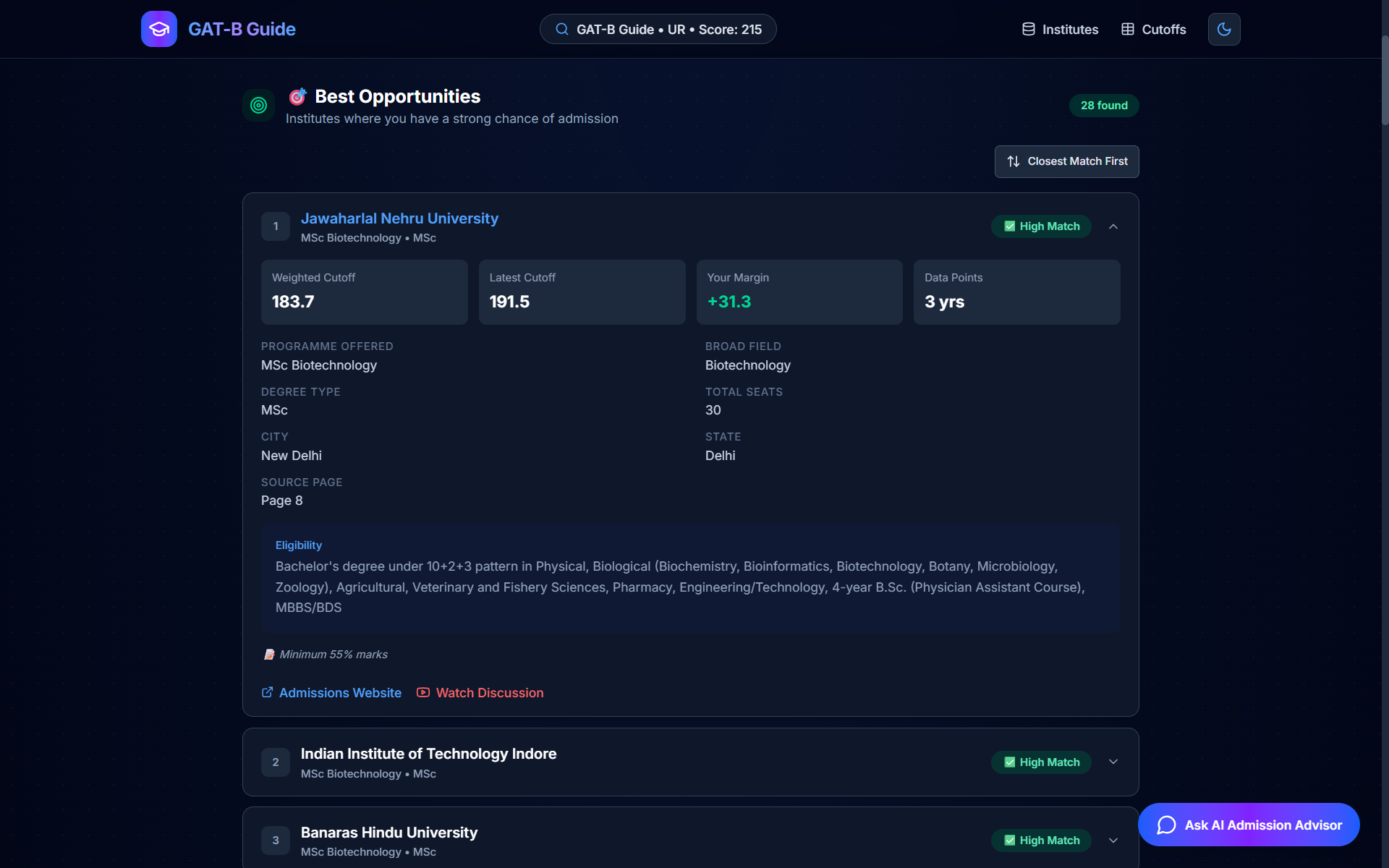
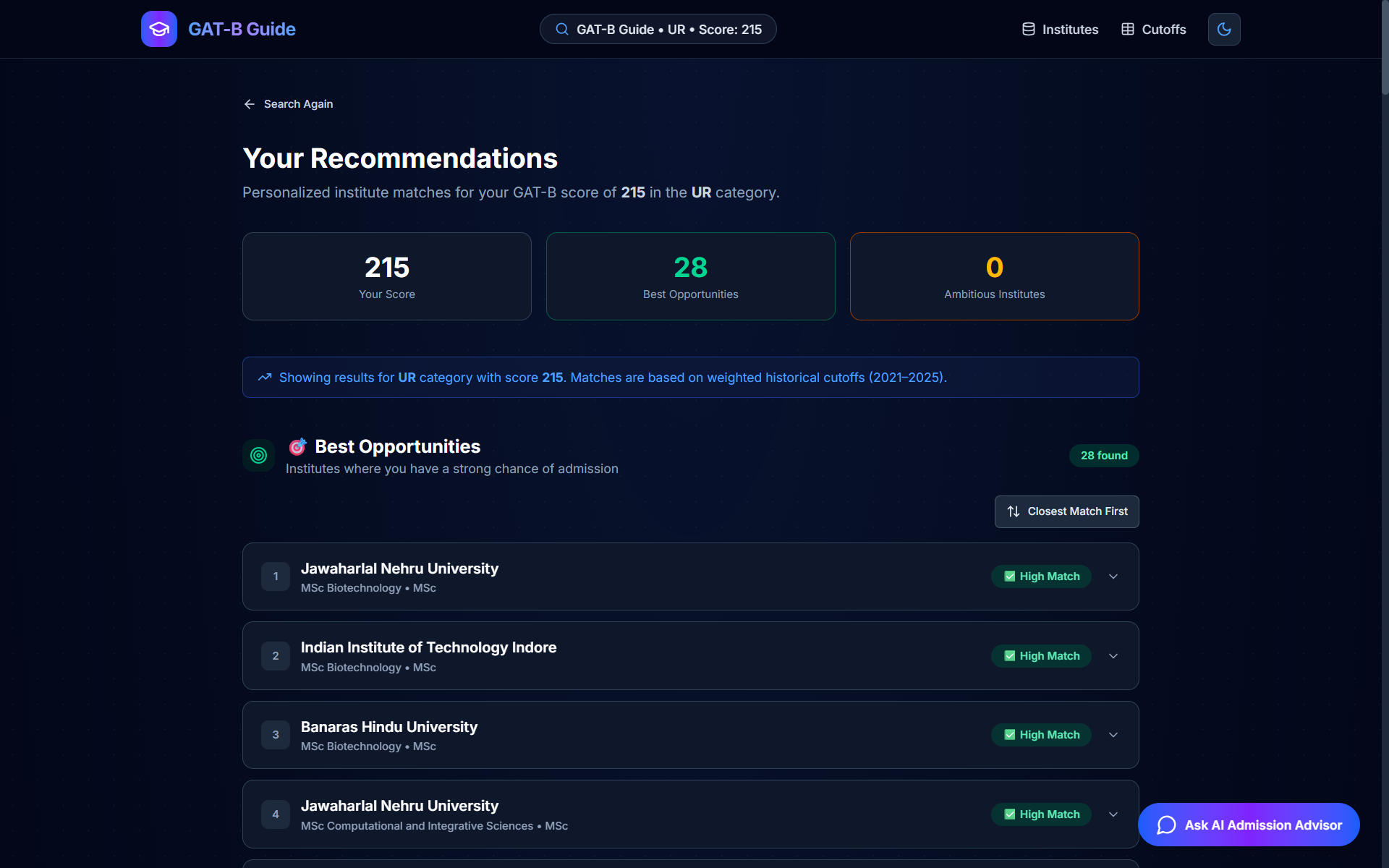
For institutes where historical cutoff information is available, GAT-B Guide calculates a weighted historical cutoff and compares it with the student's score.
The core recommendation metric is:
$$ \text{Margin} = \text{Student Score} - \text{Weighted Historical Cutoff} $$
For example, if a student's score is 180 and the weighted historical cutoff is 175:
$$ \text{Margin} = 180 - 175 = +5 $$
This helps organize opportunities according to how closely the student's score relates to historical admission thresholds.
The platform also distinguishes between stronger matches and more ambitious opportunities.
These recommendations are indicative, not guarantees of admission.
Actual admission depends on the current year's cutoff, category, seat availability, eligibility, institute-specific admission processes, and other factors.
The AI Admission Advisor
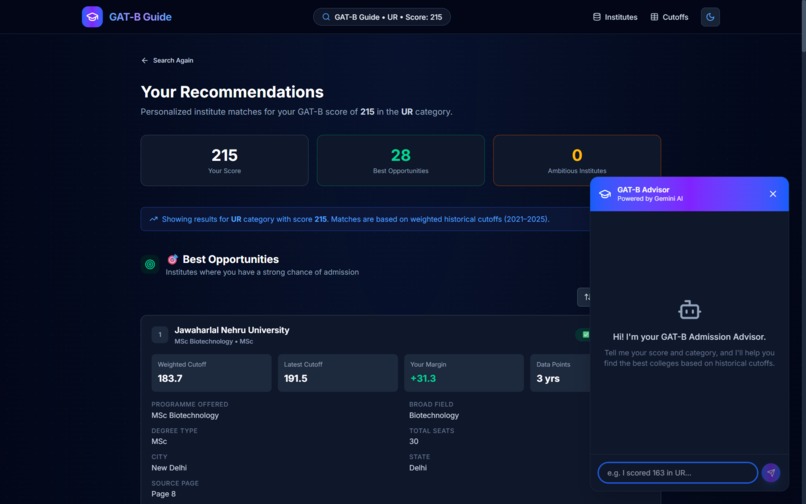
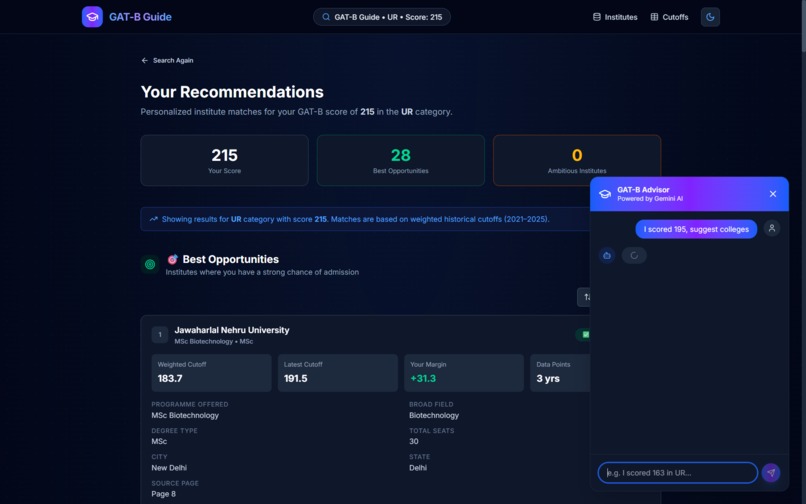
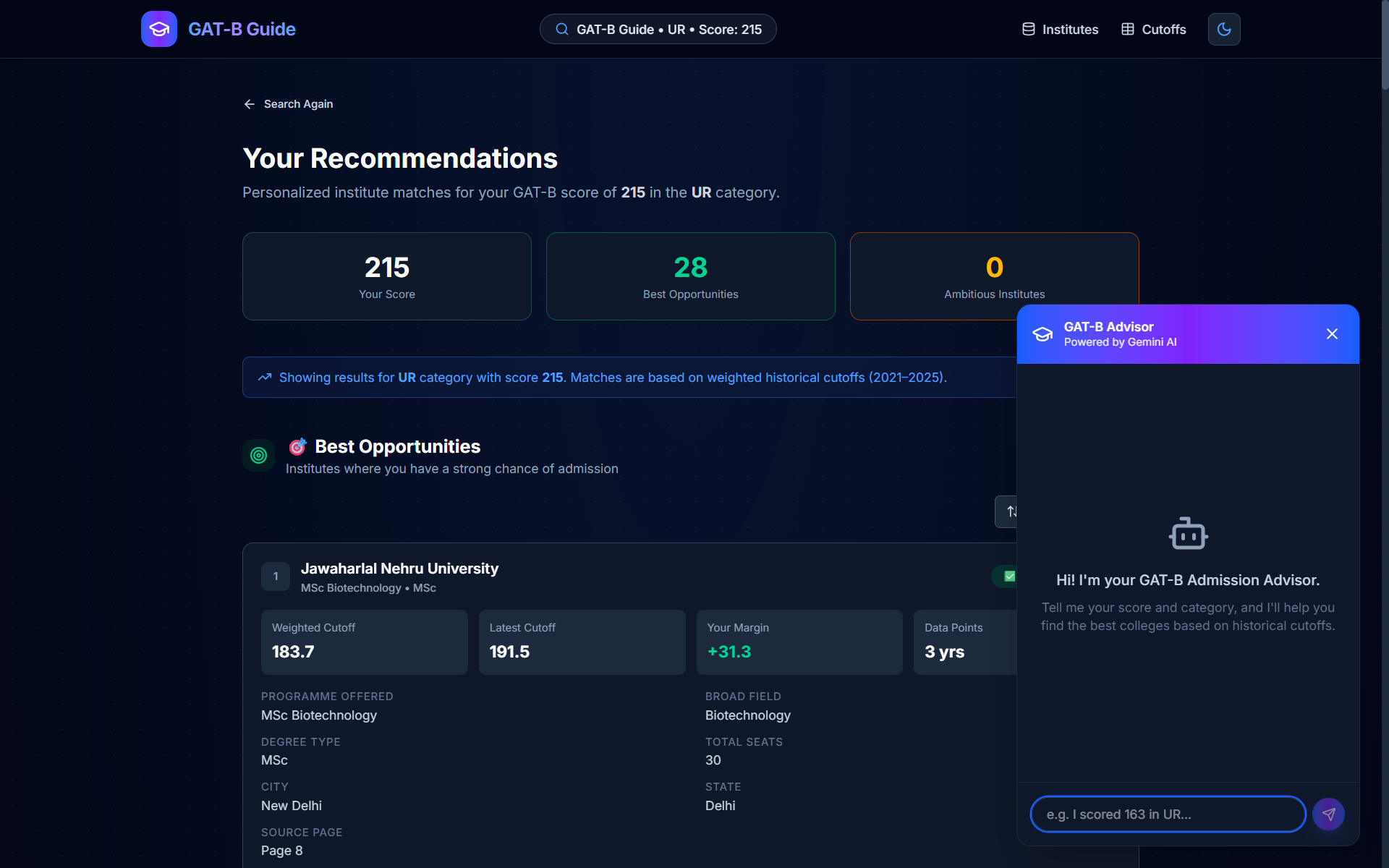
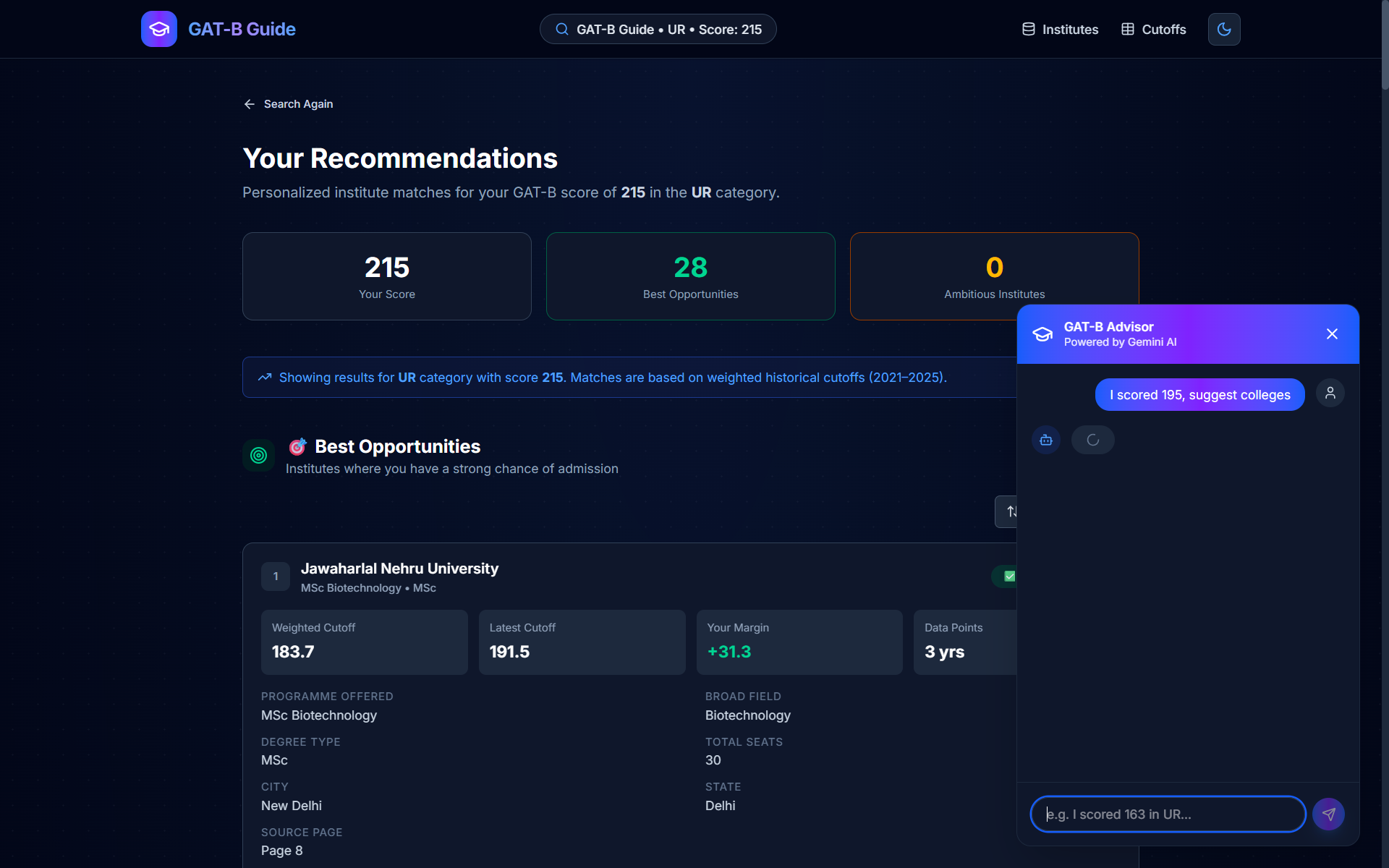
The most important feature of GAT-B Guide is the AI Admission Advisor.
The advisor is designed to understand the student's overall situation rather than simply match keywords.
A student can ask questions such as:
"I scored 163 in UR. Which colleges should I consider?"
"Compare JNU and IIT Indore for biotechnology research."
"I am interested in genetics. Which programmes should I prioritize?"
"Which options have interview-based selection?"
"I want research-oriented institutes but I don't want to move too far from North India."
The interaction is conversational, allowing students to ask follow-up questions instead of starting a new search every time.
This is what makes the AI component fundamentally different from a conventional college-search website.
A Human Problem Behind the Project
GAT-B Guide was created by Biswarup Nandi, an M.Sc. Biotechnology student at the School of Biotechnology, Jawaharlal Nehru University (JNU).
His interests lie at the intersection of:
Biotechnology + Bioinformatics + Artificial Intelligence + Computational Biology + Data Science
The project originated from his own experience as a GAT-B aspirant.
After going through the admission process himself, he realized how difficult it was for students to understand the landscape of institutes and programmes.
The idea was simple:
The problem is not always that students cannot reach good institutions. Sometimes they simply don't know where they can reach.
GAT-B Guide was built to reduce that information gap.
What I Learned
This project taught me that building an AI application is not simply about connecting an LLM to a user interface.
The difficult part is building the information foundation around the AI.
I had to think about:
- Where the data comes from
- How historical information should be represented
- How different institutes and programmes should be standardized
- What the AI should be allowed to infer
- How uncertainty should be communicated
- How recommendations should be ranked
- How students actually ask admission questions
I also learned that AI becomes substantially more useful when it is grounded in structured, domain-specific information instead of being expected to answer everything from general model knowledge.
Challenges
1. Fragmented Information
Admission information was distributed across different websites, PDFs, brochures, and other public sources.
2. Historical Cutoff Data
Reliable cutoff information was not available for every participating institute.
3. Data Cleaning
Institute names, programmes, degree types, eligibility information, and other fields needed to be standardized before they could be used effectively.
4. Avoiding Overconfidence
An admission advisor should never turn historical information into a false promise.
The system therefore communicates recommendations as guidance rather than guaranteed admission outcomes.
5. Designing the AI Interaction
The biggest product challenge was making the advisor behave like a mentor rather than a search box.
The student should be able to describe their situation naturally and receive a response that considers multiple factors.
6. Building Across Multiple Technologies
As a solo developer, I worked across:
- Biotechnology domain knowledge
- Data collection and cleaning
- Recommendation logic
- Web development
- AI integration
- User experience
- Deployment
Technology
GAT-B Guide combines a modern web application with a Gemini-powered conversational AI layer.
The application uses technologies including:
- Gemini API
- Google AI Studio
- Next.js
- React
- TypeScript
- Tailwind CSS
- Vercel
- Structured admission and cutoff datasets
The AI component is integrated into the existing admission platform so that students can move naturally between structured recommendations and conversational guidance.
The Vision
GAT-B is only the beginning.
The long-term vision is to create a broader academic opportunity intelligence platform that can help students discover:
- Degree programmes
- Research institutes
- Research laboratories
- Research areas
- Scholarships
- Admission opportunities
- Career pathways
The platform could eventually expand beyond GAT-B and support students navigating other fragmented academic admission systems.
The larger goal is:
Make academic opportunity discovery more accessible, transparent, and intelligent.
Why This Matters
Students from well-connected academic environments often have access to seniors, mentors, institute information, and informal admission knowledge.
Many others do not.
GAT-B Guide attempts to make some of that information accessible through a single platform and an AI advisor that students can interact with naturally.
It started with one student's admission confusion.
The goal is to make sure future students have more clarity than I had.
Try GAT-B Guide
🌐 Live Website:
https://gatbguide.vercel.app/
💻 Source Code:
https://github.com/okbiswa/gatb-guide
The platform is designed as an informational and decision-support tool. Students should always verify current admission requirements, deadlines, cutoffs, and official notifications with the respective institutes and the official GAT-B authorities.
What's Next?
Future development will focus on:
- Better research-interest matching
- More detailed institute and laboratory information
- More historical admission data
- Improved conversational reasoning
- Broader academic opportunity discovery
- Multilingual accessibility
- Expansion to additional entrance examinations
One admission problem today. A broader academic guidance layer tomorrow.
Built With
- aiagents
- aiforeducation
- biotechnology
- careerguidance
- datadriven
- datascience
- decisionsupport
- edtech
- geminiapi
- genai
- googleai
- googleaistudio
- googleantigravity
- llm
- natural-language-processing
- next.js
- personalizedlearning
- python
- react
- tailwindcss
- typescript
- vercel
- webapp

Log in or sign up for Devpost to join the conversation.