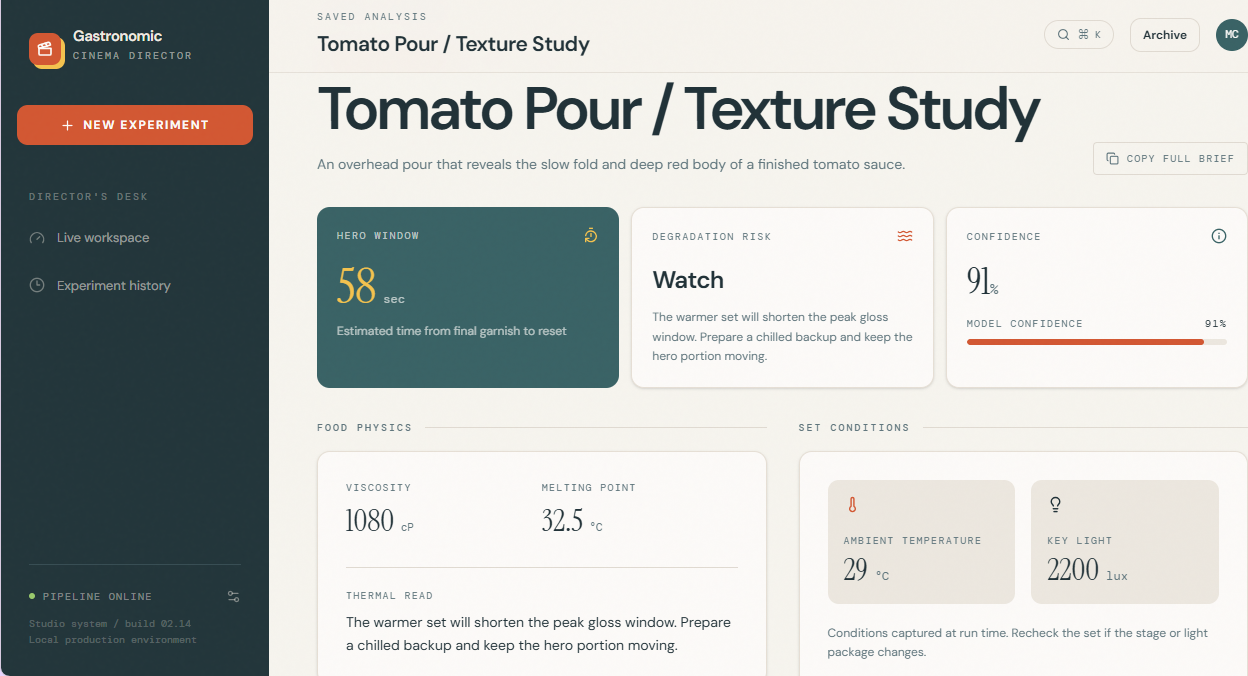
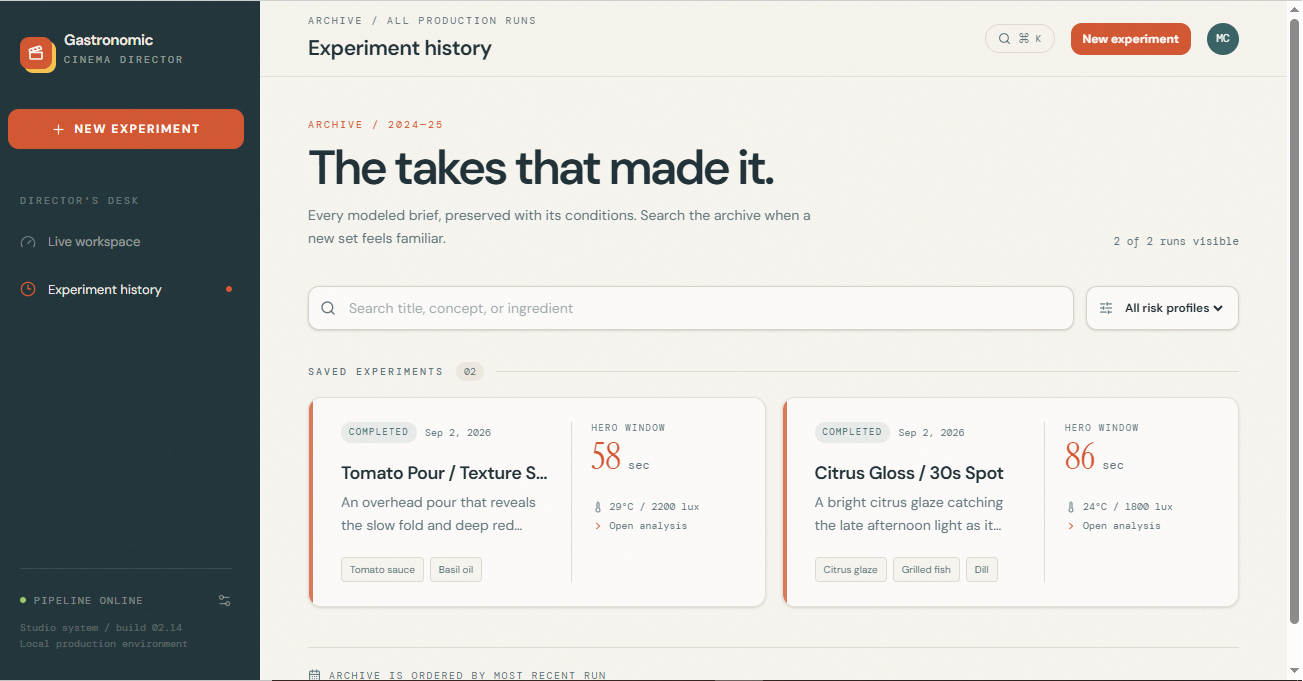
Gastronomic Cinema Director: Bridging Food Science and High-Speed Cinematography Inspiration: In high-end food advertising, capturing the ultimate "Hero Shot"—that mesmerizing moment when cheese pulls perfectly, chocolate glistens, or syrup cascades over a stack of pancakes—is a high-stakes race against time. Under intense studio lighting, food degrades at an unpredictable rate. Cheese congeals, emulsions break, and ice cream turns to soup within minutes. Traditionally, food stylists rely on guesswork and artificial substitutes, resulting in costly reshoots, wasted time, and food waste.
As a food engineer exploring artificial intelligence, data science, and agentic workflows, I recognized a unique opportunity: What if we could model the exact physics and rheology of food in real-time, matching those physical constraints with automated visual art direction and high-speed camera parameters?
This inspired Gastronomic Cinema Director, a suite of autonomous AI agents designed to transform food pre-production and on-set execution. What It Does
Gastronomic Cinema Director is an autonomous multi-agent platform powered by Google Gemini, ClickHouse*, and Replit. It bridges the gap between food thermodynamics and cinematographic precision across three specialized agents:
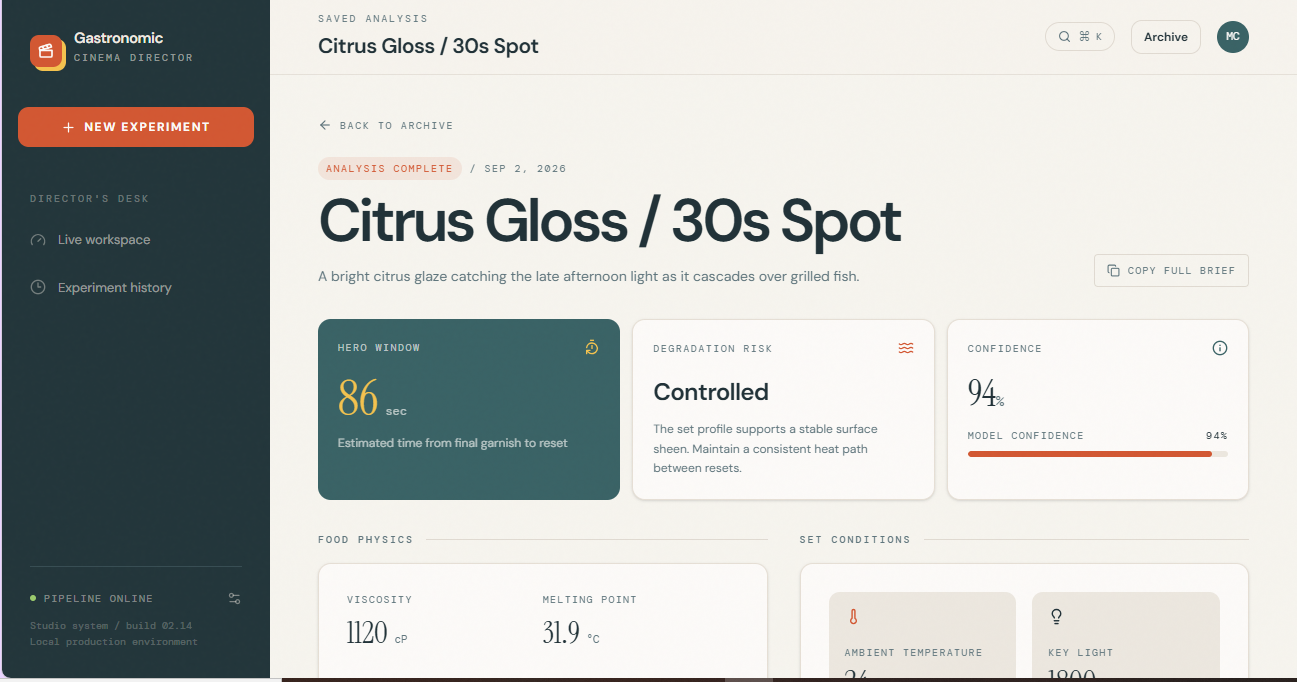
- Chemical & Rheological Physics Agent: Models ingredient behavior under heat and lighting (viscosity, melting points, syneresis) to calculate the precise Optimal Hero Window structural collapse.
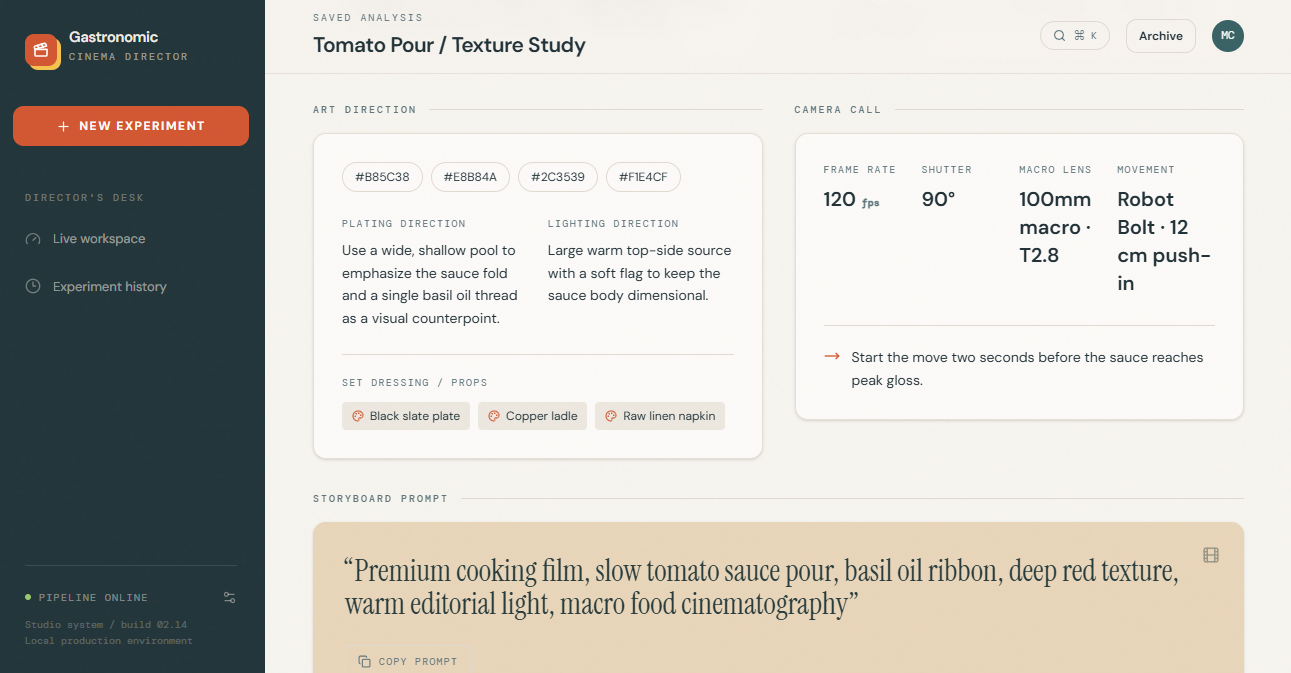
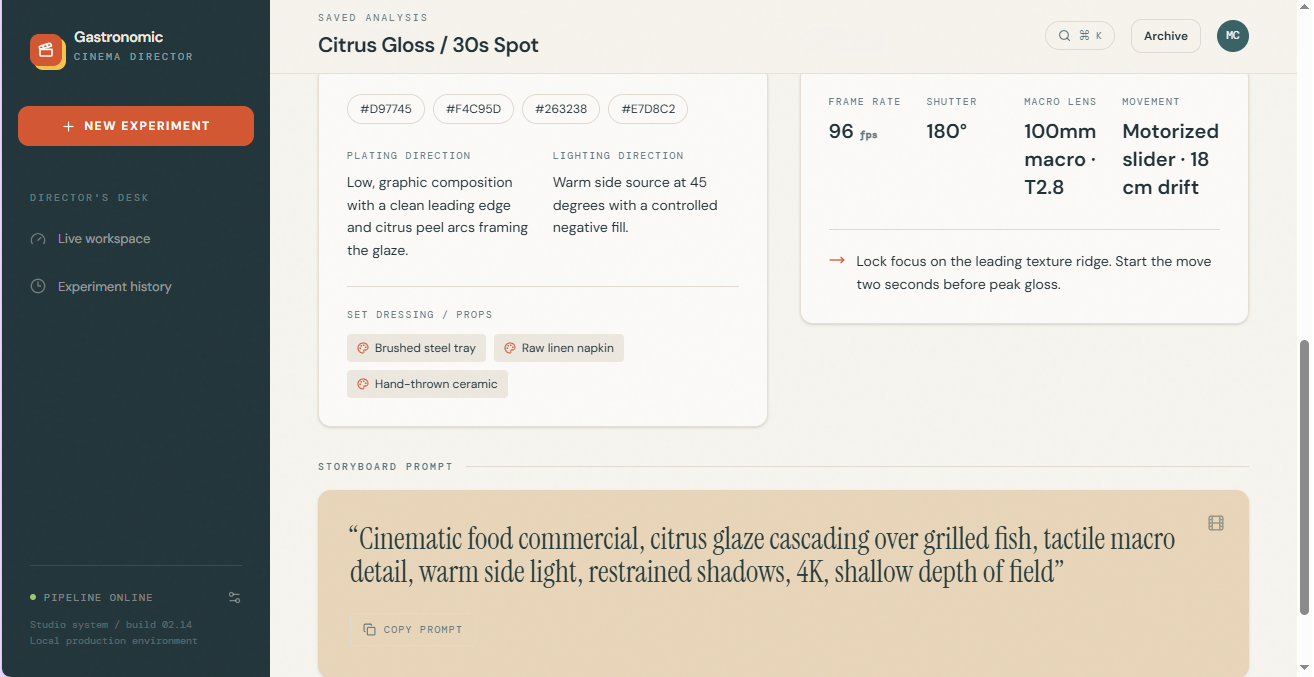
- Art Direction & Design Agent: Generates color-harmonized palettes (HEX codes), plating geometry, styling props, and photorealistic storyboard prompts aligned with the physical shooting window.
- Technical Camera Agent: Translates fluid dynamics into exact high-speed camera specifications—calculating frame rates (FPS), shutter angles, macro optics, and motion control paths (e.g., Bolt High-Speed Robot).
How We Built It
The system was engineered using a spec-driven multi-agent architecture:
Google Gemini (google-genai SDK): Serves as the core reasoning engine for all three agents, leveraging gemini-2.5-flash with structured outputs (response_schema via Pydantic) to ensure seamless inter-agent contract passing.
FastAPI & Async Python: Orchestrates the multi-agent pipeline asynchronously using asyncio.to_thread for non-blocking execution.
ClickHouse (OLAP Database): Stores real-time rheological metrics, ingredient degradation histories, and successful prompt parameters, allowing agents to execute instant sub-millisecond historical queries via Model Context Protocol (MCP).
Replit Agent (Vibe Coding): Used to rapidly prototype, build, and deploy the full-stack web application interface (React + Tailwind CSS) with native environment configuration and security scanning.
Mathematical & Physical Modeling
To determine the Optimal Hero Window , the Chemical Agent models the thermal degradation of food matrices using temperature rise functions from studio lights and viscosity decay:
This mathematical boundary is fed directly to the Camera Agent to Challenges We Faced
- Determinism in Agent Interfaces: Ensuring that creative prompt outputs from the Art Director Agent remained strictly compatible with the mathematical constraints calculated by the Chemical Agent. We solved this using rigorous Pydantic schema validation.
- Integrating Real-time Physical Data: Food physics varies widely by brand and fat percentage. Connecting ClickHouse via MCP allowed Gemini to query prior experimental runs instantly, converting qualitative descriptions into precise physical values.
- High-Speed Camera Synchronization:*Matching fluid viscosity calculations to real-world shutter angle mechanics required fine-tuning the prompt engineering for the Cinematography Agent. What We Learned Vibe Coding Accelerates Prototyping: Pairing spec-driven architecture with Replit Agent dramatically reduces the cycle from idea to production-ready full-stack applications. Interdisciplinary AI Value: AI achieves its highest value at the intersection of domain-specific physical sciences (food engineering) and creative execution (film production). Multi-Agent Synergy:Grounding agent reasoning in structured data schemas eliminates hallucinations and yields deterministic, professional production guides.


Log in or sign up for Devpost to join the conversation.