Here is the structured example for your Devpost entry, organized according to your specified section breakdown.
Inspiration
Gardens of Elara was inspired by the intersection of astrobiology and cozy resource management. Typically, space survival games treat cosmic radiation as a health hazard to be avoided or cured. However, we wanted to ask a different design question: What if radiation could be utilized as a direct source of growth and energy?
We chose Elara, an irregular moon of Jupiter, because of its location deep within the planet's intense magnetosphere. This hostile, high-radiation setting provided the perfect thematic backdrop for radiosynthesis—the concept of cultivating genetically modified alien flora that thrive on cosmic energy. Our goal was to design a mobile game that balances the peaceful, rewarding feedback of a gardening simulator with the quiet, stark beauty of deep space survival.
What it does
Gardens of Elara is a mobile simulation and management game where players build, maintain, and expand pressurized botanical domes on the surface of Jupiter's moon, Elara.
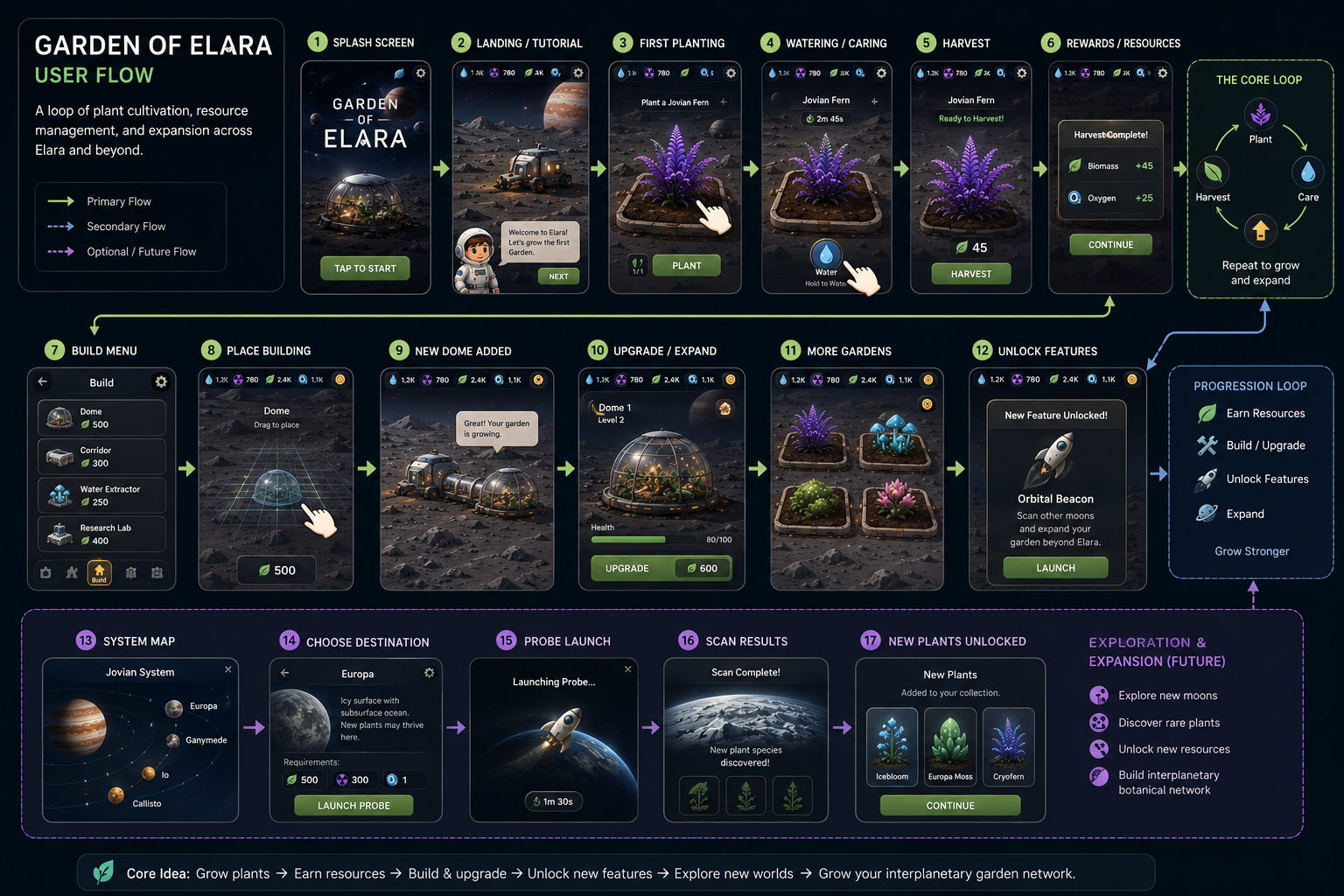
- The Core Loop: Players harvest local water-ice from the lunar surface to keep their crops hydrated, adjust their dome’s lead-shielding to regulate radiation exposure, and harvest bioluminescent biomass.
- Visible Progression: Players begin with a single, fragile landing pod. Over time, they reinvest harvested biomass and oxygen to construct interconnected biodomes, install automated watering lines, and unlock specialized greenhouse chambers.
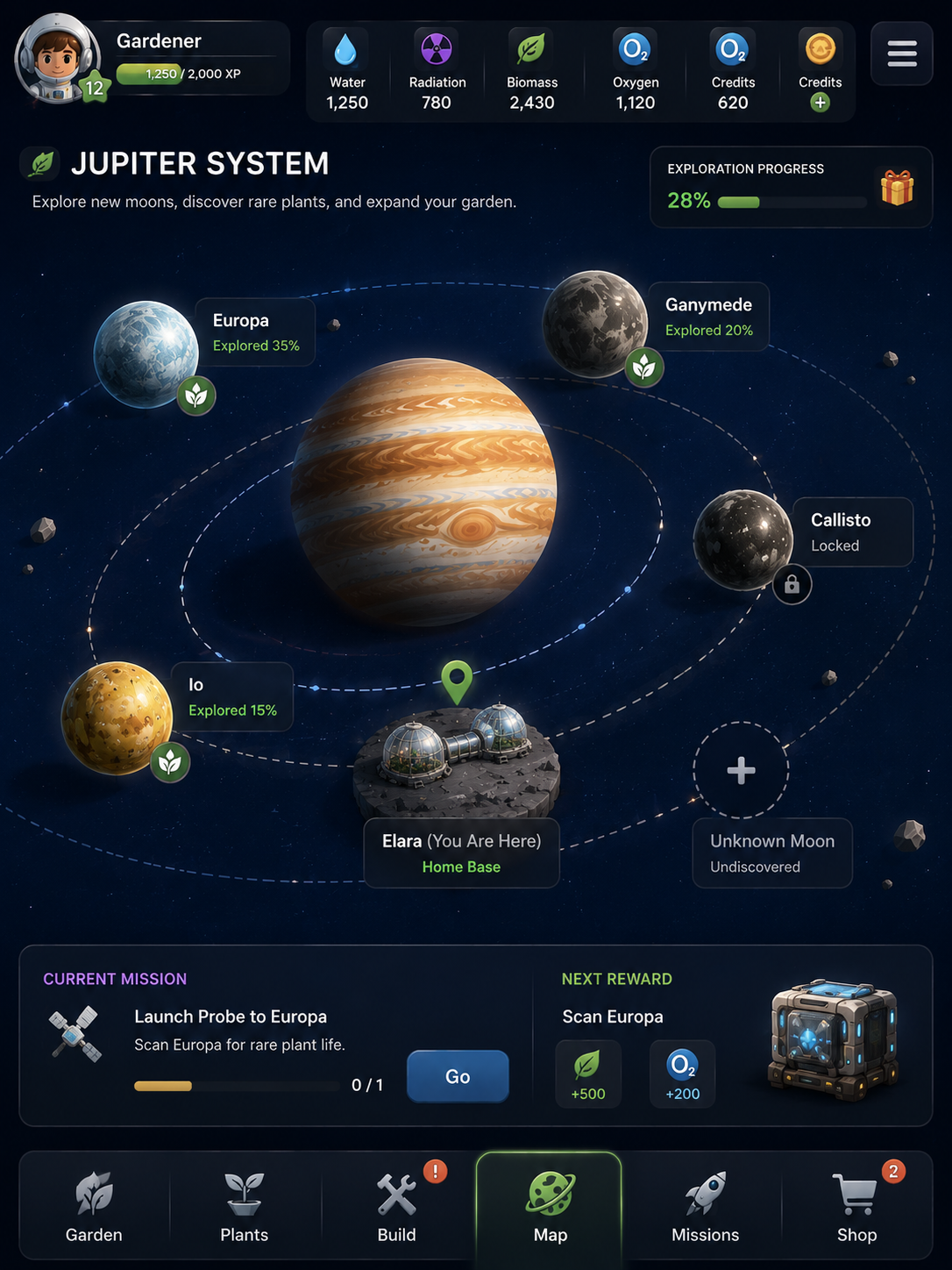
- Interplanetary Expansion: As the local economy scales, players build orbital beacons and launch seed probes to neighboring moons—such as Europa and Callisto—each introducing new environmental challenges like subsurface water networks or extreme sub-zero temperatures.
How we built it
Since this competition challenges us to design rather than program a game, our build process was focused entirely on systems design, paper prototyping, and visual world-building.
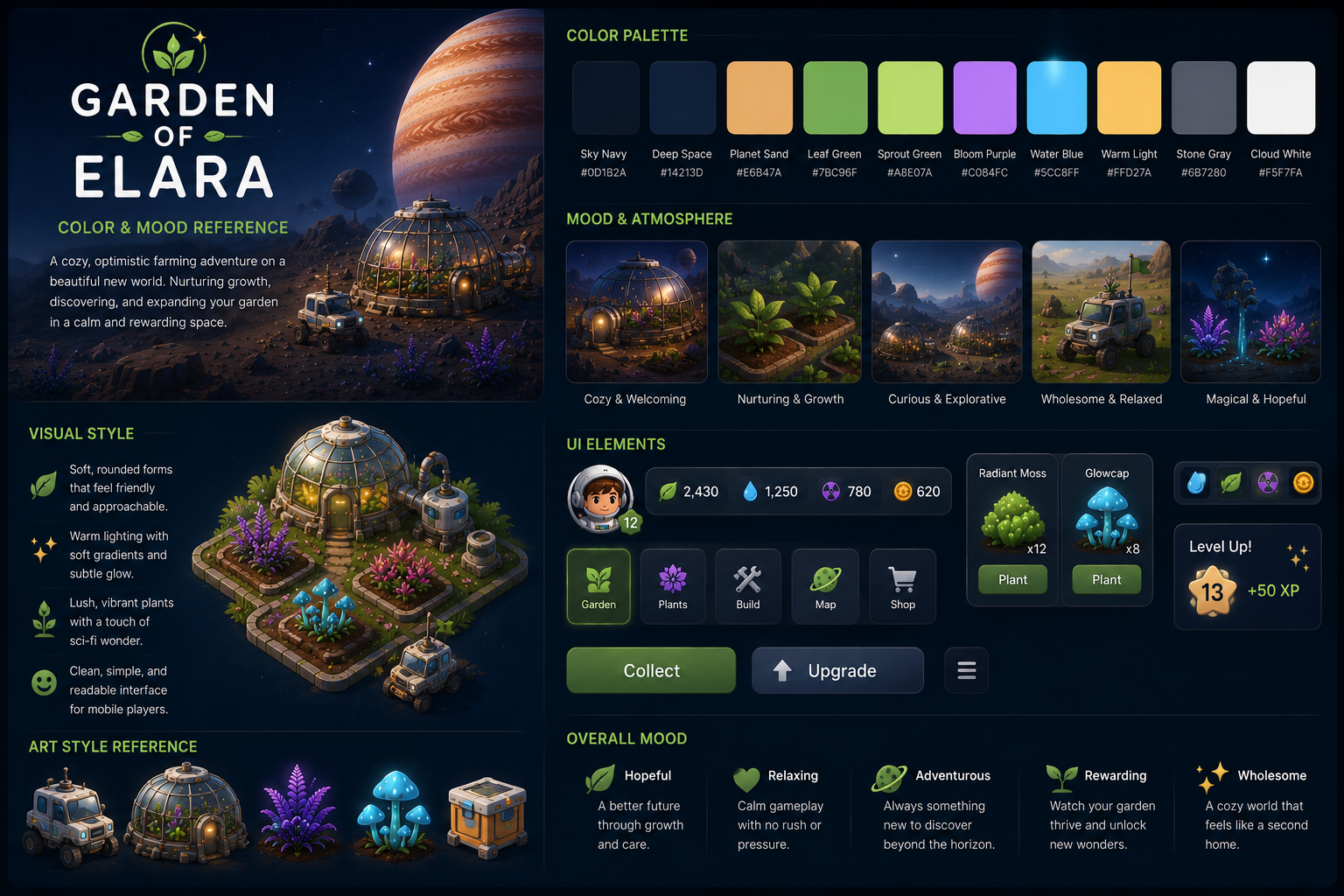
- Visual Direction: We designed our UI wireframes and mood boards, utilizing a dark-mode aesthetic to reduce eye strain for mobile players while emphasizing the vibrant, glowing neon colors of the radiosynthetic flora.
Challenges we ran into
- Scoping the Interplanetary Scale: It was initially tempting to design extensive spaceflight mechanics, manual orbit-mapping, and complex trading routes. However, we realized this shifted the game too far away from the relaxing, focused loop of a management simulation. We solved this by abstracting the space travel into automated, passive probe launches, keeping the player’s primary attention on dome management.
- Balancing Cozy vs. Hostile: Maintaining a cozy tone in a game set in a lethal space environment was difficult. We addressed this by ensuring that failures (such as a dome losing pressure or running out of water) do not permanently destroy the player's progress. Instead, plants go into a dormant, non-producing state rather than dying, giving players space to recover without severe frustration.
Accomplishments that we're proud of
- A Consistent, Coherent Design: We developed a design where the visual concept art, and the production roadmap all directly support one another. The mechanics described in the text are clearly visible in our UI mockups and budgeted in our sprint schedules.
- Integrating Realistic Science: We are proud of how we integrated actual astrophysics and biology concepts—such as Jovian radiation levels and hydroponic science—into accessible, simple mobile mechanics that do not require a scientific background to understand.
- A Realistic, Scoped Production Plan: We constructed a highly organized, phase-by-phase development roadmap that demonstrates how a small team could build a functional, playable MVP of this concept within a standard mobile development timeline.
What we learned
- Pacing as Design: Through constructing the Player Journey Map, we learned that pacing is not just about the order in which features are unlocked. It is about managing the user's emotional state—creating small dips in resources to build anticipation, followed immediately by satisfying visual feedback when a harvest is successful.
- Designing for the Mobile Form Factor: We gained a deeper appreciation for mobile UI constraints. We realized that complex systems must be compressed into simple, thumb-accessible menus, which forced us to streamline our resource screens down to the absolute essentials.
What's next for Gardens of Elara
- Prototyping the Core Loop: The next immediate step is to translate our design equations into a basic greybox prototype in Unity or Godot. This will allow us to test the tactile "feel" of harvesting water-ice, adjusting the radiation dials, and watching the plants respond to real-time inputs.
- Developing New Environments: We plan to expand our environmental design templates to focus on the unique physics of other Jovian moons, such as utilizing the tidal heating of Io to design volcanic thermal greenhouses.
Built With
- chatgpt
- gemini


Log in or sign up for Devpost to join the conversation.