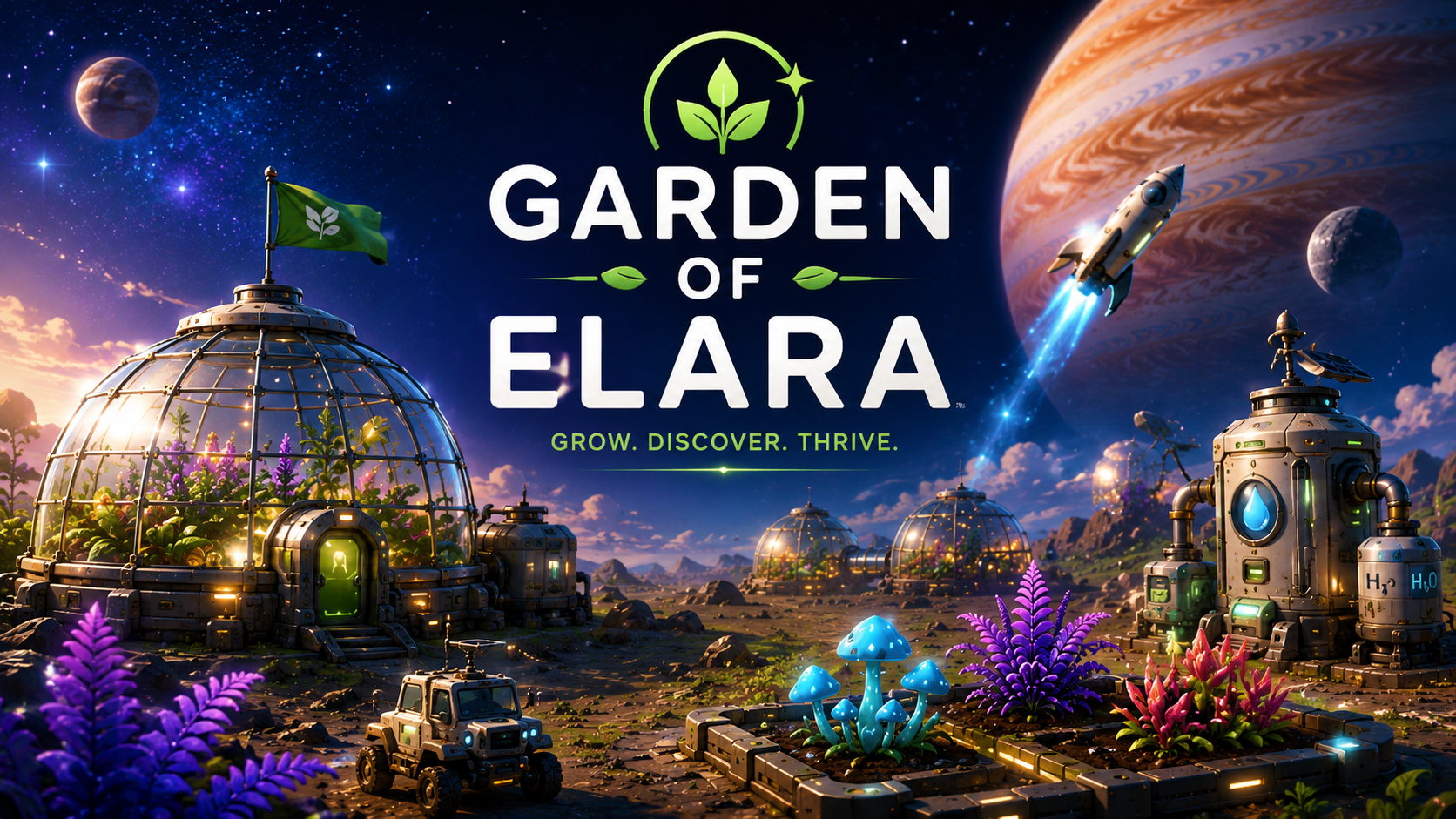
Garden of Elara
Inspiration
Garden of Elara started from a simple question: what would a cozy farming game look like if it were built around the strange conditions of the Jovian system instead of a peaceful Earth-like field?
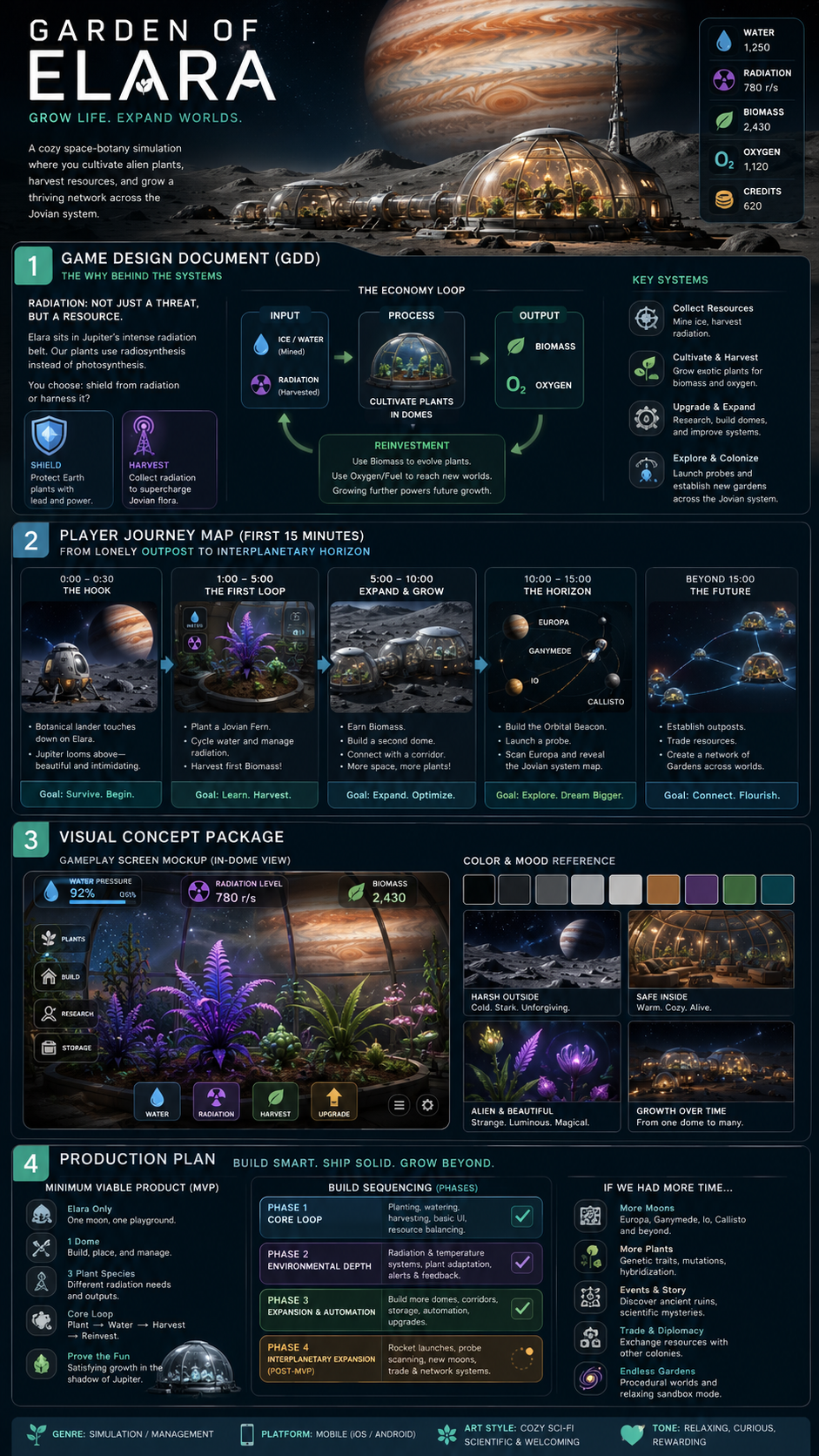
Jupiter's magnetic environment is one of the harshest in the solar system, and moons such as Europa are exposed to intense charged-particle radiation. Rather than treating that environment only as something the player must survive, we wanted to turn it into part of the fantasy of farming: alien plants that have been engineered to make use of unusual energy sources, produce useful resources, and gradually transform an otherwise hostile landscape.
The game is science-inspired rather than a literal simulation. Elara itself is an irregular outer moon of Jupiter, so the biology, atmosphere, crop behavior, and surface farming in the game are intentionally fictionalized. What mattered to us was using real ideas—Jupiter's magnetosphere, icy moons, radiation chemistry, closed-loop agriculture, automation, and resource scarcity—as a believable foundation for a cozy incremental game.
Mechanically, our biggest inspirations were FarmVille and Cookie Clicker. We wanted the tactile satisfaction of planting and harvesting individual crops, but with an incremental progression curve where the player's manual work is gradually replaced by automation.
What it does
Garden of Elara is a portrait mobile farming and management game where the player begins with a single plot and eventually builds an automated agricultural network across Jupiter's moons.
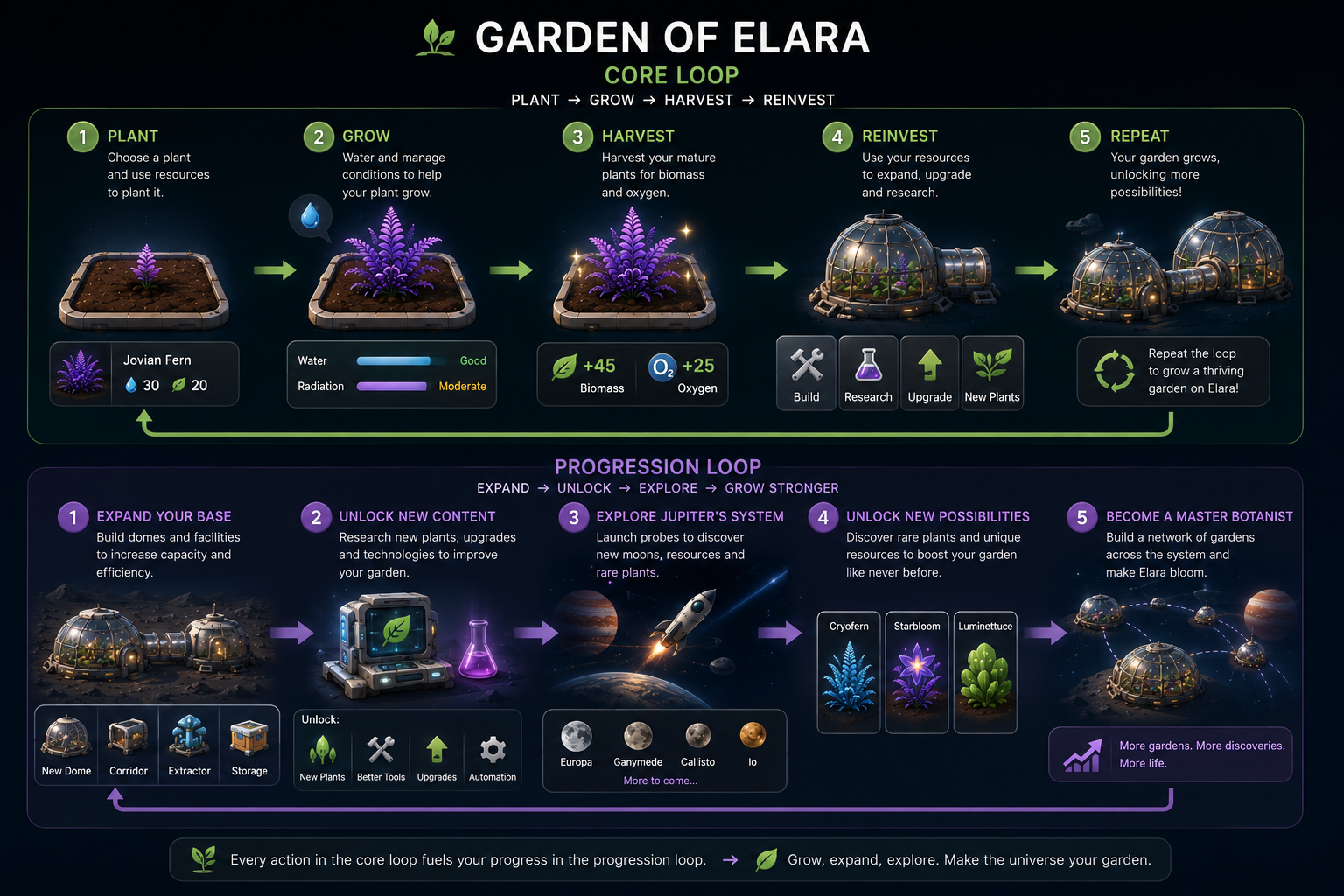
The first few minutes are intentionally simple:
- Plant a Jovian Fern.
- Tap it to accelerate its growth.
- Harvest it for Biomass.
- Replant it.
- Spend the Biomass on upgrades.
From there, the same loop expands rather than being replaced.
Biomass is the primary currency and remains the backbone of the economy. Later crops introduce secondary resources only when the player is ready for them:
- Oxygen is produced by crops such as Glowcap and Sunmoss and is used for expansion and specialized unlocks.
- Research Samples are produced by advanced crops and gate higher technology and automation tiers.
Each plot can be assigned its own crop. This means a player can keep one plot focused on fast Biomass production, another producing Oxygen, and another generating Research.
Progression gradually removes repetitive actions:
- Auto Replanter restarts harvested plots.
- Auto Harvester collects mature crops.
- Seed Printer reduces recurring seed costs.
- Crop Cycler improves the overall automated growth loop.
- Drone Network allows automation to service multiple plots at once.
- Living Soil, Irrigation, Radiation Beds, and Biodiversity improve yield, speed, rare crop chances, and mixed-farm efficiency.
The long-term goal is not simply to max out Elara. An always-visible Expedition button shows progress toward the next destination.
The campaign progresses through:
Elara → Europa → Ganymede → Callisto → Jovian Network
Each moon has its own six-crop ladder and a substantially larger economy. Launching an expedition resets normal run progress but preserves Seed Cores and permanent Core Tech, so future expeditions begin stronger and can eventually start with bonuses such as additional plots or early automation.
How we built it
The prototype is a fully playable, self-contained HTML5/WebGL game designed specifically for portrait mobile play.
The entire runtime is packaged locally:
- First-party HTML, CSS, and JavaScript.
- A custom native WebGL 3D renderer.
- Touch and pointer-based plot interaction.
- Projected 3D-to-screen plot labels and tutorial highlights.
- Procedural Web Audio sound effects.
- Local save data using
localStorage. - Offline production calculations.
- No external runtime network requests.
- No CDN dependencies or remote assets.
The game uses a single 3D farm scene with direct interaction. Tapping a plot performs the contextually appropriate farming action, while dragging empty terrain orbits the camera.
A large amount of iteration went into making the controls work naturally on a phone. Crop selection became a plot-assignment tool rather than a global planting toggle: selecting a new crop and tapping an occupied plot changes what that plot will grow on its next cycle without destroying the crop currently growing there.
We also built the tutorial directly around the live UI. It highlights actual plots, tabs, upgrades, resource counters, and crop buttons while still allowing the player to interact with the farm underneath it.
Challenges we ran into
Keeping the economy understandable
Our earliest versions introduced Water, Radiation, Oxygen, and Biomass almost immediately. Although that created more resource management, it made the opening harder to understand and repeatedly produced situations where a new player could run out of the resource needed to continue the tutorial.
We eventually simplified the hierarchy:
Biomass is universal. Oxygen is for expansion. Research is for technology.
That kept the incremental game readable while still giving different crops a strategic purpose.
Making crop selection intuitive
A global selected crop created several confusing edge cases. For example, the player could harvest a Glowcap while Sunmoss was selected and accidentally replace the Glowcap with Sunmoss.
We redesigned planting around persistent per-plot crop assignments. A plot remembers what it is supposed to grow, automation follows that assignment, and intentionally selecting a different crop lets the player change the plot's next cycle.
Designing automation that does not end too quickly
Early builds only had a few automation levels. Once the player bought Auto Replanter and Auto Harvester, there was not enough meaningful progression left.
We expanded automation into longer tracks with different purposes: speed, cost efficiency, automation bandwidth, mixed-farm bonuses, and advanced technology gates. This made automation something the player develops across the entire run rather than a feature they finish in a few minutes.
Making prestige feel worth doing
Our first prestige design mostly reset the same content with a permanent multiplier. That did not provide a strong enough reason to restart.
The final design turns prestige into an Expedition. Completing Elara launches the player to Europa, where a new crop ladder and a larger economy begin. Europa leads to Ganymede, then Callisto. Permanent Core Tech survives between expeditions, so the reset both opens new content and changes how future runs begin.
Designing for portrait mobile
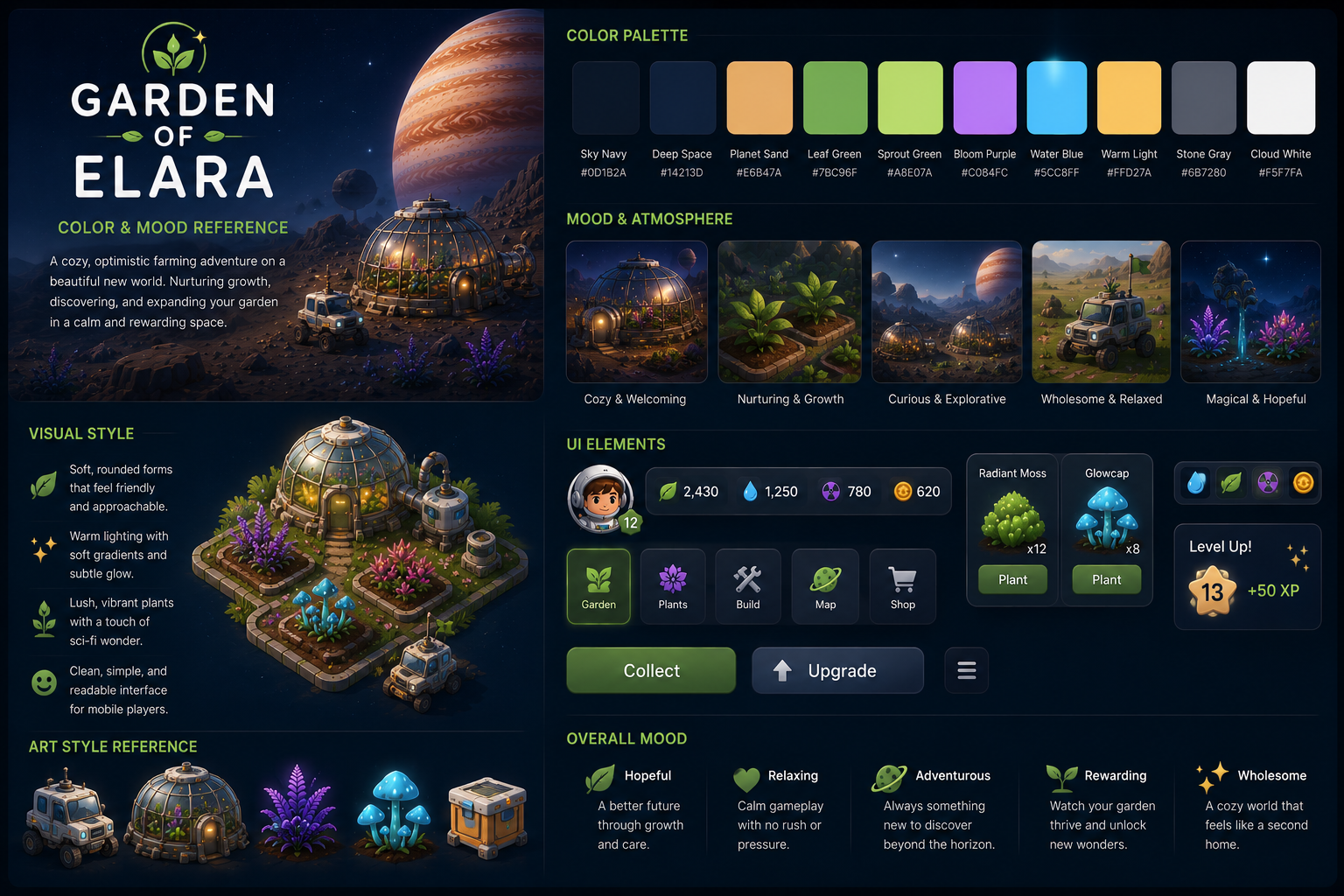
The phone screen forced us to continually remove unnecessary UI. We experimented with multiple navigation systems and resource bars before settling on a much simpler structure:
- resources and current goal at the top;
- the 3D farm in the center;
- crop selection near the bottom;
- Upgrades and Expedition as the two persistent primary actions.
The upgrade interface is a bottom sheet, and tapping the 3D map closes it immediately.
Accomplishments that we're proud of
Turning a concept into a working game
The biggest accomplishment is that Garden of Elara became more than a design document. The final submission is a functional offline prototype with a complete farming loop, 3D interaction, progression, automation, resource specialization, saving, offline production, tutorial guidance, and prestige.
A progression system that changes over time
The game starts as a one-plot tapping game and gradually becomes a management game.
The player's role evolves from:
manually grow crops → manage several plots → automate planting → automate harvesting → specialize plots → optimize automation → launch to another moon
That evolution became the central design principle for the project.
Making different crops useful
Instead of making every new plant simply a larger number, crops can fill different jobs. Some are strong active Biomass crops, some produce Oxygen, some produce Research, some perform better under automation, and some reward rare Radiant mutations.
The Biodiversity system further rewards maintaining a mixed farm.
Building a longer Jovian campaign
The prototype contains four progression environments—Elara, Europa, Ganymede, and Callisto—with six crops assigned to each moon. Later moons scale the shared upgrade and plot economy so the stronger crop values do not immediately trivialize progression.
A completely offline submission build
The game is packaged as a tiny self-contained HTML5/WebGL build. index.html is at the ZIP root, all first-party game logic remains readable, and the runtime makes no external network requests.
What we learned
Complexity is more effective when it is introduced gradually
Adding more systems did not automatically make the game deeper. The most successful version starts with one crop and one currency, then introduces Oxygen only after crop specialization matters, Research only after advanced technology becomes relevant, and prestige only after automation has been established.
Automation should change the player's job
A good automation upgrade should do more than increase a number.
Auto Replanter removes an action. Auto Harvester removes another. Seed Printer changes recurring costs. Drone Network changes throughput. Biodiversity changes the ideal layout of the farm.
The progression became much more satisfying once every upgrade had a distinct reason to exist.
Tutorial design is interaction design
We repeatedly found cases where the tutorial itself interfered with the mechanic it was trying to teach. Highlights could block taps, tutorial text could cover buttons, and dismissing an overlay could accidentally consume a farming input.
The final tutorial is attached to real controls, keeps gameplay targets interactive, and allows the player to dismiss tutorial text independently.
Prestige needs new content, not only bigger numbers
A permanent multiplier helps an incremental game, but it was not enough to make restarting exciting. Moving the player to a new moon with new crops gave prestige a clear promise:
finish this garden so you can discover the next one.
What's next for Garden of Elara
The next step would be to turn the systems prototype into a more expressive production game.
The highest-priority improvements would be:
- Give Elara, Europa, Ganymede, and Callisto visually distinct environments.
- Add visible machinery for Auto Replanters, Harvesters, Seed Printers, and Drone Networks.
- Add stronger crop growth, harvest, mutation, and resource-transfer animations.
- Give each moon environmental modifiers that change how the player builds the farm.
- Expand Core Tech so later expeditions can begin with meaningfully different strategies.
- Add contracts, collections, achievements, and limited objectives that encourage unusual crop mixes.
- Continue balancing the economy through real-device playtesting so the first expedition feels substantial without becoming repetitive.
The long-term vision is a cozy incremental farming game where the player's tiny first garden eventually becomes a self-sustaining agricultural network spread across the Jovian system.
Built With
- chatgpt


Log in or sign up for Devpost to join the conversation.