Inspiration
Throughout our academic careers, we’ve observed many students struggling to keep up in subjects like science, where each concept builds upon the last. To grasp complex topics, a strong foundational knowledge is essential. However, teachers often assume that students come prepared, relying on the previous year's instructors to have laid a solid foundation. Unfortunately, this is not always the case, leaving both teachers and students confused. The student is left wondering why they can’t grasp the material, which can lead to feelings of frustration and inadequacy.
We've all experienced this firsthand. Especially with certain group members that struggle with ADHD, we all find it hard to pinpoint exact areas that we are lacking in. Additionally, with the expectation that we remember everything from last year, which most of the time, is not true, it's hard to stay on the pace that our teachers go at.
What it does
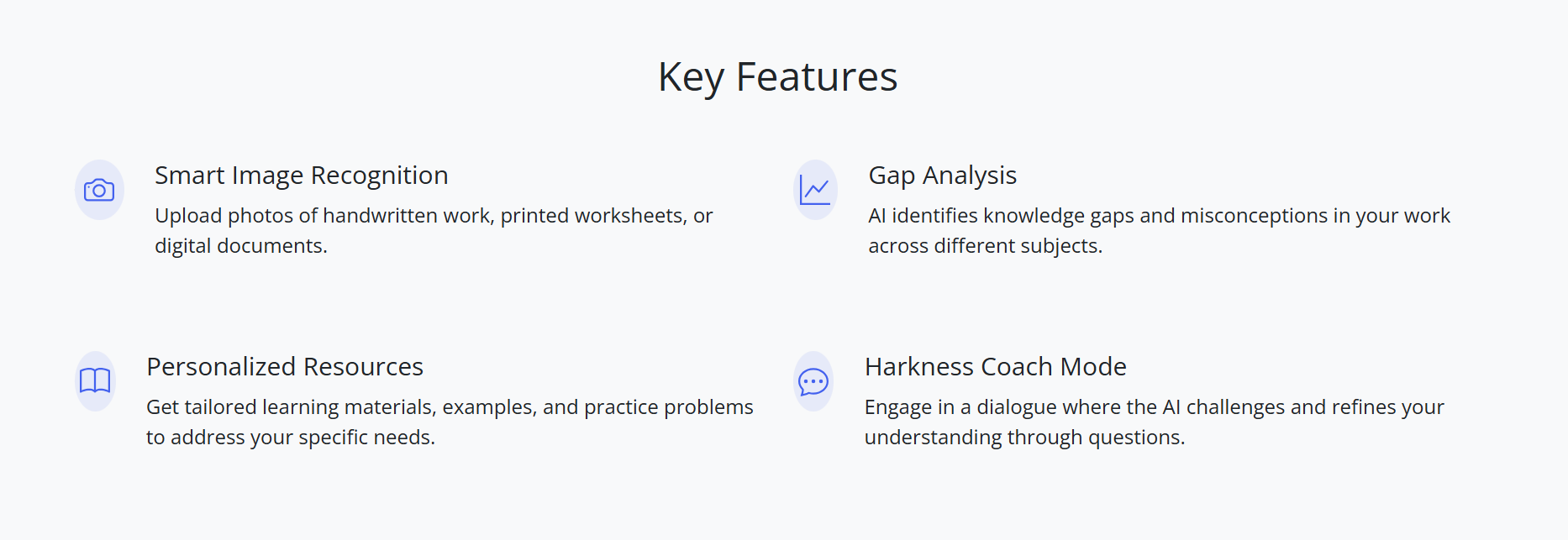
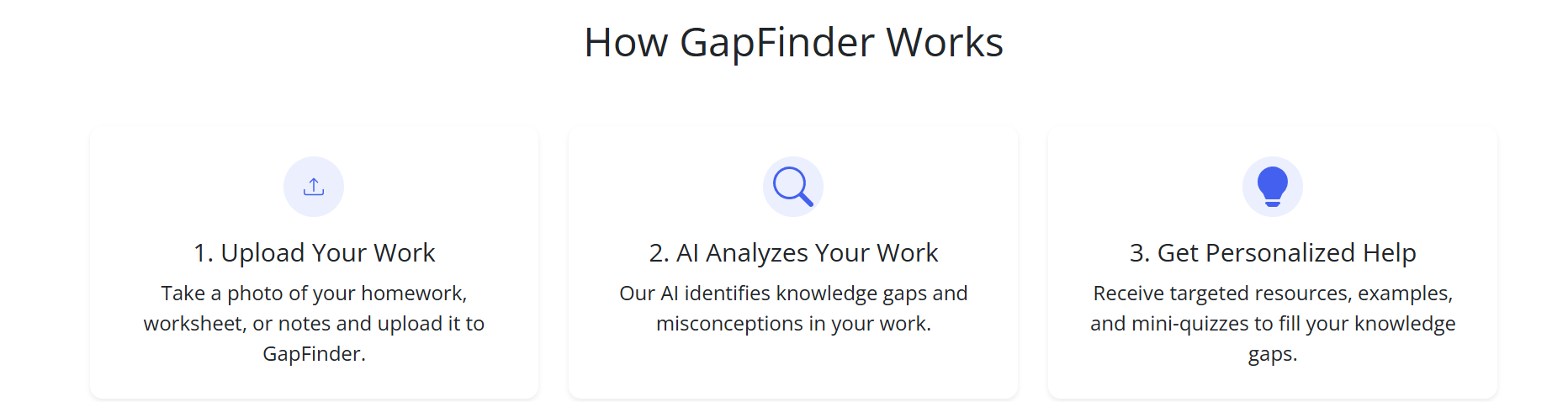
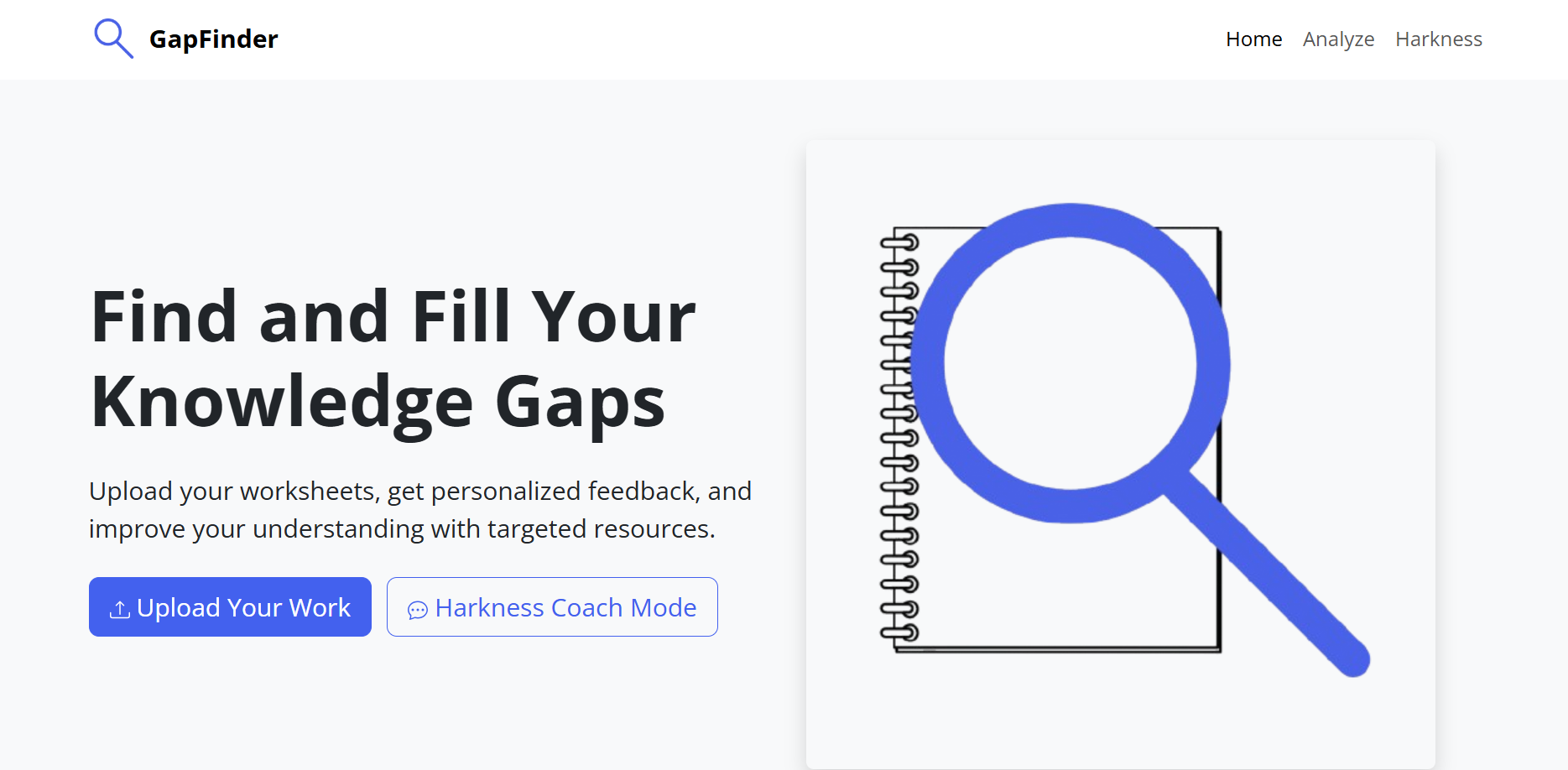
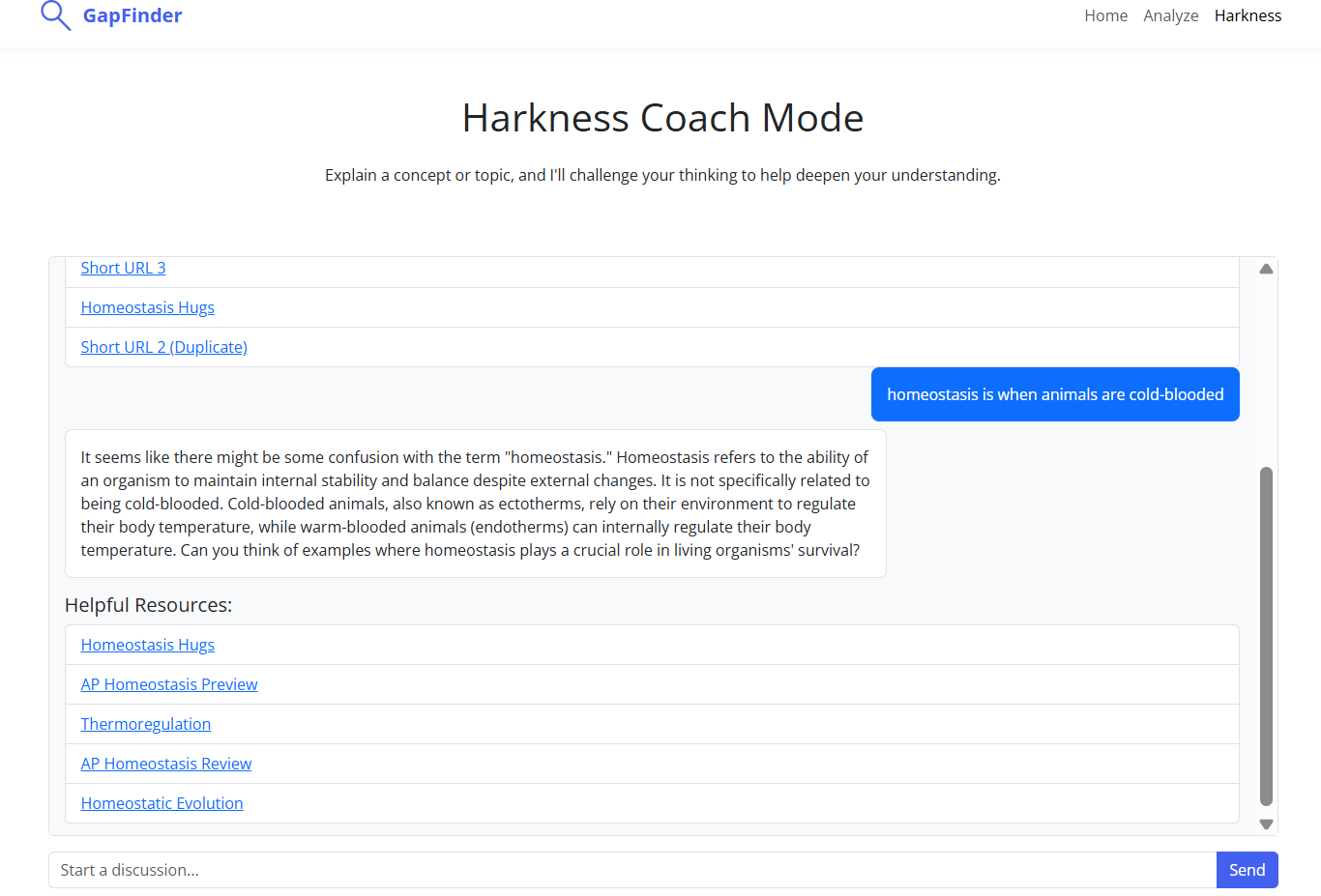
GapFinder is an AI-powered tool designed to help K-12 students identify gaps in their knowledge, particularly in subjects like science and math, where each concept builds upon the previous one. By allowing students to upload their worksheets, GapFinder analyzes the content and locates areas where they are struggling. The tool then provides personalized feedback, highlighting knowledge gaps and offering specific resources—such as videos, articles, and practice problems—to help them improve. Additionally, it features a Socratic Coach Mode, where the AI engages students in critical thinking by prompting them to explain concepts and refining their understanding. This tool is aimed at enhancing learning outcomes by addressing individual knowledge gaps and empowering students to take control of their learning.
Our tool primarily takes advantage of a Harkness approach. Rather than giving the answer right away, the goal is to guide our user to the answer through conversation. This ensures that the information sticks.
How we built it
The main technologies we used to build our website are Python, Flask, OpenAI API, Faiss, and Google Tesseract.
We put our original idea into Lovable, after generating a well-formatted website, the functionality was simply not there. So we translated the code into Flask, integrating the OpenAI API into our platform. Furthermore, we needed a vector database containing science tutorials, websites, interactive digital simulations, and much more for the AI to parse through once given the prompt. We compiled a Python dictionary containing over 700 high quality resources and put them into a vector database, while incorporating a RAG system for the AI. For our Harkness Coach, we sent the prompt to question and engage the user in critical thinking after putting in their explanation of a science topic.
Challenges we ran into
Throughout the development of GapMind, we ran through multiple challenges. Firstly, we were extremely short staffed. We were counting on another team member to show up, but they weren't able to due to personal conflicts, so we were forced to run a two person team. We adapted to this by created a plan at the beginning and making sure that we met our goals at adequate times. Another major challenge that we ran into was learning how to use new technologies. Technologies like Lovable, Flask, and the OpenAI API were all new to us. Being able to learn these and use them effectively was a huge hurdle that we are glad that we were able to cross.
Accomplishments that we're proud of
Of course, we are proud of building a working product in the end that can be iterated upon. But more than that, we are the most proud of finding ways to effectively integrate AI into a cause that we truly care about. In school, we are constantly surrounded by people using AI in bad ways, like cheating on assignments and tests. Big Red Hacks has empowered us to reach beyond these boundaries and really find ways that AI can be used ethically and for benefit in the real world. What we're most proud of is taking this skill and being able to use it in future projects. The knowledge of how to work with various API's and ethically take advantage of AI tools is invaluable in this day and age, and we are grateful that we were given this opportunity.
What we learned
One of the main things that we learned is the ethical aspect of balancing AI with the spirit of the hackathon. Although the hackathon encourages the use of AI, we wanted to make sure that we were still learning and getting the best out of our experience. That's why we decided to use AI for the parts that were tedious and that we already knew how to do, such as styling our website. For the parts that we didn't know how to do as well, we made sure that we used the internet and those around us to understand what was happening and truly learn the topic.
What's next for GapFinder and Harkness Coach
Moving forward, GapFinder and Harkness Coach have several exciting opportunities to scale and expand. First, we plan to extend support beyond science to include subjects like math, history, and English, offering subject-specific insights and tailored resources. Second, we aim to make the platform more inclusive by introducing multilingual support, allowing students from diverse linguistic backgrounds and underserved regions to access the tools. Third, we envision adaptive learning paths that adjust in real-time based on a student’s performance, helping them build mastery at their own pace. Additionally, we want to empower educators by creating classroom dashboards that track student progress, identify shared knowledge gaps, and suggest group prompts through Harkness Coach for collaborative learning. Lastly, we hope to implement a more immersive tutoring experience by adding a conversational AI mode that uses both voice and chat, offering interactive, Socratic-style discussions that feel like one-on-one mentorship.

Log in or sign up for Devpost to join the conversation.