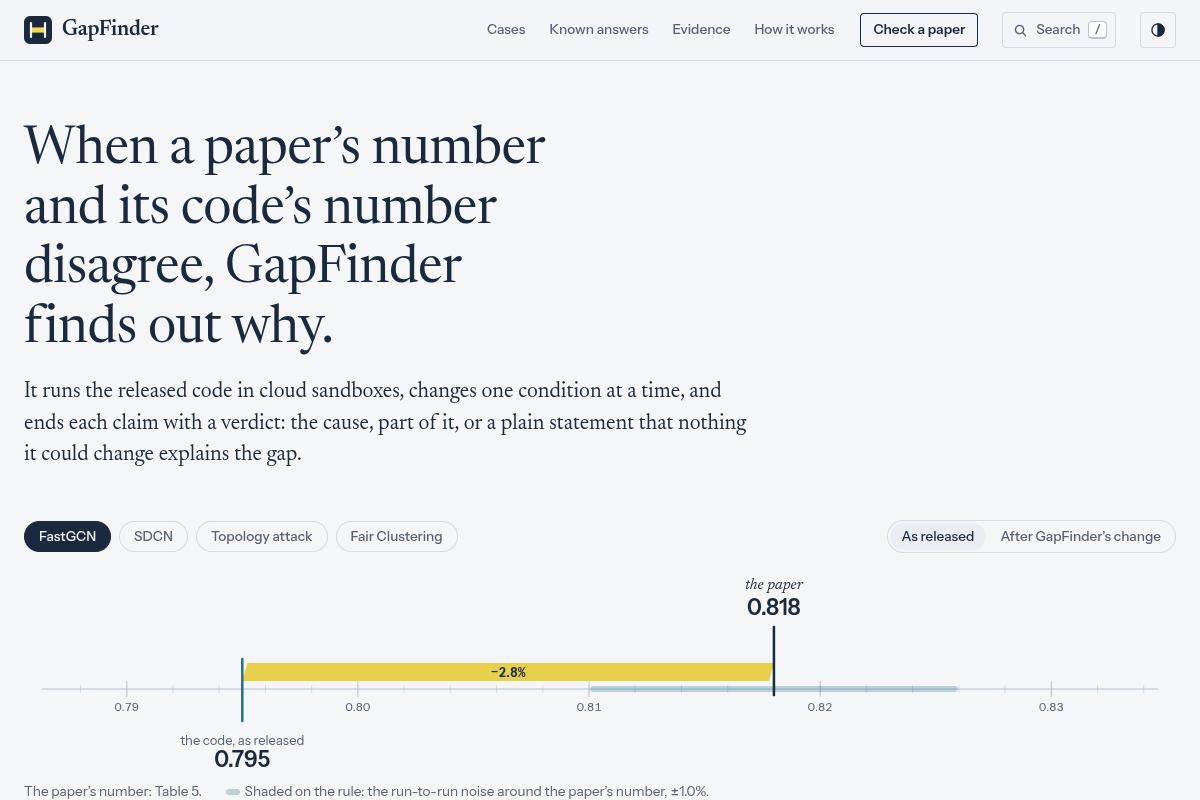
Everyone asks whether a paper reproduces. GapFinder asks why it doesn't.
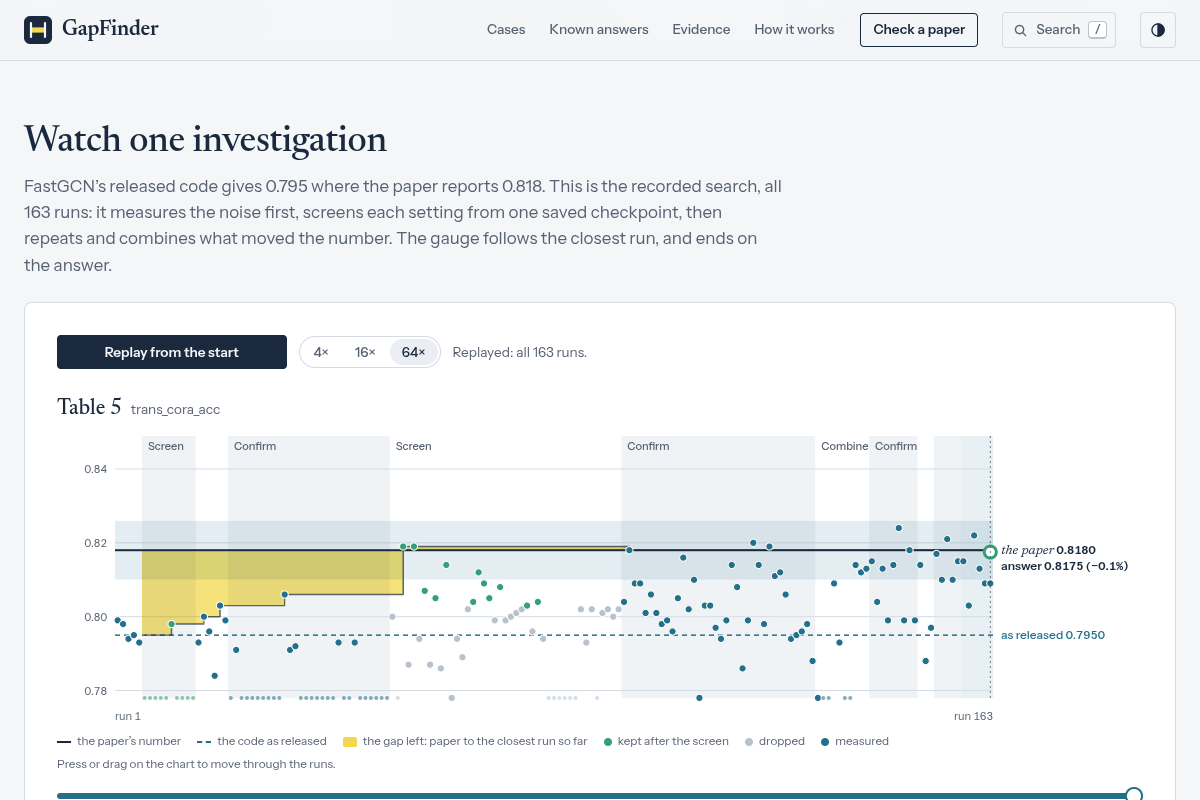
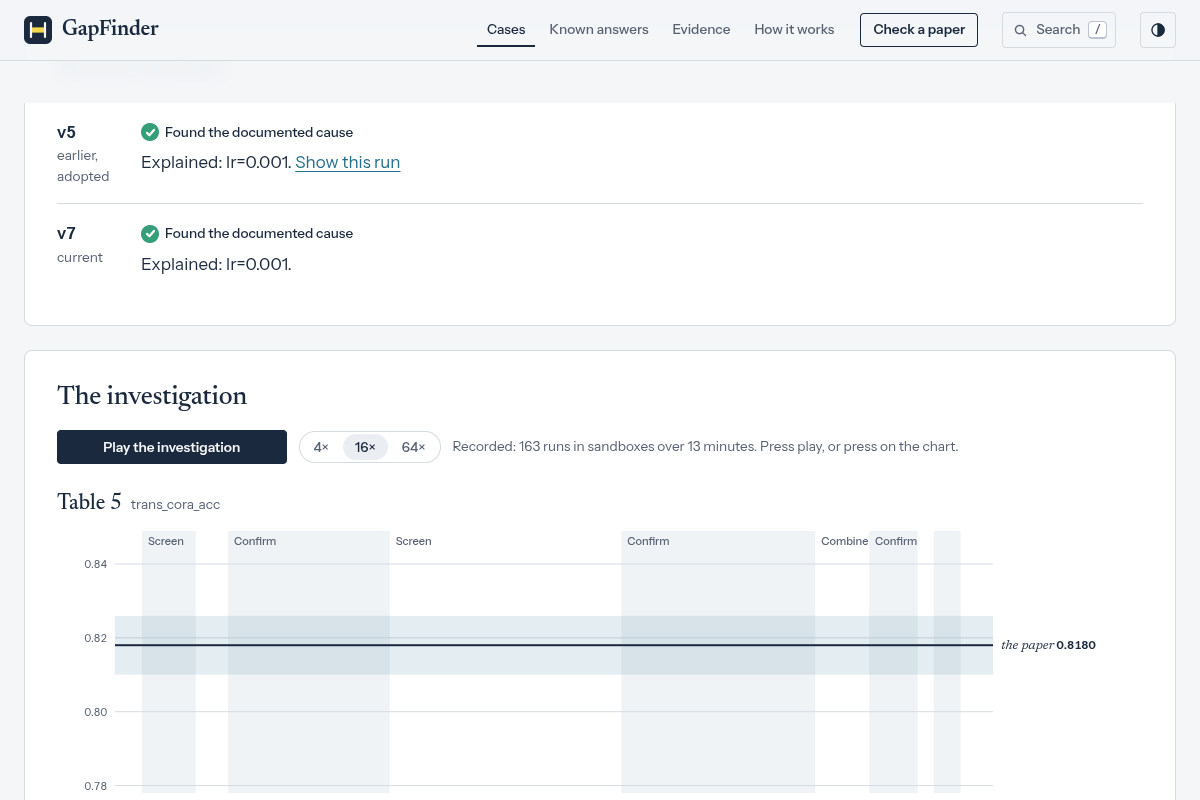
Judges: open https://sayjad21.github.io/GapFinder/ and press 16x. It replays a recorded RusKey run with no login and no cost. Then open Gap Report for the verdicts and Scoreboard for GapFinder against a standard coding agent. Code: https://github.com/Sayjad21/GapFinder (MIT license).
Inspiration
Sayjad Rahman spent weeks reproducing RusKey, a SIGMOD 2024 paper about a key-value store built on RocksDB. His numbers for Figure 6 did not match the paper's, and the paper does not say why. The cause could be a setting it never states, the scale of the data, or something else, and finding out means running one controlled experiment after another, each starting from the same loaded database. The tools we know of check whether a paper reproduces. We did not find one that searches for why it doesn't, so we built it, and we made it say "unexplained" when the evidence does not support a cause.
What it does
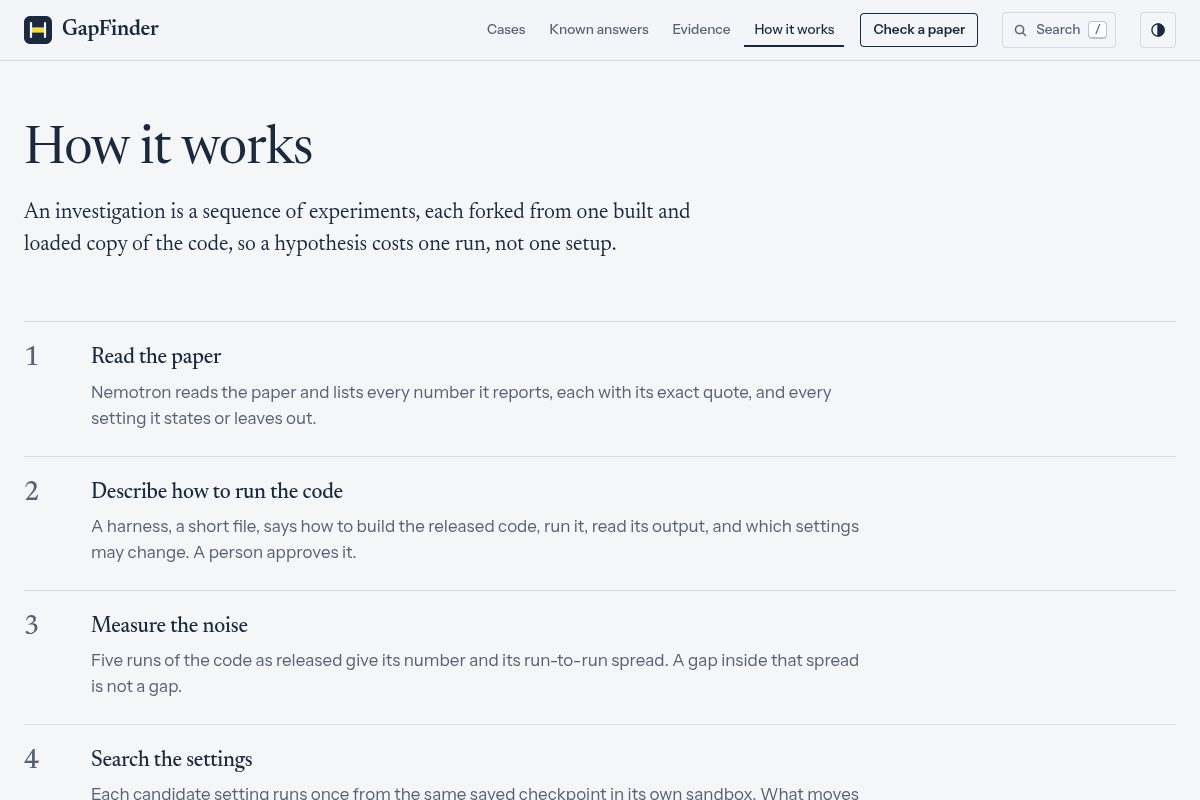
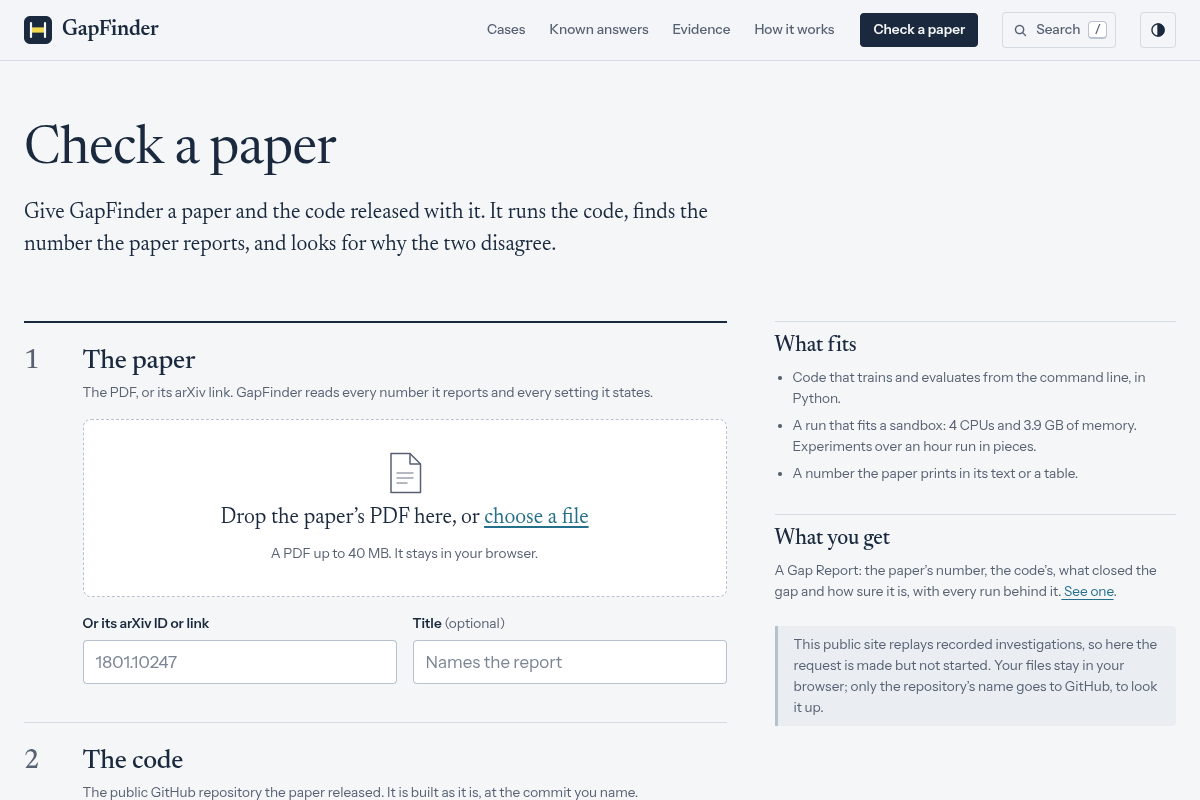
You give GapFinder a paper PDF and the artifact's repo. It reads the paper into a claim ledger (every result the paper claims, each with a quote that must match the PDF) and a ranked list of settings the results could depend on. It builds and loads the artifact once in Token Factory Sandboxes, then forks one branch per hypothesis from that exact state. The output is a Gap Report with one card per claim: a label, the setting that explains the gap (if any), the evidence for the value, a noise band, the held-out checks, and the checkpoint and command to replay the branch.
The labels are Explained, Paper-artifact inconsistency, Partially explained, Fits but unsupported, Inconclusive, Reproduced and Unexplained. A value that closes the gap but has no evidence behind it is "Fits but unsupported", never "Explained". GapFinder changes experimental conditions only (configs, flags, workload, build options, environment). It never edits the paper's algorithm code, and a diff guard enforces that.
To run it yourself without keys: python scripts/try_it.py runs a full investigation on a GapBench
dev task from recorded model answers, with the experiments running on your machine
(README). Running a new paper needs
a Token Factory key.
How we built it
The pipeline has five stages: claim ledger, assumption space, checkpoint tree, search, Gap Report. The search screens one change per branch, confirms survivors with repeats, combines the best, bisects combinations to a minimal set, then verifies. Verification reverts each setting (the gap must come back), checks the held-out claims (they must not get worse beyond noise), and looks for evidence that the authors used the value (paper, then code, then web search). When the budget runs out, nothing is labelled from runs that were not confirmed.
How we use Nemotron on Token Factory. Every call goes through one router (router.py) that splits the reasoning trace from the answer, recovers once from an empty answer, repairs malformed JSON, checks a hard spend cap before each call, and caches every response.
- Nemotron 3 Ultra (
nvidia/Nemotron-3-Ultra-550b-a55b): the two long-context reasoning calls per paper. It extracts the claim ledger from the paper and builds the assumption space from the paper and the repo map. - Nemotron 3 Super (
nvidia/nemotron-3-super-120b-a12b): filters the extracted claims down to results, and triages failed branches (it reads the error and proposes a valid value). It is also the model behind the baseline agent we compare against (mini-swe-agent). - Nemotron 3 Nano (
nvidia/NVIDIA-Nemotron-3-Nano-30B-A3B): a fallback metric parser for log formats the deterministic parsers do not know, with every value grounded in the log. We exercised it in a spike only, because every artifact in this project prints a format the deterministic parsers already handle. - Not used: Nemotron 3 Nano Omni is not served on Token Factory, so GapFinder has no model that reads figures. The RusKey Figure 6 values were digitized outside the pipeline.
- Usage and billed cost per tier are in the README table, taken from the spend ledger. Ultra: 427 calls, 1.98M tokens in and 3.62M out, $12.83 (two calls per GapFinder run, plus the MC Dropout ledgers). Super: 1,346 calls, 12.7M in and 395K out, $4.18, of which 1,333 calls ($4.15) are the baseline agent and 13 are the claim filter and failed-branch triage. Nano: 2 calls, under $0.001. All billed inference, development and both test runs included, is $17.17.
How we use Token Factory Sandboxes.
- One loaded database, many forks. The checkpoint tree builds once and loads once. Each hypothesis forks from the deepest checkpoint still valid for it: a config change forks the loaded database, a dataset change reloads from the build, a build flag rebuilds. Sandbox VMs have 4 vCPUs and 3.9 GB, so we run CPU-only artifacts.
- Checkpoint IDs as a measurement. Identical filesystems get identical IDs. With
--noise-setups NGapFinder loads the database N times with the same command before trusting a noise band. For RusKey, 5 loads with the identical command gave 5 different checkpoints. A noise band from forked repeats alone would have hidden that. - Replayable answers. Every attribution names its checkpoint and exact command. The replay site plays recorded runs and costs nothing.
- Guards on our side. Each command runs under a CPU-time limit, and a guard on the reported
sandbox cost refuses new runs past a set total (the reported
costis diagnostic and was not billed during the Beta). Two MC Dropout arms, its confirmation runs and its post-hoc diagnostic ran in Sandboxes (up to 48 simultaneous operations), and RusKey ran its 127-branch search there. GapBench's toy artifacts run on the local backend.
Evaluation
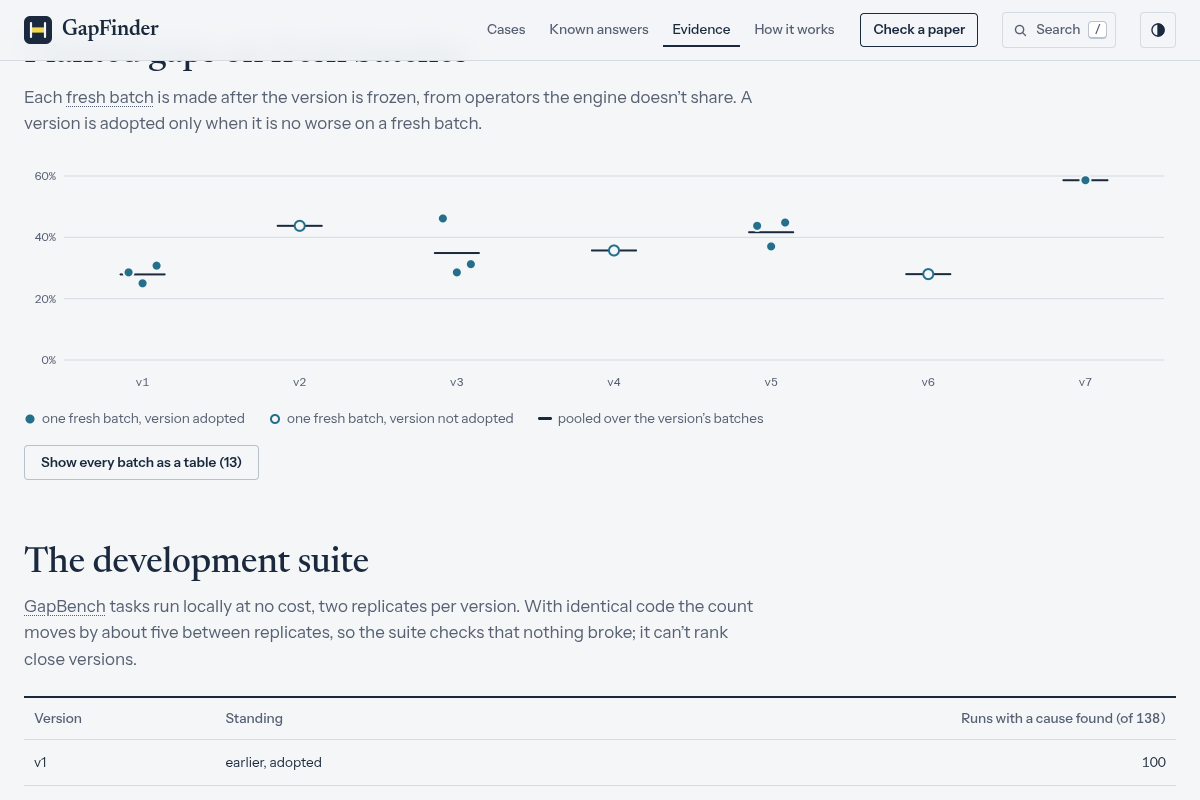
All numbers below link to the file they come from. The test protocol was committed before any test run (PROTOCOL.md). With 8 tasks, nothing here is a conclusive win, and we do not claim one.
Update: three more sealed tests (v1.1-v1.3)
After v1.0 we improved:
- which values get tried (coverage);
- how equally good fits are chosen and reported (selection);
- what "Unexplained" says (diagnosis).
Each version was frozen with a git tag, and only then was a new sealed set generated. The seed was made
after the tag, and the pre-registration is in eval/gapbench/PROTOCOL.md. 10 tasks, 3 runs per arm.
| Sealed test | GapFinder confidently wrong | Correct causes (of 15) | Correct abstentions (of 15) | Balanced accuracy | Coding agent confidently wrong |
|---|---|---|---|---|---|
| v1.1 | 0/30 | 7 (+1 partial) | 15 | 0.73 | 19/30 |
| v1.2 | 0/30 | 12 | 15 | 0.90 | 8/30 |
| v1.3 | 0/30 | 9 (+1 partial) | 15 | 0.80 | 22/30 |
- Safety: 0 confidently wrong in 90 blind runs; the coding agent was confidently wrong in 49 of 90.
- The misses are interactions where several settings fit the paper's numbers equally well. GapFinder now reports those configurations as a set instead of pretending to know.
- v1.3 missed two of its four pre-registered accuracy criteria, and we report that as it is.
- Small samples: each test has 15 cause runs, so the accuracy differences between versions are within noise. The safety result is the robust one.
GapBench blind test, run twice (v1.0)
Eight tasks drawn at random by a sealed generator, from a seed created after GapFinder was frozen
(git tag pre-tasks-1). Three runs of each arm per task, 24 runs per arm. We ran the whole test set
twice, as the protocol says, and publish both: run 1, and run 2 on the frozen release (git tag v1.0)
with the same five arms, dollar caps and settings. The search code, prompts and baseline did not change
between them. The tasks use our two toy artifacts, and we designed the generator's categories and value
pools, so these are blind tasks, not outside papers. The answers and the seed are now public. Sources:
gapbench_test_v1.json (run 1) and
gapbench_test_v2.json (run 2).
- GapFinder, run 1 and run 2: 0 of 24 runs confidently wrong in both (95% interval 0 to 14%). It abstained correctly in 9 of 9 runs on tasks with no findable cause, both times. On tasks with a cause it named the right cause in 5 of 15 runs in run 1 and in 7 of 15 in run 2 (part of it in 2 runs in run 1, none in run 2); the other runs were an abstention (6, then 1) or a hedged "Fits but unsupported" answer with knobs that were not the cause (2, then 7). Median run: 4 of 8 tasks solved in run 1 (interval 22 to 79%) and 6 of 8 in run 2 (interval 41 to 93%). The search did not change, so the difference is run-to-run variation, not an improvement. Answer stability across a task's 3 runs: 0.83 and 0.88. It never fully solved an interaction task (0 of 12 runs across both runs). Median cost per run $0.05, median wall time 52 s (run 1) and 41 s (run 2).
- Baseline (mini-swe-agent with Nemotron 3 Super, same inputs and dollar cap): confidently wrong in 14 of 24 runs in run 1 (58%, interval 39 to 76%) and 12 of 24 in run 2 (50%, interval 31 to 69%). Correct abstention in 1 of 9 and 2 of 9. Right cause in 4 of 15 runs both times. Median run: 1 of 8 tasks solved (interval 2 to 47%) and 2 of 8 (interval 7 to 59%). Answer stability 0.46 and 0.58. Median cost per run $0.06 and $0.08, median wall time 129 s and 84 s.
- Ablation without verification: 7 of 24 runs confidently wrong in both runs (29%, interval 15 to 49%). Verification is what keeps wrong answers out.
- Honest limitation, from the ablations: the arm with random hypothesis order and the arm with the evidence step off found as many causes or more than the full pipeline in both runs, still with no confident wrong answer. Random order: the right cause in 9 of 15 runs both times, 6 of 8 tasks in the median run, then 7 of 8. Evidence step off: 8 of 15 runs both times, 6 of 8 tasks both times. Full pipeline: 5 and 7 of 15, 4 and 6 of 8. On these tasks, the ledger ranking and the evidence gate cost recall. The intervals overlap, so the data do not separate these arms, and we are not claiming the ranking or the evidence step helps here.
- Caveats: the intervals treat the 3 runs of a task as independent, which they are not, so they
are optimistic. The interval on tasks solved overlaps between GapFinder and the baseline in run 1
and run 2. The separation we do see is in confident wrong answers (0 of 24 against 14 and 12 of 24),
and it comes from 8 tasks on toy artifacts. One run 2
gapfinder-randomrun crashed on a truncated model answer and is scored missed, as the protocol says (PROTOCOL.md, amendments). - Independent AI-authored tasks: tasks from an independent AI author were not run. Every task in
both test runs came from our own generator (the scored files carry one source,
generator).
The 4 dev tasks (the ones GapFinder was tuned on) are kept apart: GapFinder 4 of 4 with no false attribution, the baseline 2 of 4 with 50% false attribution (gapbench_dev_v7.json).
Sixteen real papers, misses included
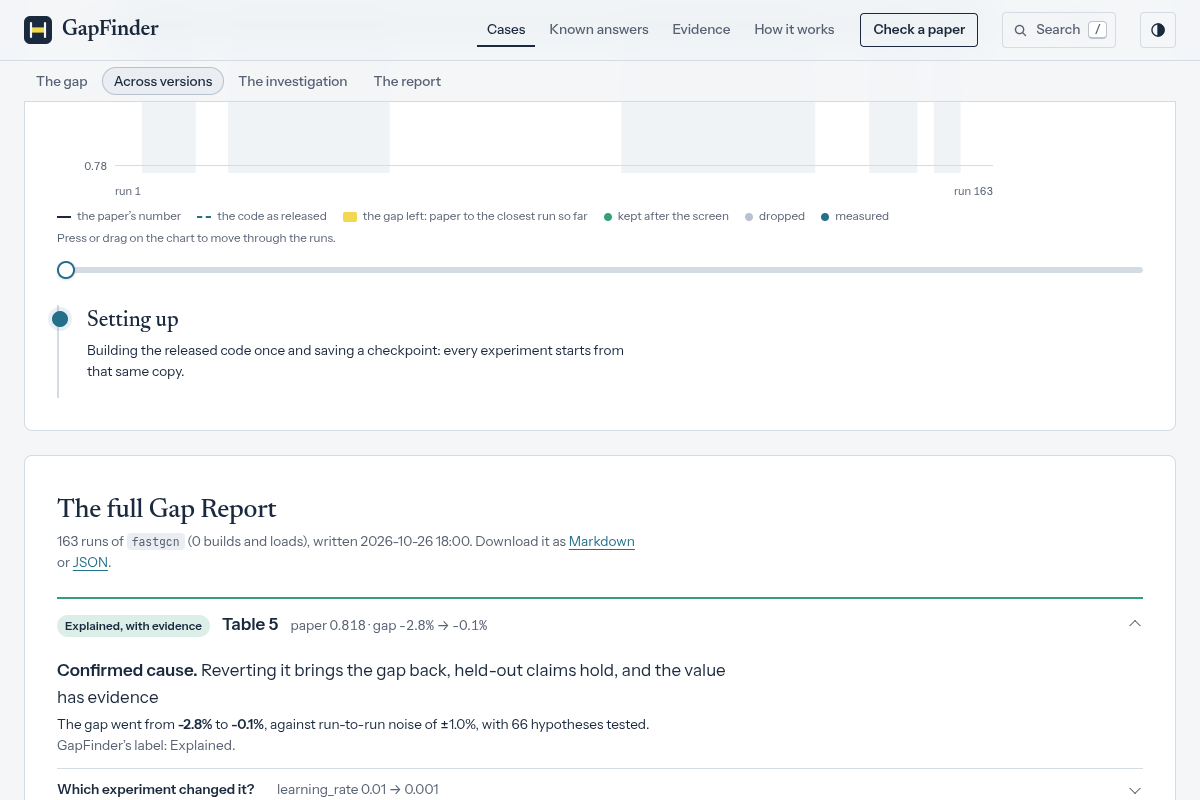
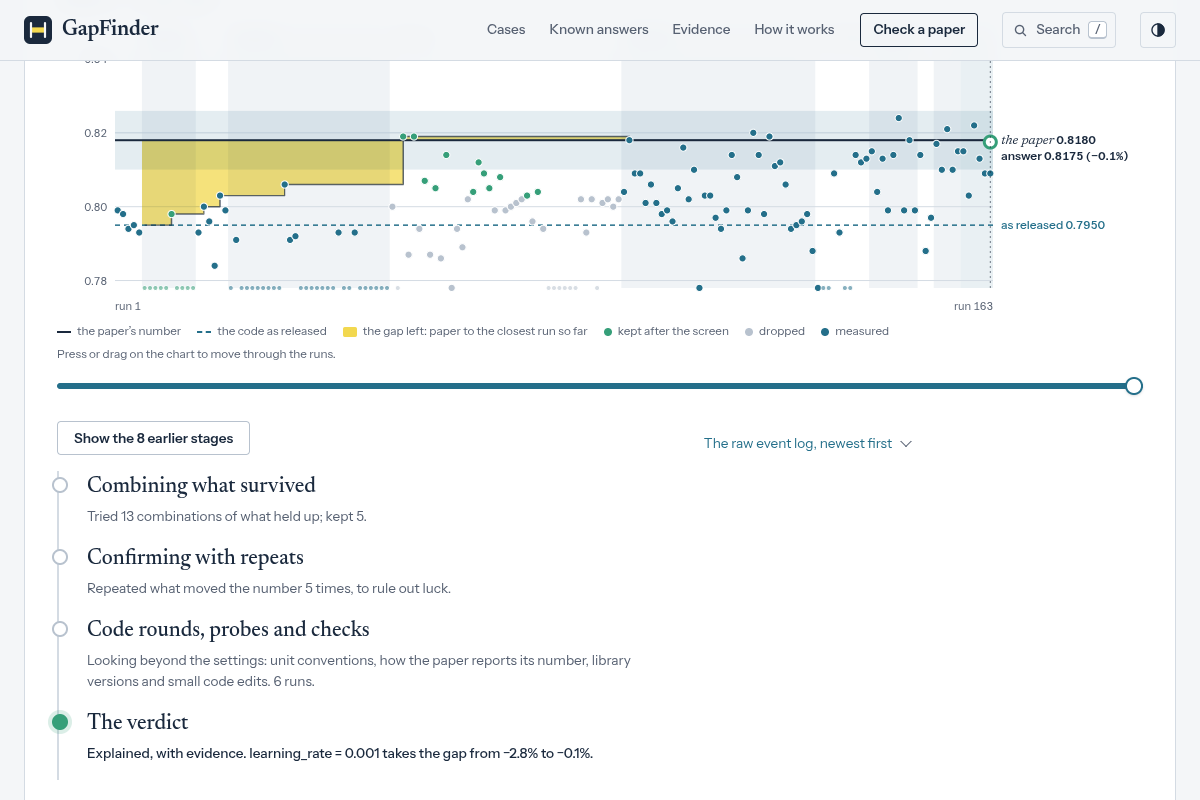
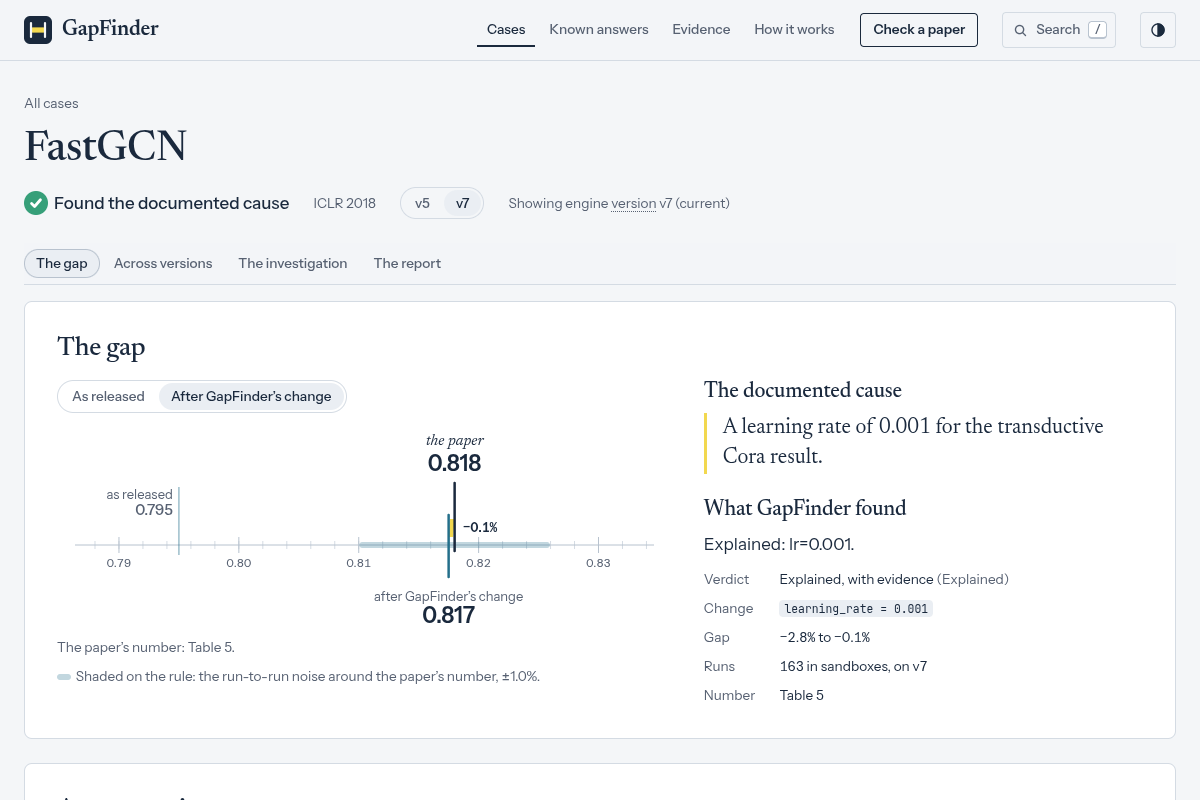
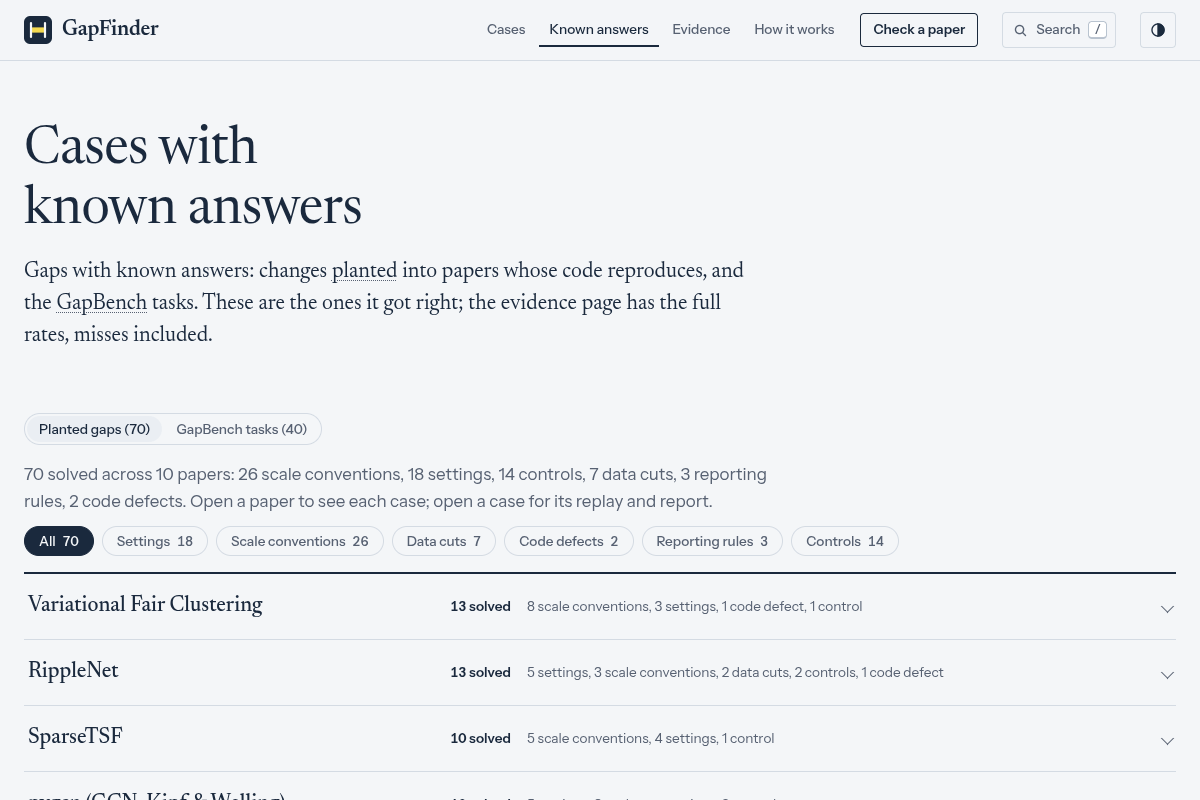
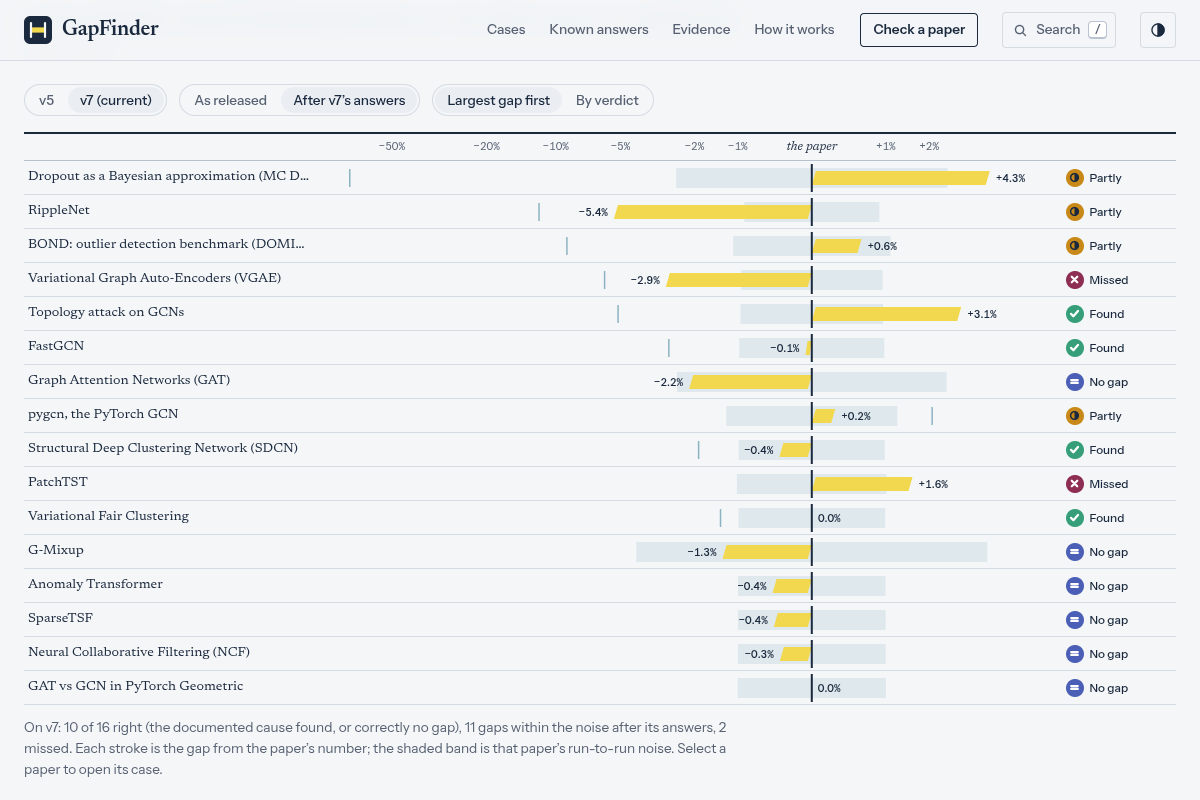
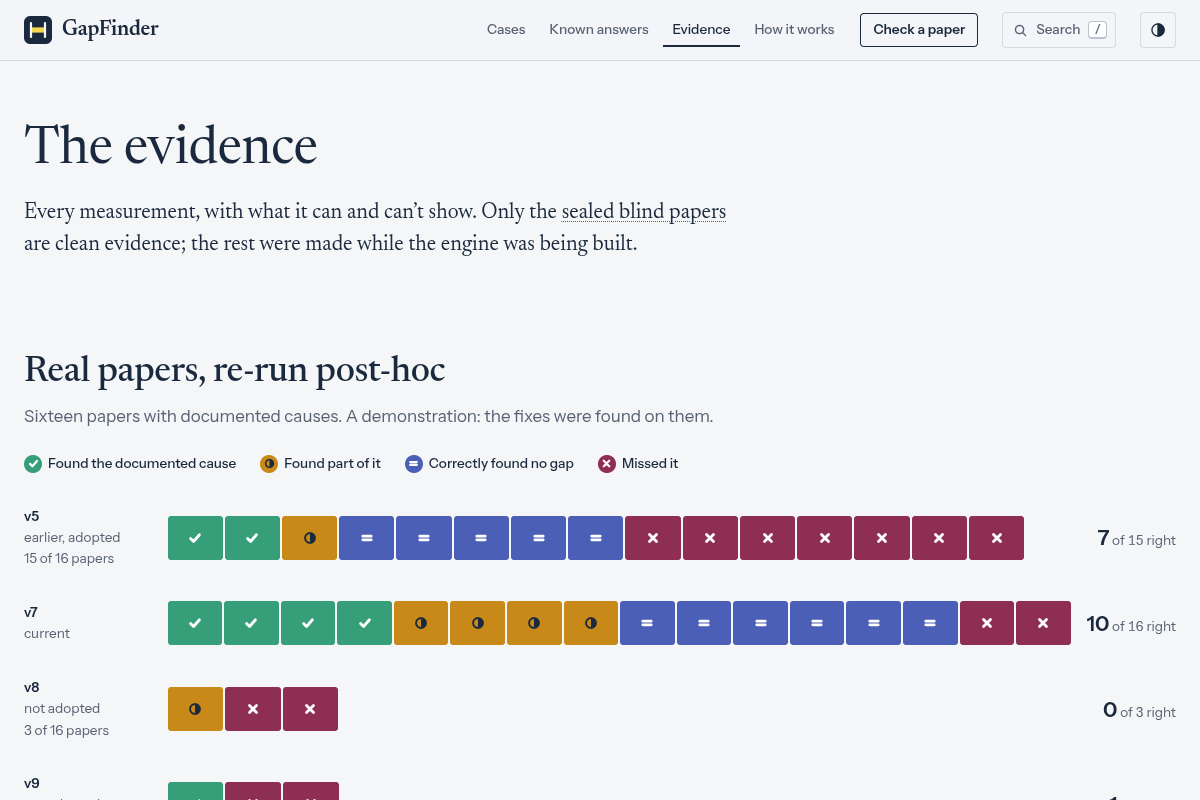
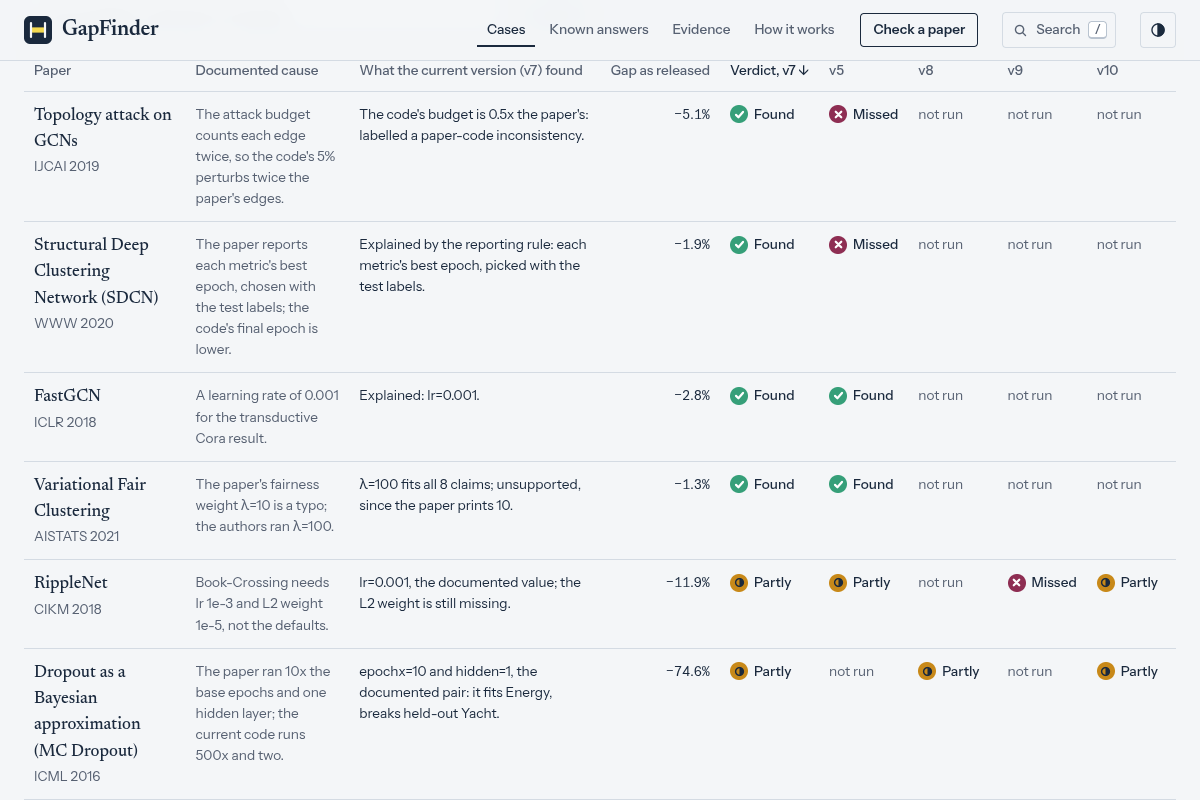
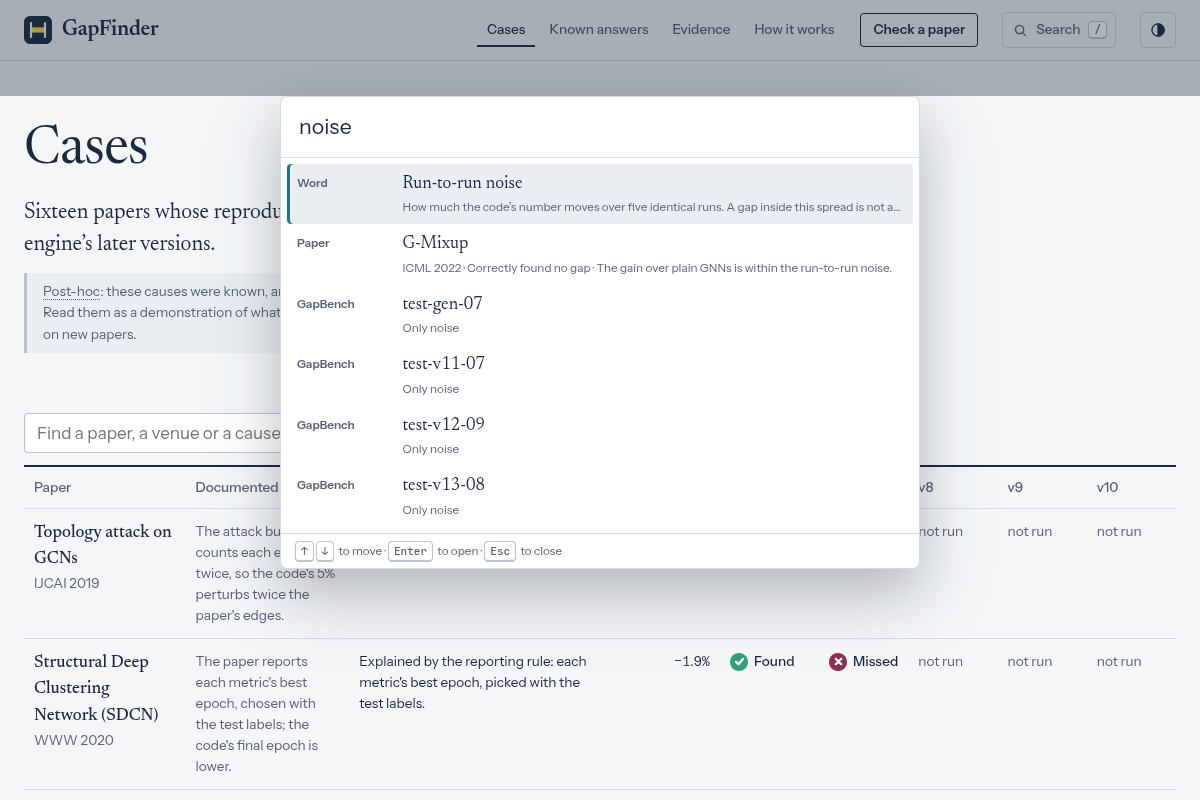
Alongside the sealed tests we reran GapFinder on sixteen published papers using their authors' own code, and recorded every run on the replay site (Cases; tallies in showcase.json).
Read this tally with its caveat. These are post-hoc reruns and the engine was tuned with these papers in view, so they measure coverage, not blind skill. The clean evidence is the sealed blind record below. The totals include every miss.
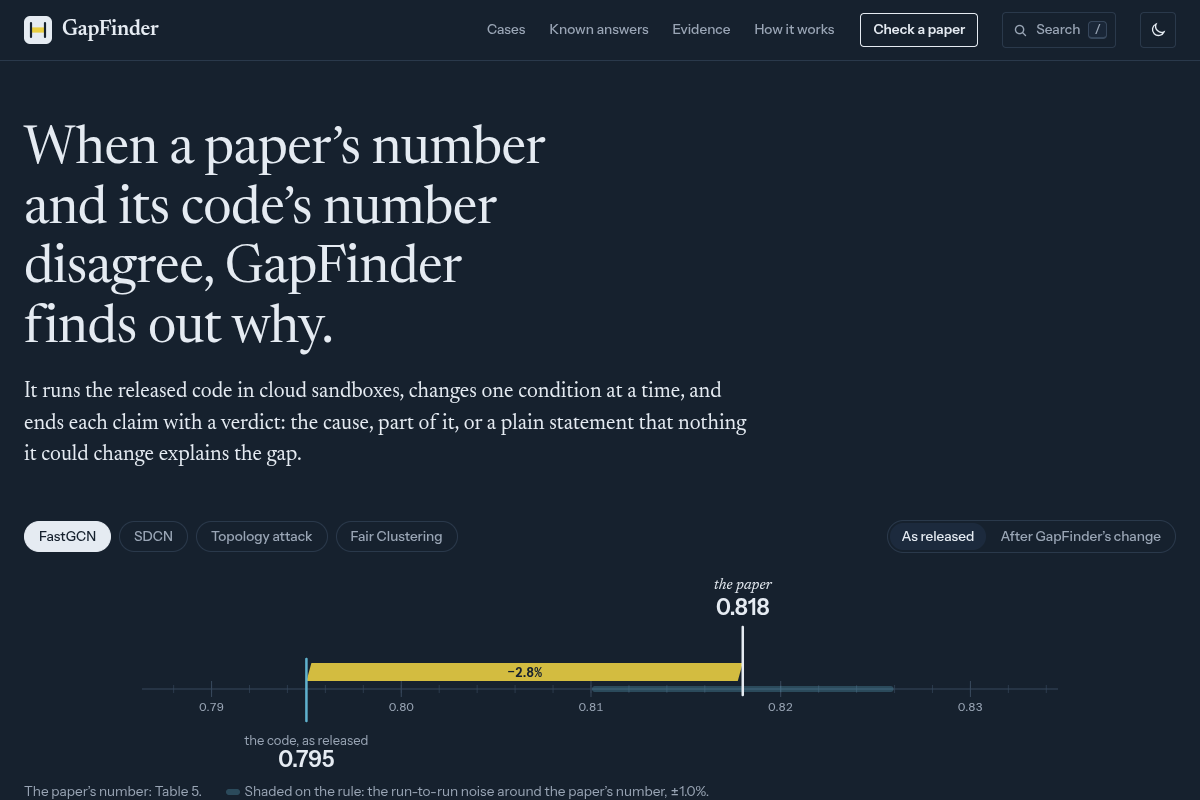
- 4 found the documented cause. Fair Clustering: the paper prints a fairness weight of λ=10 and the authors ran λ=100. SDCN: the paper reports each metric's best epoch, chosen with the test labels. Topology attack on GCNs: the attack budget counts each edge twice, so the code's 5% perturbs twice the paper's edges — labelled a paper-artifact inconsistency, not a setting. FastGCN: a learning rate of 0.001.
- 4 found part of it. RippleNet (the learning rate, but not the L2 weight), MC Dropout (the documented pair, which then breaks a held-out claim — see below), BOND, pygcn.
- 6 correctly found no gap. GAT, SparseTSF, Anomaly Transformer, NCF, G-Mixup and a PyTorch Geometric benchmark reproduced within noise, and GapFinder reported that instead of inventing a cause.
- 2 missed. VGAE: the split constants are written
30., a form the value ladder could not read. PatchTST: the harness runs a different variant from the target, so the right knob was tested on the wrong line.
The sealed blind record is the honest one. On 8 papers where a separate model chose the paper and sealed the answer key, with its hash committed before any run, GapFinder scored 1 correct (Fair Clustering), 1 partial (RippleNet), 5 missed and 1 confidently wrong (GraphMAE, whose true cause sat in an appendix table the first run never read; the appendix is now read separately, and excluding a setting is forbidden). All 8 ran before 20 October 2026, so none of the work since has blind evidence yet. Write-ups: blind-1, blind-2.
External case: MC Dropout (Gal and Ghahramani, ICML 2016)
A real paper whose reproduction gap was documented by its authors, with an answer key sealed before any run and revealed after. Semi-blind: our TODO file named the documented cause. We ran a scaled reproduction (100 Monte Carlo passes, 3 splits). Full write-up: RESULT.md.
- All four arms ended Unexplained (normal, evidence step off, no README, all flags in random order). None made a false attribution, and none found the documented cause, so by the pre-registered key none earns credit.
- The documented cause is real for the target. When we ran it ourselves (
epochx=10 hidden=1, both needed), Energy RMSE moved from 0.364 to a median of 1.716 against the paper's 1.66. Neither setting alone does it (0.533 and 0.427). - It breaks the held-out claim. The same setting gives Yacht RMSE 2.996 against the paper's 1.11, where the defaults give 0.831. GapFinder's held-out check rejects a change that makes another claim worse.
- So the miss was coverage, not verification. In a post-hoc run (not blind, scores unchanged) we
wrote the documented values into the hypothesis set by hand. GapFinder tested them, confirmed the
Energy effect (1.723 against 1.66), saw Yacht at 1.987 against 1.11, and rejected the pair. The
label was Unexplained, with the pair reported as the closest configuration. In the real runs
the search never tried a value near
epochx=10, because the ledger read the paper's "10x more iterations" as unstated and the generic grid started at 250. - Why Yacht probably cannot be matched: the authors' own 2018 README says the paper-era code tuned hyperparameters with Bayesian optimization shared across all splits, which contaminated the test sets, and was replaced by a per-split grid search. That is a code change, not a setting, so GapFinder cannot test it. We did not test it either; this is the probable reason, not a result.
- Caveats: semi-blind, a 3-split scaled reproduction, and the arms ran across local Docker and Sandboxes because a Sandboxes operation is capped at 3,600 s (deviations are in FROZEN.md).
MC Dropout on v1.3 (still not blind). v1.3 reads the code as well as the paper. That gave it:
- the multiplier factor 10 for
--epochx, and the boundary value 1 for--hidden; - a confirmation budget held back for the likeliest configurations.
The result:
- It names the documented cause,
epochx=10, hidden=1. It labels it "explains the target, conflicts with the held-out claim", and its history matching says the rest is out of space. - Its static code leads point at the documented out-of-flag differences: the per-split grid search,
batch_size = 128andT = 10000. - A patch round then tested three hard-coded constants in memory on the real sandbox, with no file
edited:
- only the training batch size moves the held-out Yacht claim (with the pair, batch 64 gives Yacht 1.18 against the paper's 1.11);
- no patch fits both claims within noise, so none was adopted. The remaining documented cause, a grid search tuned per split, is a loop, not a constant.
- Details:
eval/external/mc-dropout/RESULT_v13.md.
RusKey, the founder case
Figure 6 of RusKey, run end to end in Sandboxes at 2M keys (the paper used 100M, which we could not test). Source: FINDINGS.md.
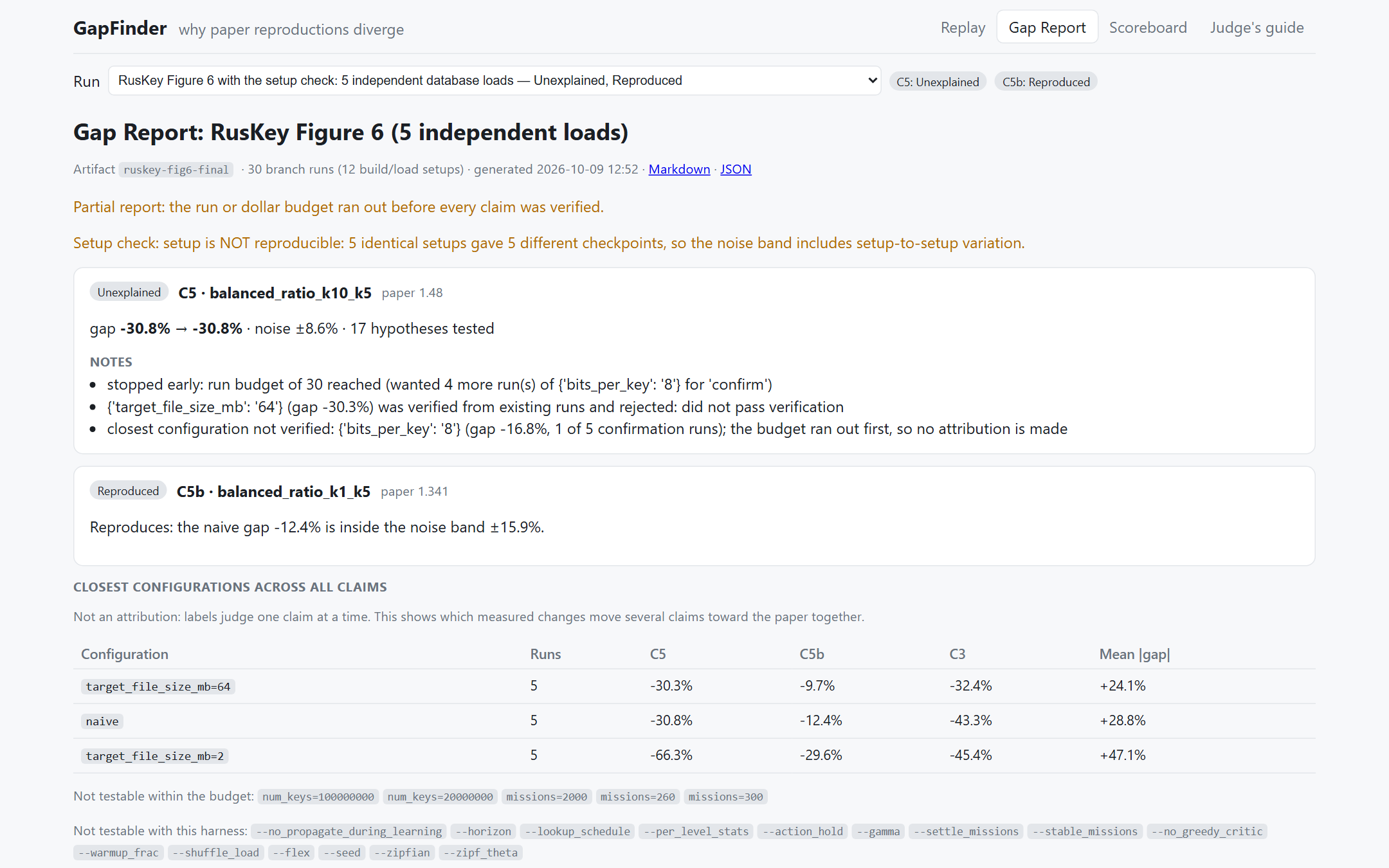
- Verdict: Unexplained. 127 branches from 13 database loads. Nothing explains the balanced-workload claims. The paper's 8 bits per key brings both balanced ratios to the paper but breaks the held-out write-heavy ratio, so verification rejects it.
- The setup is not reproducible. Loading the database with the identical command gave a different checkpoint every time: 12 loads, 12 checkpoints, and the naive K1/K5 ratio ranged from 0.52 to 1.38 (ruskey_load_variance.json). The 127-branch run had drawn an outlier load, so two of its observations were corrected.
- With the load-to-load spread in the noise band (5 independent loads), K1/K5 is within noise of the paper, with a wide band, and K10/K5 is 31% short and Unexplained (search_setups).
- Forking vs not forking, same search, 22 branches each: 8 database loads instead of 22, setup cost $1.88 instead of $5.21 (64% less), total $4.48 instead of $8.07 (45% less). These are the cost figures Sandboxes report, which are not billed in the Beta (ablation_ruskey.json).
- Claim ledger against a gold set signed off by the paper's reproducer: claim precision 1.00 (40 of 40, measured on the paper the prompts were tuned on), headline-claim recall 1.00, all-claim recall 0.93. Setting recall was 0.67, below our 0.80 bar: the tuner's mode flags are missed (ledger_ruskey_v5.json).
Challenges and what we learned
- Noise is the hard part. Our 127-branch RusKey run forked everything from one database load, and two of its observations had to be corrected once we measured 12 loads. Now the noise band includes load-to-load spread, every confirmed effect must pass a bootstrap test, and a result inside a wide band is "Inconclusive", not "Reproduced". Forked repeats from one load are too narrow to stand in for fresh loads on two of three RusKey ratios (ruskey_fork_comparability.json).
- Quotes must match. Claims and assumptions are dropped, not repaired, when their quote is not in the PDF or the repo. On RusKey 17 extracted claims were dropped as ungrounded.
- Reasoning traces. The models return their trace in different places, and sometimes an empty answer. The router handles both.
- Two bugs the ablation exposed. A single screen run could produce a label after the budget ran out, and 8 branches still in flight when the budget stopped were never recorded. Both are fixed.
- Sandboxes limits, learned the hard way. An operation is capped at 3,600 s. The reported
elapsed_timeis CPU time summed over processes, which made us read a 4-core VM as one core until we measured it. The reportedcostis diagnostic and reached thousands of dollars on the MC Dropout runs while the console showed no Sandboxes charge. The details are in our feedback. - Honesty cost us a headline. The strongest-looking result would have been "found the cause". On the real paper, RusKey, and on the external case, the honest answer was Unexplained, and we kept it.
What's next
- Derive candidate values from the paper's own numbers. The MC Dropout miss came from reading "10x
more iterations" as unstated; it should become
epochx=10. - Wider generic grids, so a random-order search can reach values far from the defaults.
- A new label for "explains the target but conflicts with a held-out claim", so a result like MC
Dropout's
epochx=10 hidden=1is reported as what it is, not folded into Unexplained. - Sharding one experiment across several Sandboxes operations, for cells that exceed the 3,600 s cap.
- A second external case where the cause is hidden from us (Paragraph Vector on IMDB), and a RusKey positive control with a planted setting.
- Longer term: artifact-evaluation committees as users, GPU papers, and more paper types. Today's limits are CPU-only VMs, a harness spec that a human confirms, and toy artifacts in the benchmark.
Provenance
GapFinder was built during the submission period; the git history shows when each part was written. The RusKey reproduction it is tested on is Sayjad Rahman's earlier research, used here as a test case. Its source code is private and is not in the repository; only the built program was uploaded to a Sandboxes snapshot. The MC Dropout case uses the public code and paper of Gal and Ghahramani, unmodified except for one documented patch (100 Monte Carlo passes instead of 10,000).
Links
- Code, MIT license: https://github.com/Sayjad21/GapFinder
- Replay site: https://sayjad21.github.io/GapFinder/
- Feedback on Token Factory, Sandboxes and Nemotron: FEEDBACK_SUBMISSION.md
Built with: Nemotron 3 Ultra, Nemotron 3 Super, Nemotron 3 Nano, Nebius Token Factory, Token Factory Sandboxes, Python, React, mini-swe-agent, Tavily.
Built With
- docker
- fastapi
- github
- github-actions
- httpx
- mini-swe-agent
- nebius-token-factory
- nvidia-nemotron-3-nano
- nvidia-nemotron-3-super
- nvidia-nemotron-3-ultra
- openai
- pydantic
- pymupdf
- python
- react
- tavily
- token-factory-sandboxes
- typescript
- vite
- vitest

Log in or sign up for Devpost to join the conversation.