-
-
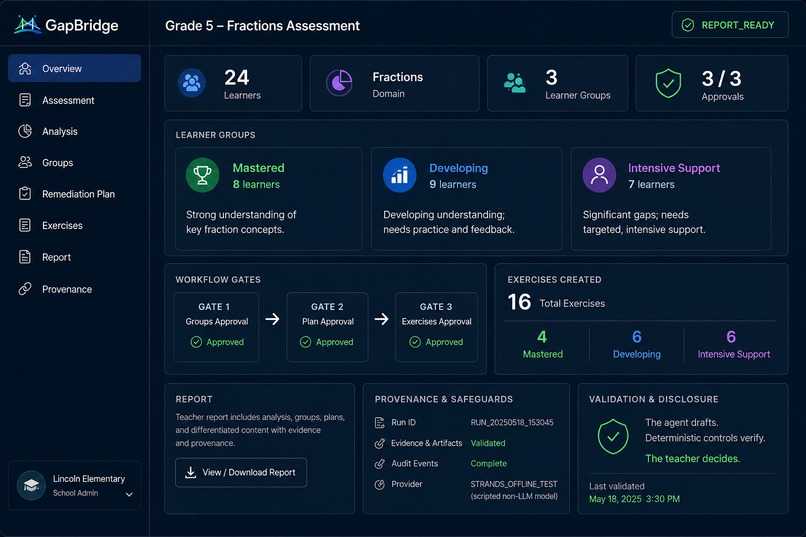
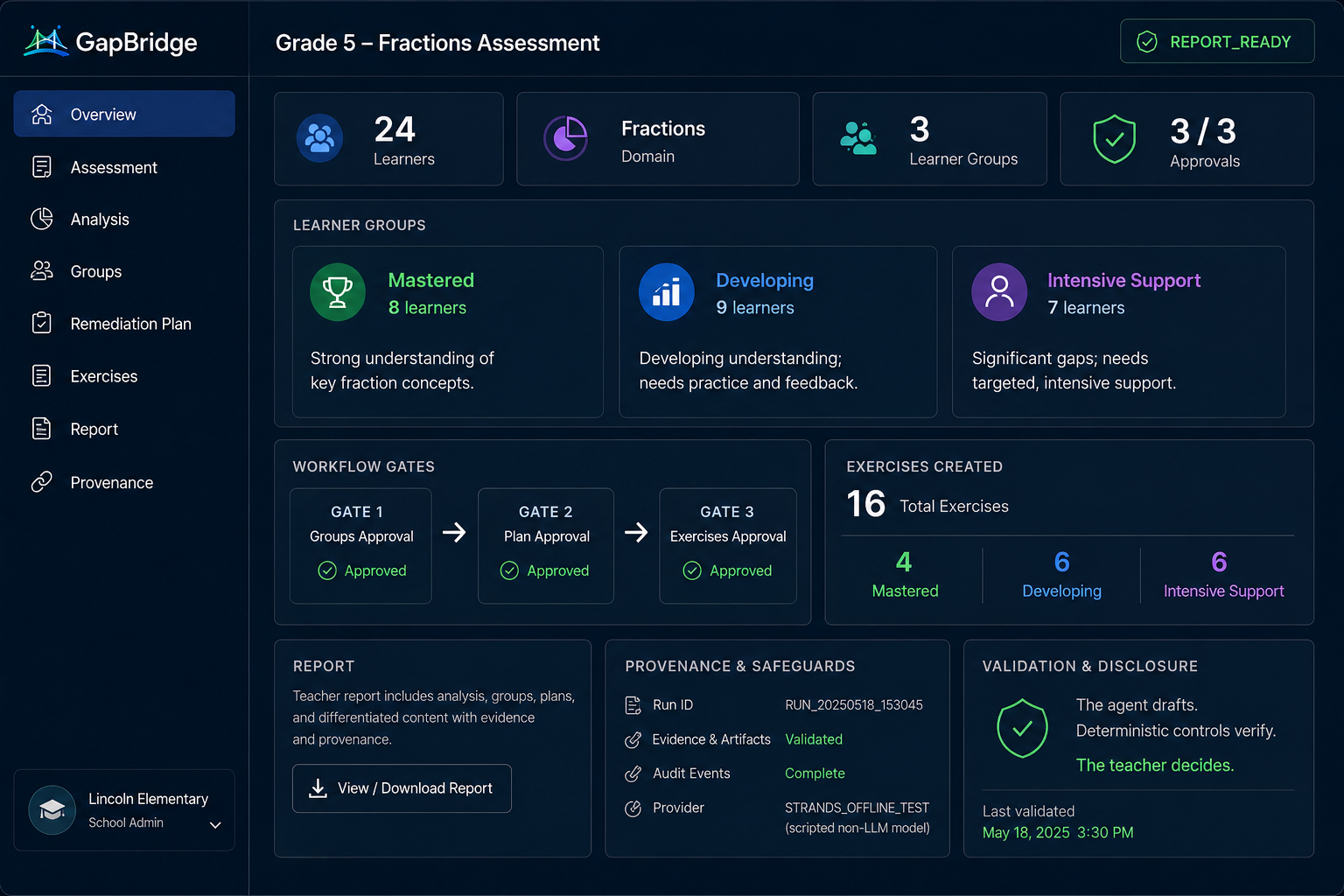
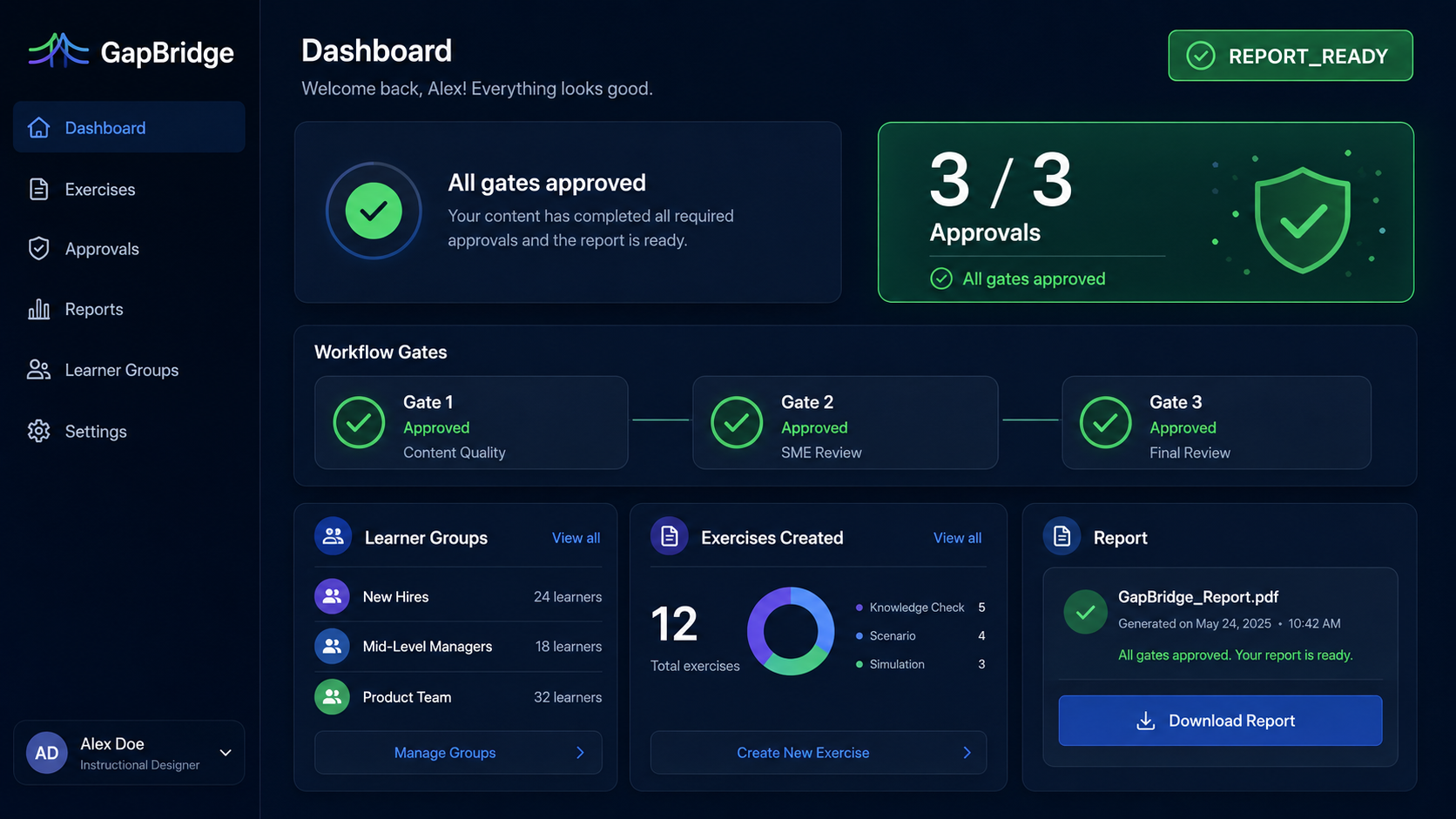
GapBridge main dashboard showing learner groups, workflow status, exercises, and teacher-controlled remediation.
-
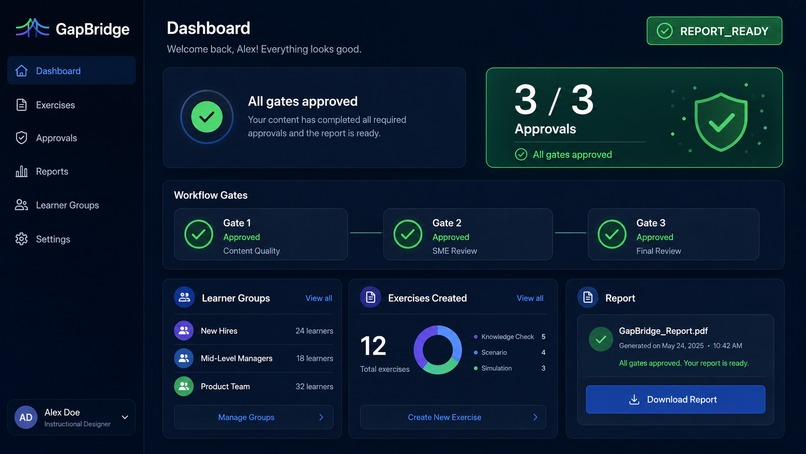
All three teacher approval gates completed — 3/3 approvals and final REPORT_READY state.
-
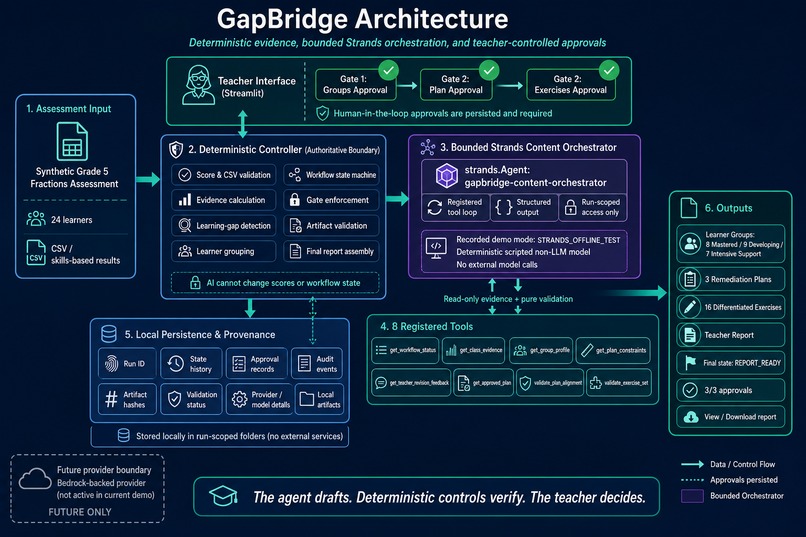
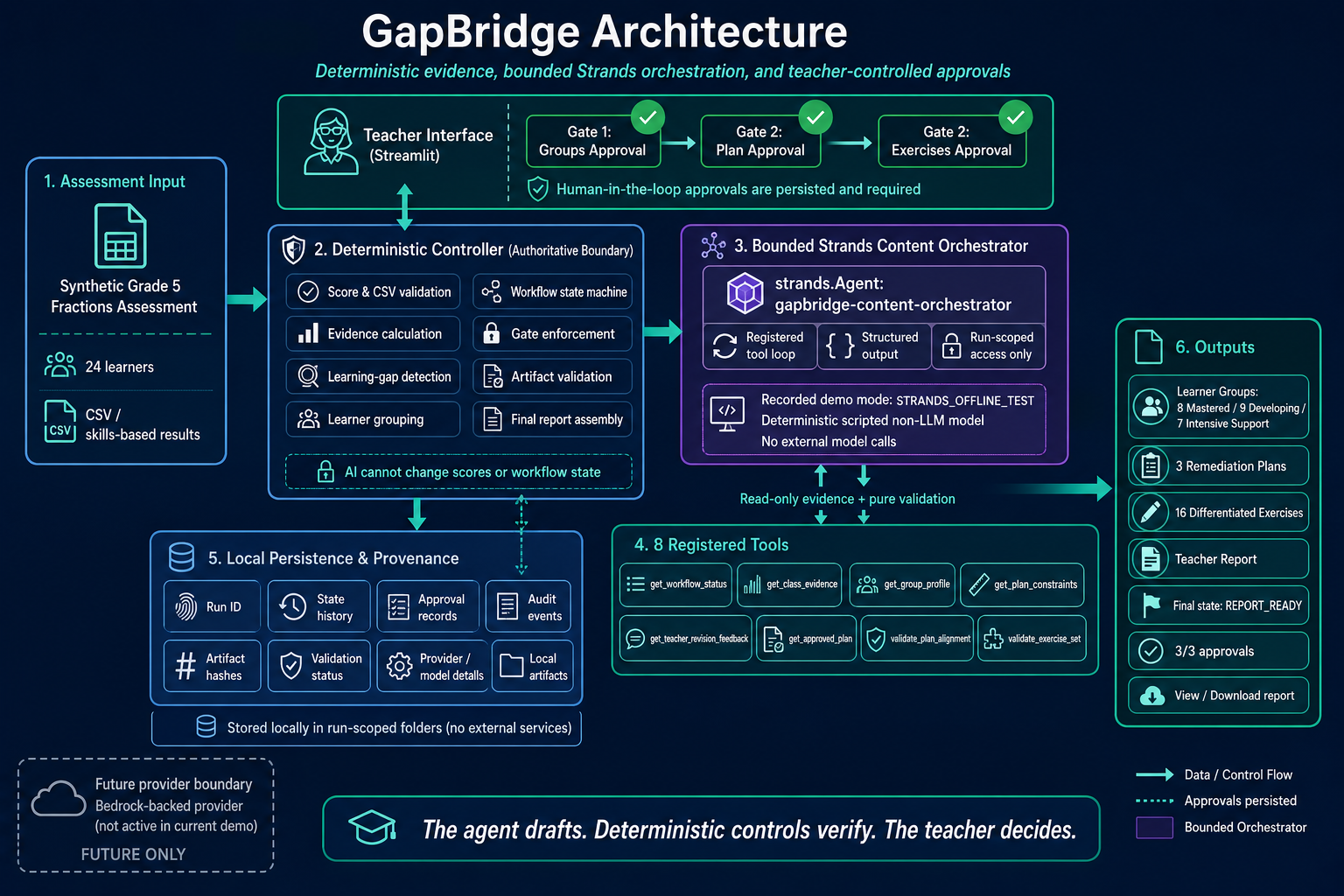
GapBridge architecture: deterministic evidence, bounded Strands orchestration, persisted human approvals, provenance, and local outputs.
Inspiration
Assessment scores tell teachers what happened, but they do not automatically turn into the right next lesson.
After an assessment, a teacher still has to identify learning gaps, group learners responsibly, prepare differentiated support, create aligned exercises, and document the result. That is repetitive, judgment-heavy work often completed under time pressure.
We built GapBridge around one principle:
The agent drafts. Deterministic controls verify. The teacher decides.
GapBridge helps teachers move from assessment evidence to remediation without giving pedagogical authority to the AI.
What it does
GapBridge is a teacher-facing remediation workflow that turns one skills-based assessment into:
- deterministic learning-gap analysis
- explainable learner groups
- targeted remediation plans
- differentiated exercises
- a final teacher report
The recorded demo uses 24 synthetic Grade 5 learners working on fractions.
GapBridge deterministically assigns:
- 8 learners to Mastered
- 9 learners to Developing
- 7 learners to Intensive Support
Each group assignment includes a score-grounded explanation.
The workflow then enforces three teacher approval gates:
- Gate 1 — Learner groups
- Gate 2 — Remediation plans
- Gate 3 — Differentiated exercises
The demonstrated run produces three remediation plans and 16 differentiated exercises.
Only after all three approvals are persisted does GapBridge assemble the final teacher report.
The completed workflow reaches:
REPORT_READY — 3/3 approvals
The teacher can then view or download the report locally.
How we built it
GapBridge uses a three-part architecture.
1. Deterministic application boundary
Python owns the authoritative parts of the workflow:
- assessment validation
- score calculations
- learning-gap detection
- learner grouping
- workflow state transitions
- approval enforcement
- artifact validation
- local persistence
- final report assembly
The agent cannot change official scores, move learners between groups, approve its own work, or advance the workflow state.
2. Bounded Strands orchestration
GapBridge uses a real Strands Agent named gapbridge-content-orchestrator.
The agent is limited to eight registered, run-scoped tools that expose approved evidence and validation operations.
It produces strict structured output for remediation plans and exercise sets, which is validated again by deterministic controller code before being saved or displayed.
3. Human decision boundary
Teacher approval is not just a visual confirmation.
Each approval is persisted and linked to the exact artifact version and SHA-256 hash.
Later workflow stages remain unavailable until the required approval exists.
Strands Agents SDK
The project uses the Strands Agents SDK for the bounded content-orchestration layer.
The recorded demo runs in:
STRANDS_OFFLINE_TEST
A deterministic scripted non-LLM model drives the real Strands Agent tool-use loop and structured-output path.
There are no external model calls in the recorded demo.
This demonstrates the implemented Strands integration, registered-tool workflow, structured output, provenance, and human-gated architecture without claiming external foundation-model generation.
The project includes provider boundaries designed for a future Bedrock-backed implementation, but Amazon Bedrock is not active in the current demo.
Human-in-the-loop workflow
GapBridge keeps the teacher in control at every consequential step.
- Groups must be approved before planning begins.
- Plans must be approved before exercises can be created.
- Exercises must be approved before the final report can be assembled.
The final demonstrated run reaches REPORT_READY only after all three teacher approvals are complete.
Challenges we ran into
The hardest design challenge was deciding what the agent should be allowed to do.
It would have been easier to let the model calculate scores, change groups, or advance its own workflow. Instead, we separated deterministic evidence, bounded content drafting, and human judgment.
Another challenge was demonstrating real Strands orchestration without overstating cloud capabilities. When the Bedrock path was unavailable at the account level, we kept the provider disclosure accurate and used a deterministic non-LLM scripted model to exercise the real Strands Agent and tool loop locally.
We also had to keep artifacts consistent across a multi-stage workflow. Plans must match deterministic targets, exercises must match approved plans, and approvals must refer to the correct artifact hash and version.
Accomplishments
We are proud that GapBridge completes a genuine end-to-end workflow with:
- 24 synthetic learners
- explainable 8 / 9 / 7 learner grouping
- three remediation plans
- 16 differentiated exercises
- three persisted approvals
- final
REPORT_READYstate - audit events and provenance
- artifact hashes and validation
- downloadable teacher report
The project currently passes 126 automated tests and an 8/8 network-free preflight.
What we learned
We learned that trustworthy professional agents are as much about boundaries as capability.
“Human in the loop” becomes meaningful only when human decisions are persisted and technically required by the workflow.
We also learned that provenance should be designed into the system from the beginning. Run IDs, tool calls, hashes, validation status, and approval records make agent workflows easier to inspect and trust.
What's next
Next steps for GapBridge include:
- implementing and evaluating a Bedrock-backed provider
- adding reassessment workflows
- adding teacher revision and artifact version comparison
- expanding report export formats
- adding authentication, encrypted storage, and role-based access before using any real learner data
- evaluating pedagogical quality and time savings with educators
GapBridge is currently a local hackathon prototype using synthetic data.
The agent drafts. Deterministic controls verify. The teacher decides.

Log in or sign up for Devpost to join the conversation.