-
-
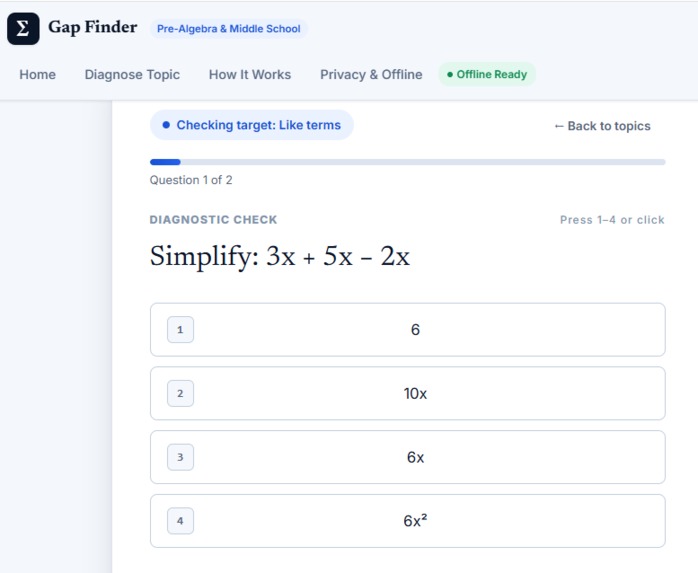
Targeted Diagnostic Assessment & Keyboard Navigation
-
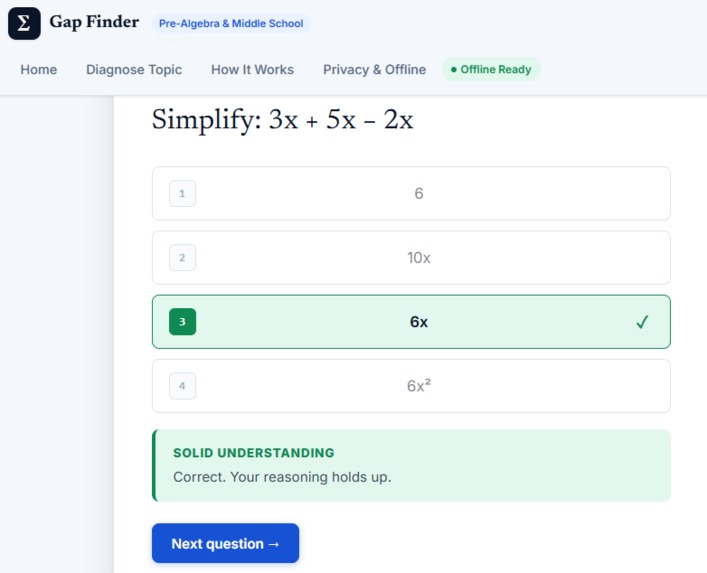
Interactive Diagnostic Question & Real-Time Feedback
-
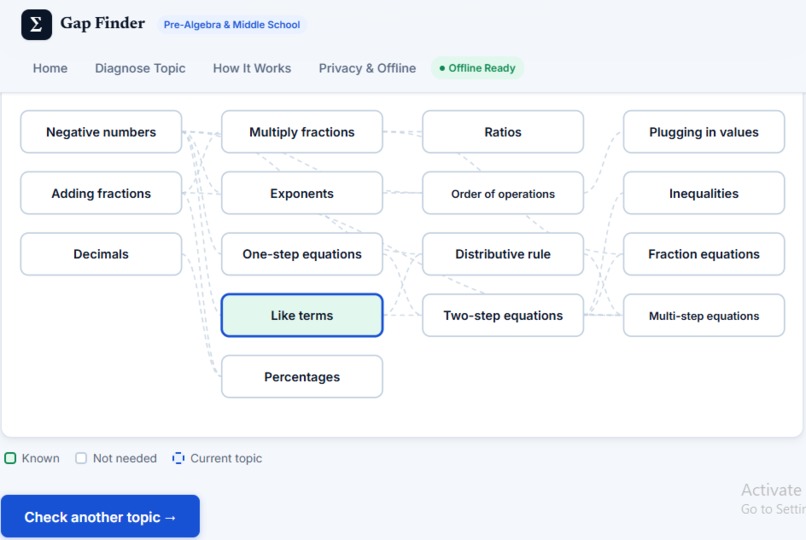
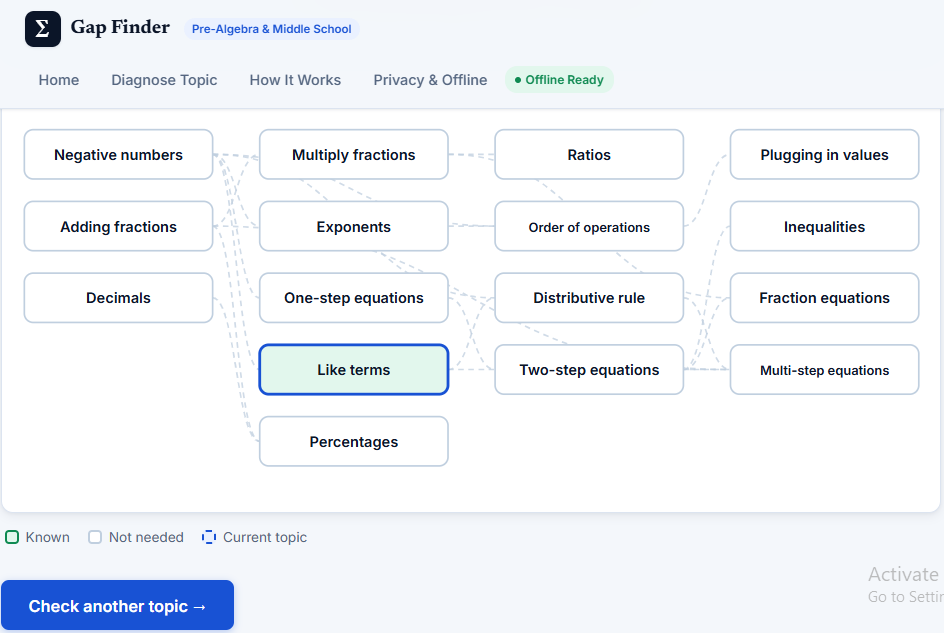
Interactive Curriculum Map & Topic Dependency Tree
-
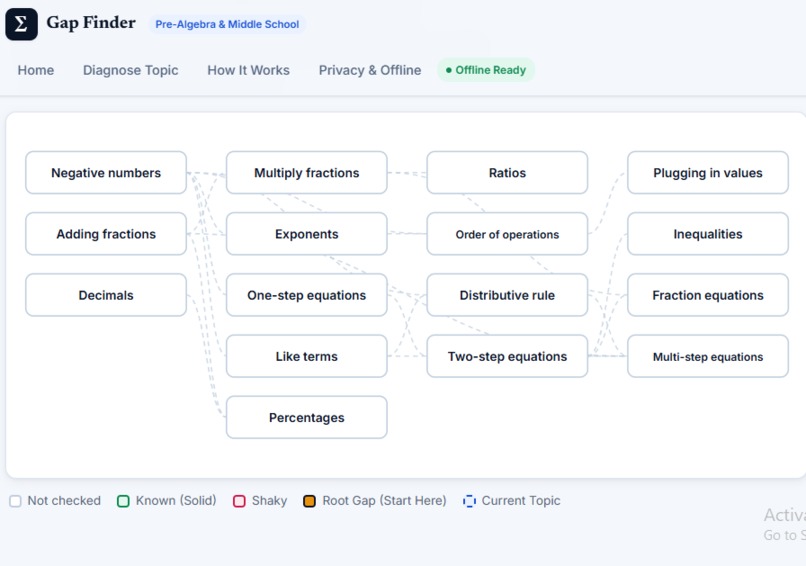
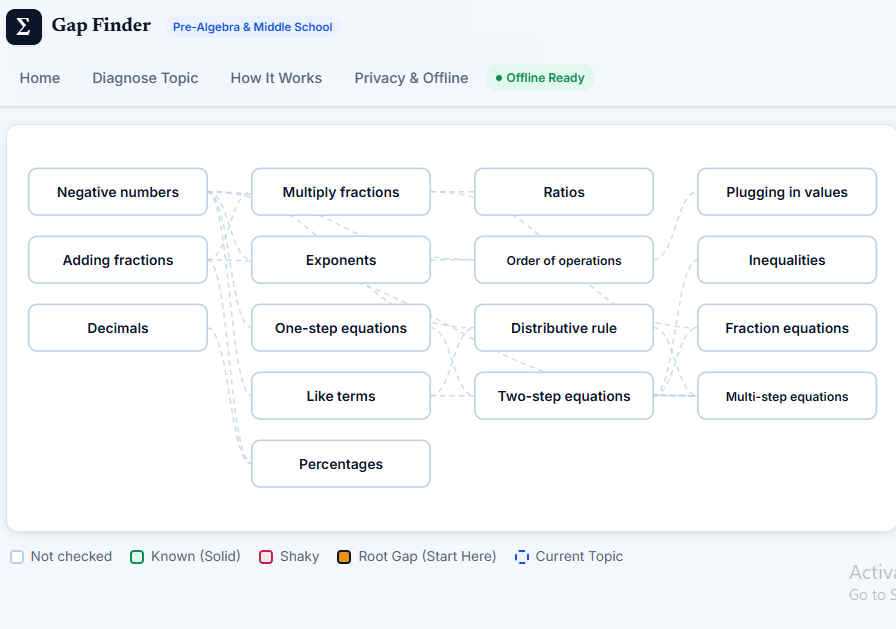
Full Curriculum Network & Comprehensive Status Legend
-
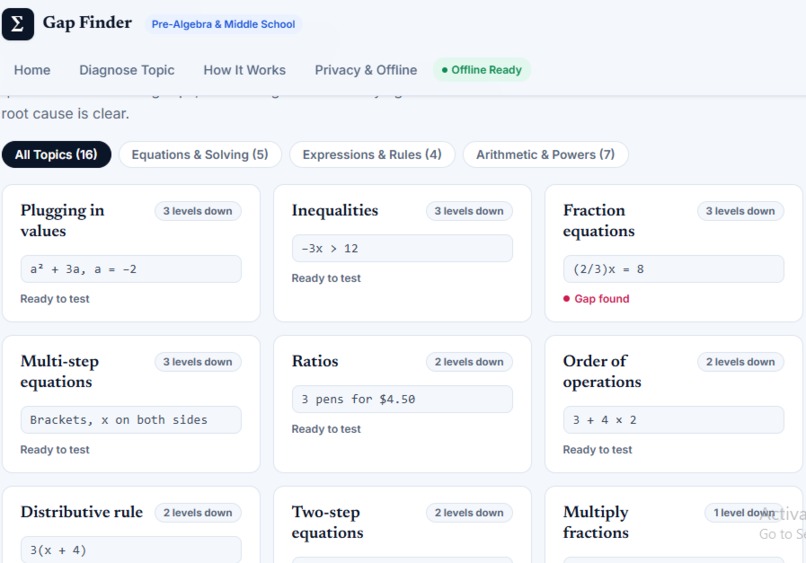
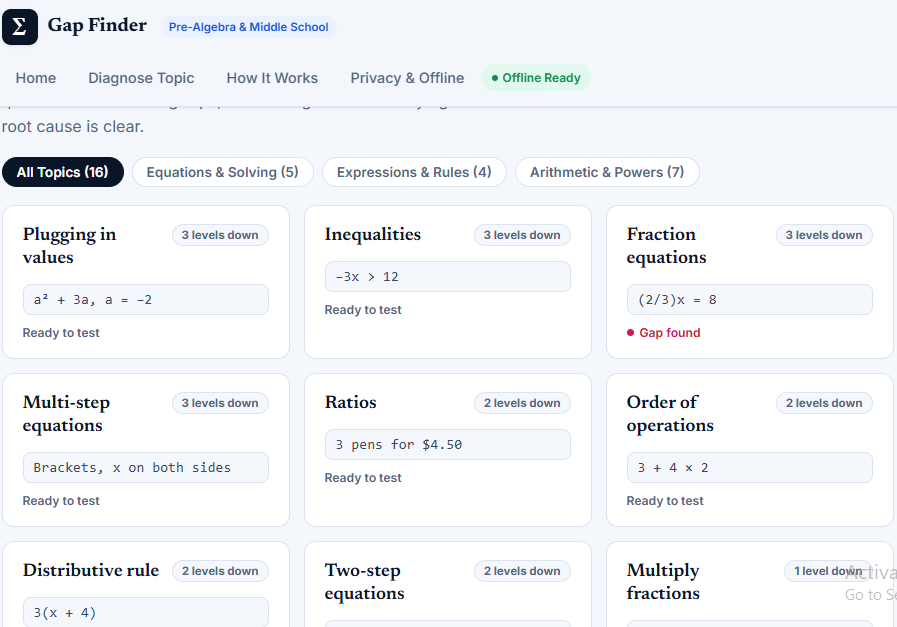
Categorized Topic Explorer & Diagnostic Hub
-
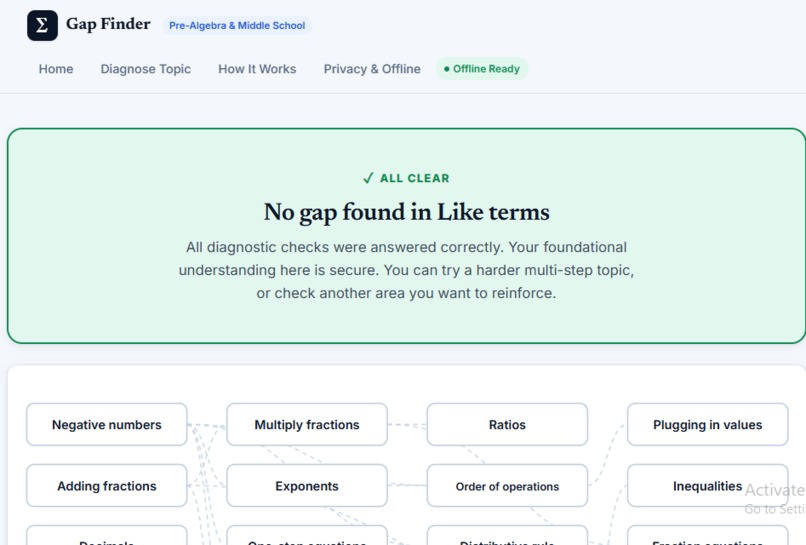
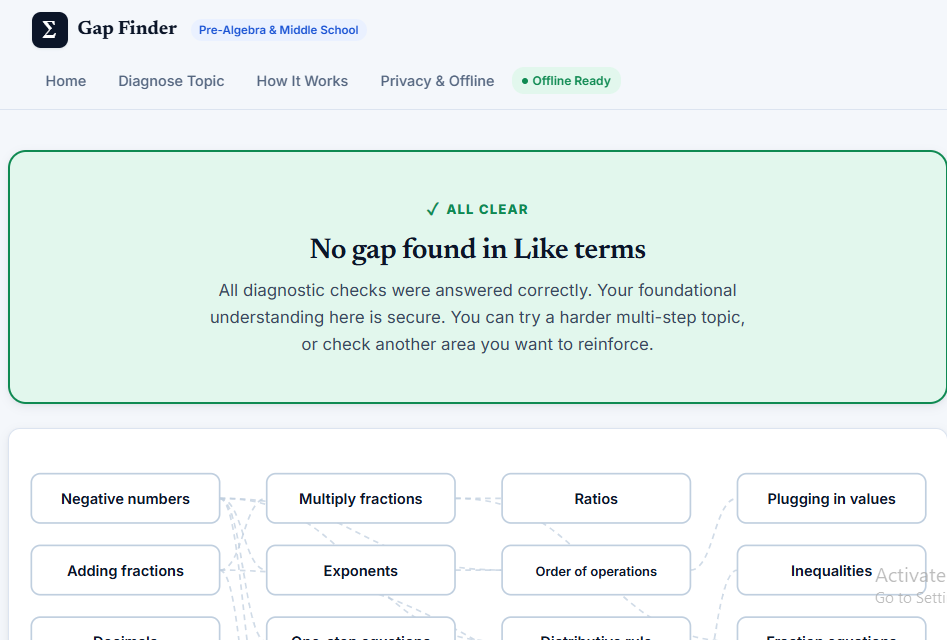
Diagnostic Success & Concept Mastery Confirmation
-
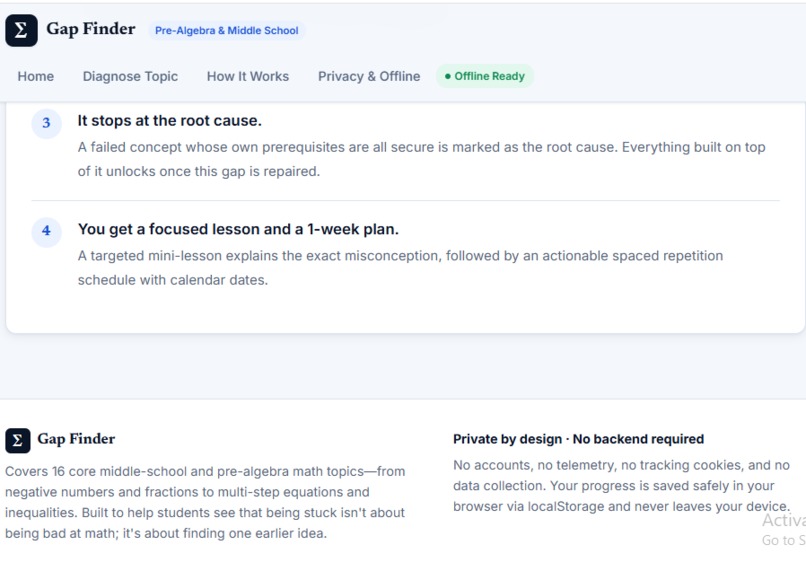
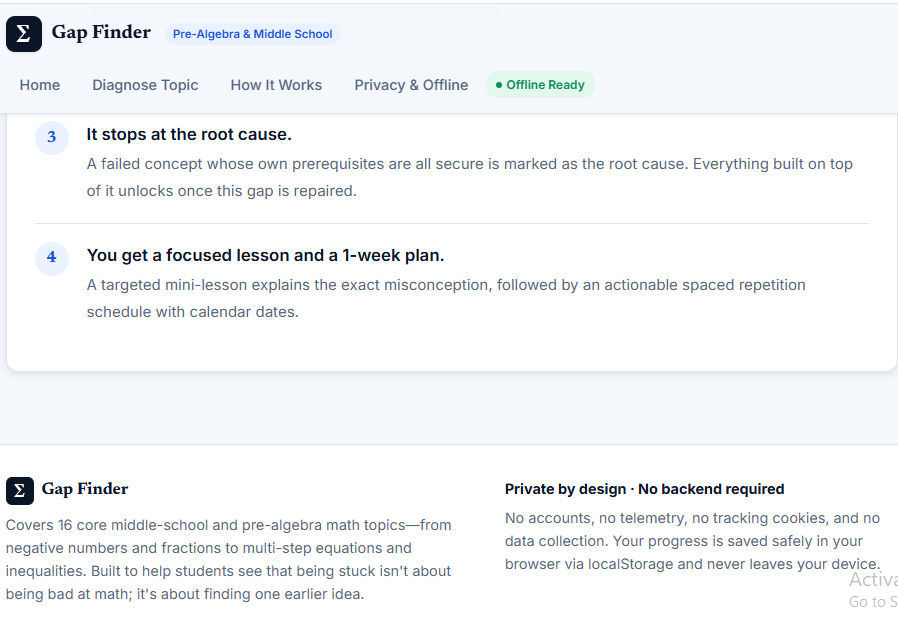
Core Philosophy, Privacy Architecture & Root-Cause Logic
-
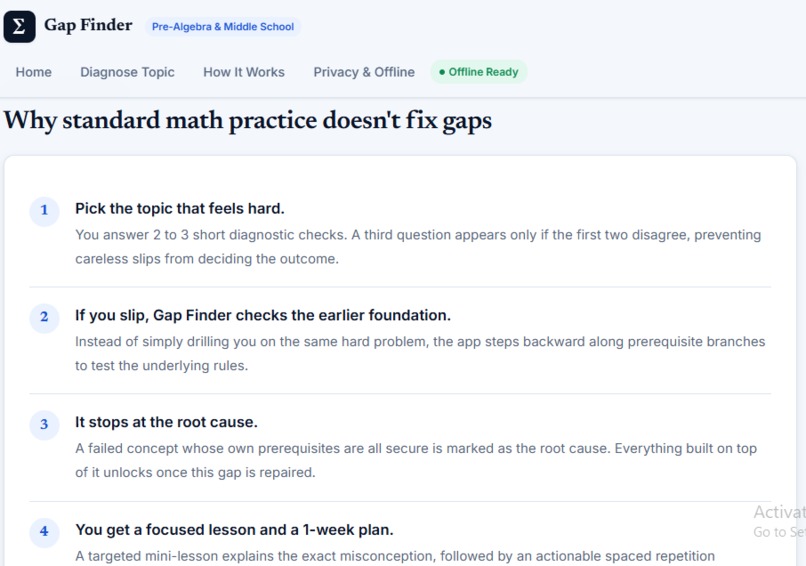
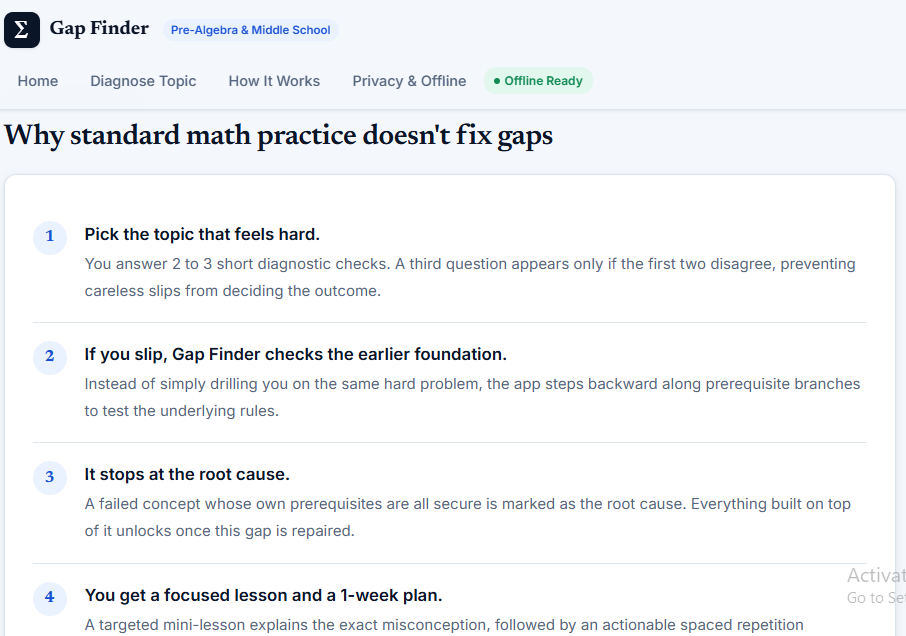
Diagnostic Logic & Root-Cause Problem Breakdown
-
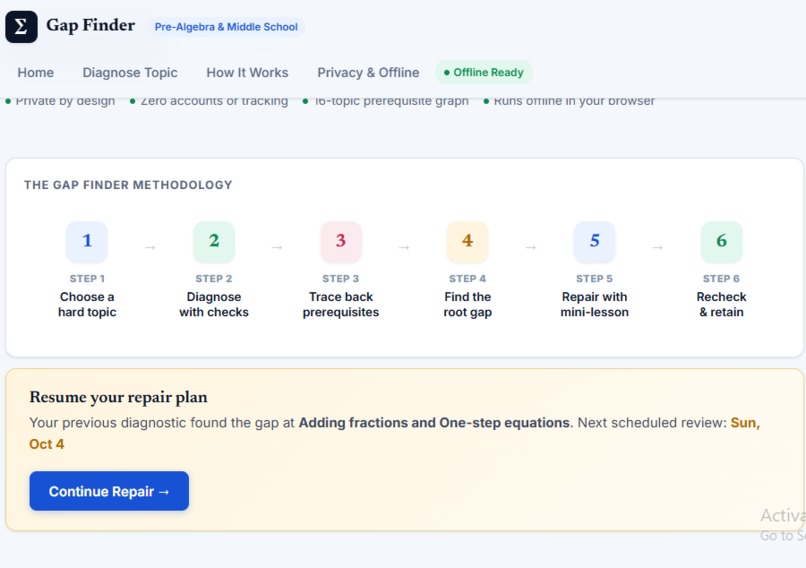
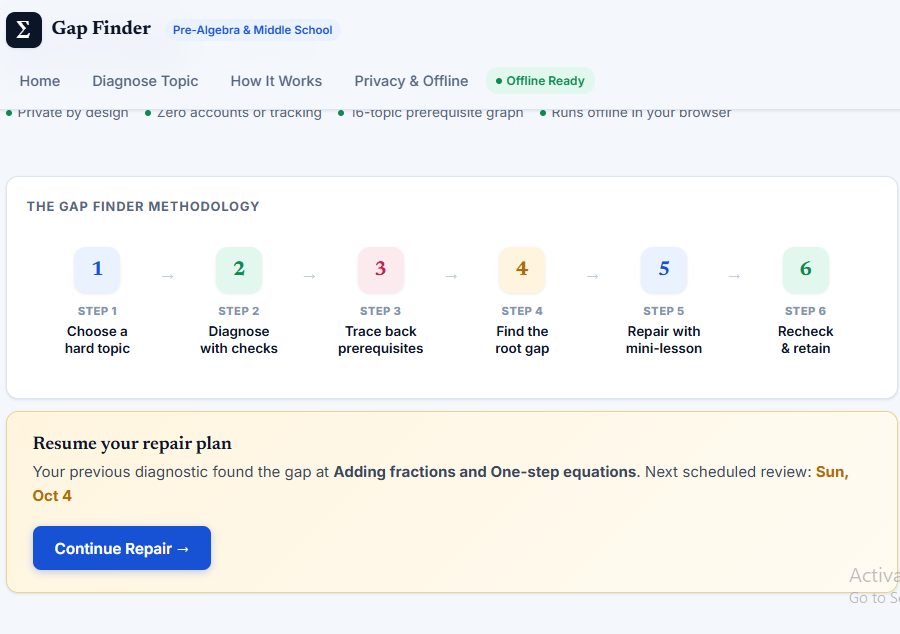
The Gap Finder Methodology & Personalized Repair Plan
-
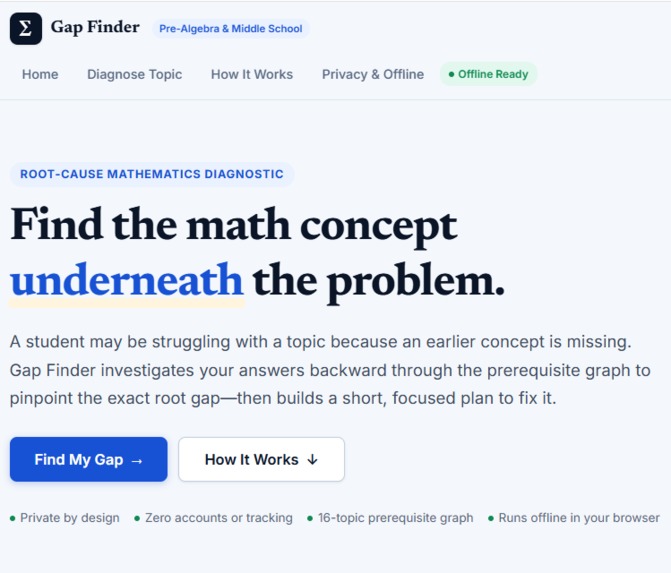
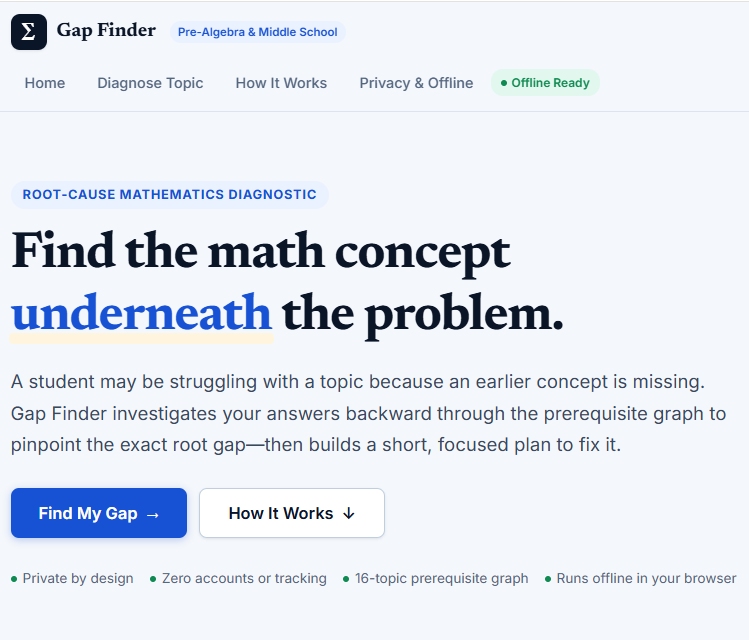
Root-Cause Mathematics Diagnostic Landing View
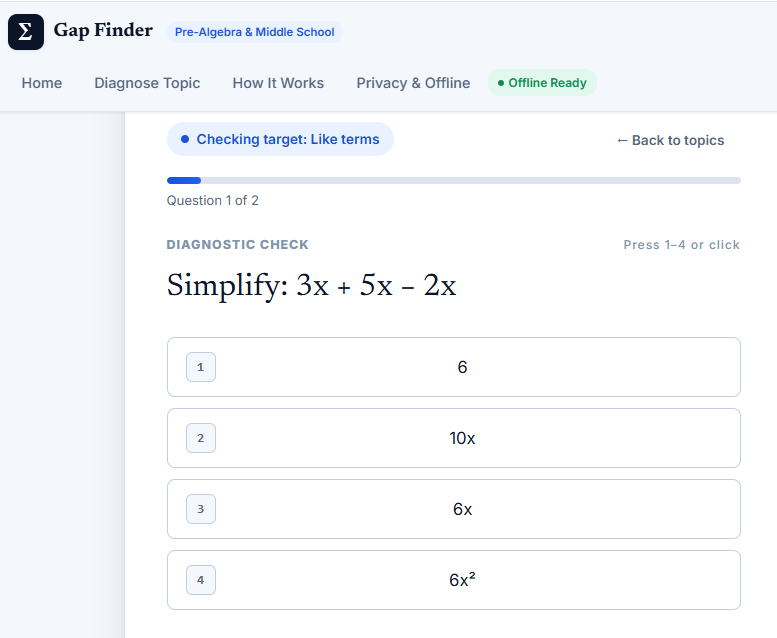
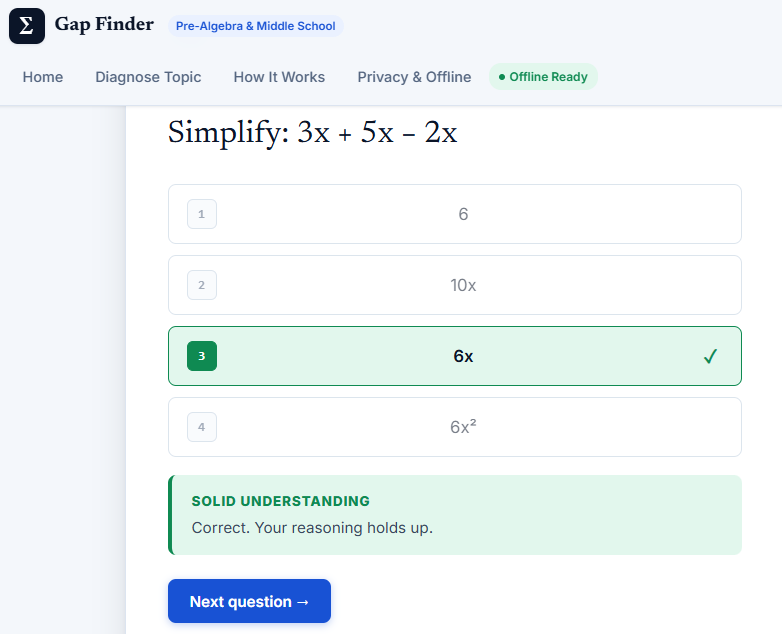
Gap Finder: Find the Concept Behind the Mistake
A learning difficulty can be a symptom, not always the real problem. Gap Finder is a browser-based math diagnostic that works backward through prerequisite concepts to find the concept underneath a student's difficulty, then tells them what to work on next.
The Problem
Most practice follows one pattern:
Wrong answer → correct answer → move on.
The missing question is why.
Math is cumulative, so a student struggling with Like Terms may actually be missing Negative Numbers. Practicing the visible topic again cannot repair a concept that sits underneath it, and the student can end up concluding:
"I'm bad at math."
The Insight
The visible difficulty may not be the real learning gap.
So Gap Finder does not stop at the topic the student names. It investigates the concepts that topic depends on.
The Solution
A student chooses a topic that feels difficult and completes a short diagnostic. Gap Finder follows their responses through a prerequisite graph to the earliest concept that appears to be failing, then connects that diagnosis to a focused lesson, a review schedule, and a re-check.
CHOOSE → DIAGNOSE → TRACE BACK → FIND ROOT GAP → REPAIR → RECHECK
A Real Diagnostic Trace
Topic: Like Terms
Diagnostic question:
"Can you simplify expressions by combining like terms with negative coefficients?"
Student response:
C — Cannot combine across subtraction/negatives
Diagnostic interpretation:
Indicates a sign-distribution misconception
↓
Prerequisite checked:
Negative Numbers, using "Evaluate expressions involving subtraction and negative integer arithmetic."
Prerequisite result:
Failed
↓
Root gap:
Negative Numbers — integer subtraction and sign rules
Repair:
Focused mini-lesson on adding and subtracting negative numbers, parentheses distribution, and sign consolidation
Review:
Today → +1 day → +3 days → +7 days → Re-check
This question is a diagnostic self-assessment: the student reports what they can do, and the response is treated as a signal about a misconception rather than as a worked calculation.
How It Reaches the Root Gap
The diagnosis starts with the topic the student chose.
When the evidence indicates difficulty, Gap Finder checks the prerequisite concepts behind that topic.
If a prerequisite check fails, the traversal continues down the dependency tree.
It stops at a foundational concept with no unmet prerequisite beneath it.
That concept is reported as the root gap.
The result is determined from the student's responses, structured question data, prerequisite relationships, and fixed diagnostic rules.
Gap Finder does not just claim a root gap. A deterministic process arrives at one.
The Design Decision That Mattered Most: "Gap Found"
I did not want the result page to be another test score.
A score tells a student how they performed.
Gap Found is designed to tell them what to work on next.
The result creates a visible diagnostic story:
WHAT YOU CHOSE
↓
WHAT WE INVESTIGATED
↓
WHERE THE DIFFICULTY APPEARS TO BEGIN
↓
WHAT TO REPAIR
↓
HOW TO RECHECK
The product's value is not simply the number of questions it contains.
It is the insight produced by connecting those questions together.
What Was Built
Gap Finder currently contains:
- 16 mathematics topics and 48 diagnostic questions, exactly 3 per topic
- prerequisite relationships between concepts
- root-gap detection
- misconception-specific feedback
- prerequisite visualization
- focused mini-lessons
- a one-week review schedule
- a direct re-check flow
- returning-user progress
- browser persistence with
localStorage - responsive layouts for phones and desktops
The core student experience runs client-side in the browser and requires no account, database, or API key.
A small Node.js server is included for local static serving and testing only. It does not perform diagnostic logic, expose business-logic API endpoints, or store server-side student state, and it is not required for the core browser experience.
The Hardest Engineering Problems
1. Turning Prerequisites Into a Diagnosis
A quiz can identify a weak response.
Gap Finder had to determine which earlier concept should be investigated next.
That required connecting diagnostic evidence to prerequisite relationships, traversing multiple dependency levels, and deciding when the investigation should stop.
The traversal is deterministic and explainable, so each result can be traced back to specific responses and rules.
2. Enough Evidence Without a Long Exam
More questions do not automatically mean a better diagnosis.
Each topic has three questions, with tie-breaker behavior for unclear evidence, so the diagnostic can remain short while still giving the traversal enough evidence to work with.
3. Reliability in Real Use
Testing uncovered issues beyond the original concept, including:
- browser-locale date formatting
- keyboard auto-repeat
- persistence after refresh
- returning-user state
- duplicate interactions
- responsive behavior
These were fixed and re-tested rather than left as theoretical edge cases.
Testing and Limits
Tested
- Responsive layouts across approximately 360px–1440px
- Touch targets, overflow, and equation readability
- Keyboard behavior
- Persistence across page refresh
- Locale and date handling
- Duplicate interactions
Not Yet Proven
- Whether repairing an identified root gap measurably improves performance on the original topic
- Whether the prerequisite model generalizes across a much larger population of students
This version focuses on proving the core diagnostic concept; the next stage is larger-scale educational validation.
AI Use
AI helped build Gap Finder. It does not make the diagnosis.
Development
I used ChatGPT, Google Gemini, Bolt, Replit, and Lovable for brainstorming, implementation assistance, debugging, code review, testing support, and refinement.
AI-assisted changes were reviewed and tested.
Runtime
No AI model is called.
Diagnosis
The diagnostic is deterministic, rule-based, and explainable, using the project's question data, student responses, prerequisite relationships, and fixed diagnostic rules.
Why It Matters
Instead of leaving a difficult problem thinking:
"I'm bad at math."
a student can leave knowing:
"I know what concept I need to work on next."
That is the behavior Gap Finder is designed to support. It is a product intention, not a measured outcome.
Why It Fits the CSC Back-to-School Challenge
Learning
Prerequisite relationships make the model of what a student may need to understand explicit, so a diagnosis can be traced rather than simply guessed.
Design
The result is a diagnosis rather than just a percentage, supported by misconception-specific feedback, prerequisite visualization, and a direct re-check.
Creativity
Most feedback looks forward from the difficulty. Gap Finder looks backward at the concepts that came before it.
Functionality
The full loop works from topic selection through diagnosis, root-gap identification, repair, review, and re-check, while returning-user progress is preserved in the browser.
Impact
The core experience has no account or database requirement, so a student can try it immediately without creating a profile or handing over private information.
Next Validation Step
When Gap Finder identifies a root gap, does repairing that concept measurably improve performance on the original topic?
That is the key question for moving from a working prototype toward a validated learning tool.
Core Idea
Find the gap. Understand it. Repair it. Recheck it.
Built With
- accessibility
- css3
- diagnostic-tool
- edtech
- education
- github
- html5
- javascript
- learning
- localstorage
- mathematics
- offline-first
- open
- personalized-learning
- responsive-design
- student-tools
- svg
- user-experience
- web-app


Log in or sign up for Devpost to join the conversation.