Elevator Pitch
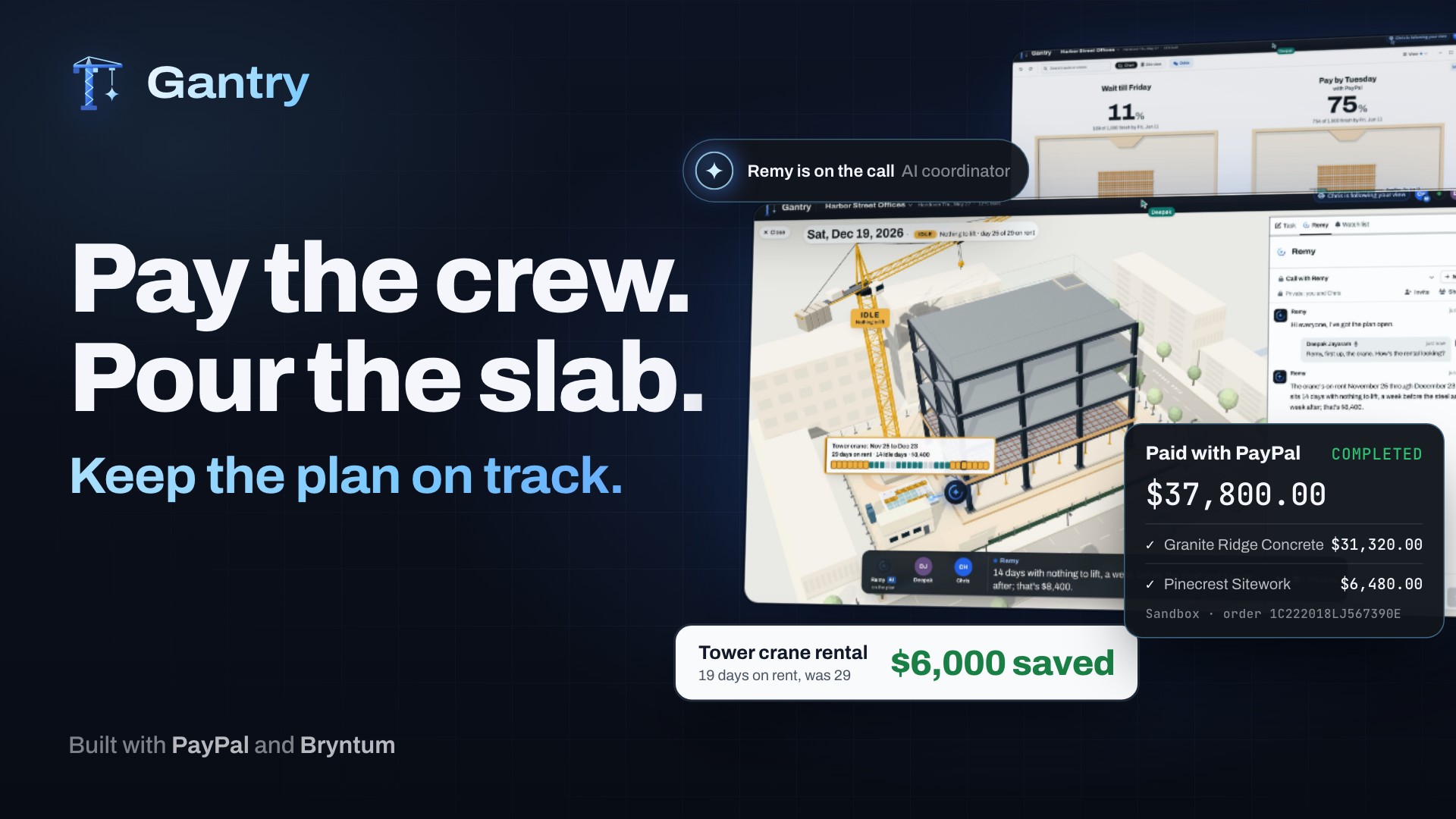
A live construction command center where payment decisions drive project progress.
Inspiration
A payment delayed by three days can push a construction handover back nearly two weeks. By the time anyone connects the dots, the damage is already done.
Construction runs on two separate clocks: the project schedule and the flow of money. General contractors manage one. Finance teams manage the other. A subcontractor waiting on payment can bring an entire sequence of work to a halt, while the Gantt chart still shows everything on track.
We asked a simple question: What if every payment lived directly on the schedule, so teams could see the cost of waiting before it was too late?
And what if making that payment could actually unlock the work?
What it does
We built a collaborative construction command center where money, schedules and decisions move together.
- A Gantt chart connected to real payments. Multiple team members edit the same live schedule. Tasks can depend on payment milestones. When a payment clears through PayPal, the hold lifts and the schedule responds.
- See the cost of waiting. Ask, "What happens if we pay Friday?" The scheduling engine calculates the impact on downstream tasks, while 1,000 simulations estimate the risk to the handover date.
- Meet Remy, your AI project coordinator. Remy joins team calls, understands the project context, runs scenarios and drafts schedule changes in real time. Humans approve every change and control every payment.
- Pay the people doing the work. PayPal handles tenant invoicing, checkout and sandbox payouts to individual trade partners' accounts.
The result: a schedule that shows what money is holding up, what a delay could cost and what action gets the project moving again.
How we built it
We connected a production-grade scheduling engine, real-time collaboration, voice AI and PayPal's payment infrastructure.
- Scheduling: Bryntum Gantt powers task dependencies, payment holds and critical-path calculations. We branch its scheduling engine to test "what if" scenarios and run 1,000 simulations without touching the live plan.
- AI coordination: Remy runs on Claude with 45 tools. Schedule dates, financial figures and risk estimates all come from tool results, keeping the model grounded in actual project data.
- Live meetings: LiveKit connects participants, OpenAI handles per-speaker transcription and ElevenLabs gives Remy a voice.
- Payments: PayPal Invoicing, Checkout and Payouts handle the sandbox money flow. PayPal's Agent Toolkit gives Remy read-only access to payment status.
- Infrastructure: Supabase provides Postgres, row-level security and Realtime collaboration. We built the interface with React and three.js, deploying across Vercel, Fly and LiveKit Cloud.
Challenges we ran into
Making the schedule trustworthy. Two people can move dependent tasks at the same time. We had to synchronize edits without losing updates, duplicating operations or corrupting the shared plan.
Simulating the future without changing the present. Running 1,000 schedule scenarios required isolation from the live project. A hypothetical delay could never become a real schedule change accidentally.
Giving AI the right amount of authority. Remy needed enough access to explain payment status and recommend action, while remaining unable to approve changes or move money. We also accounted for a second approval on payments above $25,000.
Making an AI coordinator work in a real meeting. Remy had to distinguish between people addressing her and people talking to each other, then choose when to contribute without interrupting the team.
Keeping a public demo affordable and safe. Voice, AI and payment integrations needed guardrails so the demo could remain available through judging without runaway usage costs.
What we learned
A payment date is a schedule dependency. Connecting the two lets contractors translate a financial delay into something everyone understands: days lost, tasks affected and risk to handover.
Voice AI succeeds through timing. In a meeting, a short, well-timed answer beats a long explanation. We also learned to test speech out loud. "Bill the tenant" became "fill the tank" in transcription, so we switched to "invoice the tenant."
Real payment infrastructure comes with real constraints. PayPal Payouts offers a lower-cost route but requires approval. Paying multiple trade partners through one order requires PayPal's platform program for production use.
What's next
Gantry is a humble proof of concept. On a real job, a trade partner's payment is the last step of a long chain: cost codes, a subcontract with its own schedule of values, a monthly pay application, change orders, retainage, lien waivers, insurance and tax paperwork, approvals by role and the contractor's accounting system. 76% of subcontractors say they usually or always get paid by paper check (PYMNTS Intelligence, 2024). Construction platforms already run much of that chain. Procore, for example, keeps each subcontract with its schedule of values, invoices by billing period with retainage, and keeps lien waivers, payment requirements and payment holds together in Procore Pay; Oracle Textura and GCPay cover parts of it too. Where we want to take it: work with those systems instead of rebuilding them, so that a pay application approved there ends in a PayPal payment and lifts the hold on the work waiting for it.
- Cost codes and subcontracts read from the contractor's own systems, with each task linked to the budget lines it spends.
- An approved monthly pay application, with its change orders, stored materials and retainage, becomes the PayPal payment that releases the work.
- Payments, and the work behind them, stay held until the contractor's system shows the lien waivers, insurance certificates and W-9s are in.
- Approval limits by role, a passkey at the moment of paying, and each payment's record sent back to the contractor's accounting system.
- PayPal's platform program and real trade partners' accounts, and a look at PayPal's Enterprise Payouts for trade partners who want the money in a bank account.
Built With
- anthropic
- bryntum
- bryntum-gantt
- claude
- deno
- elevenlabs
- fly.io
- livekit
- livekit-agents
- node.js
- openai
- paypal
- paypal-agent-toolkit
- paypal-js-sdk
- paypal-orders
- paypal-payouts
- postgresql
- react
- remotion
- supabase
- three.js
- typescript
- vercel
- vite
