-
-

Mobile Number Confirmation
-
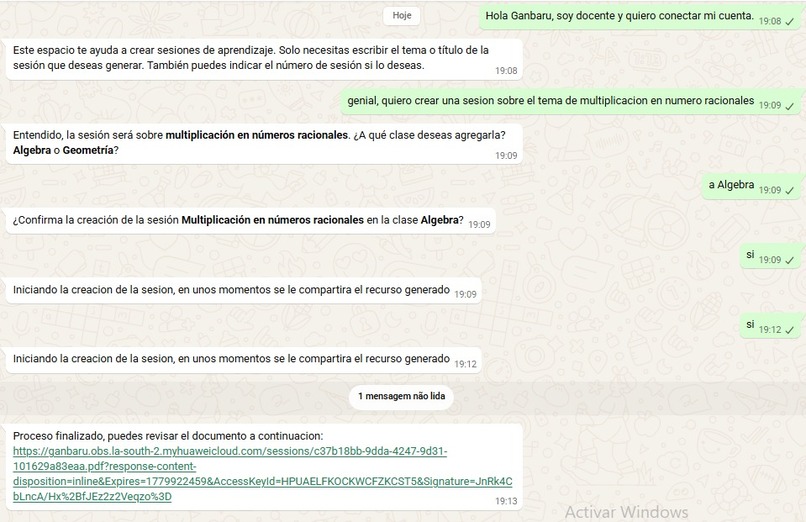
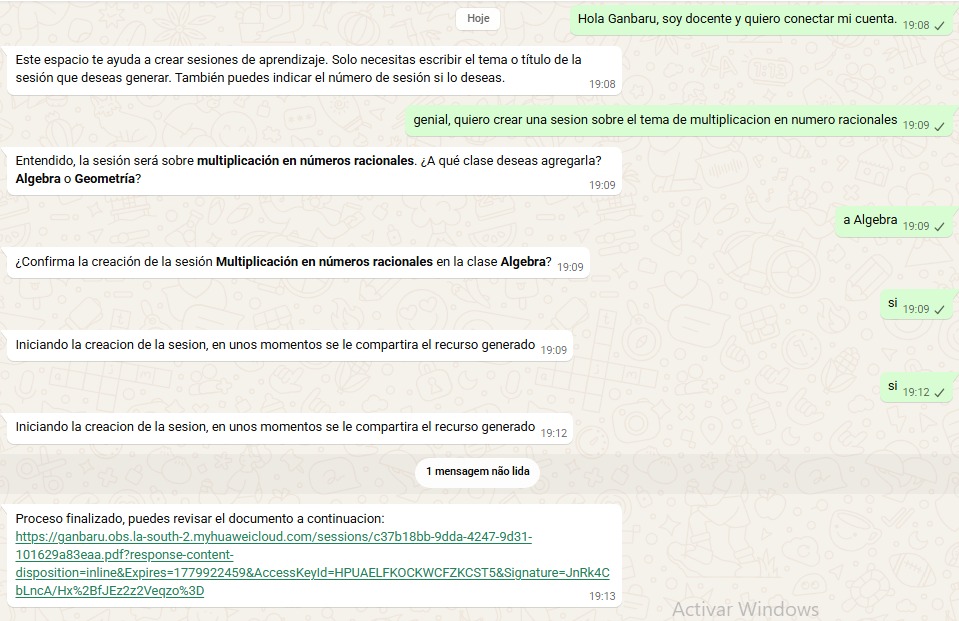
Whatsapp Agent
-
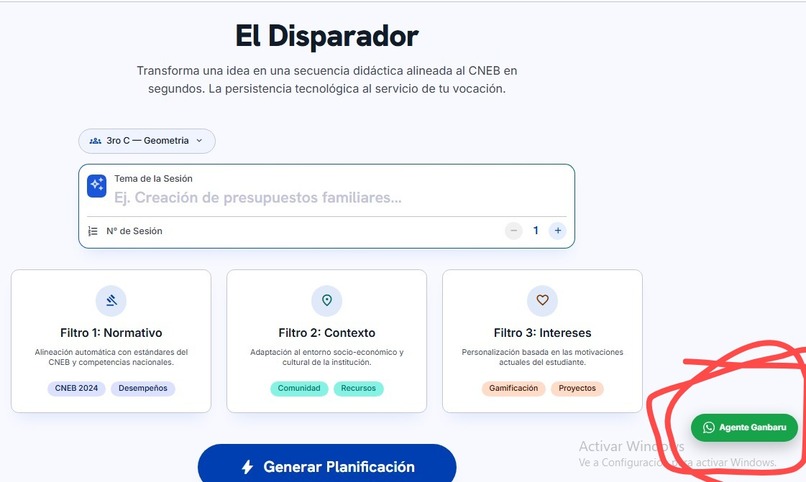
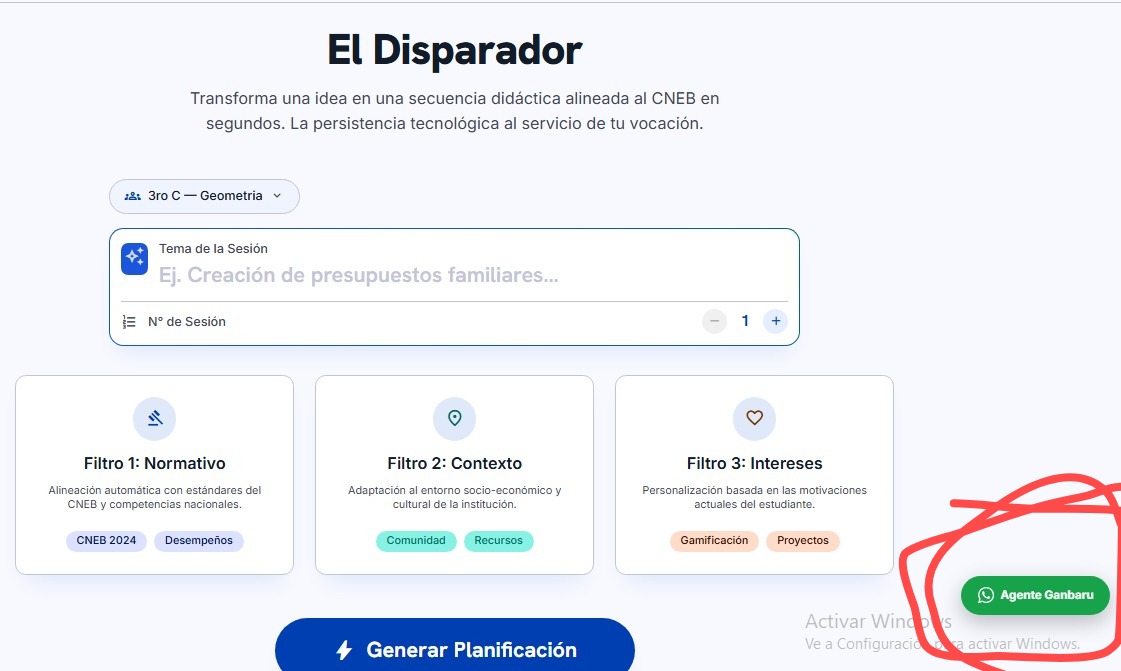
Web Platform

Inspiration
Every month, millions of public and private school teachers in emerging markets face an exhausting, invisible burden: spending over 40 hours manually drafting rigid, highly bureaucratic lesson plans to comply with strict government mandates.
In Peru, this administrative weight is amplified by the Ministry of Education's (MINEDU) National Curriculum (CNEB) and more than 220 decentralized regional school boards known as UGELs. Teachers are forced to spend nights mapping complex competency structures, leaving them with little energy for what truly matters—teaching.
As software developers and engineering students who closely collaborate with educators, we saw firsthand how generic AI systems like ChatGPT failed them completely. Teachers don't need general prose; they need a hyper-localized, context-aware engineering solution that respects their regulatory framework while adapting to the unique realities of their students.
That is why we built GANBARU.
What it does
GANBARU is a context-aware AI Co-Pilot that automates full pedagogical and legal compliance for school teachers in minutes. By establishing a teacher's technical identity, the platform locks in the exact regulatory requirements mandated by local school boards.
Instead of generating generic educational content, GANBARU initializes a dynamic context vector based on:
- The school's precise geographical location
- Available infrastructure (stable WiFi, projectors, etc.)
- Student demographic profiles
- Real-world student interests such as gaming or social media trends
This allows the platform to tailor content to regional realities, such as economic hubs, border zones, or local community characteristics.
The result is a technically flawless, hyper-localized lesson plan complete with:
- Precise evaluation criteria
- Officially aligned Desempeños Precisados
- Cross-cutting approaches
- Active methodologies
- A fully automated assessment rubric
Best of all, GANBARU features a native omnichannel interface, allowing teachers facing digital divide barriers to trigger and securely sync compliant documents directly through WhatsApp.
How we built it
The platform is engineered using a robust, cloud-synced modular architecture designed for precision and performance.
The Compliance Core (Database Layer)
We built a relational database layer that mirrors national educational frameworks. Competencies, capabilities, and performance indicators are mapped hierarchically:
Area → Grade → Competence → Capacities → Original Desempeños
The Orchestration & Context Vector Engine
When a teacher triggers a generation request, our backend compiles a highly structured context vector. This injects:
- Structural curriculum criteria
- Teacher technical identity
- Infrastructure constraints
- Geographic attributes
into a single generation pipeline.
LLM Orchestration & Prompt Engineering
Using advanced prompt engineering techniques, the AI operates as a pedagogical architect. It reads the raw input topic alongside fixed curriculum data and performs the delicate task of performance descriptor precision—injecting content into officially mandated legal structures without breaking compliance.
Omnichannel Messaging Integration
We implemented a webhook-driven conversational agent architecture for WhatsApp. The system:
- Authenticates users
- Matches requests against saved classroom profiles
- Triggers the generation pipeline
- Returns a secure, live-synced document link directly to the teacher's phone
Challenges we ran into
Enforcing Curriculum Rigidity vs. LLM Creativity
Standard generative AI models tend to hallucinate or modify strict terminology. In the Peruvian educational system, altering the text of a core competence or capacity can make a document legally invalid during an official audit.
We designed strict filtering mechanisms that isolate:
- Read-Only structures: competencies and cross-cutting approaches
- Generative fields: lesson descriptions and evaluation criteria
Structuring Highly Contextual Prompt Windows
Combining geographic data, infrastructure limitations, student interests, learning gaps, and multi-tier curriculum documents into a single prompt loop without suffering context degradation required meticulous template engineering and optimization.
Low-Latency Omnichannel Processing
Generating large, fully compliant documents through an AI pipeline takes time, which conflicts with conversational messaging timeout constraints.
To solve this, we engineered asynchronous task queues that process requests in the background while immediately notifying users through WhatsApp with secure access tokens once generation is complete.
Accomplishments that we're proud of
Zero-Friction Document Ingestion Teachers can input a simple topic phrase and receive a beautifully structured, multi-page compliant lesson plan in under two minutes.
True Accessibility via WhatsApp GANBARU bridges the digital divide by enabling teachers in underfunded schools—who may lack access to computers or stable internet—to fully utilize advanced generative AI through free messaging services.
Absolute Structural Coherence The system automatically transfers generated evaluation criteria into a fully tailored assessment rubric, eliminating repetitive double-entry administrative work.
What we learned
We learned that building AI for social impact requires deep empathy for the end-user's environmental constraints.
An AI model is only as good as the contextual constraints it respects. Designing GANBARU taught us how to model complex bureaucratic rulesets into systematic data pipelines, proving that AI should not replace human-centered workflows—it should shield humans from exhausting, repetitive administrative burdens.
We also gained valuable experience building secure, scalable conversational systems capable of cloud synchronization under limited connectivity conditions.
What's next for GANBARU
Although GANBARU was launched and battle-tested within the Peruvian curriculum ecosystem, its infrastructure was engineered from day one for global scalability.
Our next step is decoupling the country-specific compliance layer so that any nation's Ministry of Education curriculum can function as an interchangeable dataset.
By exposing an API for international curriculum schemas, we aim to scale GANBARU across Latin America and other emerging markets worldwide—ensuring that educators everywhere can reclaim their time and focus on what truly matters: inspiring the next generation.
Built With
- fastapi
- n8n
- next


Log in or sign up for Devpost to join the conversation.