-
-
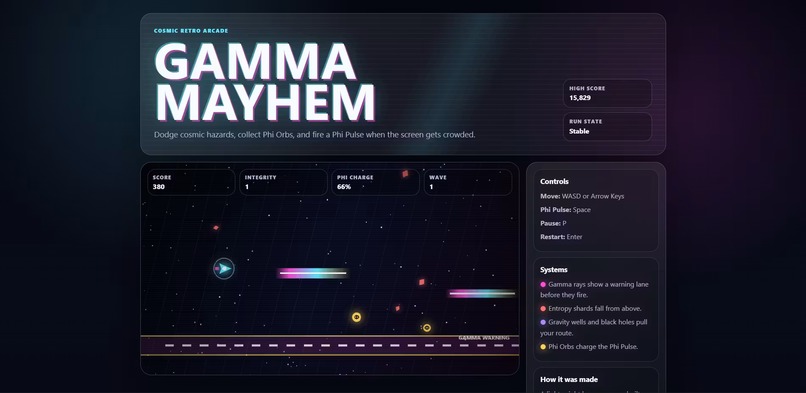
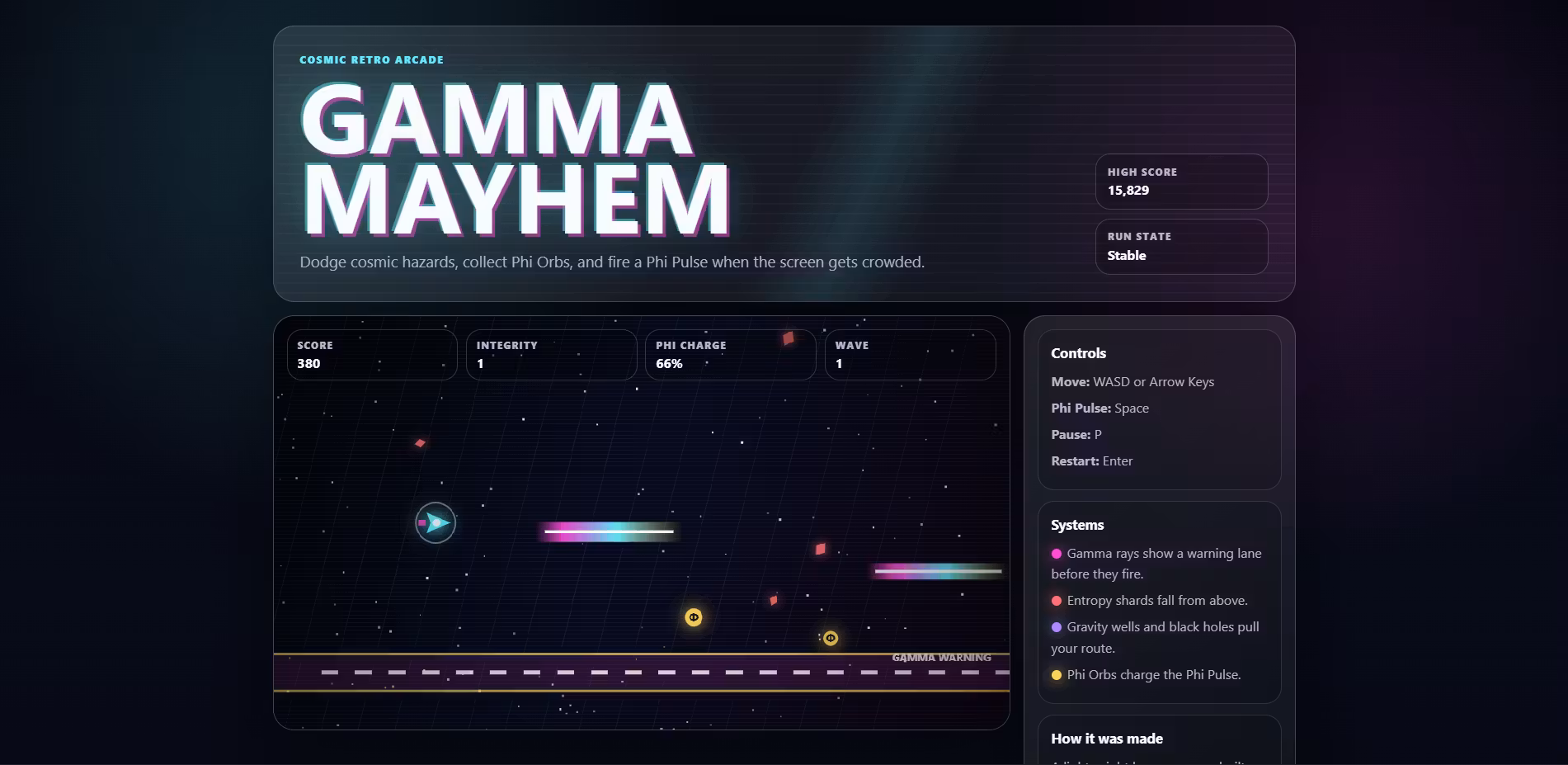
In action
Inspiration
Gamma Mayhem grew from my long-standing interest in space, gravity, black holes, radiation, entropy, motion, and the patterns that appear inside complex systems.
I did not want to create a generic space shooter where the cosmic setting was only decoration. I wanted space itself to become the opponent. Gamma rays cut across the arena, entropy shards create pressure, gravity wells distort movement, and black holes become increasingly dangerous as the player survives.
The game also reflects my interest in the golden ratio:
$$ \varphi = \frac{1+\sqrt{5}}{2} $$
I use Phi as a creative design motif rather than claiming that it governs the universe. Players collect Phi Orbs to build energy and activate Phi Pulse, a powerful burst that clears nearby obstacles and temporarily restores control inside the chaos.
My goal was to create something distinctly mine: cosmic, intense, visually memorable, immediately playable, and difficult to master.
What it does
Gamma Mayhem is a fast-paced retro survival game set inside an increasingly hostile cosmic storm.
The player must:
- Dodge gamma rays, entropy shards, gravity wells, and black holes
- Collect energy orbs
- Charge and activate Phi Pulse
- Protect their integrity
- Survive increasingly difficult waves
- Build the highest score possible
Each hazard creates a different type of pressure. Some move directly through the arena, while gravity wells and black holes actively pull the player away from safety. As the game progresses, the environment becomes faster, denser, and more difficult to control.
The central gameplay loop is simple:
Move → Dodge → Collect → Charge → Release → Survive
That simplicity makes the game easy to begin, while its escalating systems make every run increasingly demanding.
How we built it
I built Gamma Mayhem as a browser game using HTML, CSS, JavaScript, and the Canvas API.
I used OpenAI Codex to help transform my original concept into working systems, but the project was not created through one prompt. I directed the concept, mechanics, visual identity, balance, testing process, and final quality standard.
Development followed a repeated cycle:
Plan → Build → Play → Evaluate → Refine → Verify
I first established the core movement, collision, scoring, energy, and survival systems. I then expanded the project with multiple hazard types, escalating waves, gravity effects, responsive controls, high-score tracking, pause and restart states, mobile support, and stronger visual feedback.
After each major change, I tested the complete game again to make sure new improvements had not damaged existing mechanics. I used focused Codex prompts to investigate individual problems, propose changes, implement them, and verify the results.
The final project remains lightweight and can run directly in a modern browser without accounts, API keys, or a required backend.
Challenges we ran into
The hardest challenge was making the cosmic forces feel powerful without making the game unfair.
Gravity wells initially risked feeling too weak to matter or too strong to escape. Black holes created an even more difficult balancing problem because they needed to feel clearly stronger than gravity wells while still allowing skilled players to survive.
I repeatedly refined:
- Pull strength
- Effective distance
- Difficulty scaling
- Player movement
- Warning effects
- Visual clarity
- Hazard timing
Another challenge was readability. As the screen becomes more active, the player must still immediately understand what can damage them, what can be collected, when Phi Pulse is ready, why their movement is changing, and where the greatest danger is located.
Supporting both desktop and mobile controls also required careful testing. Touch controls needed to remain responsive without covering the arena, while keyboard movement needed to feel immediate and precise.
The final challenge was recognizing the difference between fixing a real problem and endlessly changing personal preferences. I continued refining the game until the mechanics were dependable, the hazards were distinct, and repeated regression tests showed that the full experience remained stable.
Accomplishments that we're proud of
I am proud that Gamma Mayhem became more than a working prototype. It became a complete and recognizable experience.
The final game includes:
- A fully playable survival loop
- Multiple hazards with distinct behaviors
- Escalating waves and difficulty
- Gravity wells and stronger black-hole attraction
- A collectible energy system
- The Phi Pulse defensive mechanic
- Score and high-score tracking
- Pause, restart, and game-over states
- Keyboard and touch controls
- Responsive desktop and mobile layouts
- A consistent retro cosmic identity
- Clear feedback for danger, damage, energy, and progression
I am especially proud that the scientific ideas are reflected through gameplay rather than simply written into the theme. Gravity affects movement. Entropy increases disorder and pressure. Black holes create stronger regions of attraction. Energy must be collected and released strategically.
The game is simple enough for someone to understand within seconds, but complete enough to reward repeated play.
What we learned
Gamma Mayhem taught me that creating a game is not only about making mechanics function. It is about building a complete system of cause, effect, pressure, feedback, and player understanding.
A mechanic can be technically correct and still feel wrong. A hazard can be mathematically stronger and still appear weak. A power can be useful and still feel unsatisfying. Every major action needs feedback that the player can see, feel, and understand.
I also learned how to work with Codex more effectively. Broad instructions produced broad results, while precise goals, constraints, testing criteria, and verification steps produced dependable improvements.
Most importantly, I learned that AI-assisted development still requires human judgment. Codex helped me implement, inspect, and test the project, but I remained responsible for the idea, direction, decisions, quality control, and final experience.
This project strengthened my ability to move from an ambitious concept to a finished product through structured iteration rather than stopping at the first functional version.
What's next for Gamma Mayhem
The current version is designed as a focused arcade experience, but its systems could support a much larger game.
Future possibilities include:
- New cosmic regions with unique environmental rules
- Additional hazards and enemy behaviors
- Unlockable ships or abilities
- Boss encounters
- Challenge modes
- Achievements
- Expanded sound and music
- Global leaderboards
- More advanced progression between runs
Any expansion would preserve the principle that shaped the original game: every feature should strengthen the central experience rather than add complexity without purpose.
Gamma Mayhem represents how I approach creative and technical work. I begin with an ambitious idea, break it into systems, test what actually works, and continue refining until the result feels intentional.

Log in or sign up for Devpost to join the conversation.