-
-
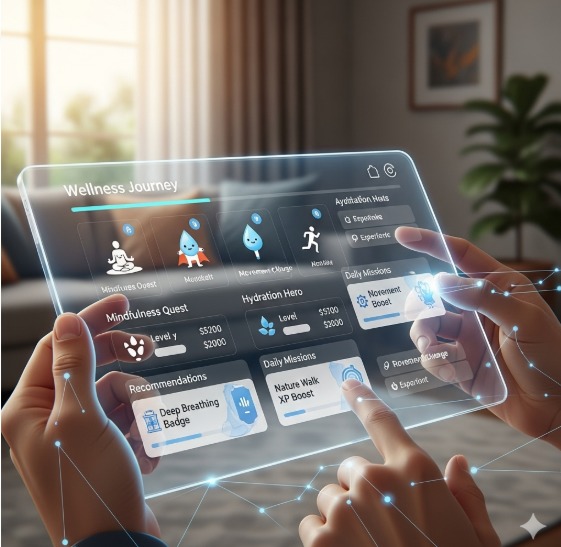
Gamified: Digital Detox That Rewards You
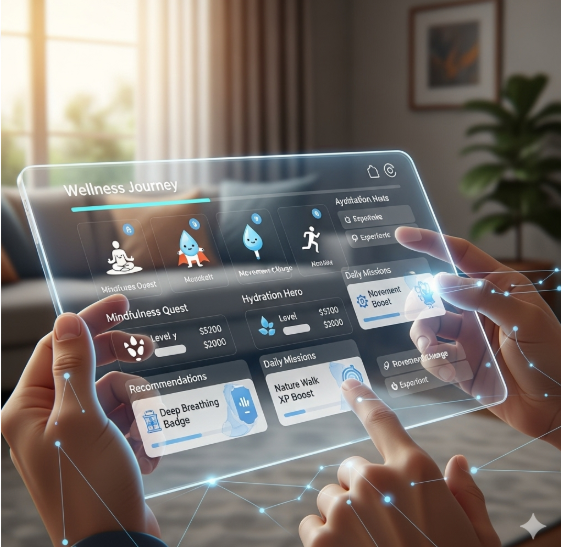
Inspiration —
I realized that screens have silently taken over our lives. From crowded classrooms to high-pressure workplaces, they follow us everywhere — from the moment we open our eyes in the morning until we finally close them at night. We stay connected, but somewhere along the way, we have forgotten how to disconnect.
I kept noticing a pattern around me: one more notification, one more scroll, and suddenly “just five minutes” turns into hours lost. Minds overloaded. Focus slipping away. Stress quietly piling up. Students struggle to stay attentive, employees feel burnt out, and so many people find it hard to function without holding onto a device — almost like a lifeline.
Seeing this made me question:
Are we using technology — or is technology using us?
That realization inspired me to take action.
I wanted to bring back balance.
A small pause in a nonstop digital world.
A chance to breathe, reflect, and feel human again.
I became passionate about designing a healthier way to interact with technology — a way where screens support clarity, productivity, and wellbeing, instead of draining them.
Because in a world that never stops scrolling…
Wellbeing begins when we choose to log out — just a little.
What it does ?
🎮 Welcome to the Gamified Digital Wellness Recommender
Our platform transforms healthy screen habits into a rewarding gameplay experience. Instead of collecting coins, users unlock real-life wellness challenges — screen-free breaks, social interactions, mindfulness moments, and more. 🌱
🤖 Powered by an AI-driven Digital Wellness Profiler, the system assesses users’ digital usage patterns and classifies them into risk categories: Healthy, Mild Risk, Moderate Risk, High Risk, and Critical Risk.
🚀 Based on this profile, the app recommends personalized and fun tasks to help users restore balance, reduce stress, and build healthier digital habits.
💡 In short: We turn mindful technology use into a game — making wellness enjoyable, motivating, and accessible for everyone.
How we built it —
Note - Incase the above image is not visible you can refer to my githup repo.
Challenges We Faced :-
We faced multiple challenges along the way:
1) Limited Data Availability - The data is often sensitive and private. We had to work with a small dataset and engineer meaningful behavioral signals from limited input.
2) Clustering Users Accurately - Grouping users using K-Means required experimentation with the right number of clusters, scaling techniques, and evaluation metrics to ensure meaningful risk segmentation.
3) Aligning AI Recommendations with Wellness Goals - Ensuring the LLM suggests healthy and responsible challenges — not generic or irrelevant responses — required careful prompt design and refinement loops.
4) Gamification Balance - We had to ensure challenges feel motivating and fun, not restrictive or punitive, to maintain long-term user engagement.
5) Deployment Constraints - Running ML + LLM models smoothly on Gradio while keeping the interface simple and responsive required optimization and iterative UI improvements.
Accomplishments that we proud of :-
🏆 We achieved several milestones we truly proud of:
1) A Complete AI-Driven Wellness Pipeline : We successfully built an end-to-end workflow — from data collection and segmentation to personalized risk prediction and LLM-based recommendations.
2) Meaningful Behavior Insights : We were able to extract key digital signals and convert them into actionable insights that help improve users’ mental wellbeing.
3) 5-Level Risk Assessment Model : We created a model that can classify users into five different digital wellness categories with solid interpretability.
4) Gamifying Self-Care : We transformed digital wellness into a fun, challenge-based experience that can motivate users rather than restrict them.
5) LLM-Powered Personalization : Our system dynamically tailors challenge recommendations to each user profile — a step toward truly individualized digital wellness interventions.
6) User-Friendly Deployment : Using Gradio, making it easy for anyone to interact with.
What we learned
1) Small Data Can Still Drive Big Insights - Even with limited behavioral data, smart feature engineering and clustering can uncover meaningful risk patterns.
2) ML + LLM Combination Is Powerful - Machine learning helps identify the problem, while LLMs help solve it — together enabling personalized wellness interventions.
3) Gamification Improves Engagement - Users respond better to positive motivation (rewards, challenges, streaks) instead of strict usage control or warnings.
What's next for Gamified Digital Wellness Recommender
Our journey doesn’t stop here — this is just the beginning. Moving forward, we aim to collect richer behavioral datasets to enhance personalization and improve our risk assessment accuracy. We plan to expand the gamified ecosystem with more challenge types, progress tracking, leaderboards, and reward mechanisms to keep users motivated long-term. We also envision integrating wearable and smartphone wellness APIs to detect stress or fatigue in real time, enabling proactive interventions. On the AI side, we hope to fine-tune our LLM for even safer, more empathetic recommendations tailored to each user’s emotional state. Finally, we want to scale our platform to schools, universities, and workplaces — helping people everywhere create healthier and happier relationships with technology. 🌍✨
Built With
- classification
- clustering
- gradio
- langchain
- llm
- machine-learning
- numpy
- pandas
- plotly
- python
- sklearn
- txtai

Log in or sign up for Devpost to join the conversation.