-
-
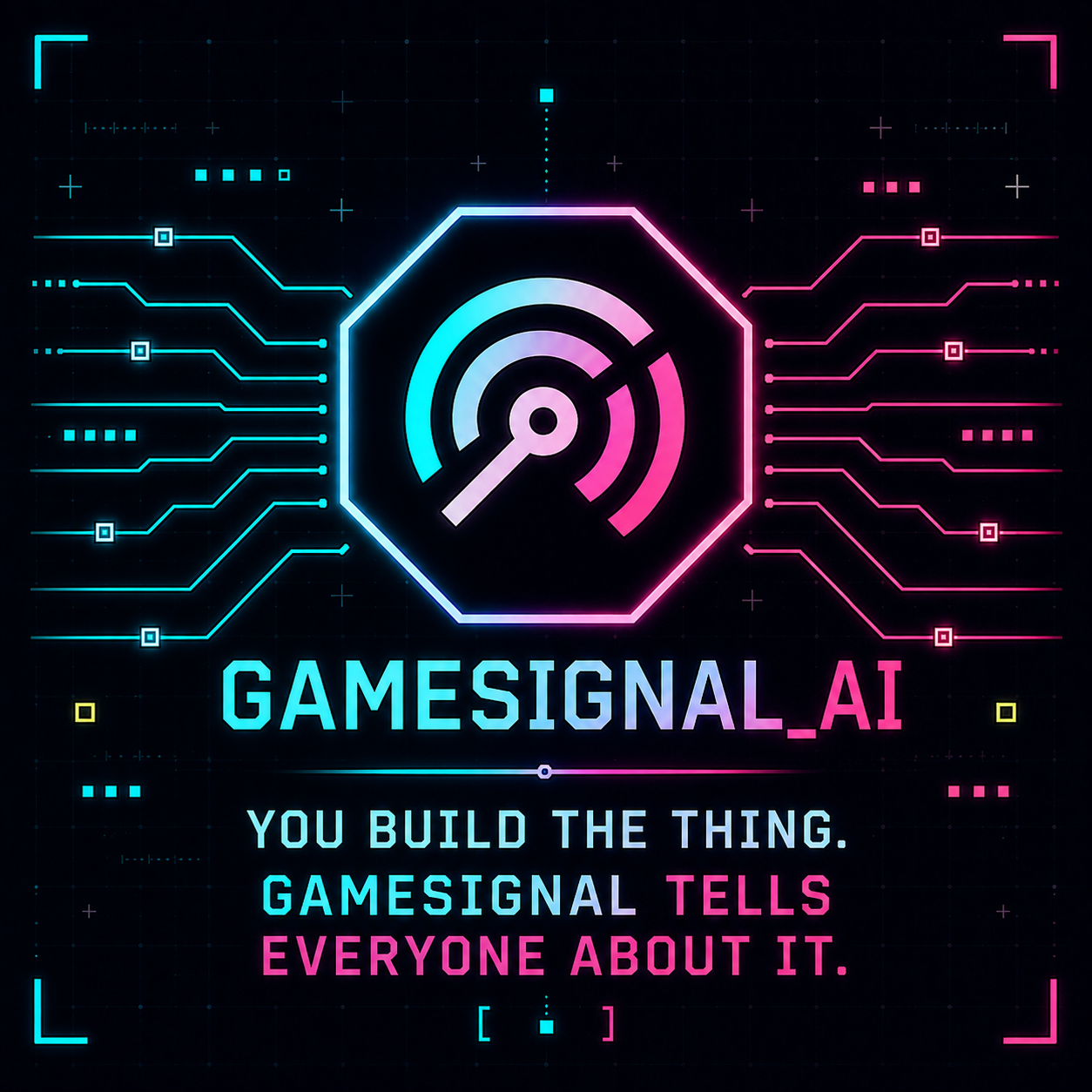
GameSignal AI
-
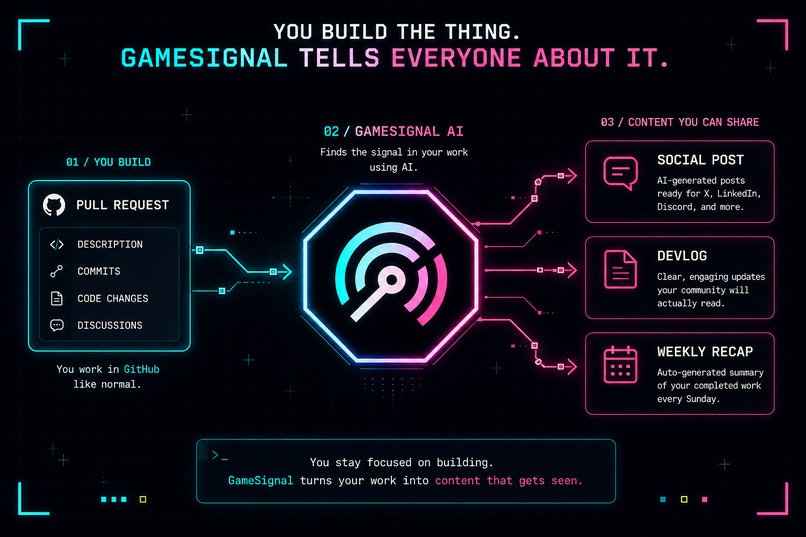
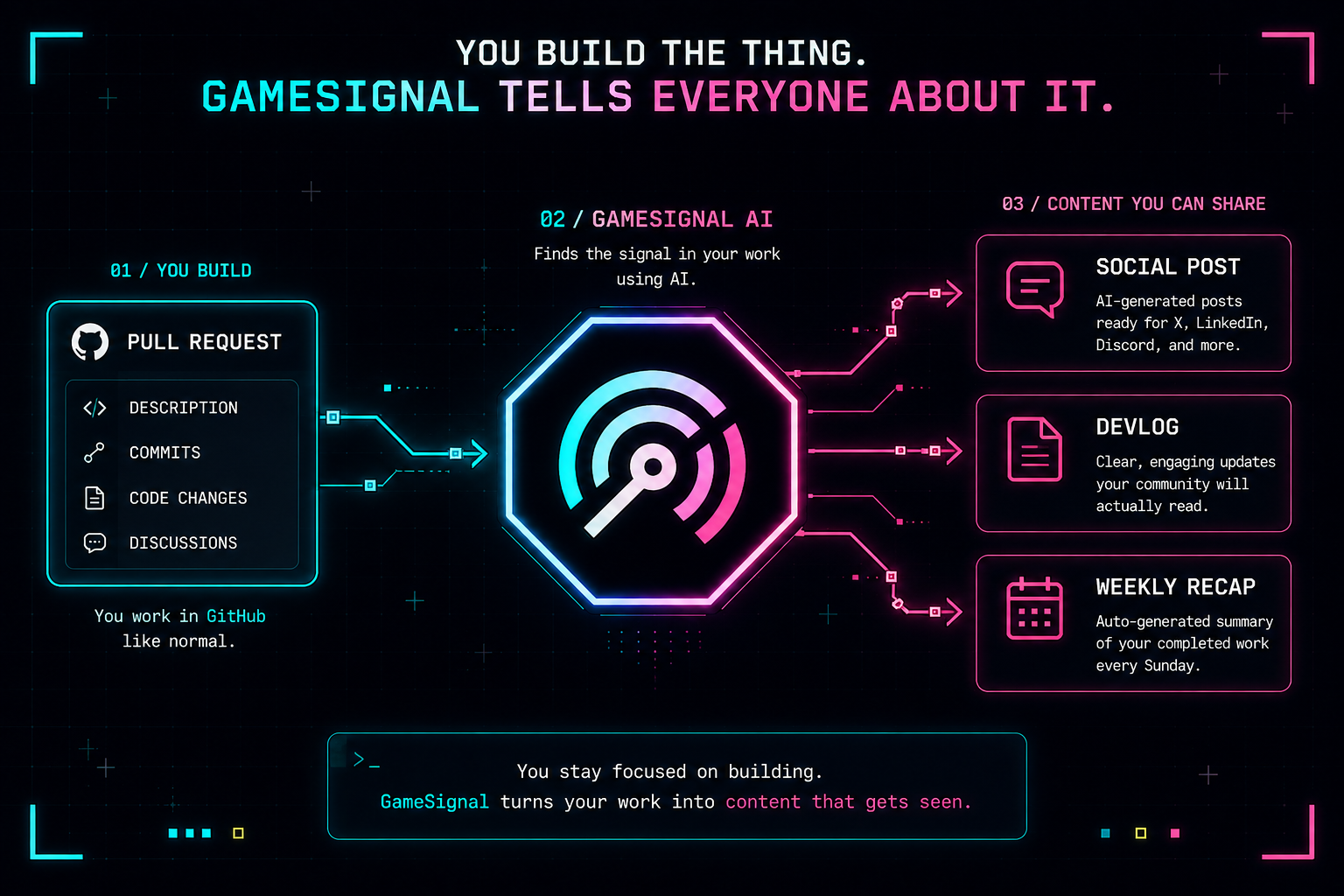
How GameSignal works
-
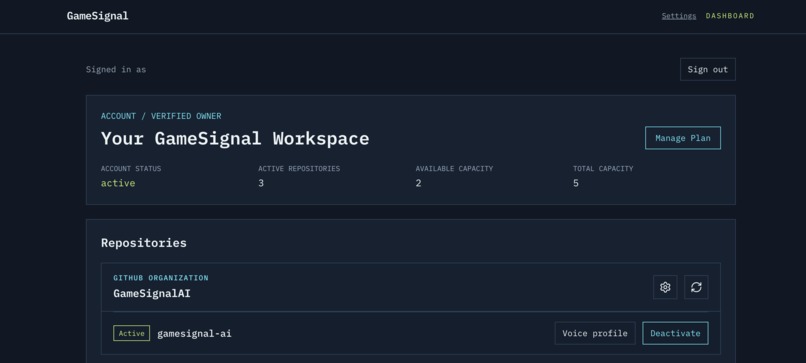
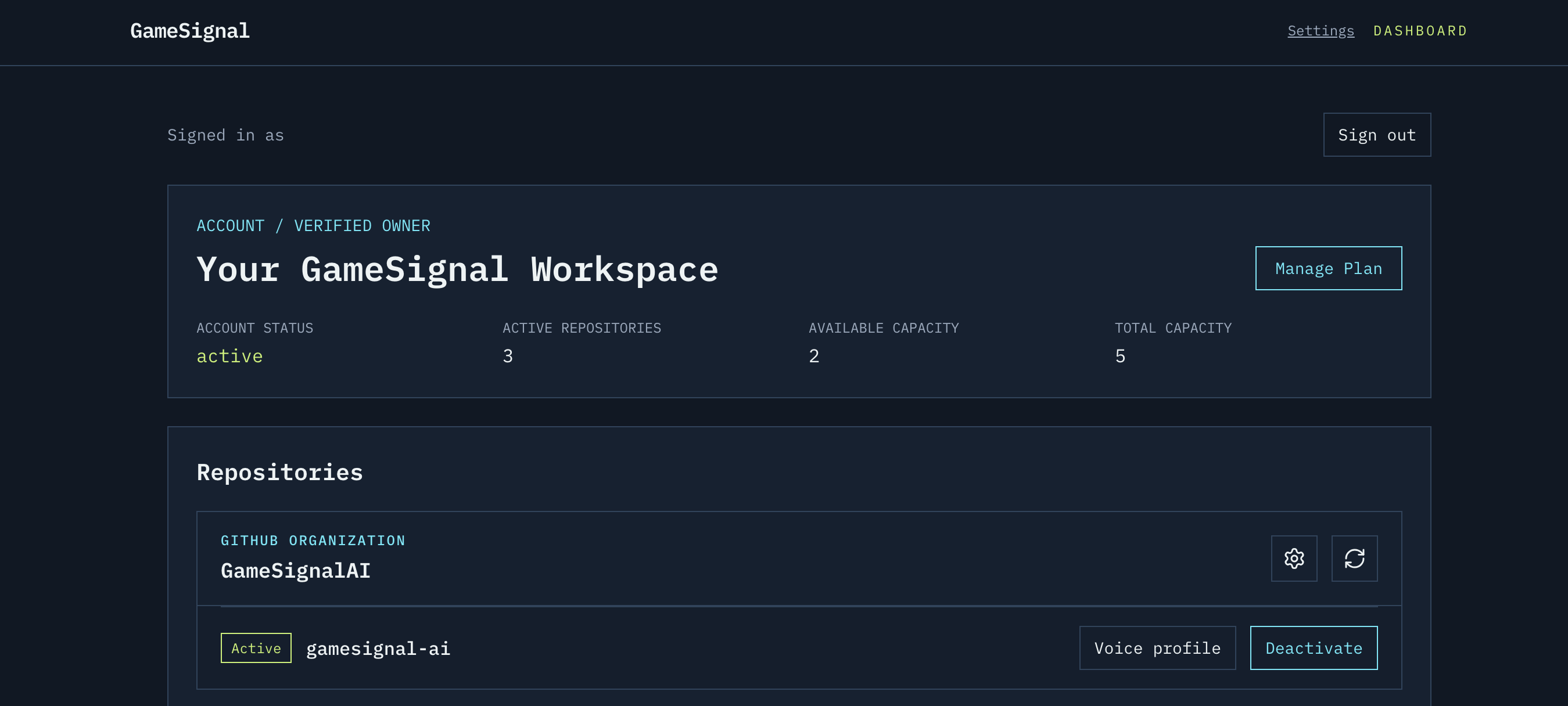
GameSignal Dashboard
-
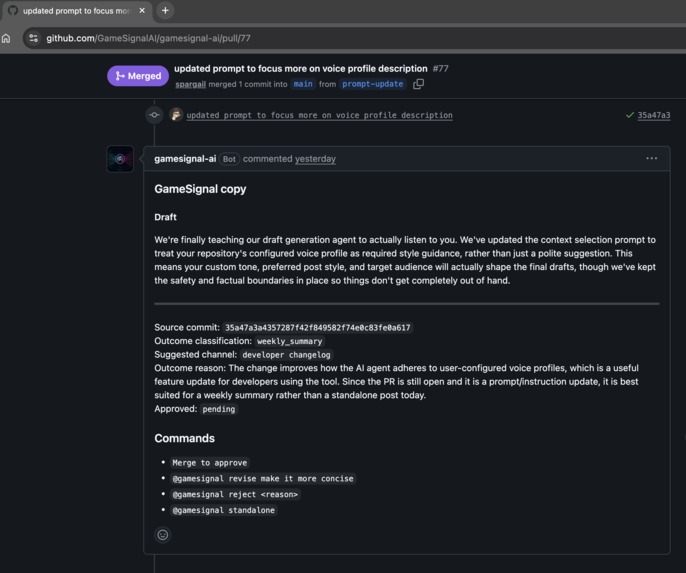
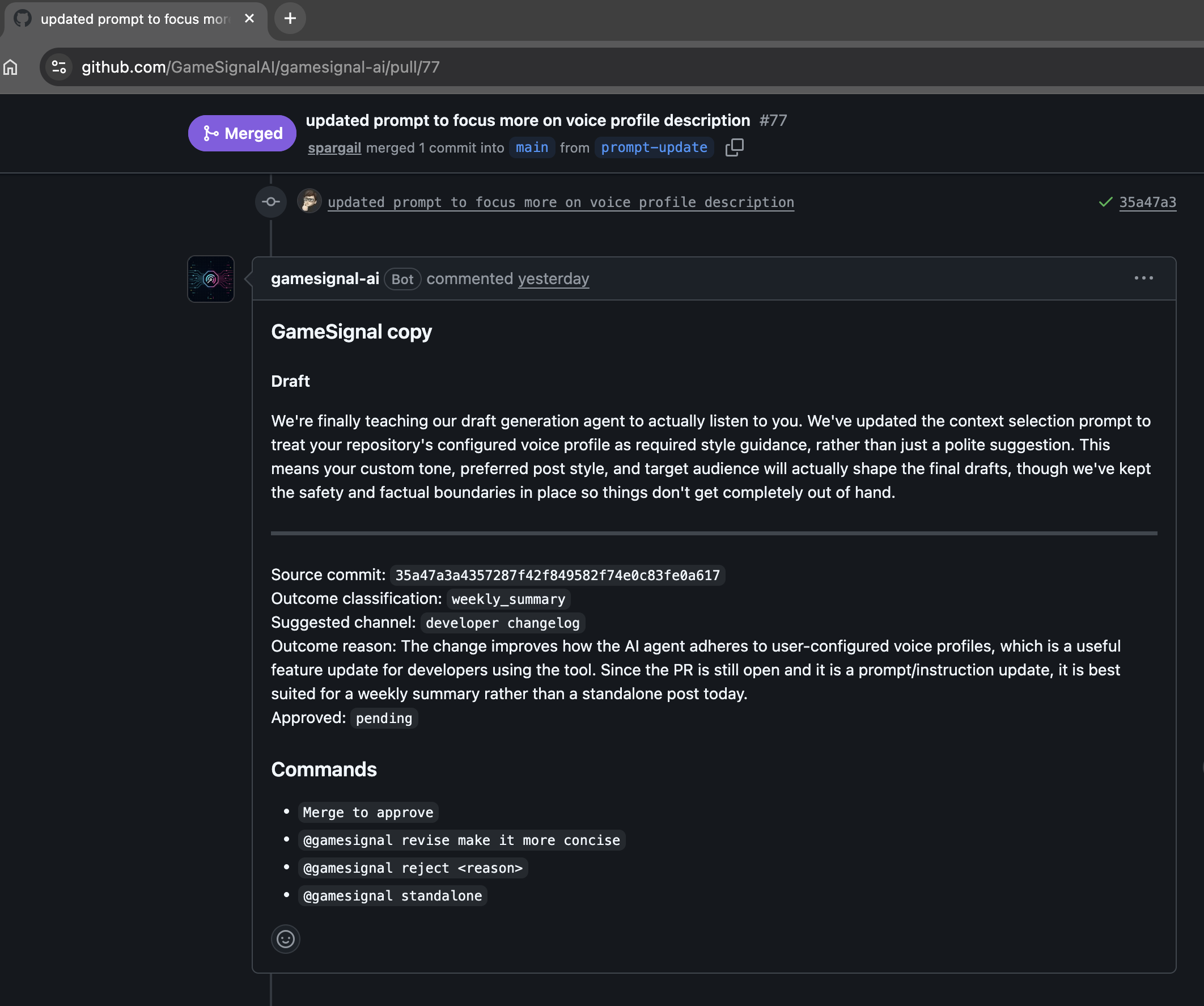
GameSignal PR Draft Output
-
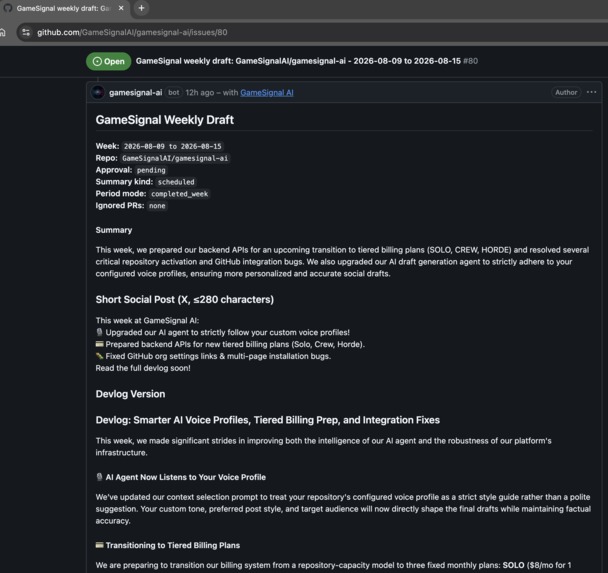
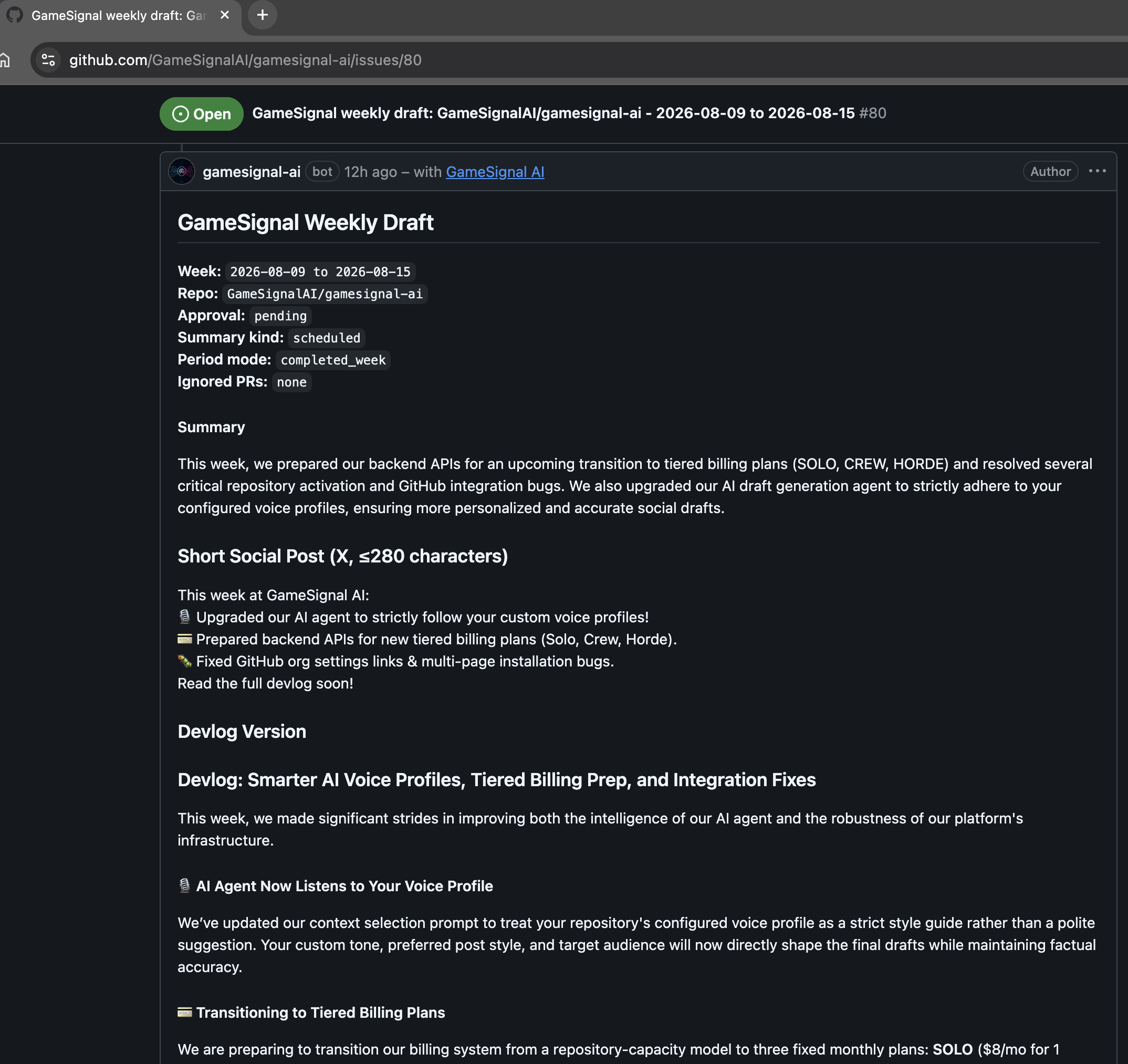
GameSignal Weekly Summary as an Issue
Inspiration
I love building things—software, games, prototypes, experiments. What I don't love is posting about what I'm building.
You can spend all your time building a great product, but if you never tell anyone about it, no one will use it. Conversely, every hour spent reconstructing what you did, writing updates, creating devlogs, and thinking about social posts is an hour you're not building.
Well, why not let AI worry about what to write using development activity I'm already pushing to GitHub?
Developers already document an enormous amount of their work through GitHub. Pull requests contain descriptions, commits, code changes, discussions, and ultimately a record of what's actually shipping.
GameSignal looks for the signal inside that activity and turns it into something worth sharing.
What it does
GameSignal is a GitHub App that uses AI to understand development activity and generate content from it.
When a developer creates a pull request, GameSignal gives an AI agent the context of the PR. The agent then determines which files and patches it needs to investigate to understand what changed and why it matters. From that investigation, it generates a draft directly inside the pull request.
The developer doesn't have to switch tools to work with the AI. They can simply reply to GameSignal in the PR:
@gamesignal revise make this less technical and focus more on what changed for the player
GameSignal interprets the feedback and generates a revised draft.
When the PR is merged, that work becomes part of the project's development history. GameSignal can then combine completed work into an automated weekly summary, turning a week of individual changes into a coherent devlog or progress update.
The goal is to find the story that's already hidden inside the work and put it into a format that can be easily shared.
How I built it
The core is a GitHub App that listens for relevant repository events. Incoming events are processed asynchronously so that AI generation doesn't interfere with the developer's normal GitHub workflow.
GameSignal uses the context available in a pull request—including descriptions, commits, and patches—to give the AI a much richer understanding of the work than a simple commit-message summarizer.
GitHub Checks provide feedback while GameSignal is processing, and generated content is posted back to the pull request as a comment so the entire review and revision process stays where the developer is already working.
I also built an automated weekly workflow that collects completed work for the previous Sunday-through-Saturday period and generates a larger summary from it.
GameSignal also has a dashboard where developers can authenticate, configure their own repositories, and manage their subscription without requiring manual onboarding.
Challenges I ran into
One of the biggest technical challenges was deciding how much repository context to give the AI.
A pull request can contain a tiny change or an enormous patch. Simply sending everything to a model doesn't scale well and doesn't necessarily produce better content. GameSignal has to determine which information provides useful context while filtering out implementation noise that doesn't matter to the eventual reader.
In the end, I developed a set of tools the AI agent can use to investigate the pull request itself. Rather than sending the entire diff to Gemini, GameSignal provides the initial PR context and lets the agent determine which files and patches it needs to inspect.
The agent can progressively investigate the changes, gather relevant evidence, and decide what actually matters before generating anything.
This reduced unnecessary context while also making GameSignal capable of reasoning over pull requests of very different sizes.
Accomplishments that I'm proud of
After building the initial product, I spent a couple of weeks trying to generate interest through X. Without an existing audience, I quickly discovered that distribution was going to be harder than building the technology.
I realized that even if someone discovered GameSignal and wanted to try it, my onboarding process still required me to manually activate their repository, so I went back to building.
In one week, I built a self-service dashboard, authentication, repository configuration, subscription plans, and Stripe payment integration. A developer can now discover GameSignal, sign up, connect a repository, start a trial, and use the product without requiring me to manually onboard them.
That's one of the accomplishments I'm most proud of because it changed my understanding of what a solo developer can reasonably build. With AI assistance, creating the infrastructure around a real SaaS product is dramatically faster than it used to be.
What I learned
The biggest thing I learned while building GameSignal is that AI changes more than the features we can put into software. It changes how quickly we can experiment with the business itself.
Traditional startup advice says to validate before building because building is expensive, but that may not be the case anymore.
Authentication, infrastructure, payments, dashboards, APIs, and deployment used to represent significant investments for a solo developer. AI-assisted development has dramatically reduced that cost.
That changed how I approached GameSignal.
Instead of spending weeks trying to determine whether developers might use a fully self-service version of the product, I could build that version, put it in front of people, and find out.
What's next for GameSignal AI
The immediate goal is simple: put GameSignal into the hands of developers and learn whether it becomes part of their normal development workflow.
Eventually, I want GameSignal to understand a project's development history well enough that developers don't have to reconstruct what they've built from memory. They should be able to search that history semantically, ask questions about previous work, and turn that knowledge into useful communication.
I also want to close the final gap in the workflow: publishing. Today, GameSignal creates content that developers review and copy elsewhere. Eventually, developers should be able to review, schedule, and publish that content directly from GameSignal.
The larger idea is simple: developers should be able to stay focused on building while GameSignal continuously turns that work into useful knowledge and communication.

Log in or sign up for Devpost to join the conversation.