-
-
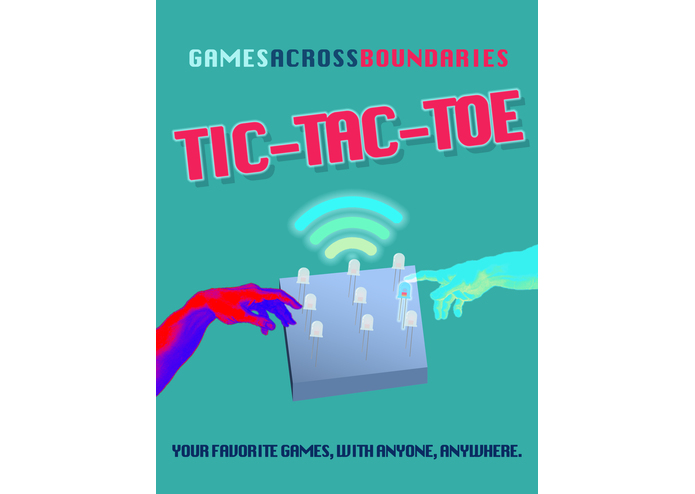
Games Without Boundaries: Tic-Tac-Toe Poster
-

After learning Arduino, and learning about different materials, this was our shot at the code. We were able to control the LEDs!
-
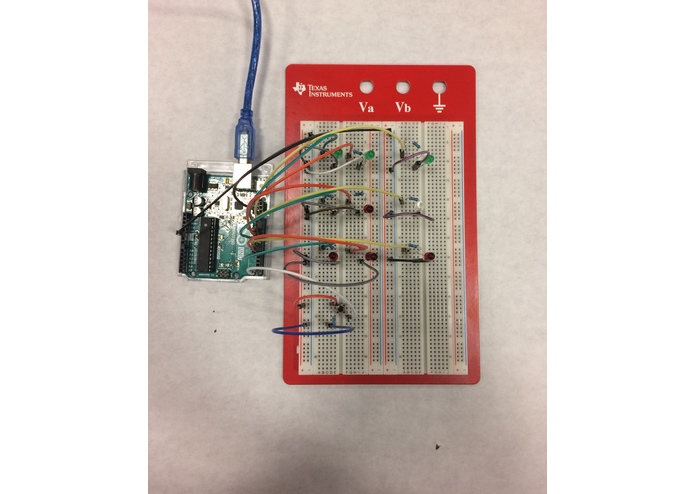
Our breadboard, with all 9 LED lights wired to the Arduino Uno.


Motivation
Games are a huge part of bonding and connected with people. A game of Scrabble, Settlers of Catan, or Monopoly are often family traditions or regular hangout activities with friends. But what happens when your friends and family live far away? Playing on an app or on software just isn't the same.
We have a solution: Games Without Boundaries allows you to stay connected with people you love, doing the activities you love... without looking at a screen.
What it Does
Tic-Tac-Toe allows you to play the game with your friends or family members via WiFi. It's a board with 9 LED lights, that coordinates with another player's board via WiFi or Bluetooth. When one person takes their turn, the other player's board changes accordingly. With Games Without Boundaries’ Tic-Tac-Toe, you will experience a new connection and feel as if you are playing in the same room as your friends and family.
How We Built It
As beginners, we wanted to learn a new skill at HackMIT, so we decided to tackle Arduino. We used an Arduino, a breadboard, a USB to connect the Arduino and breadboard, 9 LED lights, resistors, wires, and a button, and incorporated all of these components into a circuit.
Challenges We Ran Into
Since we had no experience working with an Arduino nor a breadboard, this project was a learning experience. It took the most time to determine how to wire the circuit so that we could control each LED light individually. Additionally, we wanted to use an LED array, but we were limited by materials, and so we had to wire 9 lights.
Accomplishments
At the end, we were able to control the 9 LED lights with the Arduino. We wrote a simple code to blink each light on and off sequentially.
Future Product Features
In the final version of the Tic-Tac-Toe product, we would use 2 different colored lights for each player, and blinking lights when players are selecting which square to select. We tried to incorporate a button for users to select the move they want to make and set it, but we would need to work on this more. Eventually, the product would connect to WiFi, so that players can play with other people from across the world.
What We Learned
HackMIT has taught us that our first idea will not always be the best idea. Although we had many ideas, we had to pick one that was feasible with our skills and the materials and time available. We asked for help from mentors multiple times in order to move forward with our project. This allowed us to further understand the in-and-outs of this project such as learning to use Arduino, basic electrical engineering, and having software interact with hardware.
What's Next for Games Without Boundaries: Tic-Tac-Toe
The ultimate goal is to adapt this technology to many classic board games, such as chess, checker, and connect four.

Log in or sign up for Devpost to join the conversation.