-
-
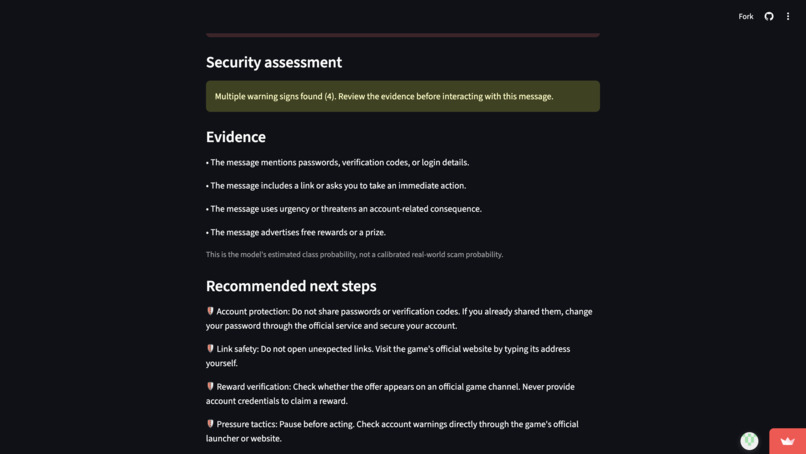
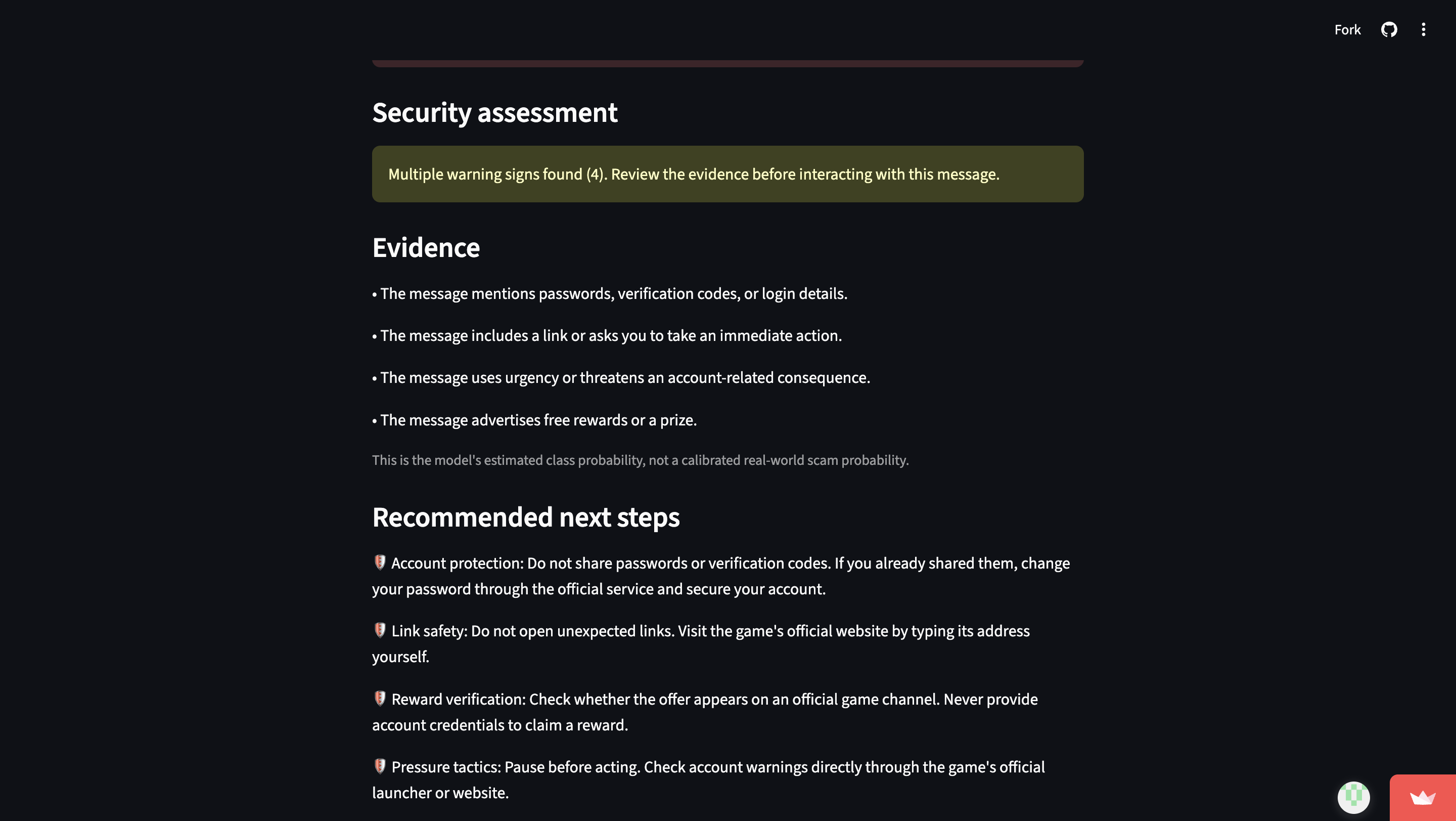
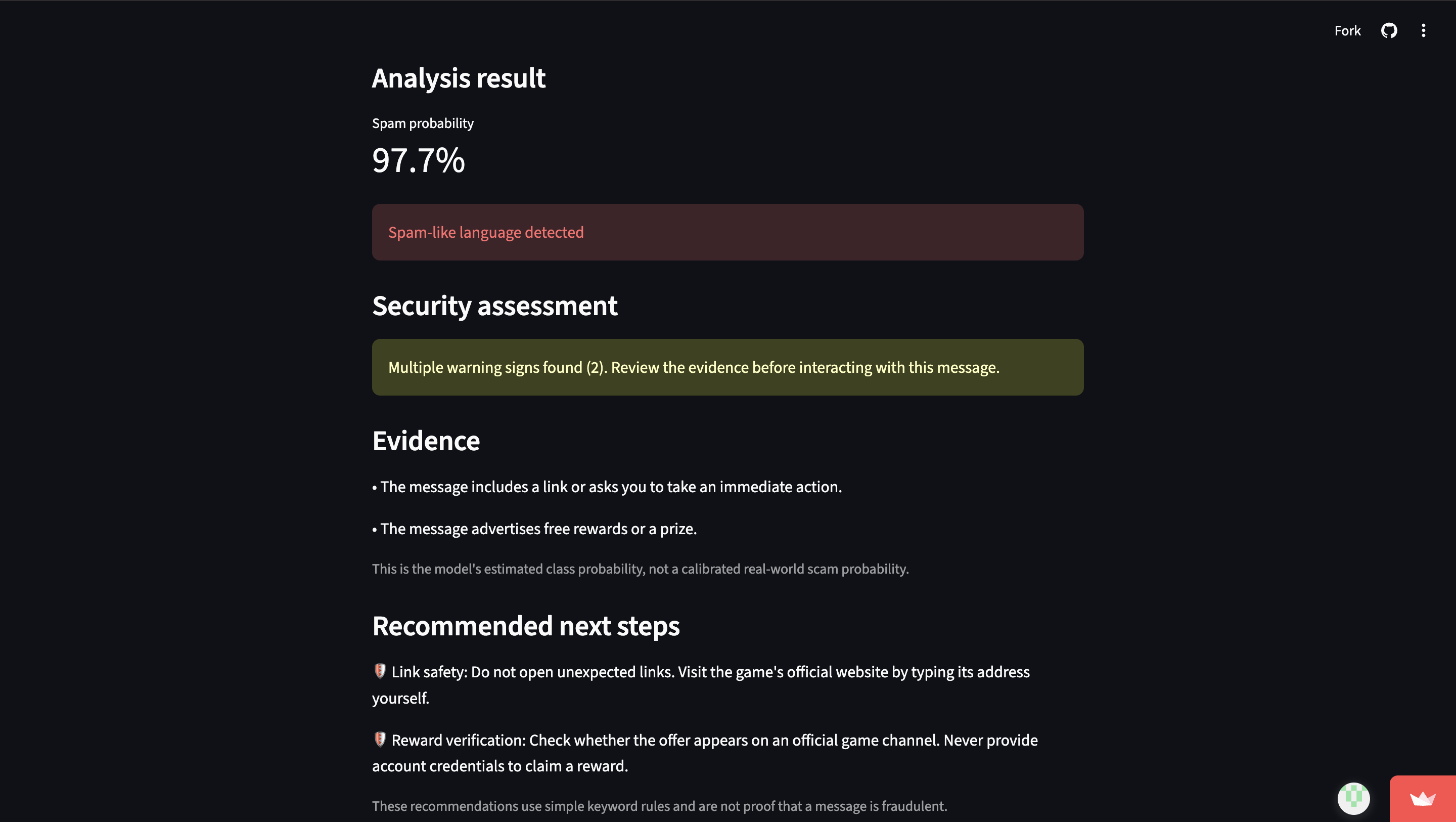
GameGuard flags four warning signs and recommends steps to protect gaming accounts from suspicious messages and links.
-
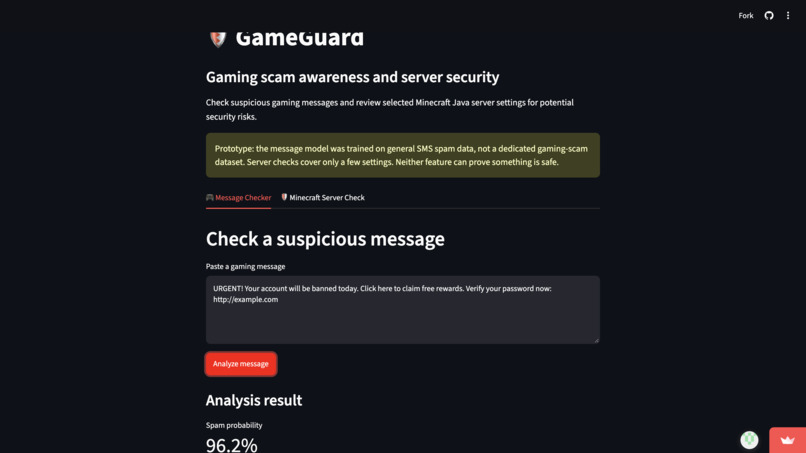
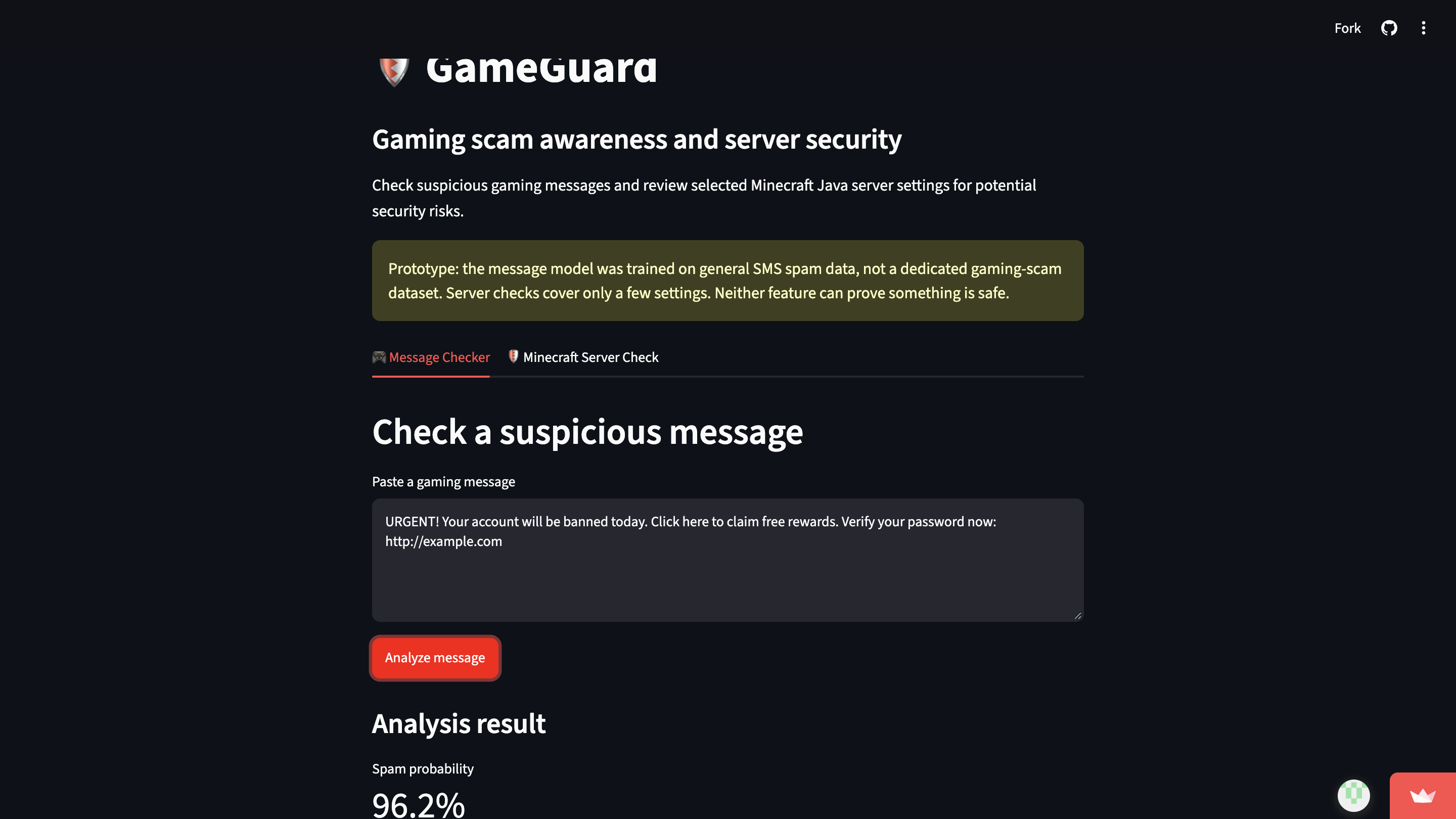
GameGuard flags suspicious gaming messages using machine learning and offers safety guidance to help players recognize potential scams.
-
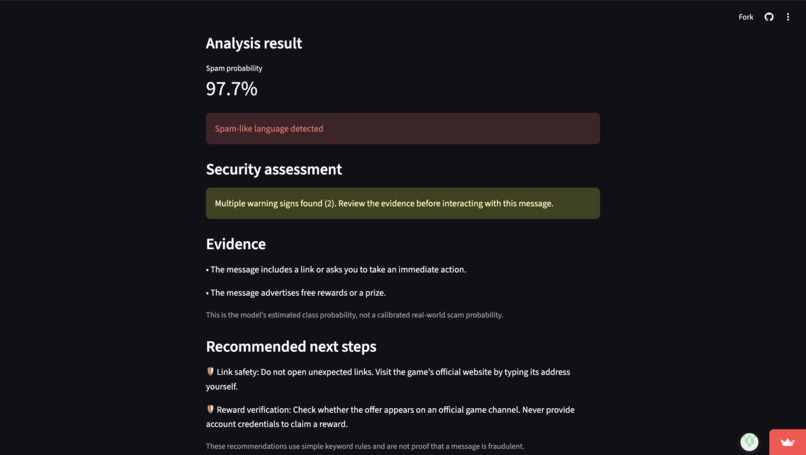
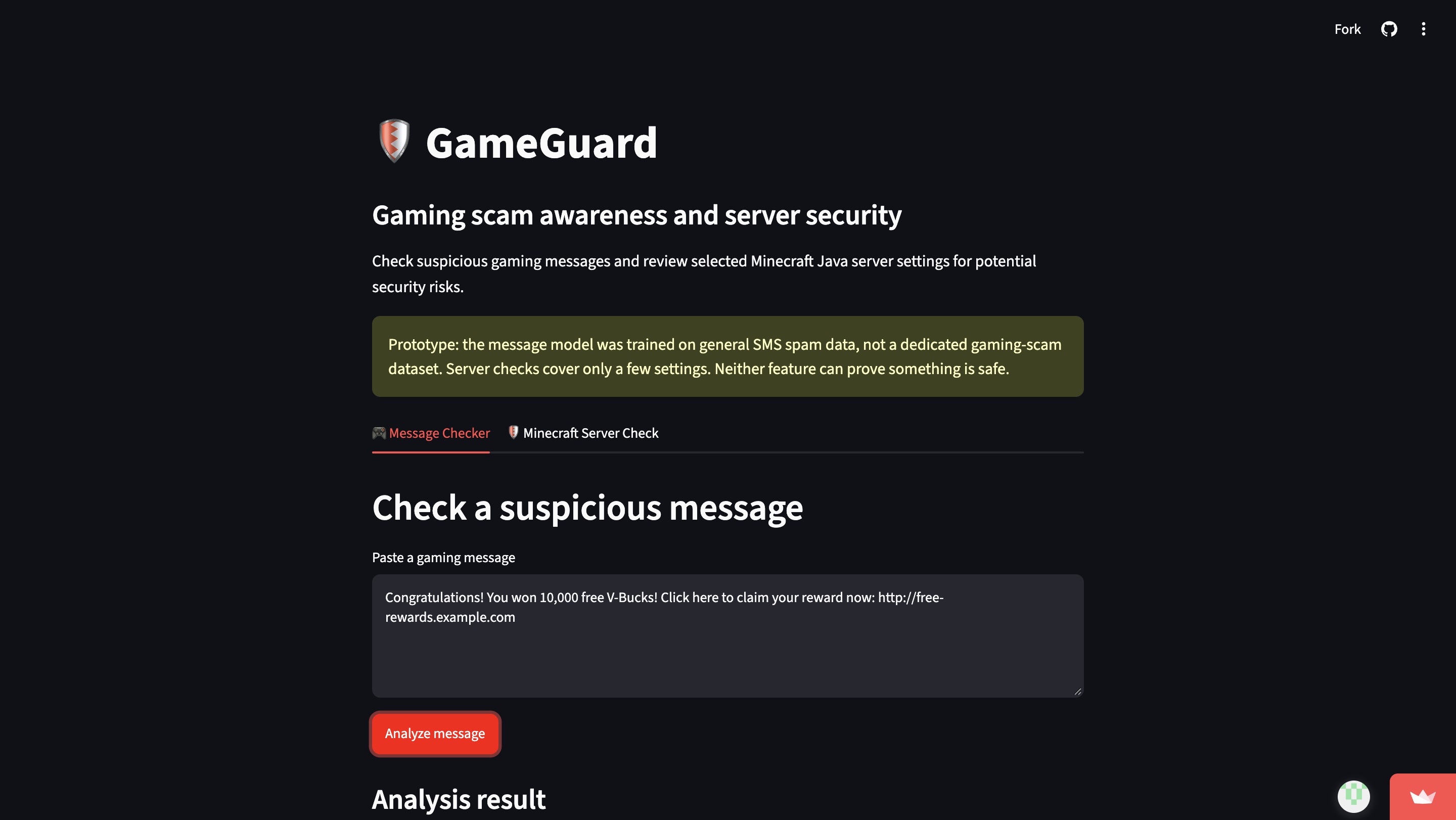
GameGuard detects spam-like language and warning signs in a fake gaming reward message, offering practical advice to avoid phishing links
-
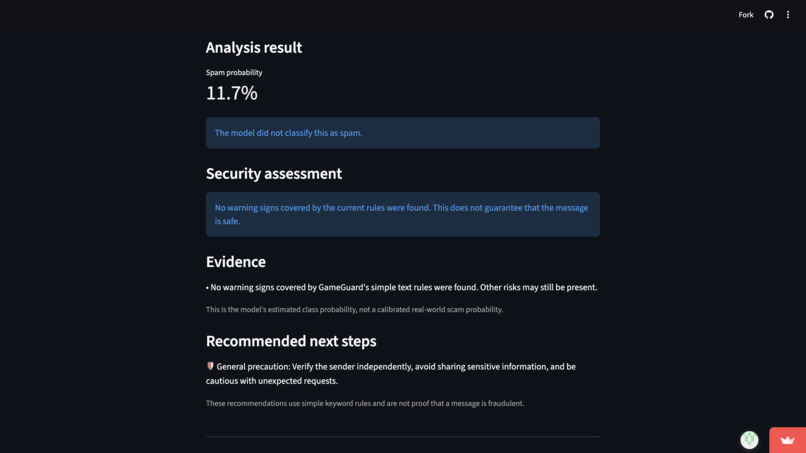
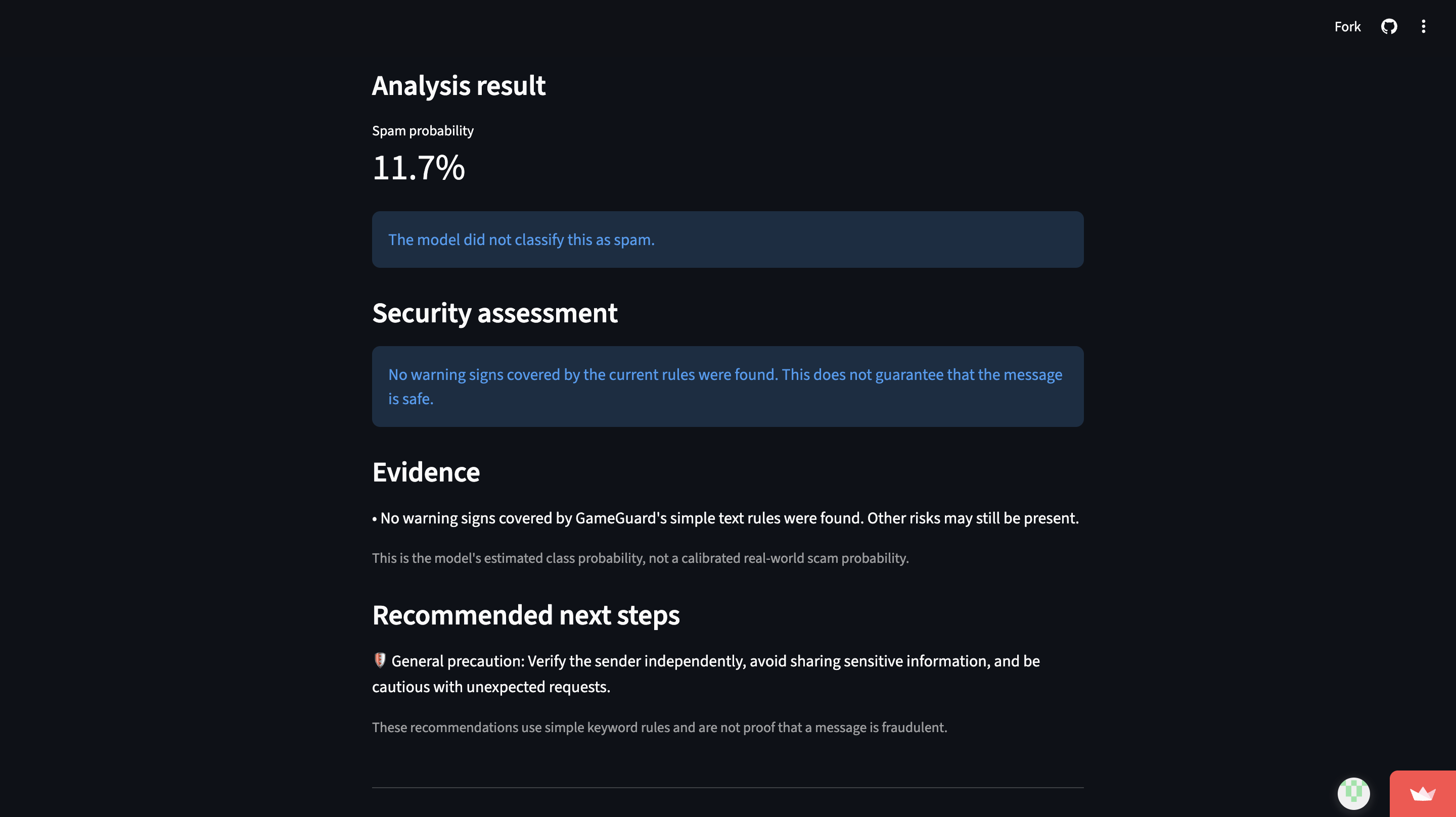
GameGuard reports an 11.7% spam probability for a normal gaming message and provides precautionary safety advice.
-
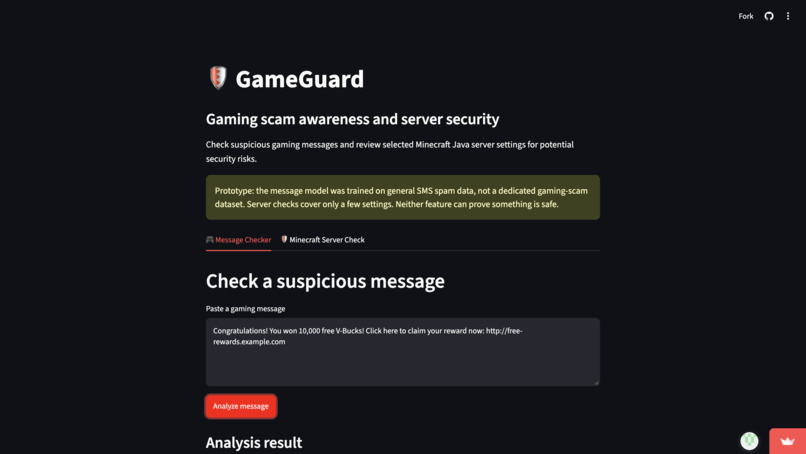
GameGuard analyzes a fake gaming reward message to identify potential spam signals and help players avoid phishing attempts.
-
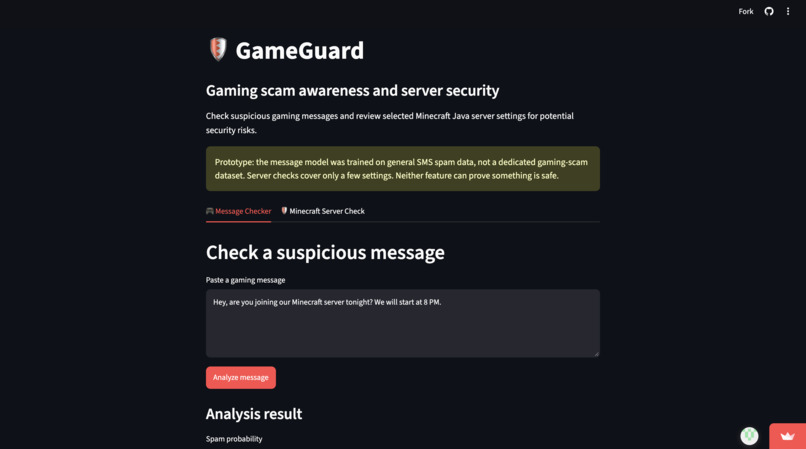
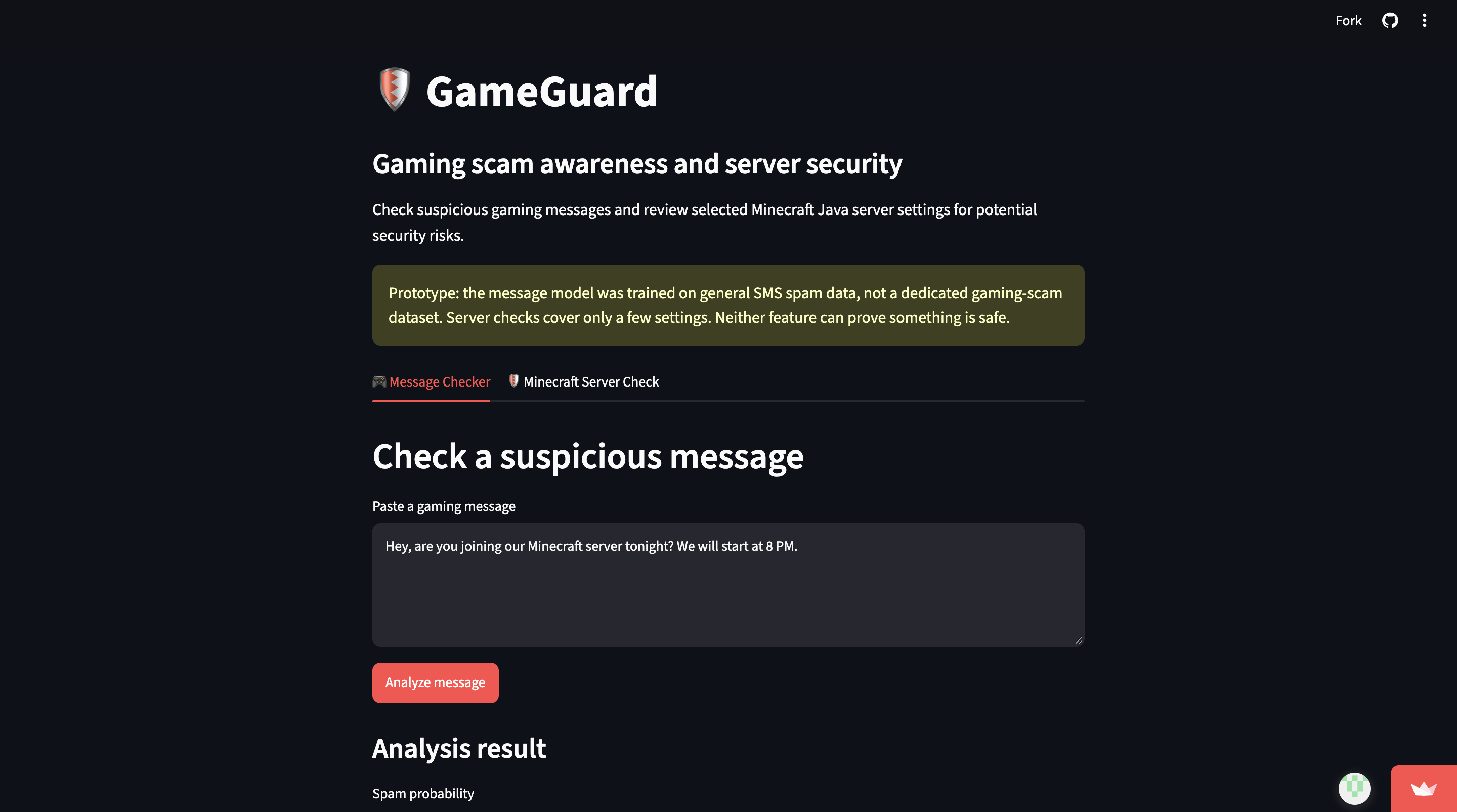
GameGuard analyzes everyday gaming messages to help players assess potential risks before responding.
-

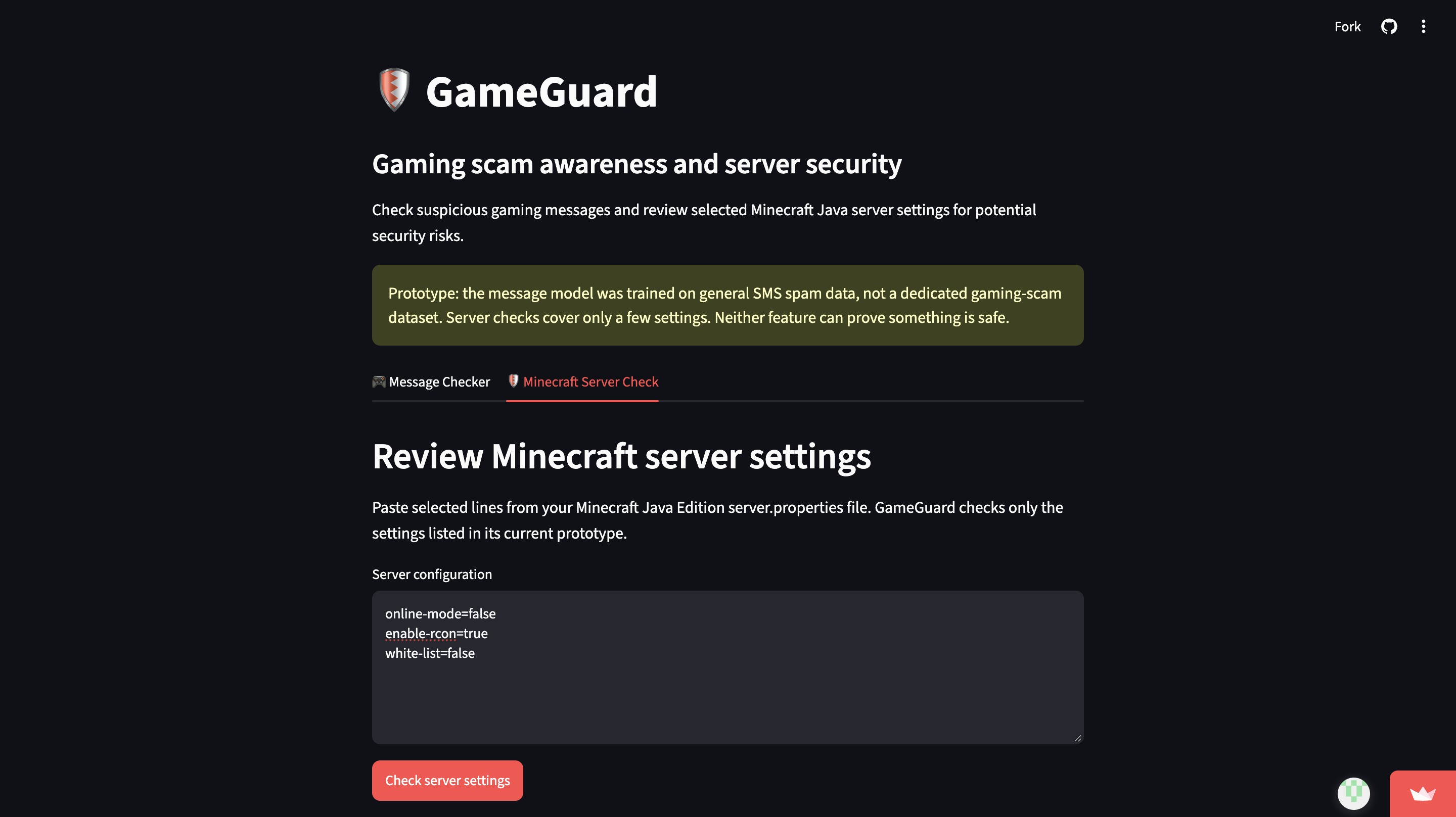
GameGuard audits Minecraft server settings, flagging offline authentication and enabled RCON as high-risk configurations.
-
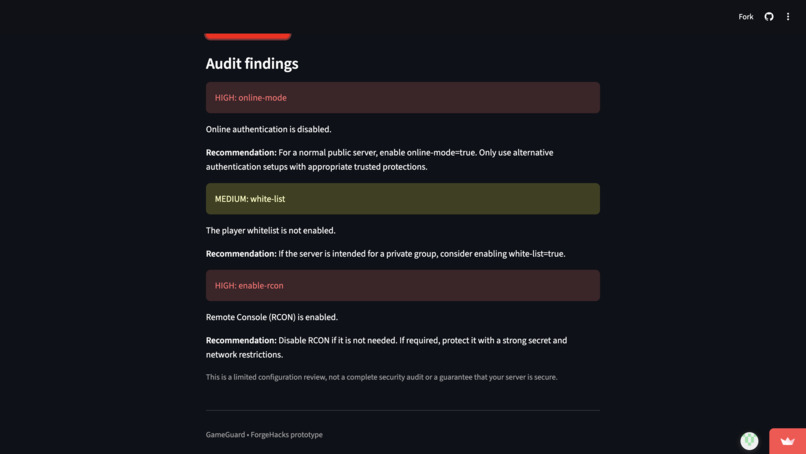
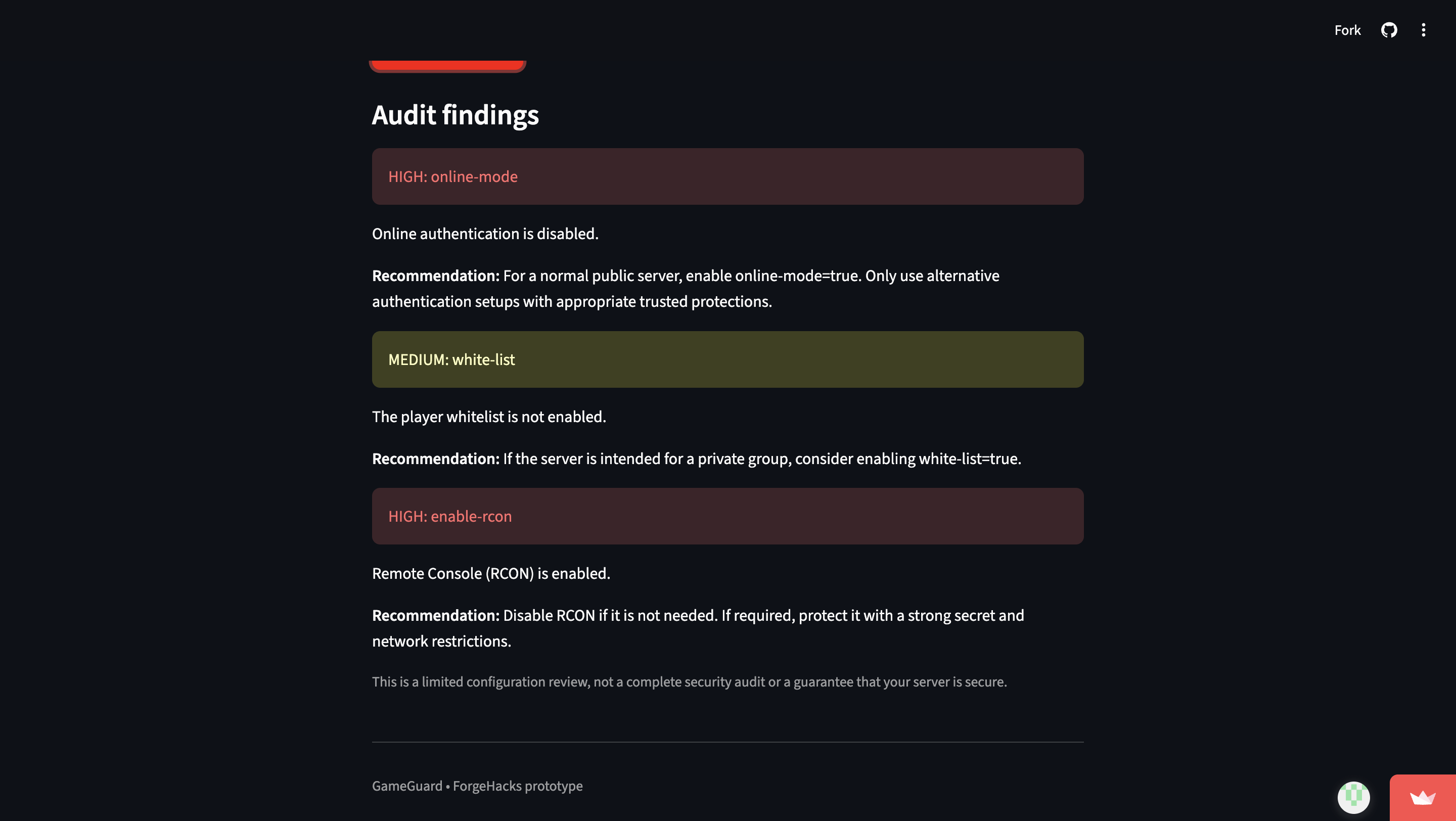
GameGuard identifies two high-risk and one medium-risk Minecraft server settings, with recommendations to improve server security.
Inspiration
We wanted to explore a cybersecurity problem that gamers can encounter in their everyday gaming experience. Messages promising free skins, threatening account bans, or asking for passwords and verification codes can pressure players into making unsafe decisions. We also noticed a gap in how we imagined security tools could work: players may have to leave their game and use a separate website to check a suspicious message. Our long-term idea is to bring security awareness closer to the moment a player encounters a potential threat.
What it does
GameGuard is a gaming-focused cybersecurity prototype with two working features:
Gaming Message Checker: A machine-learning model estimates whether a message resembles spam. GameGuard also highlights selected warning signs, such as suspicious links, urgent threats, requests for account credentials, and free-reward offers, then recommends safer next steps.
Minecraft Server Configuration Check: A rule-based checker reviews selected settings in a Minecraft Java Edition server.properties file and flags potential configuration risks.
The message model uses TF-IDF and Logistic Regression trained on the UCI SMS Spam Collection dataset. Because this is general SMS data rather than a dedicated gaming-scam dataset, its predictions are only preliminary indicators, not proof that a message is fraudulent or safe.
Our Vision: Security Inside the Game
The current version runs as a web application, but our intended direction goes further.
We want to explore an in-game security companion that could display a small warning when a player encounters a suspicious message or offer. Instead of requiring players to leave their game to investigate, it could explain the warning signs and suggest a safer action right where they play.
This is a future development goal. The current prototype does not monitor gameplay, intercept live in-game messages, or display actual in-game notifications. Integration would depend on the target game's supported interfaces and platform rules.
How we built it
We built the prototype in Python using Streamlit and scikit-learn.
For message classification, we used a TF-IDF text representation with Logistic Regression. We added transparent keyword-based checks to explain selected warning signs and provide practical safety recommendations.
For Minecraft server configuration, we implemented rule-based checks for selected settings, including online authentication, the player whitelist, and Remote Console (RCON).
We also experimented with a Random Forest model using the UCI Phishing Websites dataset. That experiment requires webpage-derived features and is not currently integrated as a scanner for arbitrary pasted URLs.
Challenges we ran into
One of our main challenges was finding a suitable dataset. General SMS spam data gave us a starting point for message classification, but gaming scams have their own language, platforms, and social context. We therefore had to be careful not to present our model as a fully validated gaming-scam detector.
Another challenge was distinguishing different types of security problems. Message classification and server configuration checks require different approaches, so we combined machine learning with explicit configuration rules.
We also had to decide how to communicate risk responsibly. A high model score should not be treated as a confirmed scam, and the absence of detected warning signs does not mean a message is safe.
Accomplishments that we're proud of
We are proud of turning our idea into a working, deployed prototype that combines machine learning with practical security checks in one application.
Built and deployed GameGuard: Created a working web application that users can access through a live link.
Implemented machine-learning message analysis: Trained a TF-IDF and Logistic Regression model on the UCI SMS Spam Collection dataset to identify spam-like language.
Made results more understandable: Added evidence explaining selected warning signs and tailored recommendations so users can better understand why a message may be suspicious.
Developed Minecraft security checks: Implemented rule-based checks for selected server configuration settings, including online authentication, whitelisting, and RCON.
Connected detection with practical guidance: Designed the prototype to go beyond a simple prediction by suggesting actions users can take to protect their accounts.
Built a foundation for our bigger vision: Established a working starting point for exploring security notifications directly within supported gaming environments in the future.
We are especially proud that GameGuard is transparent about its limitations. We want to build security tools that help people make more informed decisions rather than presenting uncertain predictions as facts.
What we learned
We learned how to build and deploy a small machine-learning application, connect model predictions to a user interface, implement rule-based security checks, and communicate the limitations of our methods.
Most importantly, we learned that building a useful cybersecurity tool involves more than producing a prediction. Users need understandable evidence, practical recommendations, and clear explanations of what the system can and cannot detect.
What's next for GameGuard
Our next goal is to investigate how GameGuard could move from a standalone web application toward an in-game security companion for a supported gaming environment. We also want to evaluate the message checker on more representative gaming-related data, improve its detection of game-specific scam patterns, and expand our security checks.
Our goal is to make security guidance easier for gamers to access without interrupting the experience they want to protect.
Built With
- language
- learning
- machine
- natural
- processing
- python
- scikit-learn
- streamlit

Log in or sign up for Devpost to join the conversation.