-
-
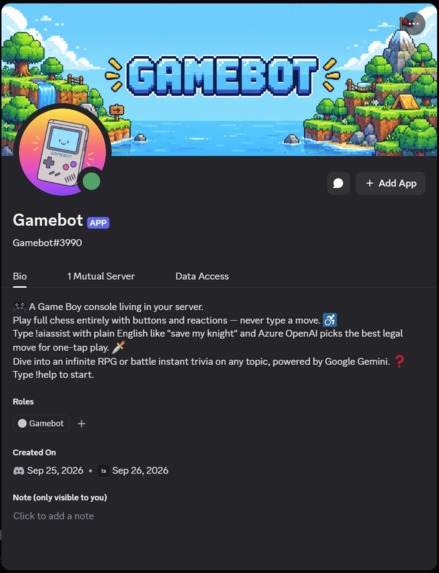
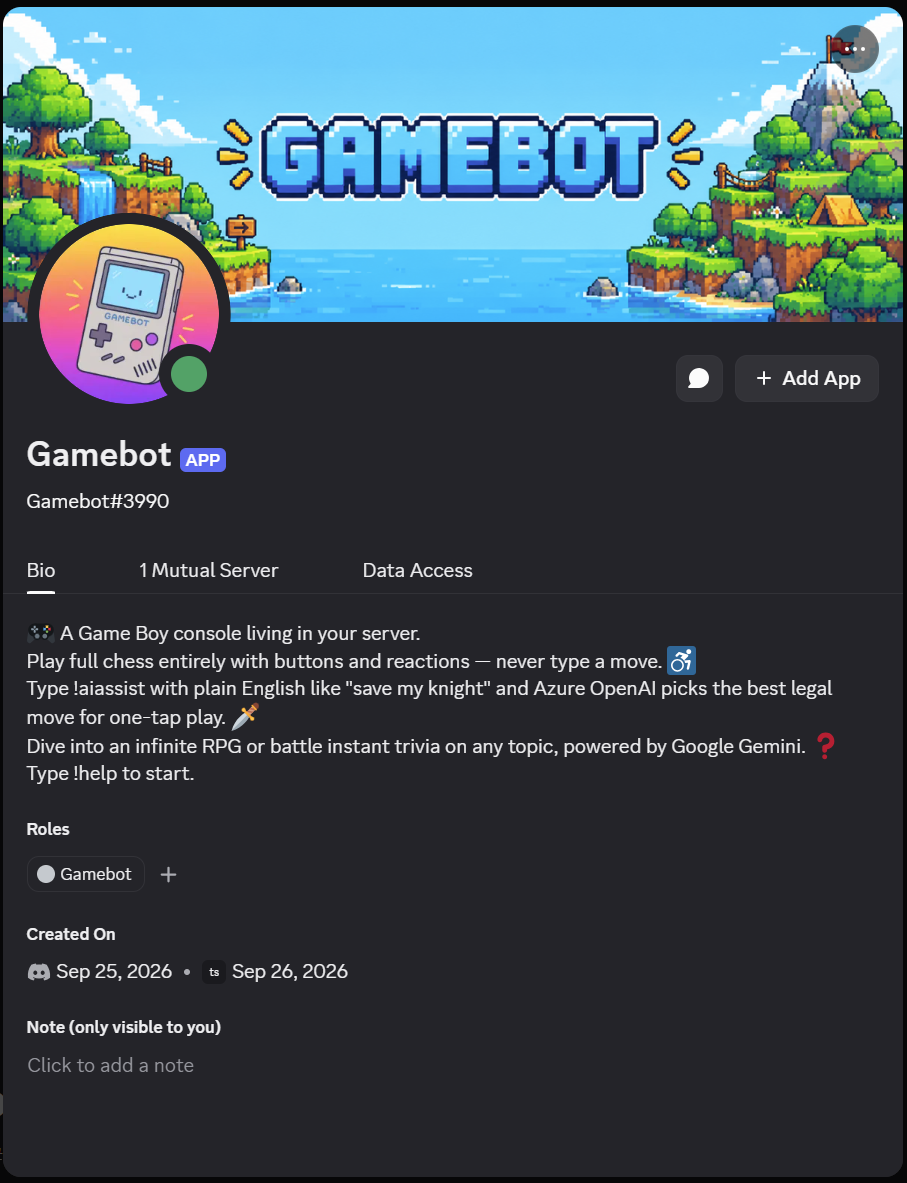
Gamebot Discord presence status and profile interface displaying localized virtual console firmware emulation branding indicators.
-
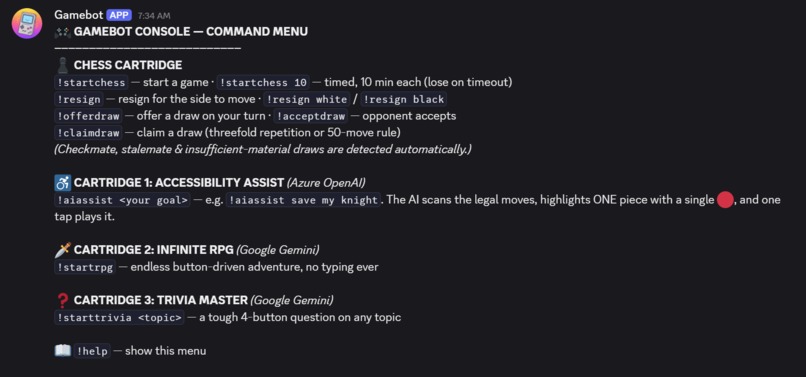
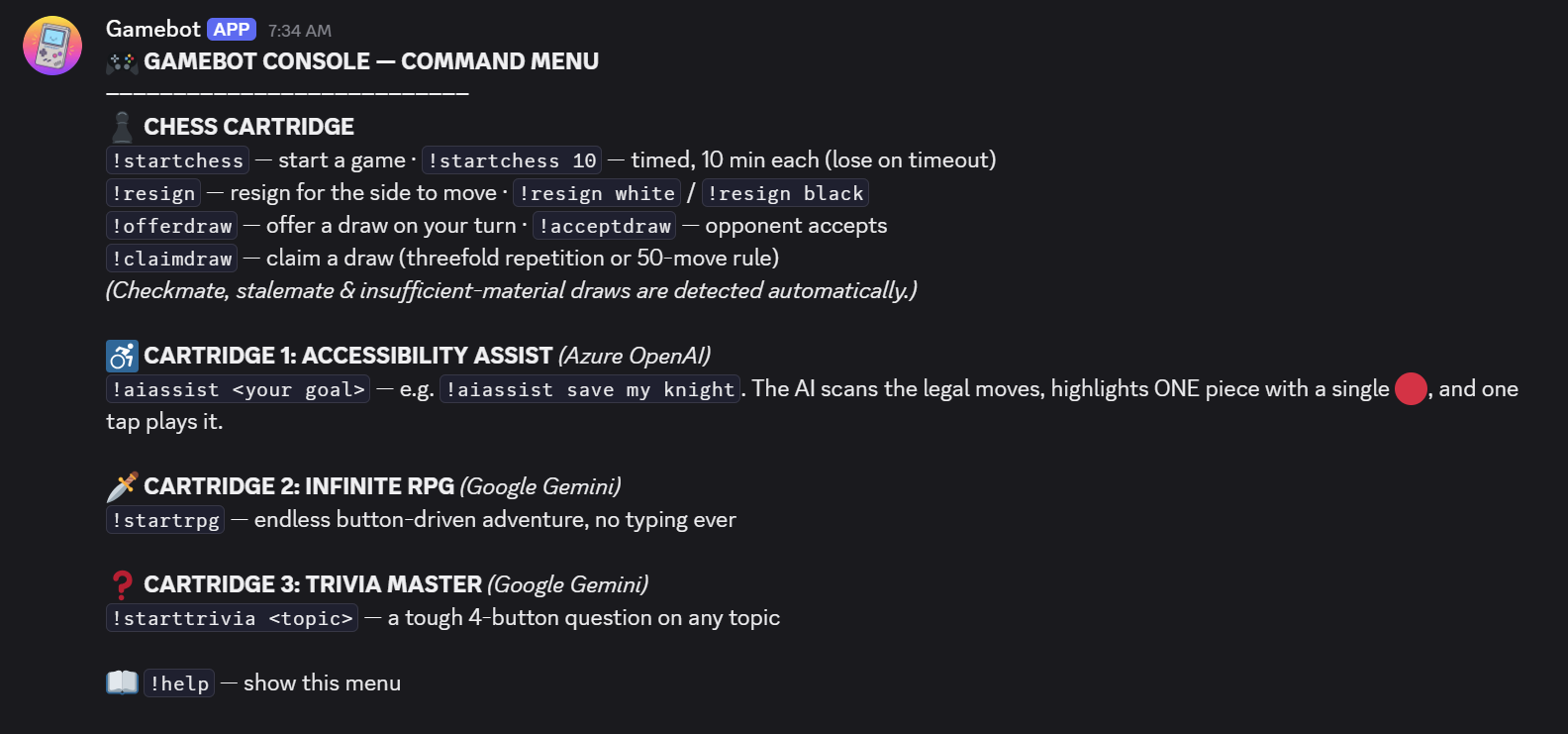
The central Gamebot hardware command matrix mapping modular game cartridge logic interfaces and multi-cloud AI accessibility routines.
Inspiration
Traditional digital tabletop games and grid-matrix strategies are functionally outdated and highly inaccessible inside community platforms like Discord. Forcing mobile users, people with motor difficulties, or visually impaired players to type precise chess notation strings or micro-click tight 8x8 spaces creates major input friction. Inspired by the tactile simplicity of the 1989 Game Boy, I set out as a solo hacker to build Gamebot—a physical, non-chatbot virtual console layer inside Discord that adapts complex coordinate systems and narrative text structures into massive, touch-friendly controller interfaces.
What it does
Gamebot functions as an interactive virtual console platform that loads three distinct, AI-powered game "cartridges" managed entirely through native UI button components and dynamic emoji reaction vectors:
- Adaptive Chess Engine: A rules-enforced board matrix where piece selection fires a backend scanner. It dynamically checks legal paths, clamping pawn reactions to their strict limits while dynamically opening slider paths up to 7 spaces.
- Infinite RPG Story Engine: An immersive, branching role-playing game where the narrative environment expands indefinitely based on player actions.
- Dynamic Trivia Master: A custom-themed quiz module capable of generating educational and pop-culture trivia challenges on any user-selected topic on the fly.
How I built it
Gamebot runs as a continuous background state-machine engine written in Python using the discord.py framework and a native python-chess backend core. The architecture is deployed as a highly advanced Multi-Cloud System split across two distinct AI provider endpoints:
- The Microsoft/Azure Accessibility Layer: When a player invokes natural language intent (e.g., "!aiassist protect my king"), the system targets a custom Azure OpenAI Service API endpoint. The model calculates the strategic vector intersection and outputs a strict mechanical coordinate: [\Delta x \cdot \vec{i} + \Delta y \cdot \vec{j}] This coordinate overrides the game loop, instantly disabling non-essential options and highlighting only that specific piece's 🔴 color circle target for a single-tap execution.
- The Google Gemini Structured Generation Core: Both the Infinite RPG and Trivia cartridges are powered by
gemini-3.8-flashusing the officialgoogle-genaiSDK. By enforcing strict JSON schemas viaresponse_mime_type="application/json", the system pipes language generation directly into physical, reactive Discord UI buttons. The user navigates entirely through hardware inputs, maintaining a strict non-chatbot environment.
Challenges I ran into
As a solo developer handling the entire stack, my biggest engineering roadblock was managing Discord's structural reaction-caching state latency. When I shifted tracking frames from vector arrow selections to dynamic numeric step limits, Discord's client API kept locking stale emojis on the user's screen, showing invalid numbers for restricted pieces. I successfully resolved this lifecycle bug by restructuring the message loop to forcefully execute await control_msg.delete() sequences. This forced the Discord client UI layer to drop old cached data footprints instantly, allowing the dynamic rules engine to refresh options cleanly.
Accomplishments that I'm proud of
- Breaking the Chatbot Paradigm: Fully implementing generative AI endpoints (Azure OpenAI and Gemini 3.8) into a complex application without relying on a single conversational text window, satisfying the core hackathon mandate.
- Solo Execution: Architecting a fully functional, low-latency multi-cloud pipeline, managing state data syncs, and mapping abstract semantic intents down to exact mechanical grid matrix coordinates completely independently.
- UI Responsiveness: Overcoming platform UI updates and emoji limitations to engineer a rapid-fire, reactive handheld console experience inside a standard text channel layout.
What I learned
I mastered the practical execution of strict JSON schema validation pipelines over low-latency multi-cloud networks. More importantly, I learned how to decouple generative AI models completely from standard text streams, proving that large language models can be mapped as direct mechanical inputs for accessible UX frameworks.
What's next for Gamebot: Adaptive UI AI Console Engine
The next step for Gamebot is expanding its hardware abstraction layer. I plan to introduce a custom Webhook socket matrix to connect the backend directly to external physical input devices (such as adaptive switches or eye-tracking arrays). Additionally, I want to engineer a multiplayer synchronization layer on the cloud VM to support cross-server tournament lobbies, establishing Gamebot as a premier open-access gaming utility for communities worldwide.


Log in or sign up for Devpost to join the conversation.