-
-
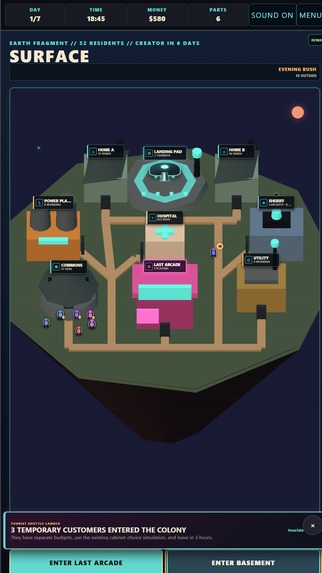
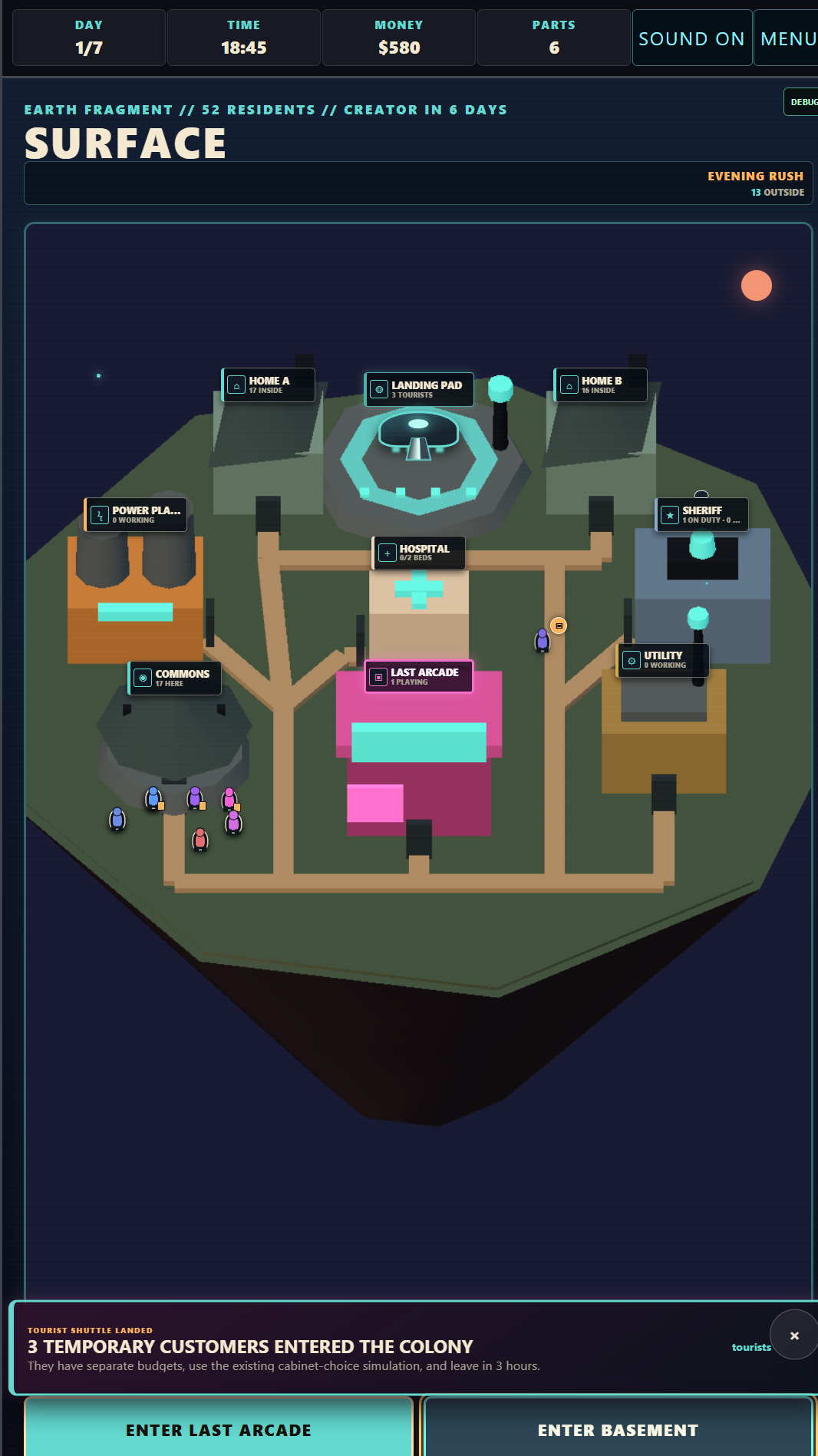
Surface visitors.
-
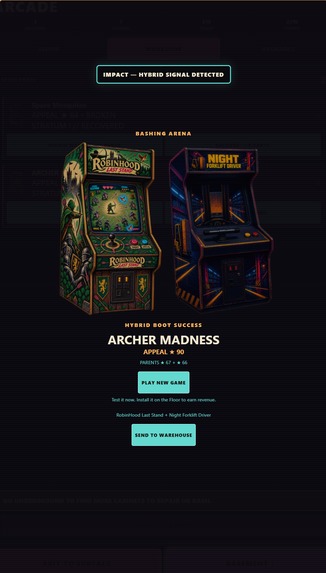
Game Bashing started
-
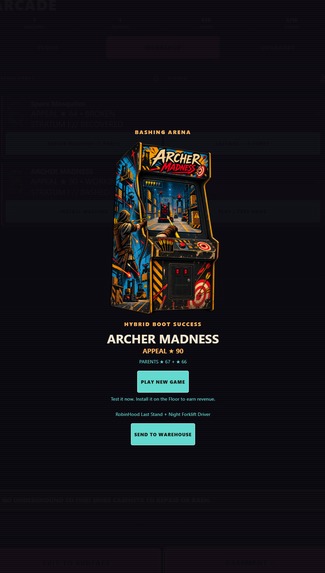
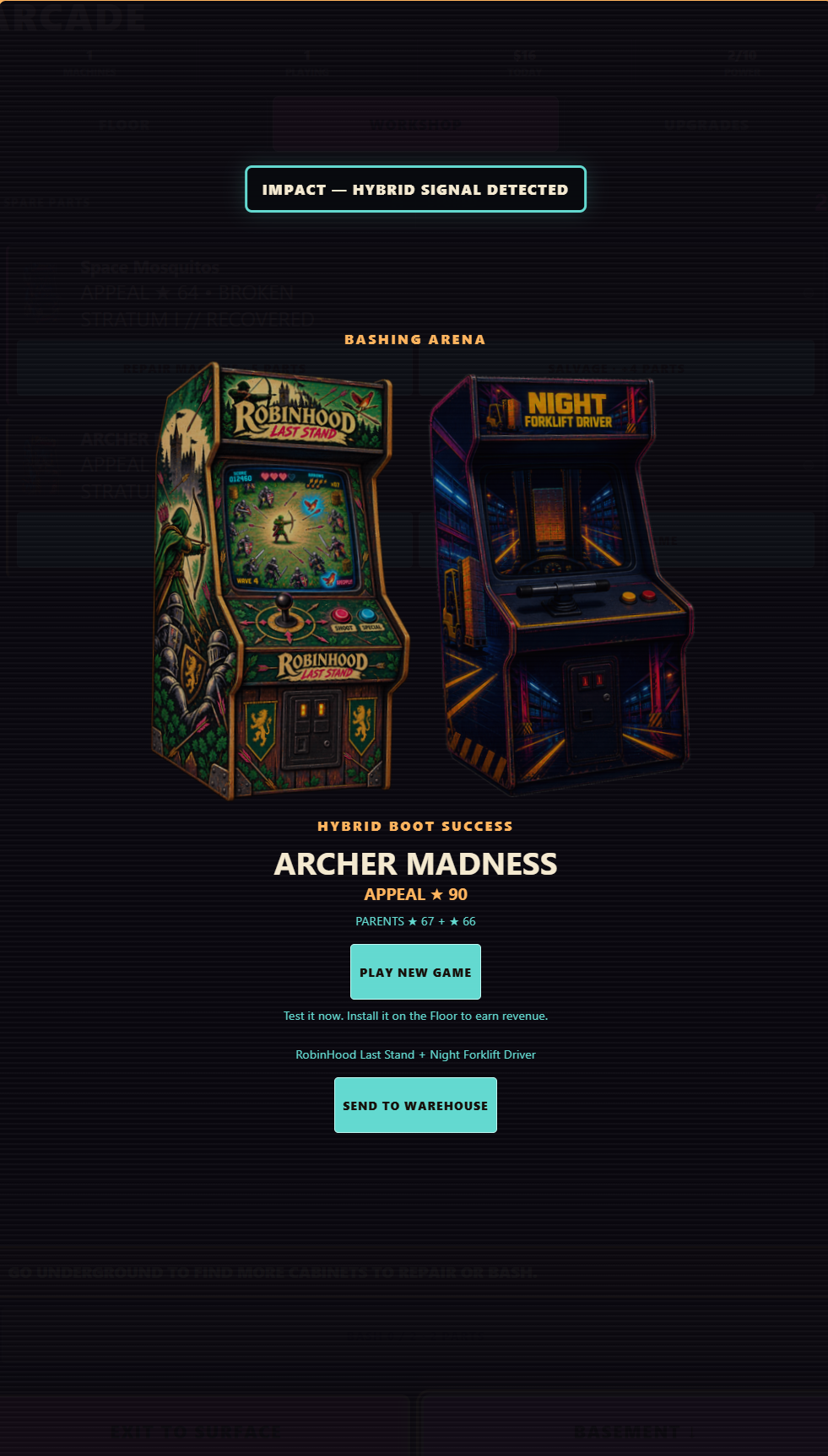
Result of Game Bash
-
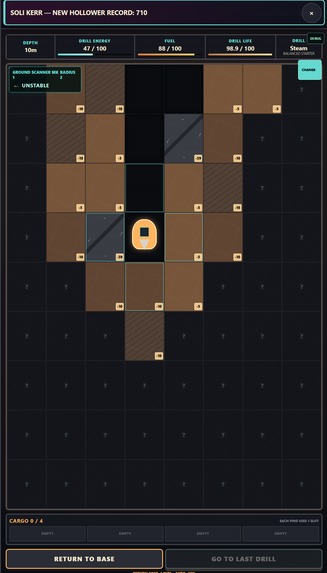
Digging for ancient cabinets
-
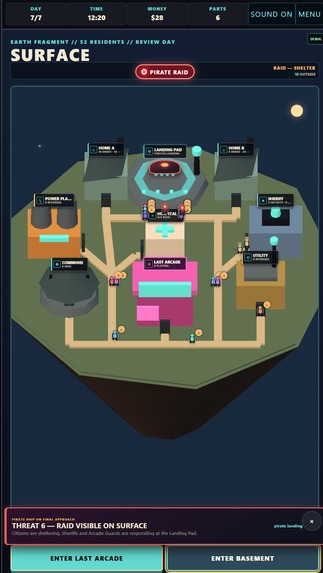
Pirate raid
-
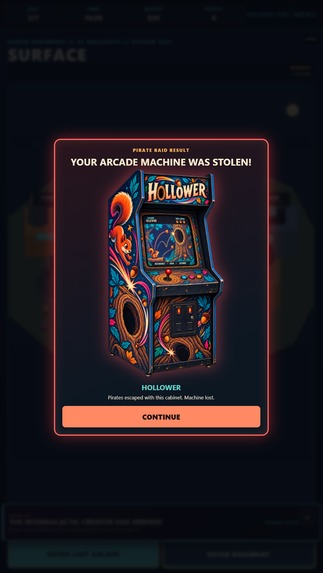
Stollen cabinet
Inspiration
GameBash started with one idea: what if old video games could be treated like archaeological artifacts?
Instead of simply collecting retro machines, I wanted the player to dig them out of the ground, repair them, salvage them, or physically smash two games together to create a completely new playable hybrid.
That became the core identity of the project:
DIG. FIND. BASH. PLAY. SURVIVE.
The game is set in the far future, on one of the last surviving fragments of Earth. A small community lives around the last great arcade, while forgotten games from previous centuries remain buried underground.
The first archaeological layer is inspired by the visual language and mechanical simplicity of 1970s arcade games, while using original game concepts, names, art, and mechanics.
What it does
GameBash is a Survival & Resource Management game built around a playable arcade.
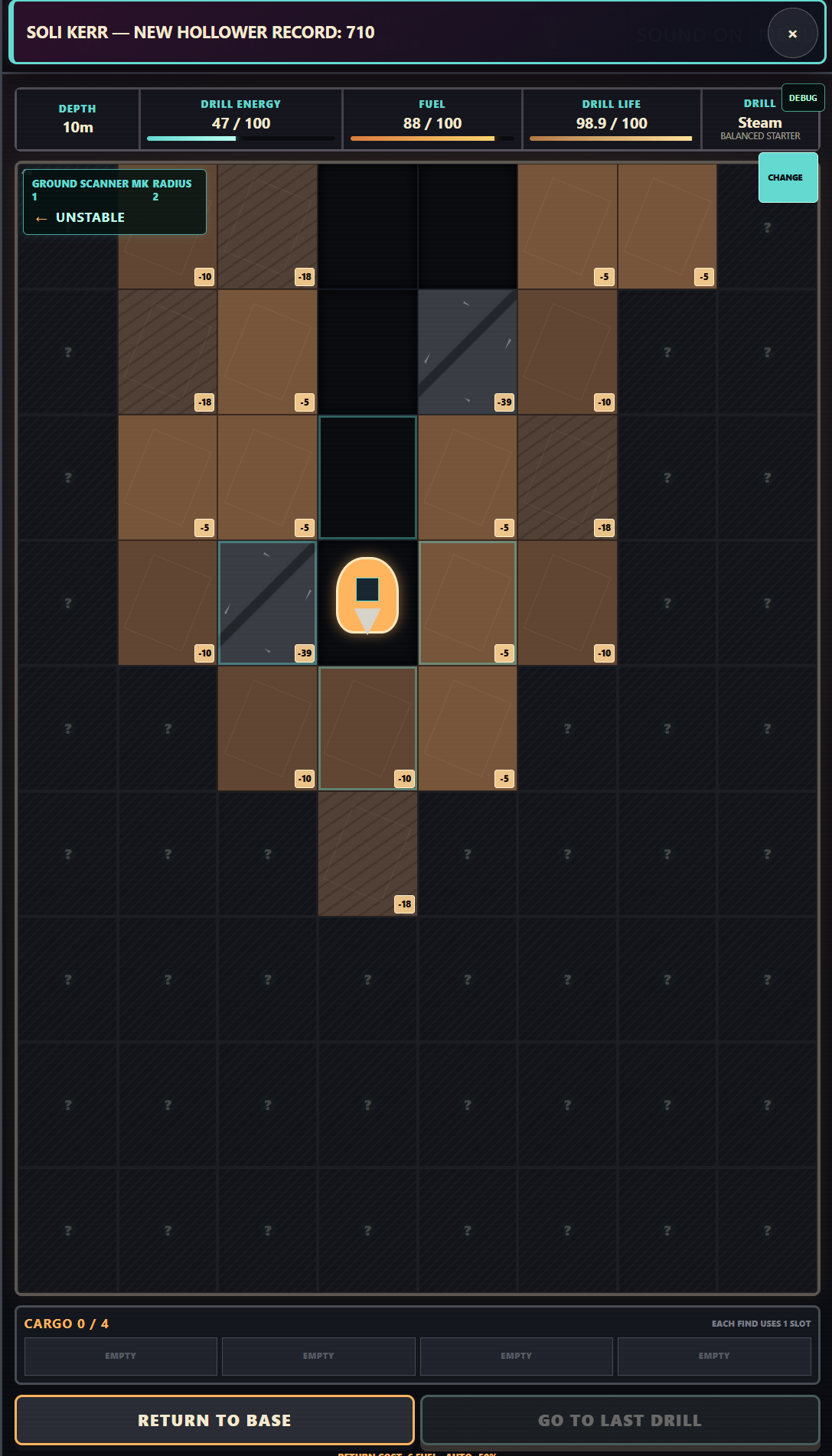
The player controls an excavation machine underground, managing Fuel, Drill Energy, Drill Life, drill technology, and the risk of travelling too far to return safely.
Recovered arcade cabinets can be:
- REPAIRED using Spare Parts;
- SALVAGED for resources;
- BASHED together to create new games.
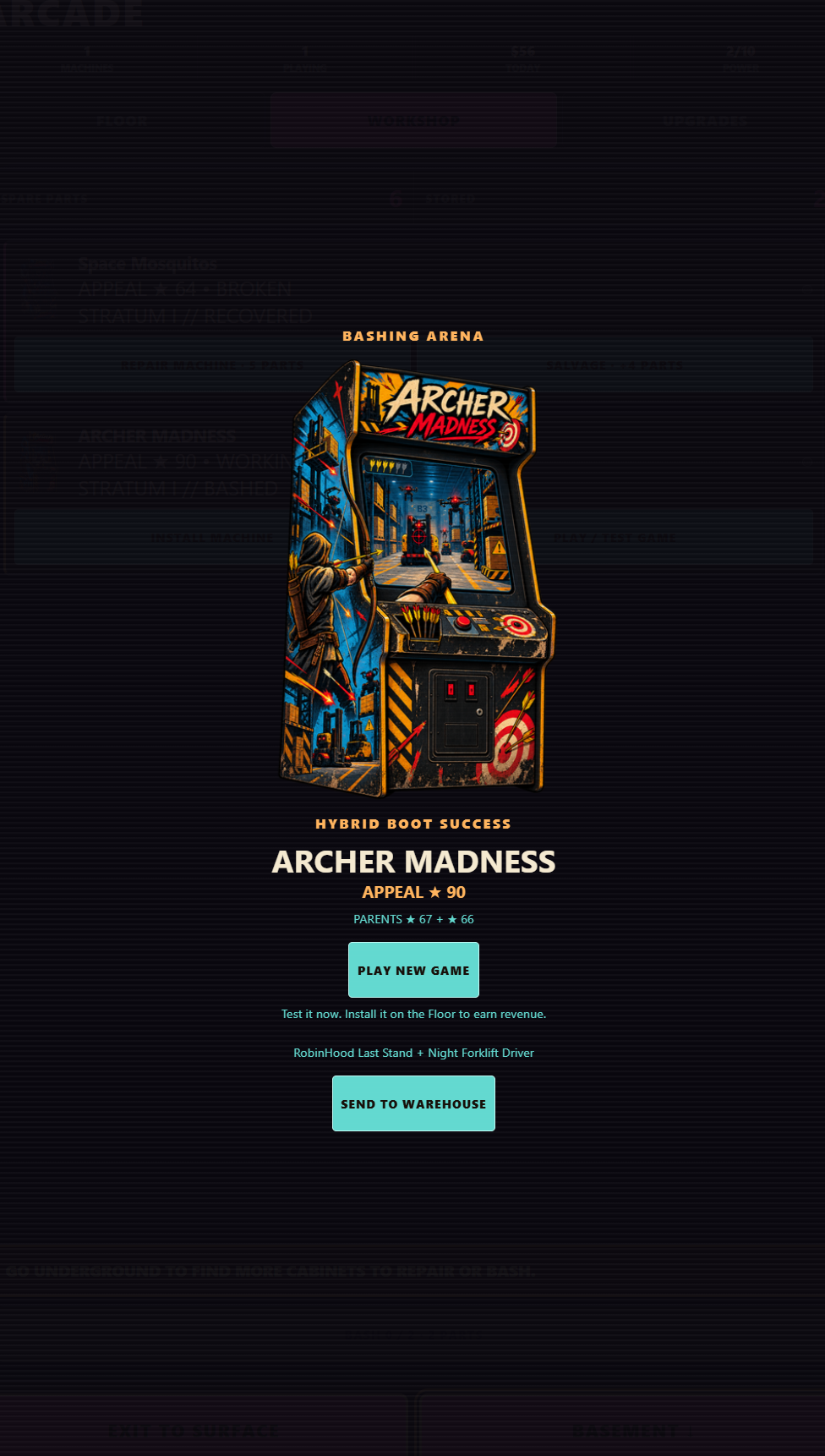
BASH is the central mechanic. Two base arcade games are physically smashed together in the Workshop, producing a genuinely playable hybrid.
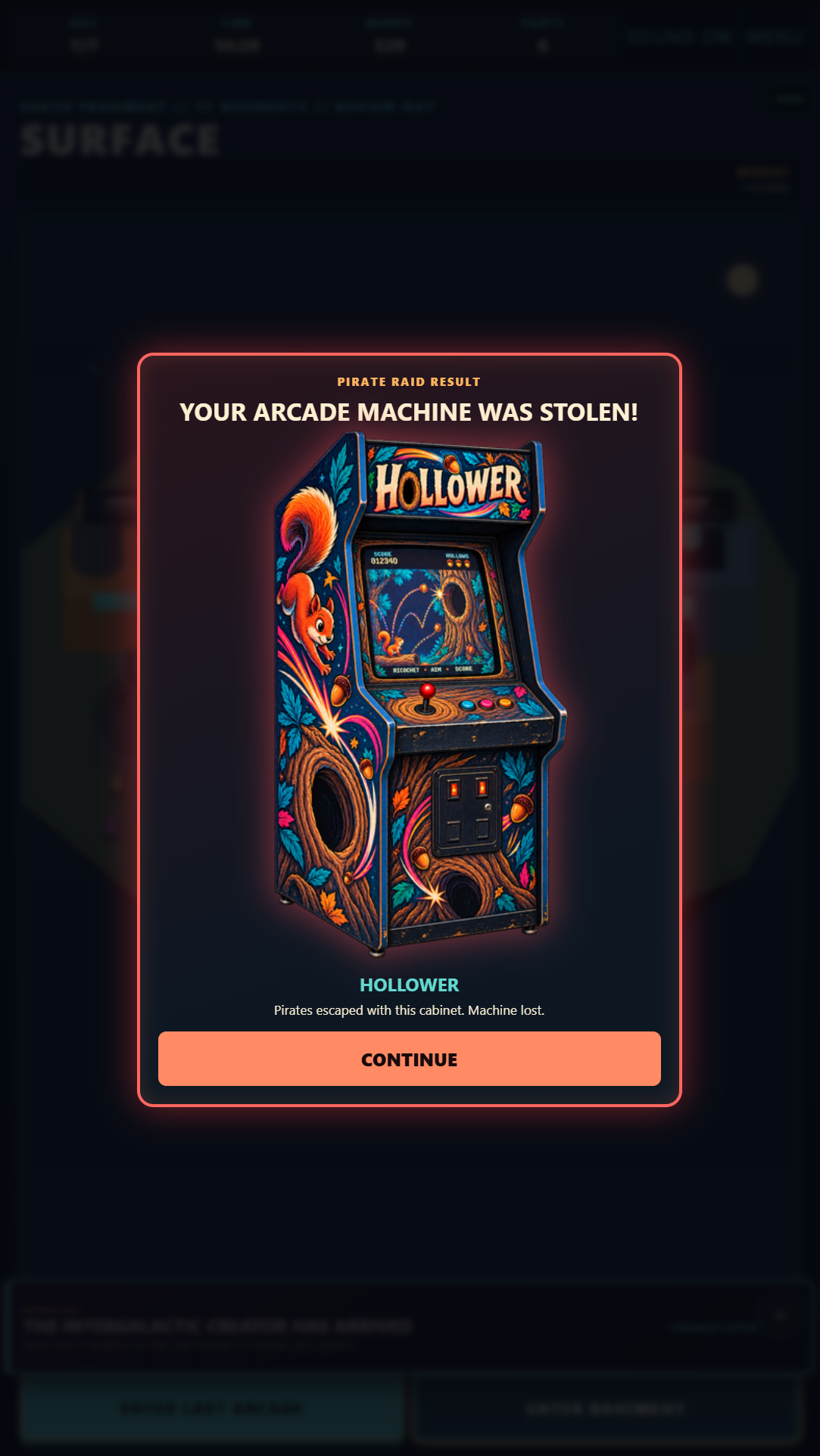
For example, Hollower is a paddle-style game about bouncing an acorn into a tree hollow, while Space Mosquitos is an arcade shooter about fighting alien mosquitoes. BASHING them creates Flathead Squirrel in Space, which combines mechanics and ideas from both games.
The current prototype contains:
- 7 base arcade games
- 21 unique BASH combinations
- 28 playable games in total
Every working cabinet can be played directly by the player.
Residents and tourists also play the machines and set high scores. If the player beats a record, the machine gains Hype, increasing visitor interest and its earning potential.
The Arcade economy includes:
- Money;
- Spare Parts;
- Power Capacity;
- cabinet slots;
- Guards;
- Surface defence;
- drill and Fuel upgrades.
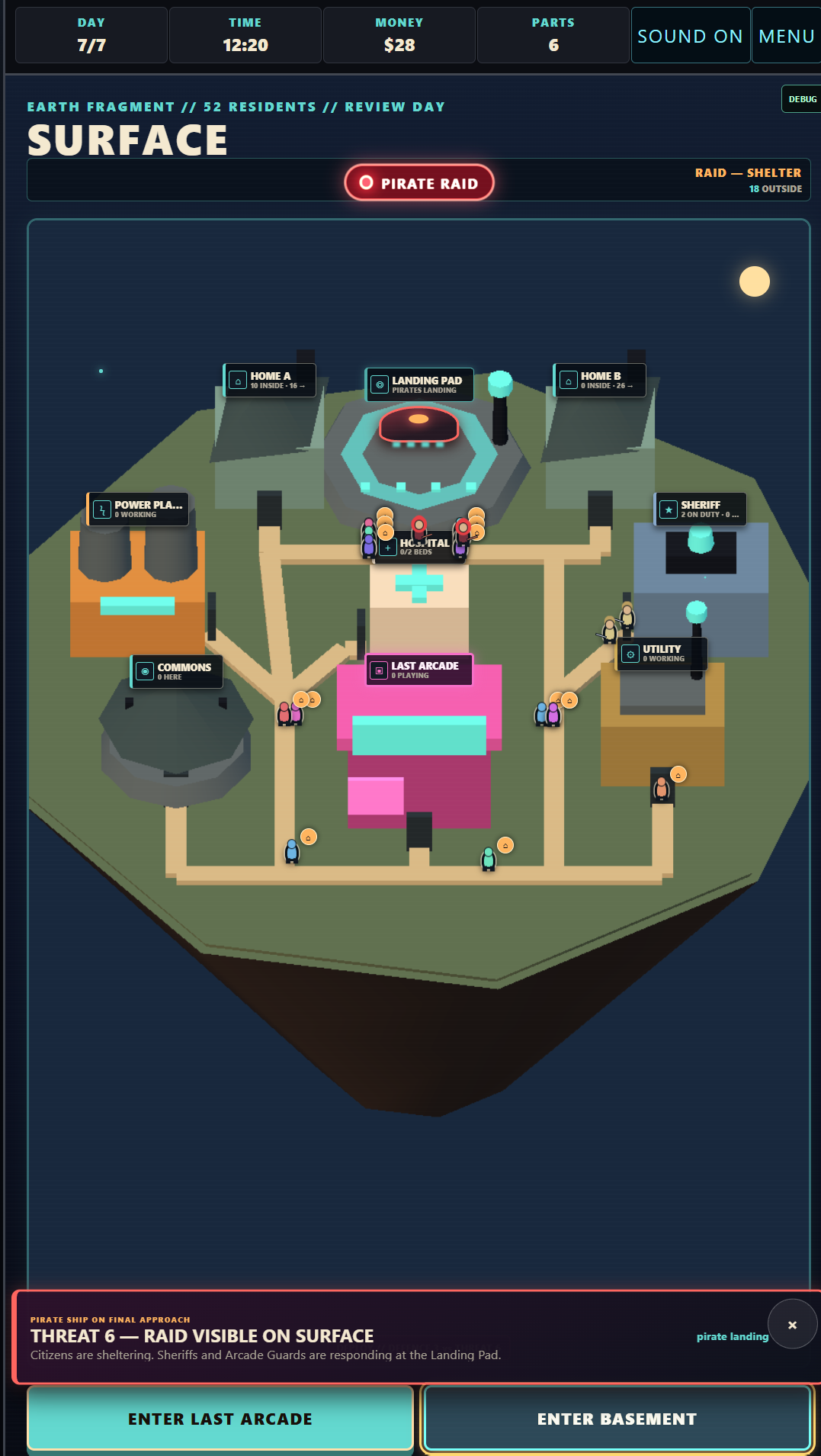
Pirates periodically attack, hurt customers, and steal valuable cabinets. Weak defence can allow several machines to be stolen during one raid.
Every seven days, an alien influencer with 180.4 billion followers visits the Arcade and reviews it. A terrible review can end the run, while a five-star review turns the Arcade into a famous destination and unlocks further expansion.
How we built it
GameBash is a fully offline HTML5 game built primarily with JavaScript, HTML, CSS, Canvas, Three.js, and the Web Audio API. The game was built in ChatGPT Work.
The project was developed with an AI-native workflow. AI agents were used extensively for:
- game design iteration;
- implementation;
- debugging;
- automated testing;
- balancing analysis;
- procedural audio;
- artwork generation;
- asset optimization;
- build tooling.
The game was developed modularly, with individual systems and minigames separated during development.
For the competition build, all first-party game code is assembled into a single readable, unminified index.html. Third-party Three.js files remain local inside /vendor.
The final game makes zero external runtime requests and can be played completely offline.
A custom build pipeline creates the contest ZIP, checks the size limit, stages only required runtime assets, and validates the final package.
The final submission build is approximately 10.34 MiB, well below the 35 MB competition limit.
Challenges we ran into
The biggest challenge was connecting direct arcade gameplay to a meaningful management economy.
Early versions risked becoming a collection of separate systems: mining, management, minigames, infrastructure, and pirate attacks. We repeatedly simplified and reworked the design so that the main loop stayed focused on arcade machines.
The key breakthrough was making player performance matter economically:
PLAY → BEAT A HIGH SCORE → HYPE → MORE INTEREST → MORE REVENUE
Another challenge was making BASH more than a cosmetic crafting system. Each hybrid had to be a real playable game rather than just a new cabinet skin or stat combination.
The Underground also required several iterations. Fuel, Drill Energy, Drill Life, drill material tiers, Scanner information, Fuel Tank upgrades, and return risk all had to remain understandable on a small portrait screen.
Mobile performance created additional problems, especially when final cabinet artwork was added. Arcade screens initially became slow due to repeated image decoding and DOM rebuilding. The rendering path was later optimized to reuse loaded assets and avoid unnecessary rebuilds.
Other challenges included:
- persistent Underground generation;
- mobile touch controls across very different minigames;
- multi-touch input;
- pirate raid choreography;
- cabinet theft during active gameplay;
- UI/fog/rendering layer conflicts;
- balancing 28 playable games inside one shared host;
- keeping the entire game offline and below the submission size limit.
Accomplishments that we're proud of
The biggest accomplishment is that the central idea actually works:
two games can be BASHED into a third game, and that third game is genuinely playable.
The prototype currently contains all 21 possible two-game combinations from seven base games, giving the project 28 playable arcade games.
We are also proud that the minigames are not disconnected bonus content. Player skill directly affects the larger simulation through high scores, Hype, visitor behaviour, and revenue.
Other accomplishments include:
- a persistent procedural Underground;
- 32 discoverable base cabinets per generated map;
- randomized Underground seeds for each new run;
- multiple drill technologies and deep rock progression;
- an Arcade populated by simulated residents and tourists;
- visible pirate raids with Guards, theft, ships, and evacuation;
- multi-week progression;
- an influencer review system with failure and five-star success states;
- fully procedural runtime audio;
- a fully offline final build;
- a final ZIP of only about 10.34 MiB;
- a full automated test suite with zero failures, zero skipped tests, and zero build warnings in the final development pass.
What we learned
The most important lesson was that adding systems is much easier than making them reinforce one another.
GameBash became much stronger when every major feature was connected back to the arcade machines.
Mining provides machines.
BASH transforms them.
The Arcade turns them into an economy.
Playing them improves that economy.
Pirates threaten what the player has created.
The influencer gives the player a clear long-term goal.
We also learned the value of stopping AI agents when architecture problems appeared instead of allowing them to silently work around them. Several systems — including shared minigame controls, persistent game progress, multi-touch input, and raid state — improved because implementation paused and the underlying shared architecture was corrected first.
Finally, building for a strict offline and mobile environment forced us to treat performance, asset size, input, and state cleanup as core design constraints rather than final polish.
What's next for GameBash
The current prototype focuses on the earliest archaeological layer: games inspired by the 1970s.
The larger vision is to let players dig through progressively newer eras of game history.
Future archaeological strata could introduce new base-game archetypes from:
- the early 1980s;
- late 1980s;
- 1990s;
- later generations.
Each new base game would create additional BASH possibilities, expanding the combinatorial game library.
Future versions could also include:
- larger settlements;
- additional Earth fragments;
- more complex Arcade expansion;
- more visitor types;
- deeper citizen simulation;
- additional pirate factions and threats;
- new forms of defence;
- new excavation environments;
- more elaborate hybrid-generation rules.
The long-term goal is for the player to rebuild a culture around forgotten games while gradually transforming the last Arcade into one of the most important destinations in the surviving human world.


Log in or sign up for Devpost to join the conversation.