-
Home
-

Share options
-
Comparative
-
Result

Inspiration
Finding the perfect place to live is often a battle—a game of thrones, if you will—where you must balance budget, lifestyle, and amenities.
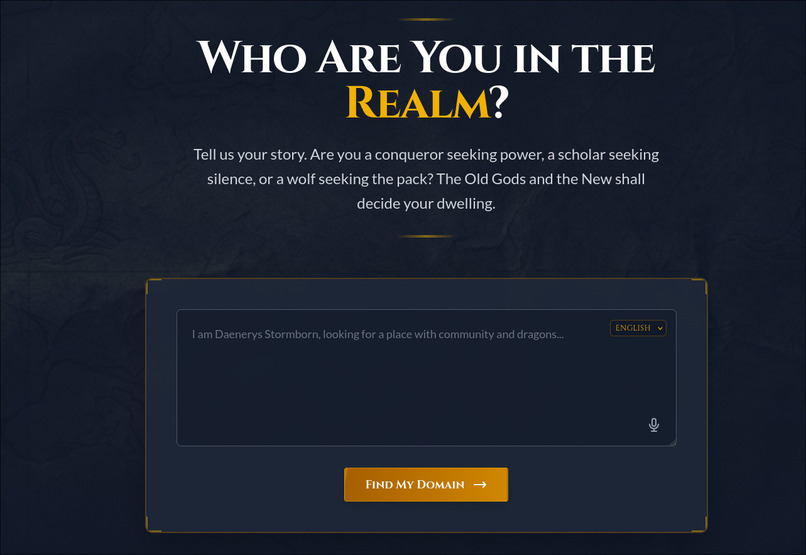
Inspired by the rich, character-driven world of Game of Thrones, we wanted to make this process fun, immersive, and intuitive. Instead of checking ordinary boxes, what if you could find a neighborhood that fits your character?
Whether you're a Night’s Watch introvert seeking quiet or a Tyrell socialite craving gardens and high society, our goal was to build a tool that understands the vibe of a place, not just its statistics.
What It Does
Game of Neighborhoods is an intelligent recommendation engine that matches your personality (or a fictional character’s profile) to real-world neighborhoods in Barcelona, and eventually beyond.
How it works:
Profile Analysis
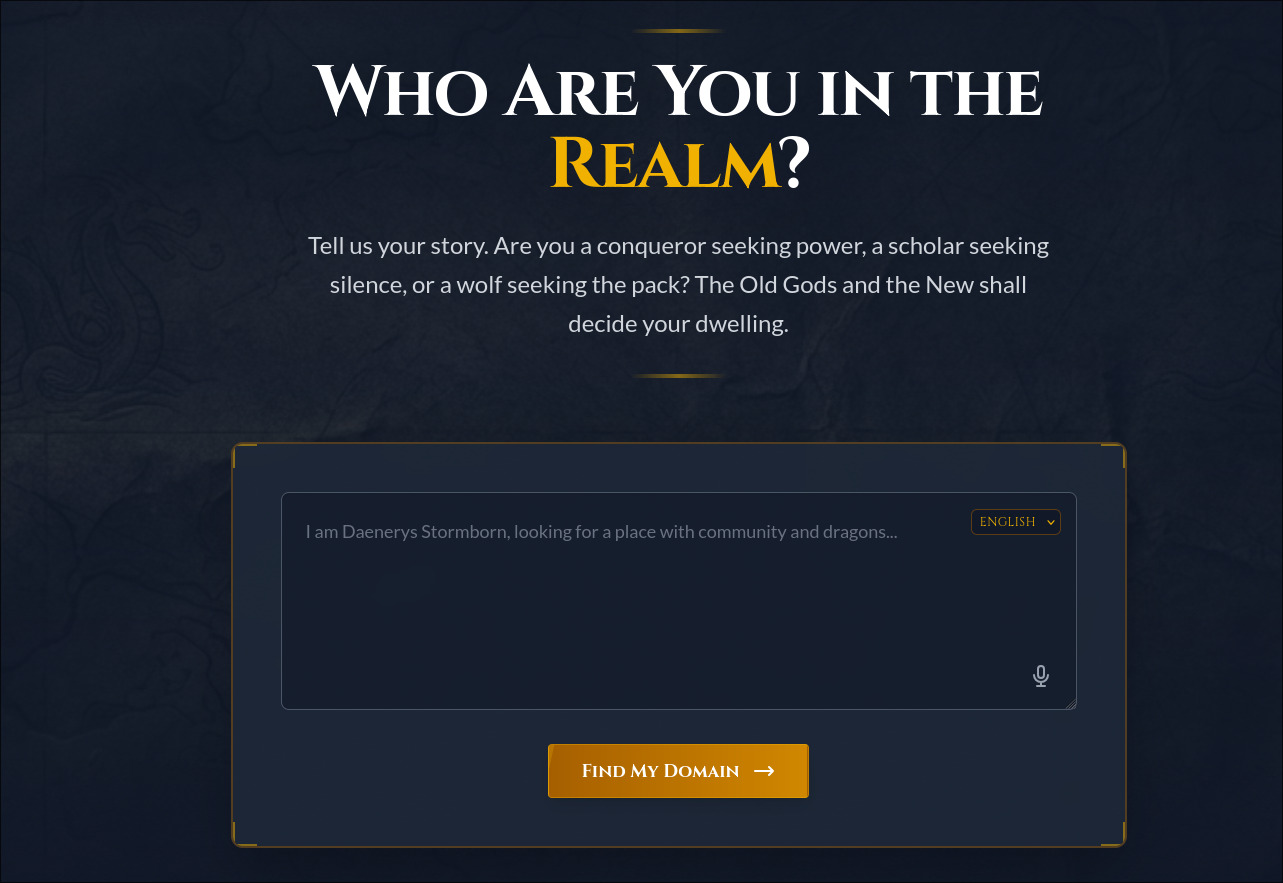
You describe yourself or choose an archetype. Our AI (Gemini) extracts key Interests and KPIs such as Nightlife, Green Spaces, or Safety.
Smart Mapping
These interests are translated into concrete OpenStreetMap tags.
For example, “Nightlife” becomes amenity=pub or amenity=bar.
Real-Time Scouting
The system queries the Overpass API to count actual amenities present in candidate neighborhoods.
The Verdict
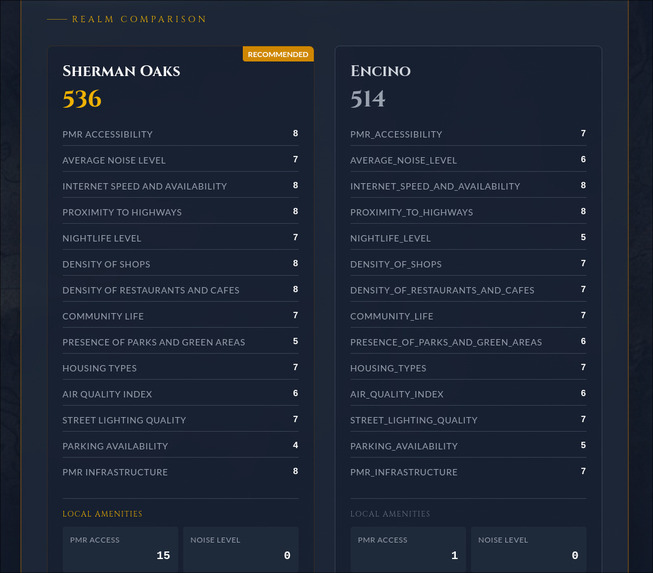
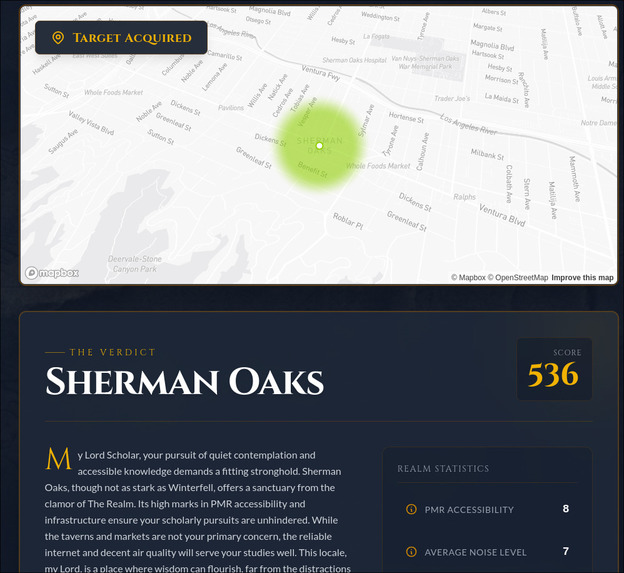
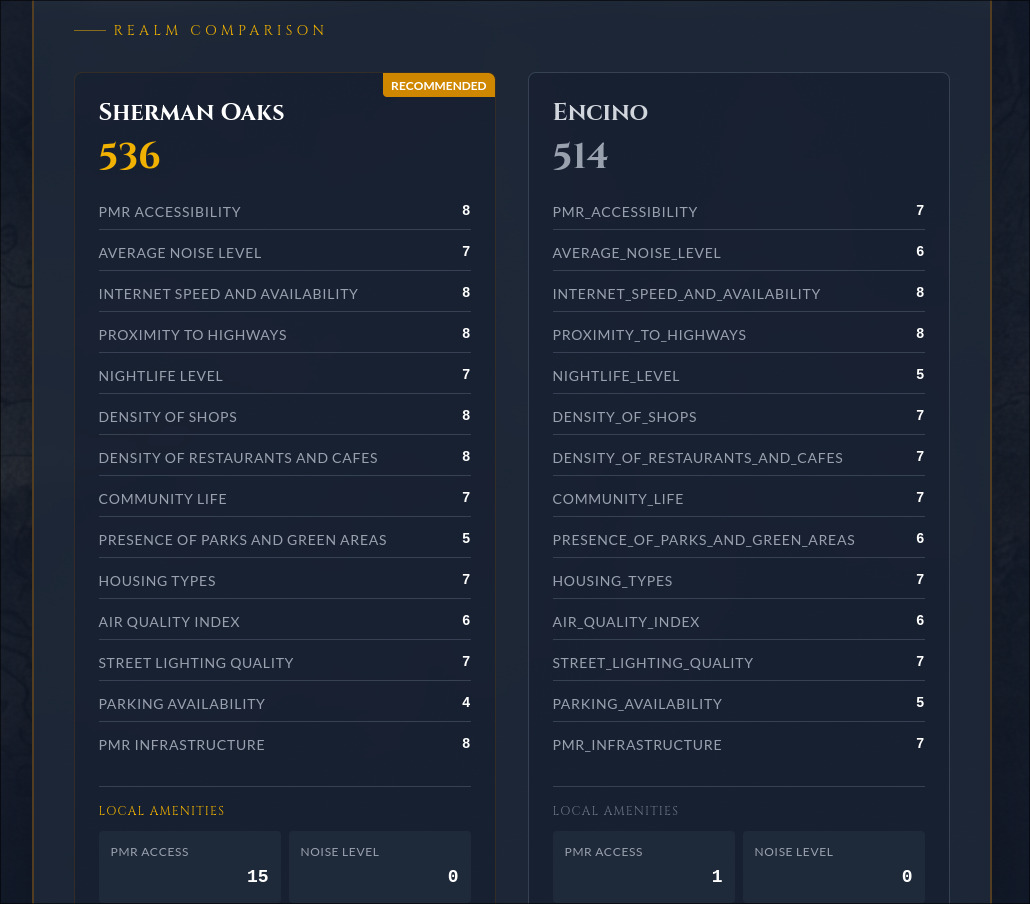
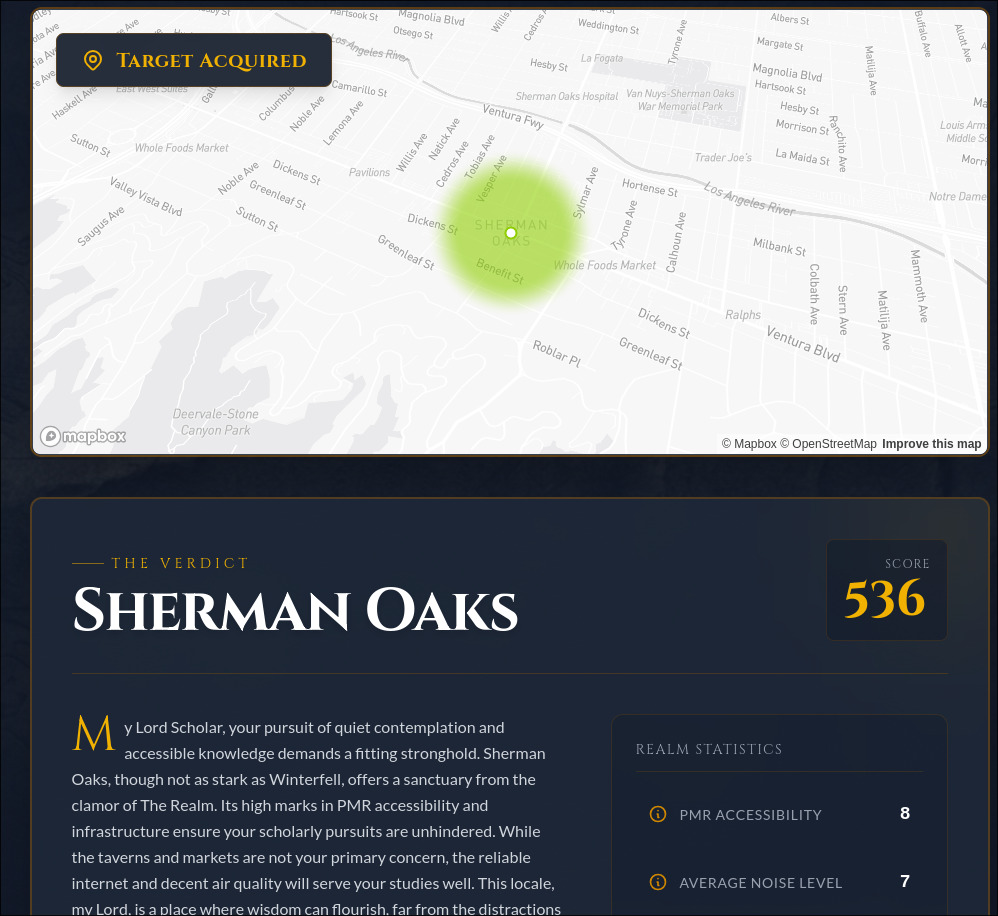
You receive a “Best Match” neighborhood with a compatibility score, a breakdown of local amenities, and a comparison against a runner-up.
Share the Realm
You can share your result via WhatsApp to coordinate with future housemates.
How We Built It
We combined LLM reasoning with verified open-data sources in a Hybrid Intelligence architecture.
The Brain (AI)
Google Gemini acts as the semantic engine. It interprets user descriptions, identifies what matters, and evaluates neighborhoods based on qualitative signals such as “bohemian atmosphere.”
The Scout (Data)
Overpass API (OpenStreetMap) provides real-world ground truth. Instead of relying on AI-generated assumptions, we count the actual parks, cafés, gyms, and other amenities on the map.
The Castle (Tech Stack)
- Backend: Laravel 12 (PHP 8.2) for business logic and orchestration
- Frontend: Vue.js 3 and Inertia.js for a reactive SPA
- Styling: Tailwind CSS 4
- Maps: Mapbox GL JS for interactive visualization
Challenges We Ran Into
Taming the AI
LLMs often hallucinate structure. Getting Gemini to consistently return strict, valid JSON required careful prompt engineering and response sanitization utilities.
Data Translation
Users speak in natural language (“I like hipster coffee”).
OpenStreetMap does not have a tag such as hipster=yes.
We created a translation layer that converts vague preferences into concrete queries such as amenity=cafe + cuisine=specialty_coffee.
API Limits
Overpass is powerful but can be slow or prone to timeouts with complex geometry. We added caching layers and optimized queries to maintain responsiveness.
Accomplishments We Are Proud Of
Real-Time Data
Every search runs against live map data, not a stale dump.
Dynamic UI
The comparison view clearly shows why one neighborhood outranks another, down to the exact count of bakeries or gyms.
WhatsApp Integration
We implemented a direct WhatsApp Business API integration to send rich, interactive results to users.
What We Learned
AI as an Orchestrator
AI excels when used to interpret user intent and translate it into data queries. Traditional APIs remain better for retrieving factual information.
Prompt Engineering as Coding
Designing structured prompts for Gemini was as critical as writing actual PHP. Stability depended on the clarity of instructions.
What’s Next for Game of Neighborhoods
Global Expansion
The system is city-agnostic. We plan to extend it to other cities.
Rental Data Integration
We aim to overlay real-time rental prices so users can see whether their ideal neighborhood is realistically affordable.
Social Voting
Groups of friends will be able to compare preferences and determine the best neighborhood for their shared “House.”

Log in or sign up for Devpost to join the conversation.