-
-
Planning

Inspiration Omar Hamza, David Lungu, and Siddhant Jain created this application with the aim of fostering essential skills in young children, including critical thinking, pattern recognition, and overall knowledge. Recognizing the increasing demands for intelligence and knowledge in today's technologically advancing society, they were inspired to contribute to education and social good. They saw the importance of nurturing intelligence from an early age, particularly in the face of emerging technologies like artificial intelligence (AI), which were reshaping the job market. Their goal was to develop an interactive and engaging learning game that harnessed the power of AI.
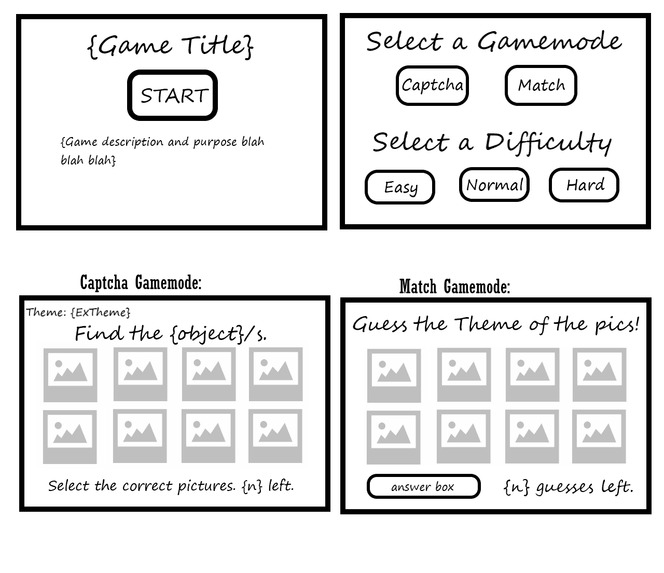
What it does The application is an interactive learning game designed to challenge and develop young children's critical thinking and pattern recognition skills. In the game, players are presented with a random theme and six pictures, one of which aligns with the theme. Players must select the correct picture to maximize their points. If they guess incorrectly, they are given two more attempts. The game leverages Google Bard's API to generate random themes and pictures.
How we built it To build the application, the team initially considered using the Pygame library but switched to Unity Engine in C# due to its familiarity and the challenges they encountered with Pygame's setup. They integrated the Bard API into the code using a Python script. The game comprises four screens: a title screen explaining the game's purpose, a game mode and difficulty selection screen, and two gameplay screens depending on the chosen mode. The difficulty level influences aspects like the number of hints provided or the number of guesses allowed. A points system, calculated using a linear equation, factors in time taken and the number of incorrect guesses.
Challenges we ran into During development, the team faced various challenges, the most significant of which was time management and maintaining focus. Time constraints forced them to rush the project, resulting in an incomplete state. They learned the importance of balancing work and breaks to optimize productivity. The team initially explored Natural Language Processing for analyzing the pictures but realized it would be time-consuming and temporarily abandoned the idea. These challenges highlighted the need for effective time management and realistic planning.
Accomplishments that we're proud of The team's proudest achievement was creating a game with a meaningful purpose beyond entertainment. They felt inspired by the opportunity to contribute positively to education and society. Additionally, they took pride in meticulously documenting their development process, ensuring readiness for future iterations and reflection.
What we learned The team gained valuable insights from the project. They understood the importance of time management and maintaining focus to complete tasks effectively. While exploring Natural Language Processing, they learned about the potential applications of AI in their project. They recognized the need to strike a balance between ambition and realistic timelines.
What's next for Game for Good The team remains committed to completing and perfecting their project in the future. They plan to integrate all the initially planned algorithms and features. They aim to create additional game modes targeting various developmental skills in children to further contribute to social good and education. Future developments will involve refining and expanding the game to achieve its full potential.


Log in or sign up for Devpost to join the conversation.