-
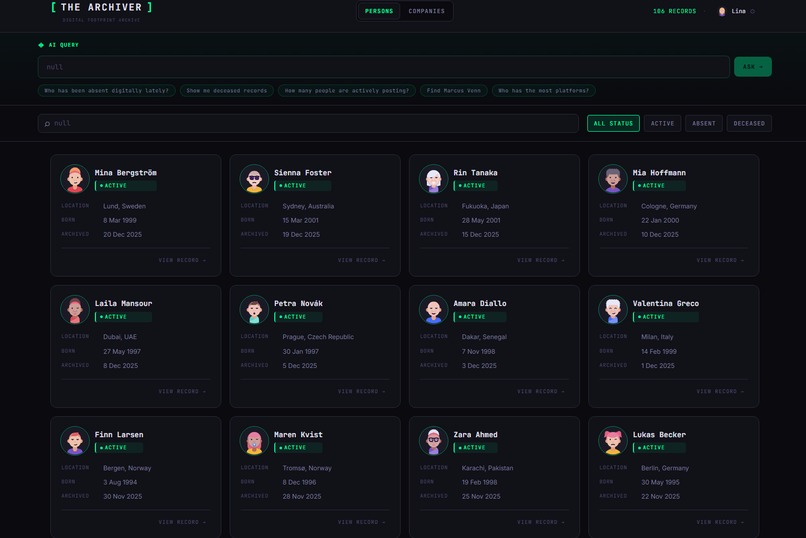
Inside look of the Archiver
Inspiration
Modern digital interfaces assume that users will “just know” where things are. In reality, even common actions like checkout, account settings, or logout are often placed inconsistently across platforms. We were inspired by the idea that instead of debating UI best practices, we could measure them—by observing how users naturally search for functionality in a realistic environment. This project explores the gap between designer intent and user expectation.
What it does
The Archiver is a simulated webshop designed to test UI intuitiveness. It presents users with simple tasks (e.g., “find checkout” or “open past orders”) while placing the same functionality in multiple plausible locations across the interface.
Behind the scenes, the system tracks how users navigate the UI, including:
- how long it takes to complete a task
- which version of an action they select
- how many incorrect interactions occur
- inferred search patterns based on cursor movement and navigation
The result is a dataset that reveals where users expect things to be, not just where designers put them.
How we built it
We built The Archiver as a modular React application with a focus on flexibility and experimentation.
Key aspects of the architecture include:
- A reusable layout system with shared components (header, sidebar, footer)
- A slot-based action placement system that allows actions like checkout or settings to appear in multiple UI regions dynamically
- A configurable experiment layer that defines which actions appear in which locations
- A lightweight tracking system that captures interaction events such as clicks, navigation, and cursor movement
This approach allowed us to rapidly prototype different UI configurations without rewriting core components.
Challenges we ran into
One of the main challenges was balancing realism with experimental control. A fully realistic webshop introduces complexity, while an overly simplified interface reduces the validity of the results.
We also had to carefully design how to infer user intent without invasive tracking. Since we do not use eye-tracking, we relied on proxies such as cursor movement, hover regions, and navigation patterns, which required thoughtful interpretation.
Another challenge was structuring the system so that multiple UI variants could coexist without making the interface feel artificial or confusing.
Accomplishments that we're proud of
We successfully built a working prototype that:
- feels like a believable webshop rather than a test tool
- supports multiple concurrent placements of the same action
- captures meaningful behavioral signals about user search patterns
- generates clear, interpretable metrics about UI discoverability
We are particularly proud of the slot-based architecture, which enables rapid experimentation and makes the system highly extensible.
What we learned
We learned that users’ expectations about interface structure are surprisingly consistent in some areas and highly variable in others.
We also learned that measuring “intuitiveness” is less about speed alone and more about search behavior—where users look first, what they try next, and how they recover from mistakes.
From a technical perspective, we gained insight into designing systems that separate UI structure from experimental logic, allowing for controlled testing without sacrificing usability.
What's next for The Archiver
Next, we plan to expand The Archiver into a more comprehensive experimentation platform by:
- adding real-time analytics dashboards and visualizations
- introducing demographic segmentation to compare behavior across user groups
- refining behavioral models to better quantify confusion and expectation
- supporting more complex interaction scenarios beyond simple navigation tasks
Long term, we envision this system as a tool for designers and researchers to empirically validate interface decisions and better understand how users interact with digital environments.

Log in or sign up for Devpost to join the conversation.